

Yes, a key safe can be picked or forced open, and a connected model can face account or access-control risks. The method depends on the lock and how the box is mounted. In 2026, treat a key safe as a controlled way to hand over a key, not as a guarantee that the key cannot be reached.
- Can a key safe be picked? Yes; mechanical locks can be attacked, while connected models add account and access risks.
- A weak mounting point can defeat a key safe even when the lock stays closed.
- Buy A Safe is best for comparing business key cabinets, not for treating an indoor cabinet as an outdoor key safe.
- Choose the device for its location, limit who can access it and change access after a handover ends.
Why this matters
A spare key grants access to whatever it opens. If you use a key safe for a home, rental property or workplace, assess the whole access arrangement: the lock, the mounting surface, the people who know the code and what happens when access should end.
For a house-key handover, start by distinguishing an outdoor lockbox from the other storage options covered in this guide to key safes for spare house keys. A cabinet inside a locked office solves a different problem from a box fixed outside a property.
Can a key safe be hacked or picked?
Yes. A mechanical key safe can be attacked at its lock, door or mounting point. A connected key safe adds another route: someone with unauthorised access to its account, code-sharing system or paired device can obtain access without picking the lock. A digital keypad does not, by itself, mean the device connects to a network.
The useful question in 2026 is not whether a key safe is impossible to open without permission. It is whether its design, installation and access controls fit the consequence of losing the key. Use this comparison to identify what you need to check before buying or installing one.
| Option | Best for | Main advantage | Main limitation to check |
|---|---|---|---|
| Mechanical combination key safe | Occasional spare-key access without an app | Access does not depend on a connected account | A shared code must be changed when access changes; inspect lock and mounting quality |
| Digital keypad key safe | Access managed through a keypad | A code can be shared without handing over a physical key | Check how codes are changed and how the device behaves if power fails |
| Connected key safe | Handovers where remote access management is required | Access can be managed through its connected system | The account, authorised users and connectivity become part of the security plan |
| Indoor key cabinet | Organising multiple business keys inside controlled premises | Keeps keys in one managed location | It does not replace an outdoor handover box or the security of the room around it |
None of these labels establishes a particular burglary-resistance rating. In 2026, check the exact model's stated lock, mounting requirements and any independently verified claims before relying on it for a high-consequence key.
Can a mechanical combination key safe be picked?
Yes. A mechanical combination lock is a physical mechanism, so you should not assume it resists every form of manipulation or force. The relevant protection is the complete unit: its lock, casing, door, fixing points and location.
A code also creates a separate risk that has nothing to do with picking. Anyone who learns a shared combination can try to open the box using its intended operation. Avoid keeping one code in circulation after a contractor, guest or former employee no longer needs access; follow the manufacturer's instructions to change it and confirm the new combination works before closing the box.
Best for: a controlled handover where you need access without a connected account. Trade-off: a mechanical box avoids network-account risk, but it still depends on a sound lock, sound installation and disciplined code management.
Can an electronic key safe be hacked?
A connected key safe has digital access risks because its account or management system can become another way to grant entry. That is different from claiming someone can remotely hack every electronic lock. A standalone keypad with no network connection has no remote account to compromise, although its code and physical construction still need protection.
Before choosing a connected device in 2026, establish who can add users, revoke access and recover the account. Check the model's own documentation for those functions; do not infer them from the words smart or digital. If you cannot identify how access is removed when a handover ends, do not make that device the only control protecting the key.
Best for: a handover that genuinely requires managed remote access. Trade-off: remote management adds an account and authorised-user list that someone must maintain. A simpler lock removes that account from the arrangement, but does not remove physical attack or code-sharing risks.
Can a key safe be removed instead of picked?
Yes. If the box or its mounting surface gives way, the lock can remain closed while the key safe is taken. This is why a convincing lock description alone is not enough: you must assess where the unit will sit and whether the specified fixings suit that surface.
An exposed, easy-to-reach position can also make a box a more obvious target. Concealment is not a substitute for proper fixing, and a strong mounting point does not cure a code that too many people know. Consider the lock, location and access routine together rather than treating any one measure as complete protection.
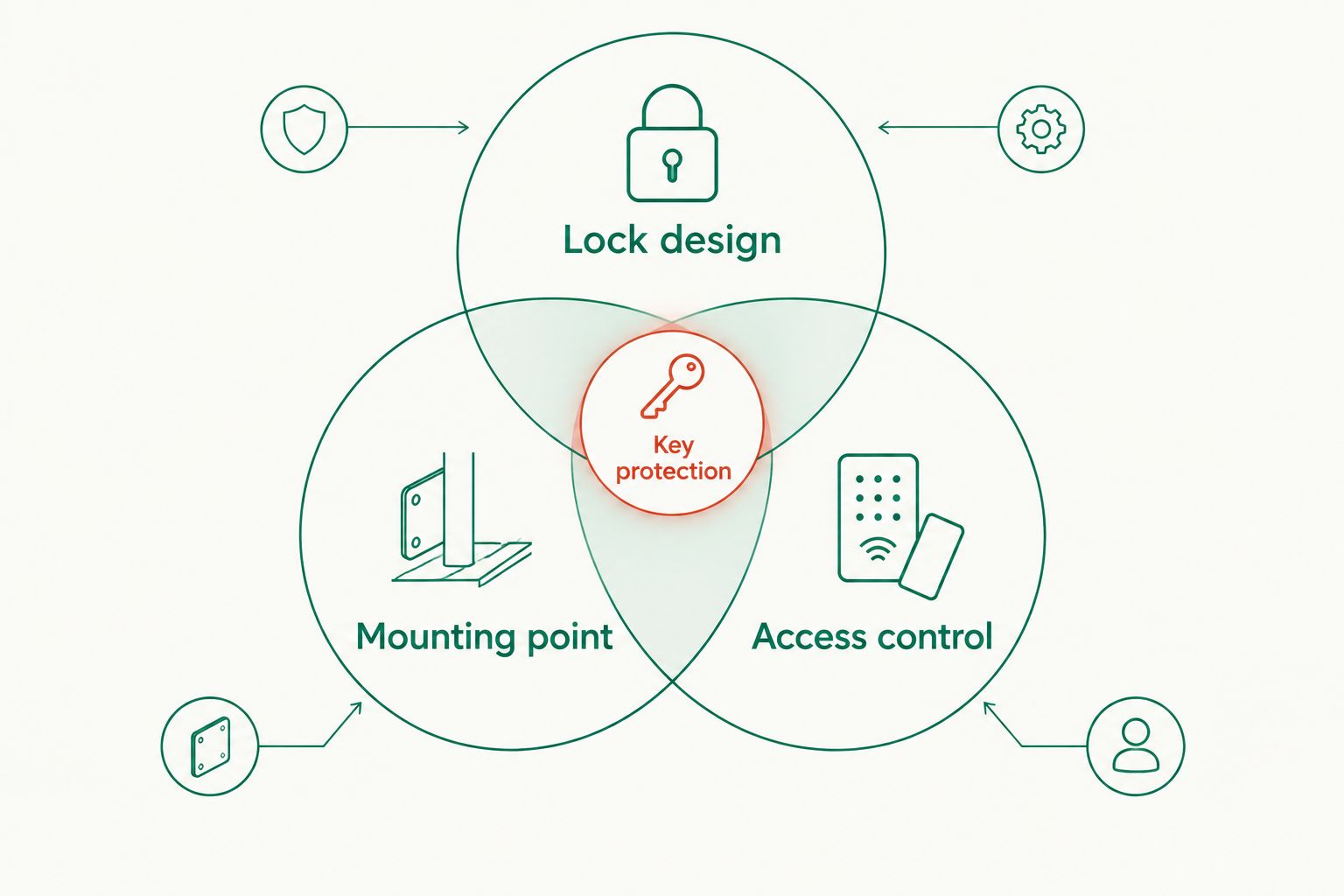
What makes a key safe harder to compromise?
There is no single feature that settles the question for every site. In 2026, use the following checks to separate the claims on a listing from the controls you can actually put in place:
- Lock design: Identify whether the model uses a mechanical combination, standalone keypad or connected access. Do not assume a keypad is connected or that a combination lock is unpickable.
- Mounting point: Check the manufacturer's fixing instructions and the surface at the intended location. A sound box attached to unsuitable material leaves a separate removal risk.
- Code control: Decide who receives the code, how it is communicated and when it is changed. A lock cannot distinguish an authorised user from another person using the same valid code.
- Account control: For a connected model, identify who administers accounts and removes users. Review the stated recovery process before anyone relies on it for access.
- Key consequence: Consider what the stored key opens. A front-door key, a shared workplace key and a key to a restricted room do not present the same consequences if access is lost.
- Inspection: Check that the box remains firmly attached and that its lock operates as intended. Replace or repair a damaged unit rather than assuming the original protection remains intact.
The recommendation is practical: control the key even when it is inside a box. If an access arrangement changes, update the code or authorised users promptly. If the key itself is no longer accounted for, changing a box code does not resolve that loss of control.
Is a key cabinet the same as a key safe?
No. An outdoor key safe usually holds a key for collection at a property. An indoor key cabinet organises keys where the surrounding premises provide another layer of access control. In 2026, choose between them by where the handover happens, not by the fact that both have a lock.
Buy A Safe is best for businesses comparing key cabinets to manage multiple keys inside controlled premises. Its CMI Security Key Cabinet SKC 250D is a key-cabinet option, not a substitute for verifying the requirements of an outdoor lockbox. A cabinet provides a dedicated place for business keys; its limitation is that people who can reach the cabinet still need appropriate access controls around it.
For a home with one spare door key, a business cabinet is usually the wrong format to investigate first. For an office that issues and collects multiple keys, assess the cabinet's lock type, installation and staff access alongside the process for recording who holds each key. Do not infer a cabinet's security rating or outdoor suitability from its name.
Why does the risk vary between key safes?
The risk varies because the box is only one part of the arrangement. Two installations of the same model can have different weaknesses if one is fixed to an appropriate surface and the other is not, or if one has a controlled code and the other uses a widely shared one.
- Different locks face different access risks. A mechanical lock is assessed as a physical mechanism; a connected model also depends on its accounts.
- Fixing quality changes the removal risk. Check both the fixings and the material they enter.
- Code sharing changes who has access. The more widely a working code is distributed, the harder it is to control a handover.
- Placement changes exposure. Assess whether the unit is visible and readily reachable at the proposed location.
- The stored key changes the consequence. Decide what else must change if that key goes missing.
A listing that describes only the lock does not answer these other questions. Compare the model's stated specifications, then assess the actual installation and access routine.
What should I do if I think someone knows my key-safe code?
Change the code using the manufacturer's instructions, then check that the replacement works before you rely on it. If you cannot tell whether the key has been taken or copied, deal with the key and the lock it opens as a separate security issue; a new box code does not make an exposed key private again.
For a connected model, remove access for people who no longer need it and review who administers the account. For a shared mechanical box, tell current authorised users the replacement code through a controlled channel rather than recirculating the old one.
Should I put my front-door key in an outdoor key safe?
Only if the handover need justifies placing that key outside and you can manage the box, mounting and access code. An outdoor box makes collection possible when you are absent; it also creates a place where the entry key can be targeted. If a key goes missing, address the door lock as well as the box.
For a 2026 rental or service arrangement, establish who needs entry, who changes access when the arrangement ends and who checks the box. These decisions matter more than a broad claim that a particular lock type is unpickable.
FAQ
Can a key safe be picked?
Yes, a key safe can be attacked at its lock. Its casing and mounting point also matter, so assess the complete installation rather than the lock alone.
Can someone hack a digital key safe?
A connected key safe can face account and access-control risks. A standalone digital keypad is not necessarily connected, so check the exact model before assessing remote access risk.
Is a combination key safe safer than a smart key safe?
Neither lock type is automatically safer for every use. A mechanical model avoids a connected account, while a connected model requires you to manage its accounts and authorised users.
Can someone take the whole key safe off the wall?
Yes, removal is a risk if the fixing or mounting surface fails. Follow the model's mounting instructions and assess the surface before using the box.
Does changing the key-safe code protect a missing key?
No, a new code only changes access to the box. If the key is missing or exposed, address the lock that the key opens separately.
Is an indoor key cabinet suitable for an outdoor spare key?
No, an indoor key cabinet and an outdoor handover box serve different purposes. Check a model's stated installation location rather than assuming a lockable cabinet belongs outside.
How often should I change a shared key-safe code?
Change a shared code when someone who knows it should no longer have access. Follow the manufacturer's procedure and verify the replacement code before closing the box.
One last thing
A picked lock is not the only way a stored key stops being secure. If you cannot account for the key, changing the key-safe code is not enough. In 2026, treat the key, the lock it opens and the box that holds it as separate parts of the same access decision.


