

You can legally keep any amount of lawfully obtained cash in a home safe in Australia in 2026; there is no general dollar cap on private cash holdings. That does not remove tax obligations, bank reporting requirements or rules against possessing proceeds of crime. Your insurance cover and the safe’s security rating are separate questions, not legal permission to hold the money.
- How much cash can I legally keep at home? Australia has no general cap on lawfully obtained cash.
- AUSTRAC’s cash transaction reporting threshold is not a home cash storage limit.
- A safe’s cash rating does not guarantee insurance cover for its contents.
- BUYASAFE is best for households comparing home safes for cash and document storage.
How much cash can I legally keep in a home safe?
Australia does not impose a general maximum amount of lawful cash you can keep at home. The legal questions concern where the money came from, whether you have met your tax obligations and whether a particular transaction requires reporting.
| Issue | What it means | What it does not mean |
|---|---|---|
| Cash held at home | Lawful cash can be stored privately | A large balance is automatically illegal |
| Bank cash transaction reporting | Reporting entities report relevant physical cash transactions of AUD $10,000 or more | You must keep less than that amount at home |
| Tax obligations | Assessable income remains reportable when received in cash | Putting income in a safe makes it tax-free |
| Safe cash rating | A security-related assessment for the safe | A statutory possession limit or automatic insurance entitlement |
| Contents insurance | Your policy determines the applicable cash cover | Every dollar inside a locked safe is covered |
For the storage side of the decision, BUYASAFE sells home safes and other security storage. Choose the protection after checking your exposure and insurance requirements, not from a supposed legal cash ceiling.
Why this matters
Confusing a reporting threshold with a possession limit leads to the wrong decisions. You do not need to spend or deposit lawful money simply because your household cash balance reaches a bank reporting threshold.
The reverse mistake is just as serious. Legal ownership does not establish that your insurer will reimburse a loss, or that a document safe provides suitable burglary protection.
For a 2026 household cash plan, answer these questions separately: is the money lawful, can you explain its source, and what happens if it is stolen or destroyed? A home safe addresses physical storage. It does not resolve the other questions.
Does the AUD $10,000 reporting threshold limit home cash?
AUD $10,000 is a reporting threshold for relevant physical cash transactions, not a maximum home balance. AUSTRAC’s threshold transaction reporting guidance explains the obligations of reporting entities, including banks, when they provide designated services involving physical currency at or above that threshold.
A report is not a finding that you have committed an offence. A lawful withdrawal or deposit can trigger reporting without making either the transaction or your possession of the money illegal.
Banks also have customer identification and transaction monitoring obligations. Expect questions about a transaction’s purpose or the source of funds when the bank needs that information; do not treat the reporting threshold as a promise that smaller transactions receive no scrutiny.
Do not divide transactions to avoid reporting. Deliberately structuring transactions to evade threshold reporting can be an offence. If you need to deposit lawful cash, explain the source and retain the records rather than organising transactions around avoiding a report.
For transactions in 2026, use AUSTRAC’s current threshold transaction reporting and structuring guidance. These rules concern financial services and transactions, not the amount sitting untouched in your household safe.
Do I need to tell the ATO about cash in my safe?
You do not lodge a separate tax declaration simply because you keep lawful personal cash at home. You must still report assessable income correctly, including income received in cash.
The Australian Taxation Office’s guidance on cash income makes the distinction clear: the payment method does not remove the underlying tax obligation. Cash wages, business takings and other assessable receipts do not become exempt because you store them privately.
A withdrawal of your own savings is not, by itself, new income. Keep the bank statement so you can distinguish that withdrawal from a new cash receipt if you later need to explain the balance.
For business money, keep the records required for your business and tax circumstances. Reconcile sales, expenses, withdrawals and deposits rather than treating the safe as an unrecorded reserve.
Record the transaction that created the cash, not just the amount currently in the safe. An inventory proves what you recorded holding; it does not establish why you received it or whether its tax treatment was correct.
What records should I keep for lawful cash?
Keep records that connect the money to its actual source. Useful evidence depends on how you obtained it; there is no universal document that proves every cash holding is legitimate.
- Bank withdrawals: retain statements and withdrawal receipts showing the movement from your account.
- Sale proceeds: retain the sale agreement, receipt and relevant ownership records.
- Business receipts: retain invoices, sales records and reconciliations that explain the takings.
- Gifts: retain a genuine record identifying the giver, recipient and circumstances.
- Inheritance: retain estate documents and distribution records that explain the payment.
Do not create a false receipt or describe income as a gift to avoid tax or other obligations. Documentation must reflect what happened.
Store copies separately from the cash where practical. If a theft or fire affects both the money and its supporting paperwork, keeping everything together makes the source harder to demonstrate afterwards.
Why the sensible amount to keep at home varies
The law does not supply a household cash target. Your practical limit depends on the purpose of the reserve, your exposure to loss and the protections you have actually arranged.
- Purpose: emergency spending cash serves a different function from long-term savings or business takings.
- Insurance terms: the policy’s money limit, exclusions and conditions determine what protection you have purchased.
- Burglary resistance: assess the safe’s documented security performance rather than relying on its size or appearance.
- Installation: the mounting method and supporting structure affect how the safe is secured.
- Fire exposure: cash is paper-based, so review documented fire protection as a separate requirement.
- Access: decide who needs access and how you will manage keys, codes and emergency arrangements.
A lawful balance can still be an unsuitable balance for your property. Keep the amount you can justify for its purpose and protect under your actual arrangements, rather than filling the safe because there is room.
Review those arrangements in 2026 if your cash balance, household access or insurance policy changes. The original purchase decision does not automatically remain suitable.
Is a home safe better than a bank account for cash?
A home safe and a bank account solve different problems. Physical cash gives you access without making an electronic payment, while a bank account avoids keeping the entire balance exposed to loss at your property.
| Storage option | Best for | Main benefit | Main limitation |
|---|---|---|---|
| Installed home safe | A household cash reserve needing controlled access | Physical cash remains accessible at home | Theft, fire and insurance conditions remain relevant |
| Bank deposit | Savings not required as physical notes | Eligible deposits receive statutory protection within applicable limits | Access to physical cash depends on withdrawal arrangements |
| Portable cash box | Organising a working float | Keeps notes and coins together | Portability does not provide the same removal resistance as secured installation |
APRA’s Financial Claims Scheme protects eligible Australian-dollar deposits up to AUD $250,000 per account holder per authorised deposit-taking institution. That is a bank deposit protection limit, not cover for banknotes stored in your home.
For a 2026 comparison, check APRA’s Financial Claims Scheme guidance and whether your deposit is eligible. Do not assume different banking brands necessarily give you separate protection limits; the authorised deposit-taking institution matters.
Neither option eliminates every risk. Match the storage method to the money’s purpose, and do not assume that private storage provides the protections attached to an eligible bank deposit.
How do I choose a safe for cash storage?
Start with the cash exposure and your insurer’s requirements. BUYASAFE home safes provide a category to compare, but the exact model, installation and policy conditions determine whether a particular purchase meets your needs.
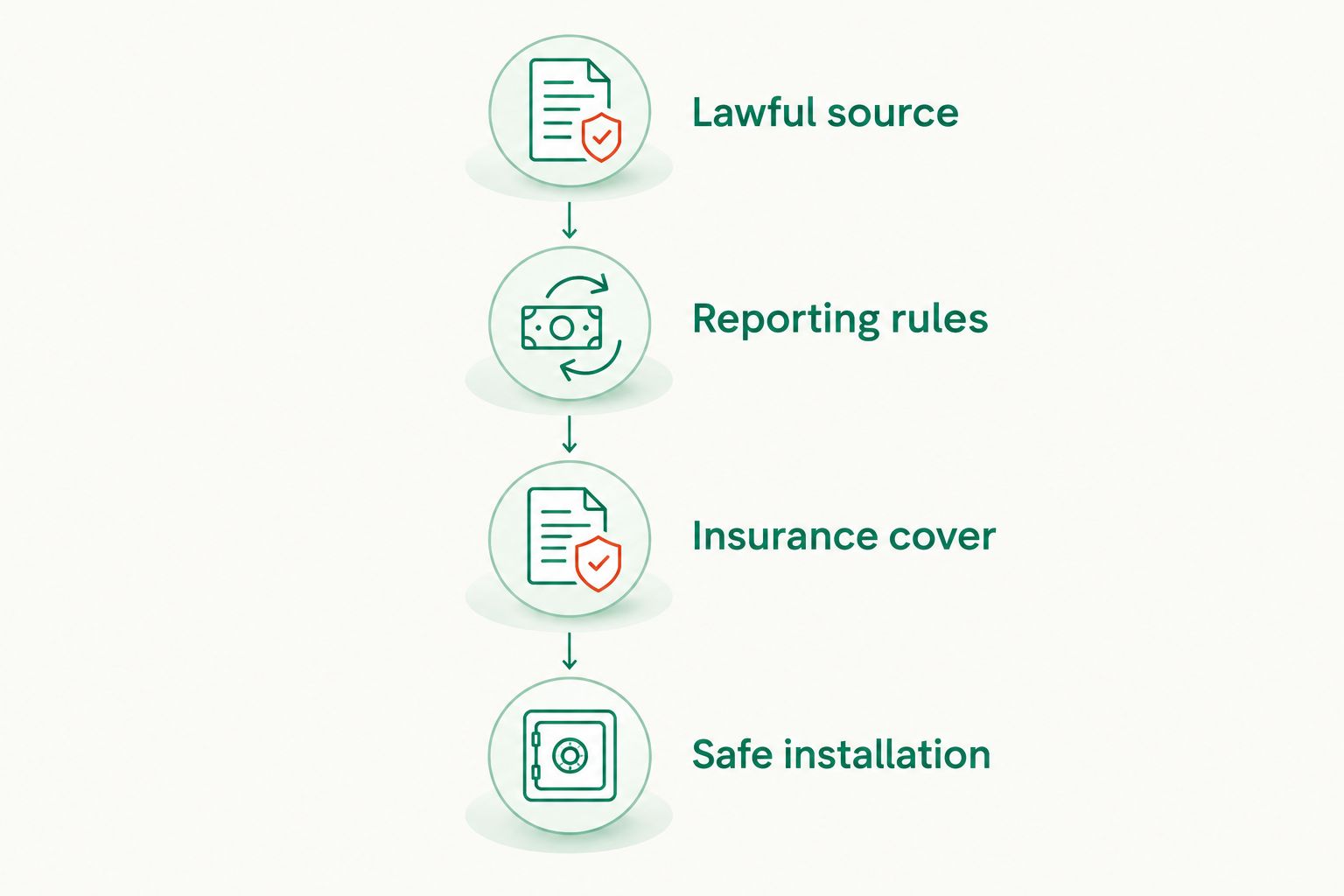
Use this sequence before ordering:
- Lawful source: identify the origin of the money and retain the supporting records.
- Reporting rules: understand the obligations attached to withdrawals, deposits and any international movement.
- Insurance cover: ask your insurer about the money limit and any safe or installation conditions.
- Safe installation: confirm the model’s protection, mounting instructions and suitability for the proposed location.
Do not confuse fire resistance with burglary resistance. A documented fire rating addresses a specified fire test; it does not, by itself, establish resistance to forced entry. Likewise, a security-focused safe needs separate evidence if fire protection is required.
The Platinum U2 Urban Cash & Fire Rated Safe is a relevant BUYASAFE cash-storage option to assess when you need both protections. Its category fits that requirement, but you still need to confirm the exact ratings, installation conditions and insurer acceptance before selecting it.
Best for households comparing cash and fire protection together: assess a model with documentation for both. Its limitation is that the product name alone does not establish your insured cash allowance or protection under every incident.
Does a safe’s cash rating determine my insurance cover?
A safe’s cash rating is not a legal limit and does not automatically set your insurance payout. Treat it as security information to discuss with your insurer, not as a guarantee attached to ownership of the safe.
Ask the insurer to confirm:
- The policy limit that applies specifically to money kept at home.
- Whether cash needs to be declared or covered under a different arrangement.
- Whether a particular safe rating or installation method is required.
- What records are required to substantiate a loss.
- Whether exclusions apply to the circumstances in which you intend to store cash.
Keep the insurer’s written response with your policy documents. A verbal assumption that valuables are covered is not the same as confirmation about money.
BUYASAFE home safe selection should follow that confirmation. Buying a larger safe does not, by itself, increase an insurance limit or make the contents recoverable after a loss.
Can I take cash from my safe overseas?
AUD $10,000 or more in physical currency, including the equivalent in foreign currency, must be reported when carried into or out of Australia. AUSTRAC’s guidance on travelling with money explains this cross-border requirement.
That obligation concerns movement across the border. It does not impose the same threshold on cash stored at your Australian home.
Before travelling in 2026, check AUSTRAC’s current instructions and the destination country’s rules. Reporting in Australia does not replace a declaration required elsewhere, and currency conversion matters when you carry foreign notes.
FAQ
How much cash can I legally keep at home in Australia?
Australia has no general dollar cap on lawfully obtained cash kept at home. Tax obligations, proceeds-of-crime laws and reporting requirements for particular transactions still apply.
Is keeping more than AUD $10,000 in a home safe illegal?
Keeping more than AUD $10,000 in lawful cash at home is not, by itself, illegal. AUSTRAC’s threshold concerns relevant physical cash transactions through reporting entities, not a household possession limit.
Will my bank report a large cash withdrawal?
Reporting entities must report relevant physical cash transactions of AUD $10,000 or more to AUSTRAC. Reporting does not establish wrongdoing, and banks can also ask questions about other transactions.
Do I pay tax just for keeping cash in a safe?
Keeping cash in a safe does not itself create a new income tax liability. Assessable income remains reportable regardless of whether you receive or retain it in cash.
Does contents insurance cover all the cash in my safe?
A home safe does not automatically make all its cash contents insured. Your policy’s money limit, exclusions and storage conditions determine the applicable cover.
Is the cash rating on a safe a legal storage limit?
A safe’s cash rating is not a legal storage limit. It is security-related information, and your insurer must separately confirm the cover available under your policy.
Do I have to report cash when I travel overseas?
AUD $10,000 or more in physical currency, including foreign-currency equivalents, must be reported when carried into or out of Australia. Check AUSTRAC’s instructions and the destination country’s requirements before travelling.
One last thing
If you receive a means-tested payment, storing money outside a bank does not make it disappear from an assets assessment. Services Australia’s assets guidance includes cash among financial assets; check the reporting rules for your payment.
Write down your storage purpose, confirm your insurance and keep genuine source records before increasing the balance. There is no general legal cash ceiling, but there are still obligations and loss risks to manage. This is general information, not advice on your individual legal, tax or insurance circumstances.


