

A commercial safe for a small business has no single useful cost figure: the right choice depends on what you store, who needs access and how the safe will be installed. In 2026, compare current product listings for the right safe type, then check delivery and installation separately before setting your budget.
- Commercial safe cost small business decisions start with the storage task, not a single headline figure.
- Choose a security safe for restricted access, a deposit safe for cash drops, or fire-resistant storage for records.
- Buy A Safe is best for Australian small businesses comparing commercial safes by storage task and installation needs.
- Check current product listings and installation requirements before approving a 2026 purchase.
How much does a commercial safe cost for a small business?
The answer is the cost of a safe suited to your contents plus any delivery and installation needed at your premises. A cash safe, a deposit-chute safe and a fire-resistant filing cabinet solve different problems, so comparing their listed amounts without checking the job each does gives you a misleading budget. The business safe budgeting guide covers the factors to record before requesting a final figure.
Use this 2026 breakdown to compare quotations:
| Budget component | What to check | Why it changes the decision |
|---|---|---|
| Safe | Intended contents, lock, capacity and stated protection | A safe that fits the budget but not the contents is the wrong purchase. |
| Delivery | Access to the premises and the proposed safe position | The route to the final position matters as much as the doorway beside it. |
| Installation | Fixing method and suitability of the installation surface | A safe should be assessed as an installed unit, not just an item on a product page. |
| Ongoing access | Who holds keys or codes and how access changes when staff leave | The lock has to suit the people operating it. |
Buy A Safe is best for Australian small businesses comparing commercial safes by storage task, rather than treating every safe as interchangeable. Its listed categories include commercial, fireproof and deposit safes; the useful next step is to narrow the task before comparing individual products.
Why this matters to a small business
Your storage routine determines whether a safe is practical. If staff need to place cash inside without opening the main door, a deposit design answers a different question from an ordinary security safe. If you need to retain paper records, document capacity and stated fire resistance move ahead of deposit access.
A 2026 budget should describe the contents and the operating routine in plain terms. Write down what goes inside, who can open the main door, where the unit will sit and what protection you need stated in the listing. That short brief gives you a basis for rejecting unsuitable products before comparing their current listings.
Which type of commercial safe should you budget for?
| Option | Best for | Strength | Limitation |
|---|---|---|---|
| Chubb Mini Banker MkII Security Safe Size 3 Digital Locking (M-40) | A business seeking a security safe with digital locking | Its product description specifies a 65 mm body barrier. | The product name does not establish a deposit opening or a fire-resistance rating. |
| Platinum D2 Defender Deposit Chute Safe | A business evaluating a chute-style deposit workflow | The listed product is identified as a deposit-chute safe. | Confirm that the chute and main-door access suit your cash-handling procedure. |
| Guardall GDF4000 Fire Resistant Filing Cabinet Safe | An office organising paper files | The listing identifies it as a fire-resistant filing cabinet safe. | A filing cabinet format is not a substitute for a deposit opening. |
These are different starting points, not an interchangeable shortlist. Check each current listing for the protection claims, internal space and lock details that matter to your business. Do not infer a fire rating, cash rating or insurance acceptance from a product name alone.
A small office storing contracts can also compare filing capacity across formats: the supplied CMI security filing cabinet listings include a 2-drawer model and a 4-drawer model. Drawer count tells you how the storage is organised. It does not, by itself, tell you which protection level your records require.
Security safe: best when access control is the main job
Start with a security safe when you need to restrict access to business contents and do not need staff to make deposits through a chute. Check the stated protection, the usable interior and the lock type against the contents and your staff procedure. A larger exterior does not answer whether the items you actually store will fit.
The Chubb Mini Banker MkII Security Safe Size 3 Digital Locking (M-40) is a concrete comparison point: its supplied description specifies a 65 mm body barrier and a digital lock. Those details help you ask a better question than whether a safe simply looks heavy. The limitation is equally clear: do not assume its listed features cover fire exposure or a cash-drop workflow unless the current product information says so.
For a 2026 purchase, decide who needs full-door access before choosing the lock. A lock that suits a single authorised person need not suit a workplace where responsibility changes between staff. Record that requirement before reviewing the listing, rather than choosing a lock first and rewriting the procedure around it.
Deposit safe: best when cash drops are part of the routine
A deposit safe is the relevant category when staff need a way to put takings away without repeatedly opening the main compartment. Compare the deposit opening with the items you actually deposit, then decide who can retrieve them. The deposit function is useful only if it fits the way your business handles cash.
The Platinum D2 Defender Deposit Chute Safe is identified in its listing as a chute-style deposit safe. That makes it a better category match for cash drops than a filing cabinet. Its drawback is the narrower purpose: do not select a deposit format merely because the business sometimes holds documents or valuables.
Ask whether the proposed position lets staff use the opening without obstructing other work, and whether authorised retrieval can happen in that position. Those are installation questions as well as product questions. In 2026, include them when requesting the final delivered and installed figure.
Fire-resistant storage: best when paper records lead the brief
Choose a document or filing format when paper records are the principal contents. Check the specific fire-resistance information in the current listing and compare it with the records you intend to store. The word fire-resistant in a product title is a reason to inspect the stated rating, not a complete specification.
The Guardall GDF4000 Fire Resistant Filing Cabinet Safe is a relevant comparison because its listing names both the filing format and fire resistance. Its disadvantage for a cash-handling business is just as practical: filing drawers do not answer a requirement for controlled cash drops. If both jobs matter, write them down as separate requirements rather than assuming either format covers both.
Do not treat protection for paper as proof of suitability for every other item in the office. Match the manufacturer's stated protection to the actual contents. That keeps the 2026 shortlist focused on documented features instead of broad category labels.
Why commercial safe costs vary
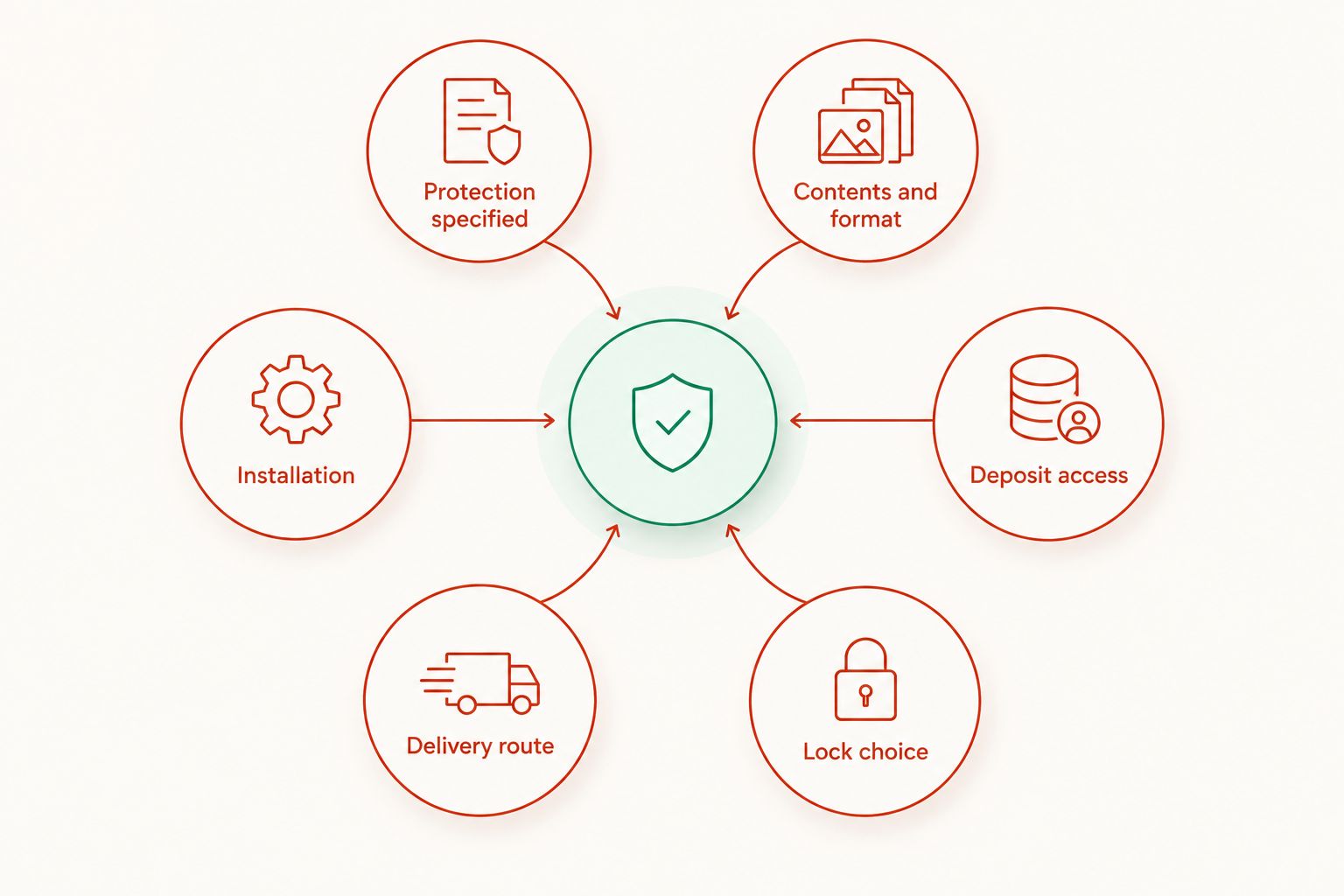
- Protection specified: Compare stated burglary and fire-resistance information, where provided. A label without its underlying specification is not enough to choose a safe.
- Contents and format: Cash, paper files and other valuables place different demands on access and usable space.
- Deposit access: A chute changes how staff put contents away and how authorised staff retrieve them.
- Lock choice: Match key or digital access to the people responsible for opening the safe. Check the lock on the exact model being quoted.
- Delivery route: Identify the proposed location and the access route before asking for a delivered figure.
- Installation: Check how the unit will be secured and whether the intended position can accommodate that method.
The largest avoidable budgeting error is to compare product listings while leaving the installation site undecided. A safe that fits the storage brief still needs a workable route and final position. Set those details out before asking anyone to confirm the total.
The comparison below uses current product cards for a security-safe option and a compact fire-resistant option. Their listed amounts are product figures; check the relevant listing and any delivery or installation requirements before treating either as a final 2026 budget.


The LOCKTECH - Compact Small Fire Resistant Safes listing is a useful contrast with the Chubb security safe: its description focuses on a compact, fire-resistant format for home and office use. That is a reason to inspect its fire-protection information, not to assume it meets a burglary-protection requirement. Neither listing replaces a deposit safe if staff need a cash-drop opening.
How do I compare the total cost of two commercial safes?
Compare the same scope: the exact model, its stated protection, delivery to the proposed position and the installation work required there. A product-only figure and a delivered-and-installed figure answer different questions. For 2026, ask for those components to be identified before deciding which option fits the budget.
Do I need a deposit safe or an ordinary security safe?
You need a deposit safe when placing contents inside without opening the main door is part of the job. Choose an ordinary security safe when restricted full-door access meets the storage routine. Check the exact deposit design and lock details rather than relying on the category name.
Does a fire-resistant filing cabinet replace a cash safe?
No: a fire-resistant filing cabinet is a starting point for storing paper files, while a cash safe addresses a different operating need. Compare the stated protection and access method of the exact models. If the business has both requirements, assess both explicitly.
FAQ
What should a small business include in a commercial safe budget?
Include the chosen safe and any delivery and installation needed at the premises. Check the exact product listing and proposed position before accepting a total figure.
Is a deposit safe better than a standard safe for daily cash drops?
A deposit safe is the better category when staff need to put cash away without opening the main door. Check whether its opening and retrieval access match your procedure.
Can I use a fire-resistant document safe for business cash?
Do not choose a fire-resistant document safe for cash on the strength of its fire-resistance label alone. Check its stated security features and the access your cash-handling routine requires.
Does the lock type affect which commercial safe I should choose?
Yes. Choose a lock that fits who needs access and how that access is controlled, then confirm the lock fitted to the exact model.
Should I choose the installation position before buying a safe?
Yes. Identify the route to the proposed position and how the safe will be secured before approving the purchase.
What is the difference between a commercial safe and a filing cabinet safe?
A commercial safe can serve several storage tasks; a filing cabinet safe organises files in drawers. Compare each model's stated protection and access method against the contents you need to store.
How do I check whether a safe's fire protection meets my needs?
Read the exact model's stated fire-resistance information and match it to the contents. Do not treat the words fire-resistant in a product title as a full rating.
One last thing
Decide the installation position before you settle on the product. It is the simplest way to make a 2026 commercial-safe comparison about a safe you can actually place, secure and use. Buy A Safe's commercial-safe options cover different storage jobs; the right budget starts with the job and ends with the installed unit.


