

Yes—add a safe if you keep valuables or important original documents at home, even when you have a home alarm system. An alarm detects activity and raises an alert; a suitable, correctly installed safe puts a physical barrier around selected belongings. You do not automatically need both if you have nothing that needs secure storage, but an alarm does not replace a safe’s burglary resistance or a verified fire rating.
- Do I need a safe if I have a home alarm system? Yes, when valuables need physical protection.
- A home alarm detects activity; a home safe restricts access to its contents.
- Choose burglary resistance for valuables and verified fire protection for important documents.
- BUYASAFE home safes are relevant to households adding secure storage alongside an existing alarm.
Why this matters
Your alarm protects a different part of the security process from your safe. It alerts you to a detected event, but it does not lock away jewellery, passports or cash. A safe protects the items inside it, but it does not detect someone entering your home.
For your 2026 home-security review, start with what you need to protect rather than buying another device. The guide to choosing the right size safe for your home is a useful next step once you have listed the contents.
Choose each security measure for the job it performs. Good door and window security, an alarm and secure storage complement one another; none makes the others unnecessary in every household.
Is a safe necessary if I already have a home alarm?
A safe is necessary when you need a separate physical barrier around belongings that would otherwise remain accessible after someone enters your home. Whether that justifies buying one depends on your possessions, storage obligations and installation options—not simply whether the house has an alarm.
The comparison below separates the benefits from the limits. It does not assume a particular alarm configuration, monitoring service or safe rating.
| Security arrangement | Best for | Main benefit | Main limitation |
|---|---|---|---|
| Alarm alone | Detecting configured intrusion events | Raises an alert when a covered event triggers the system | Does not physically secure loose belongings |
| Safe alone | Restricting access to selected contents | Places a locked barrier around stored items | Does not detect entry elsewhere in the home |
| Alarm and safe | Combining detection with secure storage | Addresses intrusion detection and access to valuables separately | Requires correct setup, installation and consistent use |
An alert is not the same as an intervention. What happens after an alarm activates depends on your system and response arrangements. Do not assume that receiving a notification prevents someone from reaching an unlocked drawer.
Likewise, a locked container is not automatically suitable for valuable jewellery or important records. Its construction, documented protection and installation need to match the task.
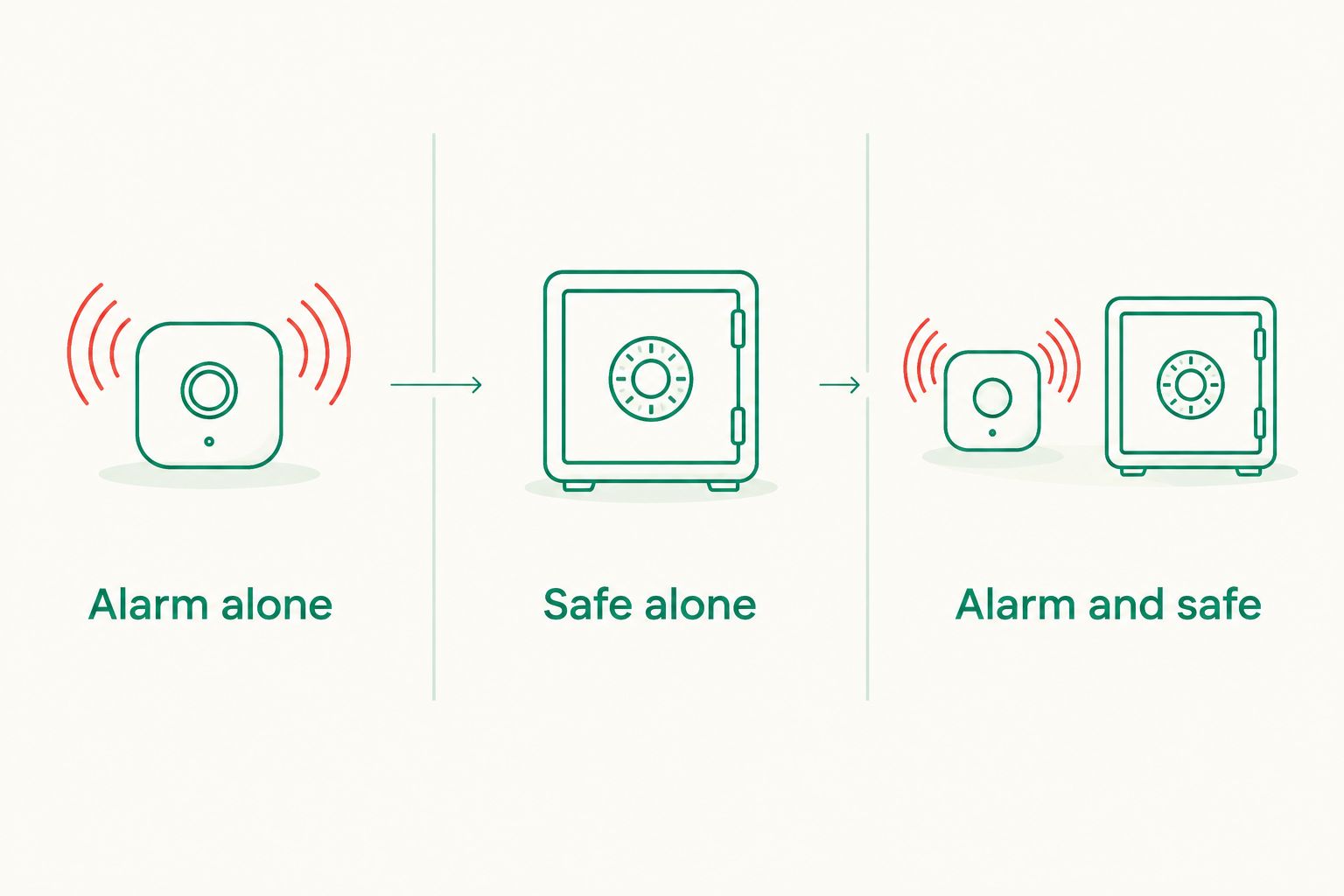
When an alarm alone does not address your storage needs
You keep jewellery, cash or valuable collections at home
Small valuables need protection at the item level. An alarm does not make a bedside drawer, jewellery box or cupboard resistant to unauthorised access.
Best for these contents: a burglary-resistant safe with documented protection appropriate to the items. Confirm the safe’s suitability with your insurer where relevant. Do not choose solely by its outside dimensions, lock appearance or the word security in its name.
The limitation is scope: a safe protects only what you put inside it. Jewellery left on a dresser remains outside that protection, even if you own a suitable safe elsewhere in the house.
You keep passports, wills or other original documents
Documents raise a separate question: do you need protection from access, fire, or both? An intrusion alarm answers neither question about the storage container itself.
Best for important paper originals: a safe with verified document fire protection, plus burglary resistance where needed. Check the stated test, duration and protected contents rather than treating fireproof as an unlimited promise.
Paper protection does not establish suitability for electronic media. If you intend to store backups, drives or other sensitive items, verify that the safe’s documentation covers those contents. Keep accessible copies of records separately where appropriate.
You need to control access within the household
Secure storage also matters when the concern is access by someone already inside the home. An intrusion alarm is not a substitute for controlling who holds a safe key or knows its code.
Best for household access control: a suitable locked container with restricted credentials. Match the container to the contents. General valuables, firearms and medicines do not automatically share the same storage requirements.
For firearms, consult your state or territory’s current requirements in 2026. Do not treat an alarm or a general-purpose home safe as evidence that your storage arrangement complies.
When buying a safe is not the first priority
You do not need to buy a safe merely because you own an alarm. If you keep no valuables, sensitive originals or restricted items at home, identify a real storage need before selecting a product.
A safe also does not repair weak external doors, unsecured windows or an incorrectly configured alarm. Address those problems directly. Adding secure storage leaves the rest of the property’s security unchanged.
Installation is another deciding factor. If your proposed location cannot support the required installation, choose a different location or obtain specialist advice before purchasing. A convenient cupboard is not automatically a suitable mounting site.
For a 2026 purchase, define the contents and installation requirements first. The correct decision can be to postpone buying until those questions are settled—not to buy a container that cannot perform its intended job.
Why the need for a home safe varies
These factors determine whether a safe adds useful protection to your alarm:
- Contents: Jewellery, cash, original documents and restricted items create different storage needs. Write down what will actually go inside.
- Replacement difficulty: Insurance reimbursement does not reproduce an original document or an irreplaceable keepsake. Consider more than purchase value.
- Required protection: Burglary resistance, document fire protection and household access control are separate criteria. Verify each one you need.
- Installation: The mounting surface, approved fixing method and access route affect whether a particular safe suits your home.
- Access arrangements: Decide who needs permission to open the safe and how you will protect keys, codes and recovery information.
Your alarm’s notification and response arrangements belong in the assessment too. Check what activates it, who receives alerts and what action follows. Those details explain your detection coverage; they do not establish the protection provided by a safe.
Do not turn the decision into a simple comparison of alarm versus safe. Ask which risk remains unaddressed after considering the measures you already have.
How do I choose a safe to complement my alarm?
Use this sequence before comparing products. It keeps the decision tied to your contents rather than to a lock type or brand name.
- List the contents. Include their dimensions and whether you need everyday access. Allow for folders, jewellery cases and other packaging, not just the bare items.
- Separate the risks. Specify whether you need burglary resistance, protection for paper in a fire, restricted household access, or a combination.
- Check the documentation. Read the exact model’s specifications and any stated test or certification. Keep burglary and fire claims separate.
- Confirm installation. Check the manufacturer’s instructions and ask an installer about the proposed mounting surface. Obtain permission where your tenancy or property arrangements require it.
- Plan access and records. Restrict credentials, arrange recovery information securely and retain appropriate ownership records outside the safe.
An electronic lock is an access method, not a complete security rating. The door, body, locking arrangement and installation still matter. Similarly, a substantial-looking cabinet does not prove a particular level of protection.
Two security-safe options to investigate
BUYASAFE is best for households comparing home safes alongside an existing alarm. The following models illustrate specifications to examine, not a claim that either suits every home. Confirm the complete documentation and installation requirements before choosing.
| Model | Best for | Supported specification | Limitation to resolve before purchase |
|---|---|---|---|
| Chubb Mini Banker MkII Security Safe Size 3 Digital Locking (M-40) | Buyers examining body-barrier construction and digital locking | The supplied description states a 65mm body barrier, welded steel construction and Chubbsafes barrier material | Body thickness alone does not establish the required burglary or fire protection |
| Burg Wachter - Karat MT-24-NE-FS - Electronic Fingerprint Safe | Buyers considering fingerprint access and documented testing | The supplied description states ECB.S testing and supervision, burglary and fire protection, and a triple-walled body | Confirm the precise certification, fire scope and installation requirements |
The Chubb model’s 65mm body barrier is a construction specification, not a promised attack-resistance time. The Burg Wachter model’s three-wall construction likewise describes its body, not the duration of protection. Neither detail removes the need to inspect the complete rating information.
For your 2026 shortlist, compare documented protection before choosing between digital and fingerprint access. The practical drawback of any model is a mismatch: the wrong internal space, unsuitable protection or an installation you cannot complete properly.


Does a monitored alarm mean I can skip the safe?
A monitored alarm does not replace physical protection for valuables. Monitoring changes how detected events are handled; it does not change the storage resistance of an unlocked drawer.
Check your response arrangements rather than assuming a guaranteed arrival time. Choose a safe according to the contents and required protection, not an assumed interval between detection and assistance.
Will a safe reduce my home insurance premium?
A safe does not automatically qualify you for a premium reduction or increased cover. Ask your insurer about the exact model, installation and items before relying on either outcome.
For your 2026 insurance review, obtain written confirmation of applicable storage conditions and limits. Keep receipts, valuations and identifying records accessible separately from the items they describe.
Should I hide the safe or bolt it down?
Concealment does not replace installation in accordance with the safe manufacturer’s instructions. If the model requires anchoring, use the approved approach and a suitable structural surface.
Choose a discreet location that still permits proper fixing, door operation and routine use. A location that discourages you from putting valuables away defeats the purpose of buying secure storage.
FAQ
Do I need a safe if I have a home alarm system?
Yes, if you keep valuables or important originals that need physical protection at home. An alarm detects configured events; a suitable safe restricts access to the contents you place inside it.
Is a home safe better than a monitored alarm?
Neither replaces the other because they perform different jobs. A monitored alarm supports detection and response arrangements, while a safe provides secure storage for selected items.
Can I leave a home safe unbolted if my alarm is on?
An armed alarm does not replace the safe’s installation requirements. Follow the manufacturer’s instructions and confirm a suitable anchoring method where required.
Do I need a fire-resistant safe for passports and wills?
Choose verified document fire protection if protecting passports and wills from fire is part of your storage requirement. Check the stated test and protected contents; an intrusion alarm does not provide that protection.
Does having a safe guarantee my jewellery is insured?
Having a safe does not guarantee jewellery cover. Ask your insurer to confirm the applicable limits, item declarations and storage conditions for your exact arrangement.
What should I check before buying a safe from BUYASAFE?
Check the exact model’s protection documentation, usable internal space, access method and installation requirements. Match those details to your contents rather than relying on the product name alone.
Do I have to connect my safe to my alarm?
A conventional safe does not need an alarm connection to provide its specified physical protection. Only consider integration when the equipment documentation confirms compatibility; do not assume a digital lock connects to your alarm.
One last thing
Check the storage routine, not just the equipment. A suitable safe provides no protection to a watch left beside it, and an intrusion alarm only detects events covered by its active configuration.
Finish your 2026 review with a simple household rule: put designated valuables away, lock the safe and arm the alarm as intended. Keep recovery information somewhere secure and separate—not beside the safe with its spare key.


