

The cost to bolt down a safe professionally is a site-specific quote in 2026, rather than a single fee that applies to every installation. Ask whether the quote covers only anchoring or also moving the safe into position, checking the fixing surface and supplying suitable anchors. Get the scope in writing before booking, because delivery and bolting down are different jobs.
- Compare the cost to bolt down a safe using identical installation scopes, not an unsupported average.
- Professional safe installation must follow the safe manufacturer's anchoring instructions and suit the fixing surface.
- Separate safe delivery, positioning and anchoring when checking a quote.
- Buyasafe sells home and commercial safes; confirm installation arrangements for your model and location.
How much does it cost to bolt down a safe professionally?
Get a written quote for your exact safe, location and fixing surface. A quote for anchoring a safe already in its final position is not equivalent to a quote that includes carrying it upstairs, preparing the site and then securing it.
Before requesting quotes, read the guide to bolting down a safe correctly. The installation method matters as much as the quoted total: suitable fixings cannot compensate for an unsuitable surface or an installation that ignores the manufacturer's instructions.
Use this breakdown to establish what you are actually comparing. These are scope checks, not a published fee schedule.
| Part of the job | What to ask the installer | Why it belongs in the quote |
|---|---|---|
| Attendance | Does the total cover attendance at this address? | Establishes whether travel is included |
| Positioning | Must the safe already be in its final location? | Separates handling from anchoring |
| Site assessment | How will the fixing surface and drilling location be checked? | Establishes whether the proposed position is suitable |
| Anchors and materials | Are the specified anchors and installation materials included? | Prevents comparing labour-only work with a complete installation |
| Anchoring | What fixing method will be used? | Connects the work to the safe's installation instructions |
| Completion | What checks and installation records are included? | Defines what you receive at handover |
Ask for a total that identifies inclusions, exclusions and any conditions requiring approval before extra work starts. Keep the safe purchase separate from the installation scope so you can check each clearly.
Why this matters
Bolting down addresses a different risk from locking the door. A locked safe still needs an appropriate installation to resist removal as intended by its design.
For your 2026 installation, agree on the fixing method before agreeing on the job. A brief quote that says only “install safe” leaves unanswered questions about handling, anchors, drilling and the finished installation.
You also need a usable location. Check door clearance, access to the lock and space to reach the contents before anyone marks a drilling point; correcting a poor position after anchoring means revisiting completed work.
Which installation scope should you request?
Choose the scope that matches the safe's current position and the work required. Do not request a basic bolt-down service when you also need delivery, relocation or building work.
Each option has a practical benefit and a limitation. None removes the need to confirm the safe's anchoring instructions and the suitability of the building surface.
| Installation scope | Best for | Practical benefit | Limitation to resolve |
|---|---|---|---|
| Anchoring only | A safe already in its approved final position | Keeps the request focused on fixing work | Positioning and site preparation need separate confirmation |
| Positioning and anchoring | A safe on site but not yet at its final location | Covers handling and fixing in the same scope | The installer needs details of the access route |
| Delivery, positioning and anchoring | A new safe requiring placement and fixing | Defines the full journey to the installed position | Confirm the delivery endpoint and who performs each task |
| Site assessment before installation | An uncertain floor, wall or drilling location | Resolves suitability before fixing work starts | Assessment is not the same as a completed installation |
Request anchoring only when the safe is ready for anchoring. Otherwise, describe the full job and ask the provider to identify which parts they will undertake.
Anchoring only
Tell the installer that the safe is already in place, then provide its make, model and installation instructions. Include photographs showing the proposed fixing surface and access to the safe's mounting points.
The installer still needs to establish whether that position works. “Already in place” describes the handling situation; it does not establish that the surface, clearance or drilling location is suitable.
Positioning and anchoring
Describe where the safe currently sits and where it needs to go. Include steps, narrow openings, changes in floor level and anything else along the route that affects handling.
Ask who is responsible for protecting the route and preparing the final position. Keep those responsibilities explicit rather than assuming that every bolt-down booking includes moving a heavy safe.
Delivery and installation together
Ask where delivery ends and installation begins. A booking described as delivery should not be treated as confirmation that the safe will be positioned and anchored.
For a new safe ordered in 2026, get the responsibilities recorded before dispatch. Identify who will deliver it, who will position it and who will complete the fixing work.
Why the cost to bolt down a safe varies
The useful comparison is the work included, not a generic national average. Give each installer the same information so their proposals address the same job.
- Fixing surface: Identify whether the proposed anchoring location is concrete, timber or another construction. The method must suit the actual structural material, not just its visible finish.
- Safe design: Supply the model and manufacturer-approved mounting details. Do not assume every safe permits the same fixing arrangement.
- Access and handling: Describe the route from the safe's current position to its final location, including stairs and restricted openings.
- Site preparation: Disclose floor coverings, skirting, uneven surfaces or other features that need assessment before positioning and drilling.
- Drilling constraints: Tell the installer about known services, underfloor heating, waterproofing or building restrictions affecting the proposed location.
- Scope boundaries: Specify whether you need attendance, assessment, handling, materials, anchoring and handover records included.
These details belong in the initial enquiry. Withholding an access problem does not simplify the job; it prevents the installer from assessing it accurately.
Do not prescribe an anchor based only on the safe's weight. The safe, anchor and structural surface must work together. Let the installation instructions and site assessment determine the method.
How do you get a useful professional installation quote?
Give the installer enough information to assess the work before visiting. You do not need to diagnose the structure yourself, but you do need to distinguish confirmed information from assumptions.
- Identify the safe. Provide the make, model, manufacturer-stated weight and any available installation instructions. Send photographs of the mounting points if accessible without unsafe handling.
- Describe the location. State the address, building type and intended position. Explain whether you own the property or need permission to drill.
- Show the surface. Photograph the floor or wall and explain what you know about its construction. Do not describe a tiled floor as a concrete slab unless that construction is confirmed.
- Describe the access. Show the route, stairs, doorways and tight turns. Explain whether the safe is already in the room or still needs delivery or movement.
- Define the scope. Request positioning, anchoring and completion checks as separate items where relevant. Ask what must be ready before the appointment.
- Confirm the handover. Ask what installation record you will receive and how any unexpected work will be authorised.
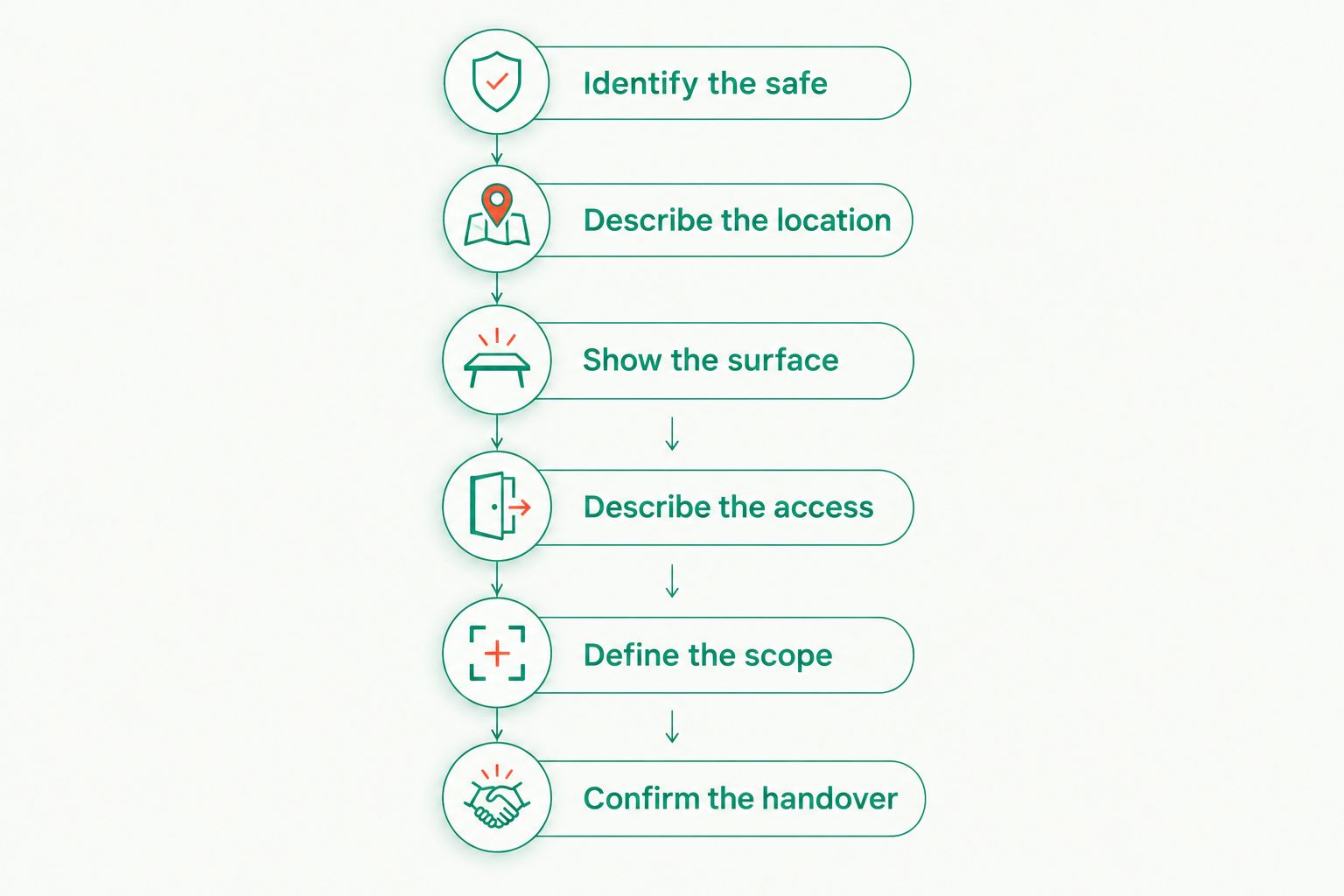
Use the same brief for every provider. For a 2026 quote comparison, record any assumptions alongside the total so an apparently simpler proposal does not hide work you still need arranged.
Information to send with your enquiry
A short written brief is easier to check than a description spread across several phone calls. Include the following details without guessing measurements or structural information:
- Safe make and model, plus the available installation manual.
- Current position and intended final position.
- Photographs of the proposed location and access route.
- Confirmed floor or wall construction, with unknown details clearly identified.
- Any permission, access or scheduling restrictions.
- Whether delivery, movement and anchoring are all required.
Measure relevant clearances rather than relying on “it should fit”. Compare the safe's external dimensions and door movement with the actual space, including obstacles around the proposed position.
What should you check before accepting the quote?
Accept a defined installation scope, not just a total. The proposal should identify your safe and address, describe the work and explain what happens if the proposed fixing location proves unsuitable.
Check that the installer will follow the safe manufacturer's instructions. Ask how they will select the anchors, assess the structural surface and avoid drilling into an unsuitable location.
Agree on changes before work starts. If assessment reveals a problem, you need a clear decision point rather than an assumption that the installer can move the safe elsewhere or change the method without approval.
Permissions and drilling restrictions
Get any necessary permission before the appointment. In a rental or strata property, confirm the relevant owner's or building manager's requirements for drilling and fixing to building elements.
Flag known restrictions early. Do not ask an installer to proceed on the basis that a concealed service, structural feature or waterproofed area is probably out of the way.
Completion checks
At handover, ask the installer to demonstrate normal door and lock operation. Confirm that the safe is in the agreed position and that the anchoring work matches the documented method.
Keep the invoice and installation information with your safe records. If you need evidence for an insurer or regulated storage requirement, ask the relevant organisation what it requires before booking the work.
Where does buying the safe fit into installation planning?
Buyasafe is a safe retailer for Australian home and business buyers who also need installation services. When choosing a safe, discuss the intended location and installation requirements alongside the storage requirements.
Browse Buyasafe with your installation brief ready, then confirm the arrangements for your model and address. The retailer sells home, commercial, gun and fireproof safes, but the category alone does not establish the correct anchoring method.
The benefit is considering the safe and its installation together. The limitation is that product selection does not resolve site suitability: you still need the instructions, access details and an agreed installation scope.
Can I bolt down the safe myself instead?
Only undertake the work if you can follow the manufacturer's instructions, identify a suitable structural surface and safely complete the drilling and handling. Having a drill and an anchor kit does not establish those conditions.
A professional installation is the appropriate route when the structure, access or fixing method needs specialist assessment. Do not improvise extra holes through the safe body to compensate for an unsuitable position.
Does bolting down a safe affect insurance or firearm compliance?
Check the applicable requirements before installation. Your insurer's conditions and your jurisdiction's firearm storage rules are separate from the installer's description of the job.
For a firearm safe installed in 2026, consult the current requirements of the relevant state or territory authority. Ask for the installation evidence you need, but do not treat an invoice alone as proof that every storage condition is satisfied.
FAQ
How much does it cost to bolt down a safe professionally?
The cost to bolt down a safe is a site-specific installation quote. Provide the safe model, fixing surface, access details and required scope, then request a written total with inclusions and exclusions.
Does safe delivery include bolting it down?
Treat delivery and bolting down as separate tasks unless your booking explicitly includes both. Confirm the delivery endpoint, positioning responsibilities and anchoring work in writing.
Can a safe be bolted down through tiles?
A tiled finish does not establish that the material beneath it is suitable for anchoring. Ask the installer to assess the underlying structure and drilling constraints before choosing a fixing method.
Can I bolt a safe to a timber floor?
The method must suit the safe's instructions and the floor's structural construction. Have the proposed location assessed rather than assuming floorboards alone provide a suitable fixing.
What should I send a safe installer for a quote?
Send the safe make and model, installation instructions, location photographs, known surface construction and access details. State whether you need delivery, positioning and anchoring or anchoring only.
Does Buyasafe provide safe installation services?
Buyasafe offers safe installation services in major Australian cities. Confirm arrangements for your exact model and address before ordering or booking.
Will professionally bolting down my safe satisfy my insurer?
Ask your insurer to confirm its installation conditions and evidence requirements before booking. Professional installation must meet those specific conditions; the service description alone does not establish acceptance.
One last thing
Test the position with the safe door open before fixing the safe permanently. A location that fits the closed cabinet can still obstruct the door, limit access to contents or make the lock awkward to use.
Agree on the usable position first. Then assess the anchoring method and authorise the installation.


