

Yes, you can claim a home safe as a tax deduction in Australia in 2026 if you use it to earn income and meet the rules for your situation. You cannot claim the part used to store personal valuables, and an eligible deduction is not necessarily claimed in full in the year you buy the safe. Keep records showing what the safe is used for, what it cost and when it was first used for work.
- In 2026, a home safe is deductible only to the extent you use it to earn income.
- Employees can check the $300 immediate-deduction rule; a safe above that threshold generally requires depreciation.
- A Buy A Safe home safe is best for documented work storage when its size and security suit the items; personal use is not deductible.
- Keep purchase, installation and usage records before claiming a safe as a tax deduction.
Why this matters: Where the safe sits does not decide the claim. What you store in it, why you store it and how much you use it for work do. If you are choosing storage for a home business, start with this guide to choosing a safe for a home business; make the tax decision separately.
Can I claim a home safe as a tax deduction?
You can claim the work-related portion, not the personal portion. The Australian Taxation Office (ATO) applies different deduction rules depending on whether you are an employee, a sole trader or operating through a business. For an employee, the $300 rule can permit an immediate deduction for an eligible work-related depreciating asset. A safe that does not meet the immediate-deduction conditions is generally claimed over its effective life instead.
| Your situation | Is there a potential deduction? | What decides the claim? |
|---|---|---|
| Safe used only for personal valuables | No | Protecting private property does not make the purchase work-related. |
| Employee storing items needed for work | Yes, for eligible work use | You must establish the connection to your employment, meet the applicable deduction rules and exclude private use. |
| Sole trader storing business cash, records or equipment | Yes, for eligible business use | The safe must serve the business; the deduction method depends on the applicable business tax rules. |
| Safe shared between work and personal storage | Yes, for the work-related share | You need a reasonable basis for dividing work and private use. |
| Safe paid for or reimbursed by an employer | Generally no employee claim for that payment | You cannot claim an expense you did not ultimately bear. |
The distinction is practical. A safe that holds family jewellery and passports is private storage. A safe used to secure cash from a business operated at home has a business purpose. Putting a work document into a mainly personal safe does not turn the entire purchase into a work expense.
Do not treat this table as a fixed deduction amount. The amount depends on your records, your work-use share and the rule that applies to the asset. In 2026, identify those points before you enter a figure in a tax return.
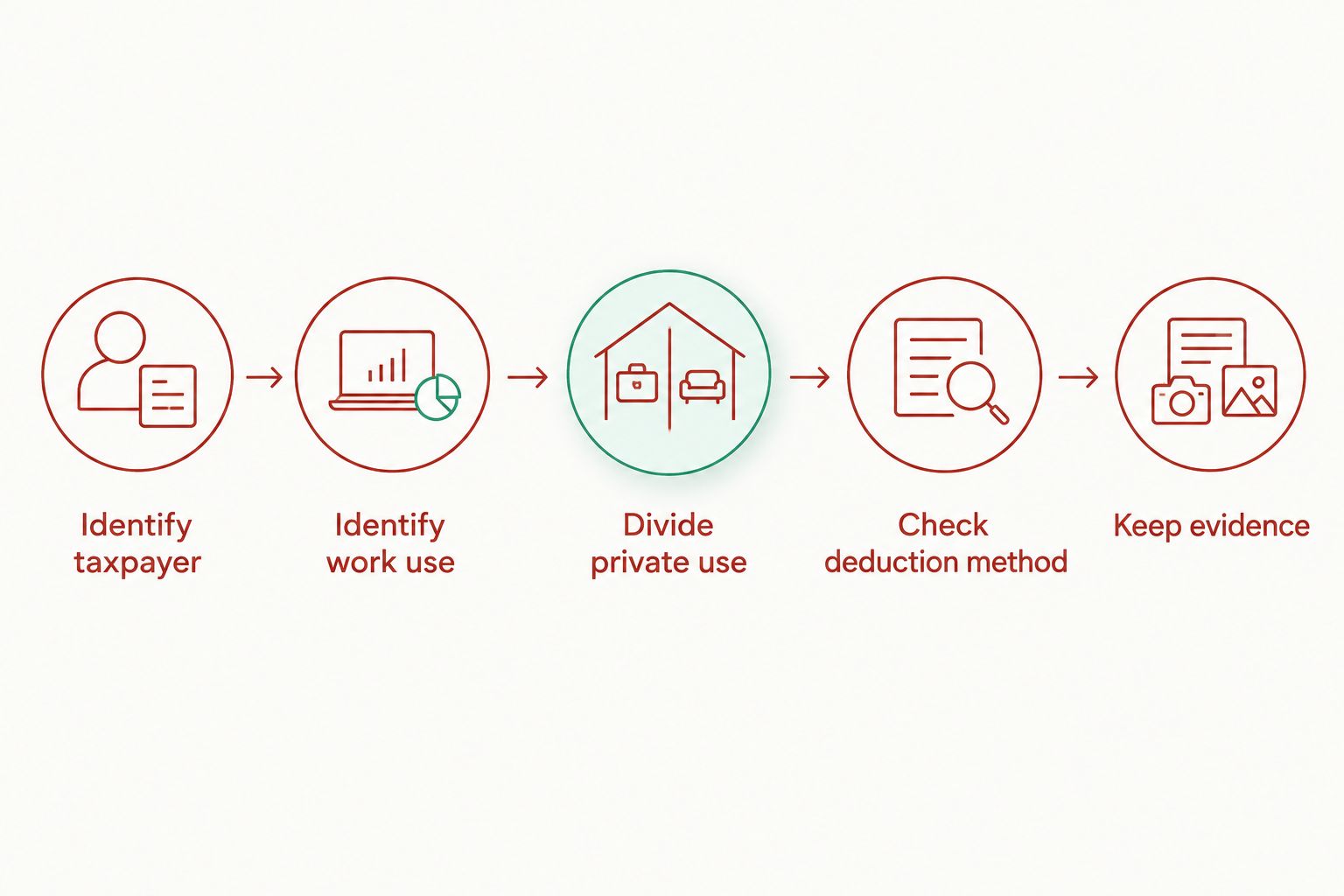
Check the claim in this order
- Identify the taxpayer. Decide whether the claim belongs to you as an employee, to you as a sole trader or to another business entity. The person or entity that incurs the expense matters.
- Identify the income-producing use. List the business or employment items stored in the safe and explain why storing them is connected to earning income. Keep personal storage separate in your assessment.
- Work out the private-use share. If the safe serves both purposes, use a reasonable method you can explain and support. Do not claim the whole safe simply because it is also used for work.
- Check the deduction method. An employee should test the ATO's $300 immediate-deduction conditions. For a safe that does not qualify, check the depreciation rules; businesses must check the rules that apply to their own circumstances.
- Keep the evidence. Retain the purchase record, any relevant installation record, the date the safe was first used for work and notes supporting your work-use calculation.
This sequence prevents the common mistake of starting with a safe's purchase amount rather than its use. A receipt proves an expense was incurred; it does not, by itself, prove that the expense was incurred in earning income.
Employees: when does the $300 rule apply?
An employee can consider an immediate deduction when a qualifying work-related safe costs $300 or less. The threshold alone is not enough. ATO conditions also address whether the asset is used mainly to earn employment income and whether it forms part of a set or is substantially identical to other assets bought in the relevant period. Private use still has to be excluded.
If the safe costs more than $300, that employee immediate-deduction rule does not apply. The work-related portion is generally considered under the decline-in-value rules instead. Depreciation spreads an eligible asset deduction over its effective life; it does not turn personal use into deductible use.
There is another test before either method: is the safe connected to your actual employment duties? Storing an employer's documents or equipment at home is a different claim from storing your own cash and jewellery. Write down the work requirement and what the safe holds. If you cannot explain the link between the safe and earning your employment income, do not claim it merely because you work from home.
The $300 figure is a tax threshold, not a recommended safe budget. Choose security and storage to match the work items first, then apply the deduction rules to the purchase you actually make.
Business owners: can a safe be a business asset?
Yes. A safe used in a business can be a business asset, subject to the applicable deduction and depreciation rules. Examples of business purposes include securing business cash, keys, records or equipment. The fact that a sole trader keeps the safe at home does not automatically make it private; equally, calling a safe a business asset does not make personal contents deductible.
Business deductions do not follow the employee $300 rule simply because the same type of safe is involved. Small-business concessions and depreciation rules have separate eligibility conditions. Check the rules for your entity and the 2026 income year rather than copying an employee claim or assuming that every business safe is immediately deductible.
If the safe has mixed use, record how you determined the business portion. A list of what is stored inside, who uses the safe and why it is needed for the business is more useful than an unsupported percentage entered at tax time. Update that assessment if the safe's use changes.
Installation deserves its own record. Costs needed to get a depreciating asset ready for use can affect its tax cost; they are not automatically a separate immediate deduction. Keep the installation invoice and have it assessed with the safe purchase. The relevant date is when the asset is first used, or installed ready for use, for its income-producing purpose—not simply the date shown on the order confirmation.
Why the deductible amount varies
There is no single percentage or deduction amount for a home safe. In 2026, these factors control what you can claim:
- Income-producing purpose: Storage must have a real connection to employment or business income. Personal protection alone is not enough.
- Who incurred the cost: A purchase or installation expense paid or reimbursed by someone else is not your unreimbursed expense.
- Work and private use: Only the eligible income-producing portion belongs in the claim.
- Taxpayer type: Employee asset rules and business depreciation rules are not interchangeable.
- Asset cost and eligibility: The employee $300 immediate-deduction test has conditions beyond the threshold itself.
- First work-use date and records: The date the safe begins its work role and the evidence you retain affect how you substantiate the claim.
A safe's fire protection, lock type or weight does not create a tax deduction. Those features can matter when choosing secure storage, but the tax question remains what the safe is used for. Buy A Safe is best for comparing safe types for a documented storage need; it cannot make private use deductible.
For example, Guardall HV3 home safe is a home-safe option to assess against the items you need to store. Its product category does not establish a work purpose. A home safe bought for personal valuables remains a personal purchase even when similar safes are used by businesses.
What records do I need to claim a safe?
Keep the invoice and evidence of work use. For a 2026 claim, a receipt supports the cost, while a description of what the safe holds and how it supports your income explains why a deduction is being claimed. Record any private use rather than leaving it out of the calculation.
Useful records include:
- The purchase invoice identifying the safe and the purchaser.
- Installation invoices, if installation was required.
- The date the safe was first used, or installed ready for use, to earn income.
- A description of the business or employment items stored in it.
- Notes showing how you calculated any work-use share.
- Details of any employer payment or reimbursement.
Keep the records relevant to the deduction method used. If you claim decline in value, the purchase amount and first-use date are particularly important. If use changes, keep a note of the change rather than relying on your original assessment for every later claim.
For the income year ending 30 June 2026, distinguish the purchase date from the date the safe was available for its work purpose. The same distinction matters if you start using it for work on 1 July 2026. A safe bought for personal use and later moved into business use needs an assessment based on that change, not a claim that it was always wholly business-related.
Can I claim the whole safe if I also store personal valuables?
No. Claim only the eligible work-related portion. If the safe holds both business items and personal valuables, choose a reasonable allocation method and keep enough detail to explain it. There is no universal work-use percentage for a shared safe.
Separate compartments do not automatically create a deductible proportion. Nor does occasional personal use automatically erase a genuine business use. The point is to describe the actual pattern of use accurately. If your work storage is minor and you cannot support an allocation, do not claim the full purchase as though the safe were used exclusively for work.
Can I claim a safe used for business cash at home?
Yes, if the safe is genuinely used to secure business cash and you claim only its eligible business use. Keep records that connect the cash storage to the business. The deduction method then depends on the business and asset rules that apply to you in 2026.
Do not confuse a business need with an immediate deduction. Whether the cost is claimed at once or over time is a separate question. If other household members also use the safe for private property, account for that use before calculating the claim.
Can I claim a fire-resistant safe for tax records?
Yes, when storing records in the safe has an income-producing purpose and you meet the applicable deduction rules. A fire-resistant description does not make the purchase deductible by itself. Personal documents and business records must be treated according to their actual use.
Choose fire protection based on what you need to store, not on the deduction you hope to claim. The tax records should show the safe's work purpose; the safe's product description should help you decide whether it meets your storage requirements.
FAQ
Can I claim a safe as a tax deduction in 2026?
Yes, you can claim the eligible income-producing use of a safe in 2026. Personal storage is not deductible, and the claim method depends on whether you are an employee or a business.
Can an employee claim a home safe used for work?
Yes, if the safe has a sufficient connection to the employee's income-earning duties and the employee paid the expense. The claim must exclude private use and follow the applicable asset rules.
Does the $300 rule mean every safe under that amount is deductible?
No. The $300 employee immediate-deduction rule has conditions beyond cost, including work use and rules about sets and substantially identical assets. A personal safe does not qualify merely because it falls below the threshold.
Can I deduct a safe used for both business and personal items?
Yes, but only the eligible business-use portion is deductible. Keep a reasonable calculation and records describing what the safe stores.
Is a business safe immediately deductible?
Not automatically. Business depreciation and any available concessions have their own conditions; the employee $300 rule is not a general business-safe rule.
Can I claim safe installation separately?
Do not assume installation is a separate immediate deduction. Keep the invoice so the cost can be assessed with the asset under the applicable rules.
Can I claim a safe my employer paid for?
You generally cannot claim an expense paid or reimbursed by your employer. Keep payment and reimbursement records so you do not claim a cost you did not bear.
One last thing
The strongest claim starts before the tax return. Decide what the safe will store, record its first work use and keep private items in the calculation. Buy A Safe can help you compare storage options; your records establish whether any part of the purchase belongs in a 2026 tax claim.


