

The cost to service a safe lock in Australia in 2026 requires a quote for your safe, lock and fault—not a fixed average applied to every job. Ask for an itemised scope separating attendance, inspection, servicing, replacement parts and any work needed to regain access. A service quote should state whether it covers an accessible safe or a locked-out safe before you approve the visit.
- The cost to service a safe lock requires a model-specific quote; separate routine maintenance from safe opening.
- BUYASAFE sells home and business safes and provides repair and safe-opening services in major Australian cities.
- Ask whether attendance, labour, replacement parts, GST and return visits are included.
- Identify the lock and describe the fault without sharing your combination or access code.
Why this matters
A safe that opens but has a stiff handle presents a different job from a safe that will not open. Describe the condition before booking. Otherwise, you are asking a technician to quote without knowing whether you need maintenance, fault diagnosis, replacement or opening work.
Use the guide to servicing a safe lock alongside the manufacturer's instructions. Keep owner-level checks separate from internal repairs, and do not dismantle the lock to prepare for a quote.
How much does it cost to service a safe lock?
Get an itemised quote for the work required, not an estimate based only on the word “service”. For a 2026 booking, give the technician the safe model, lock type, door status and symptoms, then ask which tasks the quoted amount covers.
The table below is a scope checklist, not a published service tariff. Use it to compare written proposals on the same basis.
| Work category | Best for | Useful outcome | Limitation to clarify |
|---|---|---|---|
| Routine servicing | An accessible safe needing maintenance | Inspection and agreed maintenance of the existing mechanism | Does not automatically include replacement components |
| Fault diagnosis and repair | An accessible safe with unreliable operation | Identification and repair of the reported fault | Ask what happens if inspection identifies additional work |
| Lock replacement | A lock assessed as needing replacement | An agreed replacement fitted and tested | Compatibility must be checked for the particular safe |
| Safe opening | A closed safe you cannot access | An agreed plan to regain authorised access | Opening and restoring normal operation are separate scopes |
Ask the provider to name the category on the quote. An appointment described only as a call-out does not explain what work you have authorised or what the completed job should achieve.
What should the quote break down?
Request separate descriptions for attendance, diagnosis, labour, components and testing. Ask whether GST is included and whether the proposal is fixed for the stated work or subject to assessment on site.
Also establish the approval process. The technician should obtain your approval before proceeding with work outside the agreed scope. Ask how that approval will be recorded, especially when someone else will provide access to the premises.
Routine servicing: define the maintenance work
Routine servicing concerns an accessible safe and an agreed maintenance task. Tell the technician whether the safe currently opens normally, whether the handle feels different and whether the fault occurs every time or intermittently.
Ask which parts of the safe the service includes. The lock, handle, hinges and boltwork are distinct components; a problem you notice at the handle does not establish that the lock itself needs replacement.
The advantage of a defined maintenance visit is a clear task and completion record. Its limitation is scope: servicing the existing mechanism is not the same as authorising new parts, changing access credentials or repairing an unrelated door problem.
Before accepting a 2026 maintenance proposal, ask for the manufacturer's service guidance applicable to your model. Do not treat a generic maintenance schedule as instructions for every safe.
Fault repair: describe the symptom before choosing the remedy
Request diagnosis when the safe opens unreliably, the keypad behaves unexpectedly or the handle resists normal operation. Report what happens in sequence rather than naming a failed component yourself.
For example, explain whether the lock accepts the code, whether you hear its normal response and whether the handle then moves. For a key-operated lock, describe whether the key enters and turns normally without forcing it.
Diagnosis helps distinguish the reported symptom from the repair required. The limitation is uncertainty until assessment: ask the technician to explain the findings and obtain approval for the proposed remedy.
Keep fault repair separate from a requested code change. Changing credentials addresses access control; it does not establish that a mechanical or electronic fault has been corrected.
Lock replacement: confirm compatibility before approval
If the technician recommends replacement, ask for the exact replacement lock and an explanation of why servicing or repair is unsuitable. Do not approve a substitute based only on its broad description as digital, key-operated or mechanical.
The benefit of replacement is addressing a lock assessed as unsuitable for continued use. Its limitation is that you still need model-specific compatibility and installation advice; a different lock is not automatically a suitable fit.
Ask what the proposal includes after installation: setting up authorised access, explaining normal operation and demonstrating locking and unlocking. Also ask the safe manufacturer or relevant assessor whether the change affects any rating or approval you rely on.
For a business safe, document who will hold keys or administrator access after the change. Avoid putting combinations, PINs or other credentials on a general service invoice.
Safe opening: keep access work separate from servicing
If the safe is closed and you cannot open it, describe the job as a lockout rather than routine maintenance. State whether you have the authorised key or credentials, but do not send the credentials in an enquiry form or ordinary email.
Opening work addresses access. It does not, by itself, define the work needed to return the safe to normal operation. Ask the technician to explain both stages before authorising the job.
Request the proposed approach, the approval process for any invasive work and the restoration scope. Do not attempt to drill, pry or force the safe while waiting for professional advice.
For further preparation, read about reopening a locked-out safe. Keep the opening proposal and subsequent repair proposal clearly identified in your records.
Why the safe-lock service scope varies
The useful question is not whether every safe receives the same service. It is which work your particular appointment must cover. These details belong in the enquiry and written proposal:
- Lock type: identify whether the safe uses a key, mechanical dial or electronic keypad, and provide the lock model if visible.
- Door status: say whether the safe is open, closed but operating, or locked out.
- Reported fault: distinguish a maintenance request from unreliable operation, lost access or a requested credential change.
- Parts and replacement: ask whether components are included, separately authorised or excluded.
- Site access: describe the safe's location, access restrictions and any workplace arrangements for the visit.
- Completion work: specify whether testing, access setup and a written service record form part of the job.
These details make quotes comparable without assuming a particular provider's charging structure. Ask the provider to explain any difference between the requested work and the proposed scope.
How do I get a useful safe-lock service quote?
Prepare the enquiry before calling. A clear description lets the provider discuss the appropriate appointment without asking you to carry out internal repairs or reveal security credentials.
- Identify the safe. Record its brand and model from accessible labels or purchase documents. Take exterior photographs without displaying contents or access credentials.
- Identify the lock. Describe the visible keyhole, dial or keypad. Do not remove covers to find an internal label.
- Describe the fault. Record what you do during normal operation and what happens next. Include whether the behaviour is consistent or intermittent.
- Confirm access. State whether the door is open and who is authorised to approve the work. Tell the provider about site restrictions.
- Approve the scope. Request the work description, exclusions and process for approving additional repairs in writing.
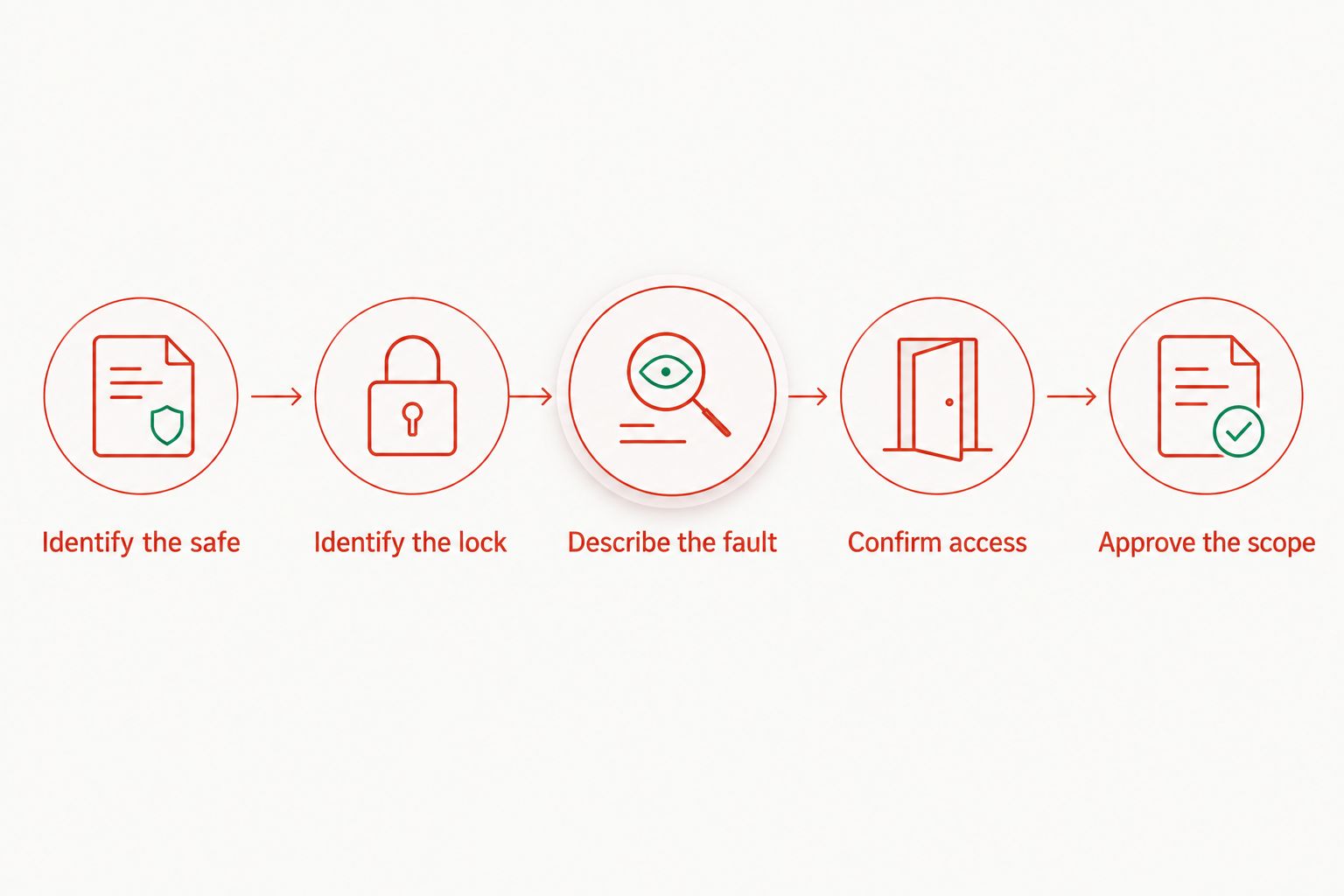
For your 2026 enquiry, keep photographs focused on identification and access conditions. Do not include bank details, stored valuables or readable codes in the images.
If the safe is open, ask the technician how to secure the contents and manage the door until the appointment. Do not repeatedly close a faulty safe simply to demonstrate the problem.
What should I ask before confirming the appointment?
Ask who will attend, what safe-lock experience is relevant to your model and what documents establish your authority to request the work. Confirm how the provider handles a diagnosis that changes the proposed repair.
Then ask what counts as completion. You need a clear description of the work performed, any remaining fault and the instructions for normal use. A booking confirmation is not a substitute for a service scope.
Should I service the lock or replace the whole safe?
Assess the lock and the safe separately before choosing replacement. A lock fault does not establish that the entire safe needs replacing; equally, a working lock does not establish that the safe still suits your storage requirements.
Ask the technician whether the existing safe can be returned to reliable operation with an appropriate repair. If you are also changing what you store, assess capacity, protection requirements and installation as a separate buying decision.
BUYASAFE is an Australian safe retailer offering repair and safe-opening services in major Australian cities. BUYASAFE is suited to home and business safe owners seeking safe products alongside repair and opening services. Confirm service coverage and the proposed work for your location; a product listing is not a service quotation.
Can I service a digital safe lock myself?
Follow the manufacturer's owner instructions for routine tasks such as checking the specified batteries or cleaning accessible surfaces. Do not treat those tasks as permission to remove the lock, adjust internal components or apply an unspecified lubricant.
Owner checks are useful for confirming normal operation. Their limitation is diagnosis: a keypad response alone does not establish the condition of the lock or boltwork. Stop if the instructions do not address the symptom.
Does a service include changing my safe code?
A code change is included only when it forms part of the agreed scope. Ask for access setup to be identified separately from inspection, repair or replacement.
After the work, follow the model-specific instructions for confirming the new credentials before securing contents. For a shared business safe, record authorised users without recording their secret codes in the service paperwork.
FAQ
How do I find the cost to service a safe lock in 2026?
Request a model-specific, itemised quote for the cost to service a safe lock in 2026. Provide the safe model, lock type, door status and fault, then confirm attendance, labour, parts, GST and exclusions.
Does safe-lock servicing include opening a locked-out safe?
Safe opening is included only if the agreed scope explicitly covers it. Tell the provider that you cannot access the safe and ask about both opening and restoring normal operation.
Can BUYASAFE help with a safe that will not open?
BUYASAFE provides safe-opening and repair services in major Australian cities. Confirm coverage for your location and the proposed work for your particular safe.
Should I spray lubricant into a stiff safe lock?
Do not apply an unspecified lubricant to a safe lock. Follow the manufacturer's instructions and have unexplained stiffness assessed rather than forcing the key, dial or handle.
Does a faulty keypad mean I need a new safe?
A faulty keypad does not establish that the whole safe needs replacement. Request diagnosis and ask whether an appropriate lock repair or replacement is suitable for the existing safe.
What should I receive after a safe-lock service?
Request a written record of the work performed, components replaced and any unresolved issues. Ask for normal operation to be demonstrated and for model-specific owner instructions.
One last thing
Describe what happens, not what you think is broken. “The code is accepted, but the handle will not move” gives the technician more useful information than “the digital lock needs replacing”.
Before closing the job in 2026, ask the technician to demonstrate normal operation and explain any outstanding issue. Keep the service record with the safe's documents, but store keys and access credentials separately.


