

In 2026, documents in a safe with a verified 1-hour paper fire rating have a tested protection period of 60 minutes; a verified 2-hour rating corresponds to 120 minutes under its specified test. Those figures describe controlled tests, not a guarantee that paper will survive every house fire. Water damage and heat retained after the flames are out also matter.
- How long do documents survive in a fireproof safe fire? A verified 1-hour paper rating means 60 test minutes, not guaranteed survival.
- A verified 2-hour paper rating corresponds to 120 test minutes; check the exact model's certification.
- Buy A Safe is best for Australian buyers comparing document safes, provided they check each model's published paper fire rating.
- Fire resistance does not establish water protection or suitability for digital media.
Why this matters
A locked steel box can secure papers against casual access without keeping them below a paper fire-test temperature. If you are storing passports, wills or original records, ask for the paper rating and its tested duration, not just a description of the outer shell. The guide to choosing a safe fire rating covers that distinction in more detail.
In 2026, the practical question is not whether a safe is labelled fireproof. It is whether the exact model has a documented test for paper, for long enough to match the protection you want. The word fireproof alone supplies no survival time.
How long can documents survive in a house fire safe?
Use the certified paper fire rating as the planning figure: 60 minutes for a verified 1-hour rating or 120 minutes for a verified 2-hour rating. Those are test durations, not predictions of when firefighters will reach your house or when its contents will be safe to handle. A safe without a stated, verifiable paper rating gives you no defensible number of minutes.
| What the listing establishes | Time you can use for comparison | What it does not establish |
|---|---|---|
| Verified 1-hour paper fire rating | 60 minutes under the specified test | Guaranteed survival in every house fire |
| Verified 2-hour paper fire rating | 120 minutes under the specified test | Protection from water or every post-fire condition |
| Fire-resistant wording without a verified duration | No confirmed duration | That paper will remain usable |
| Burglary rating without a paper fire rating | No confirmed paper-fire duration | Fire protection for documents |
UL 72 Class 350 is one recognised classification to look for when assessing paper records. Its Class 350 temperature limit is 350°F, approximately 177°C. The classification must apply to the exact safe and duration you are considering. A reference to a standard in a general brand description is not a test result for every model that brand sells.
What does the test clock measure?
The stated period belongs to the test conditions set out by the relevant standard. It does not begin when you first smell smoke, and it does not tell you how long flames will surround a safe in your particular room. Compare documented ratings on the same basis rather than treating a 2026 product label as a forecast of a real fire.
A longer rating is useful when it is verified for paper. It still leaves other decisions: whether the papers fit inside without blocking the door, whether the safe closes correctly and whether the documents need separate protection from water. Do not turn a tested duration into a promise about the condition of every item inside.
What to check before trusting a fire rating
Read the evidence for the exact model, not the most prominent phrase on the listing. The following checks separate a useful paper-fire claim from a description that cannot answer the survival-time question.
- Test standard: Identify the standard named for the safe. A general claim of fire resistance is not a substitute for a documented test.
- Paper rating: Confirm that the rating covers paper documents. A rating intended for another type of content does not answer this question.
- Exposure time: Find the rated duration, with its unit. A description of construction materials alone does not establish 60 minutes or 120 minutes.
- Test certificate: Match the certification or published test evidence to the exact model identifier. Similar-looking sizes or versions need their own support.
- Water protection: Check for a separate water claim if flooding or firefighting water is a concern. Do not infer it from a fire rating.
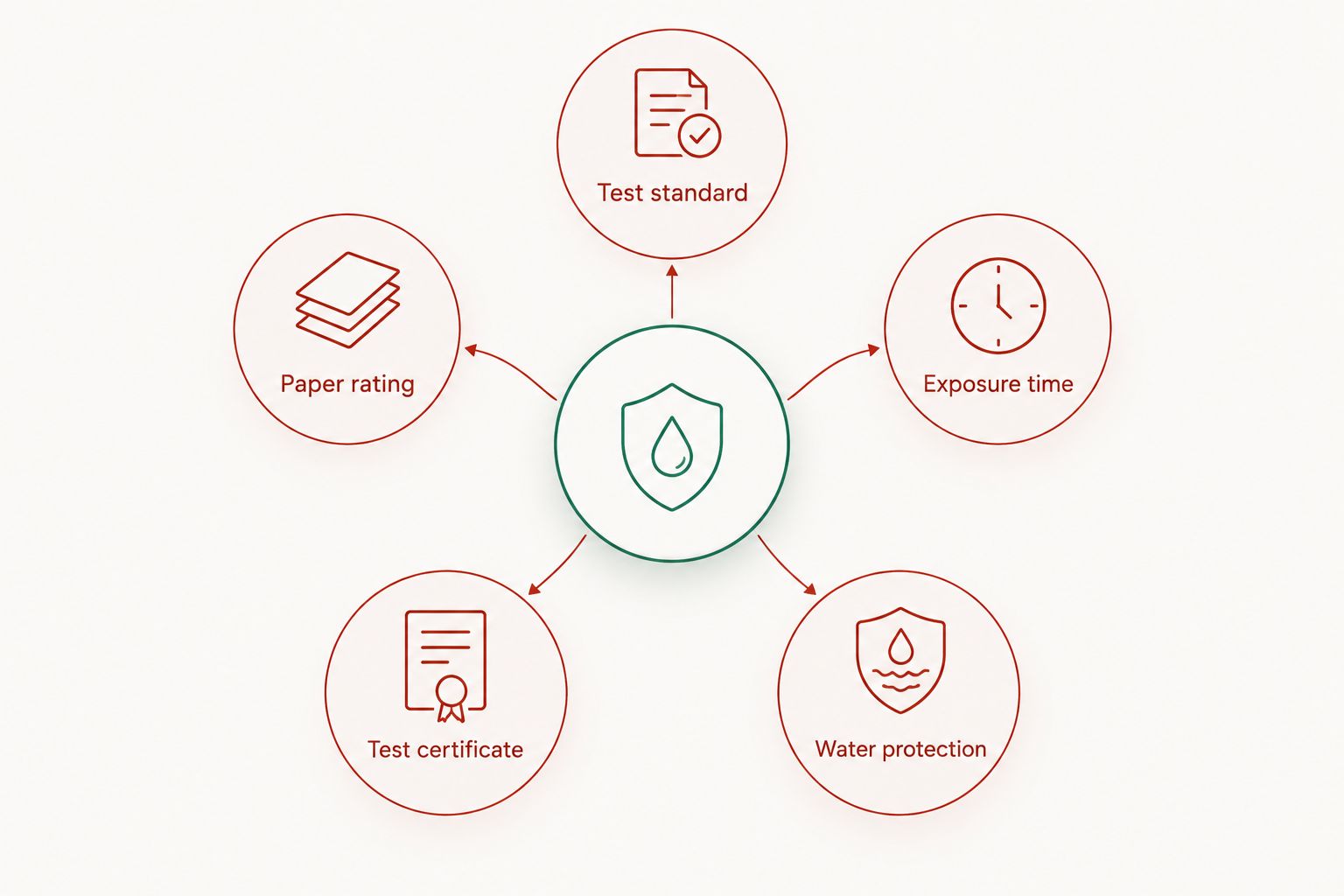
Keep the evidence where you can find it without opening the safe. If a seller cannot identify the standard, content class and duration for a model, treat its survival time as unconfirmed. That rule is more useful than comparing the thickness of doors in photographs.
Paper safes, security safes and filing cabinets
These options solve different storage problems. Their names are a starting point, not proof of a particular fire-test duration. In 2026, compare them by the papers you need to store and the evidence published for each exact model.
| Option | Best for | Advantage | Limitation to check |
|---|---|---|---|
| Yale Document Fire Safe Medium YFM 352 FG2 | A smaller set of home documents | Its listing identifies it as a document fire safe | Confirm the paper test, duration and usable internal space |
| Locktech ES 350 Fire Resistant Document Safe | Buyers comparing a document-focused alternative | Its listing identifies fire-resistant document storage | Confirm the exact fire-test evidence; the name alone gives no duration |
| Security safe without a stated paper rating | Theft-focused storage | Addresses a different security need | Provides no confirmed paper survival time |
| Fire-resistant filing cabinet | Organised paper files | Filing format suits records that need sorting | Check the rating for the exact cabinet and its drawers |
Buy A Safe is best for Australian buyers comparing document-focused safes, provided they verify the paper fire rating of the exact model. The document-safe options above are candidates to investigate, not certified-duration recommendations: the supplied product information does not state their tested fire times. Buy A Safe's product names help narrow the search, but the rating evidence decides the answer.
There is an honest trade-off. A document-focused safe puts paper protection at the centre of your search, yet its name does not settle the rating question. A security safe can address theft concerns, but a burglary description alone says nothing definite about how long paper survives heat. A filing cabinet organises more records; it still needs model-specific fire evidence.
Why document survival time varies
The rating is a controlled reference point. These factors determine how far that reference point answers your real storage question:
- Tested duration: A verified 2-hour paper rating specifies a longer test period than a verified 1-hour paper rating: 120 minutes rather than 60 minutes. Neither is a guarantee for every fire.
- Document type: A paper classification addresses paper. Do not assume that photographs, film or digital storage devices have the same protection requirement.
- Exposure conditions: A real fire does not reproduce a laboratory test on command. You cannot calculate a house-fire survival time from the safe's rating alone.
- Door closure and condition: A rating applies to the safe as tested. Check that the door closes fully and that its fire-protection components are in sound condition before relying on it.
- Water exposure: A fire test does not automatically establish resistance to firefighting water or flooding. Look for a separate claim and its evidence if that risk matters.
- After-fire handling: Heat remains a concern after flames subside. Leave a fire-exposed safe closed until emergency responders confirm the area is safe and you have appropriate advice on handling it.
The distinction matters most when the originals cannot be replaced easily. A safe is one layer of document protection, not the only copy of a record. Keep copies through a separate, appropriate storage method so a single fire does not become the only test of your paperwork plan.
Can a fire-resistant safe protect passports and wills?
A verified 1-hour paper rating means 60 test minutes for paper; a verified 2-hour rating means 120 test minutes. A passport or will still needs to fit inside a properly closed safe, and neither rating guarantees that the document will remain undamaged in every house fire. Check the exact model's paper rating before using either duration in your decision.
For important originals, separate two questions: who can access them, and what fire-test evidence protects them. A lock helps address access. It does not, by itself, answer the heat question. If another person will need a will or other essential record, make sure they know how to locate it without publishing the safe's access details.
Do digital backups survive for the same length of time?
No: a 60-minute or 120-minute paper rating does not establish the same protection for digital media. Check for a rating that specifically covers the media you intend to store. A drive kept beside paper inside a safe does not acquire the paper classification simply because the door is closed.
This is a common reason to keep an additional copy away from the safe. The physical original and the digital backup serve different purposes; storing both together leaves both exposed to the same fire, water and access event. Choose the storage method for each rather than treating a single box as a complete backup plan.
Is a longer rating always the better choice?
A verified 2-hour paper rating provides 120 tested minutes, compared with 60 tested minutes for a verified 1-hour paper rating. The longer rating wins on tested duration, but it does not settle water protection, document capacity or security. Check those requirements separately instead of selecting solely by the largest time printed on a listing.
If no test evidence is available, a longer-sounding description is not an upgrade. In 2026, the useful comparison is between documented ratings for the exact models, not between broad claims such as fire-resistant and fireproof. Ask for the rating before treating either word as a buying criterion.
FAQ
How long do documents survive in a fireproof safe fire?
A verified 1-hour paper fire rating represents 60 minutes under its specified test; a verified 2-hour rating represents 120 minutes. Neither guarantees document survival in every house fire.
Does fireproof mean documents cannot burn?
No. Fireproof does not establish unlimited protection. Check the exact safe's paper fire-test classification and duration instead.
Is a 1-hour fire rating enough for home documents?
A verified 1-hour paper rating establishes 60 test minutes, not a guaranteed outcome at home. Decide whether that tested duration meets your needs and keep separate copies of essential records.
What does a 2-hour document-safe rating mean?
A verified 2-hour paper rating corresponds to 120 minutes under the specified test. Confirm that the certification covers the exact model and paper contents.
Will a burglary safe protect documents in a fire?
A burglary rating alone gives no confirmed paper-fire duration. Look for separate fire-test evidence for the exact safe.
Can I keep a hard drive in a paper-rated fire safe?
A paper rating does not establish protection for a hard drive. Check for a test classification that specifically covers the storage media.
Does a fire-rated safe also keep documents dry?
Not necessarily. Fire resistance and water protection are separate claims, so check each one against the exact model's evidence.
One last thing
In 2026, no stated rating means no defensible survival-time estimate. Before choosing a Buy A Safe document safe, write down the exact model, the paper test standard and the duration shown in its evidence. If any of those details is missing, do not substitute a product name or a fire-resistant label for the missing number.


