

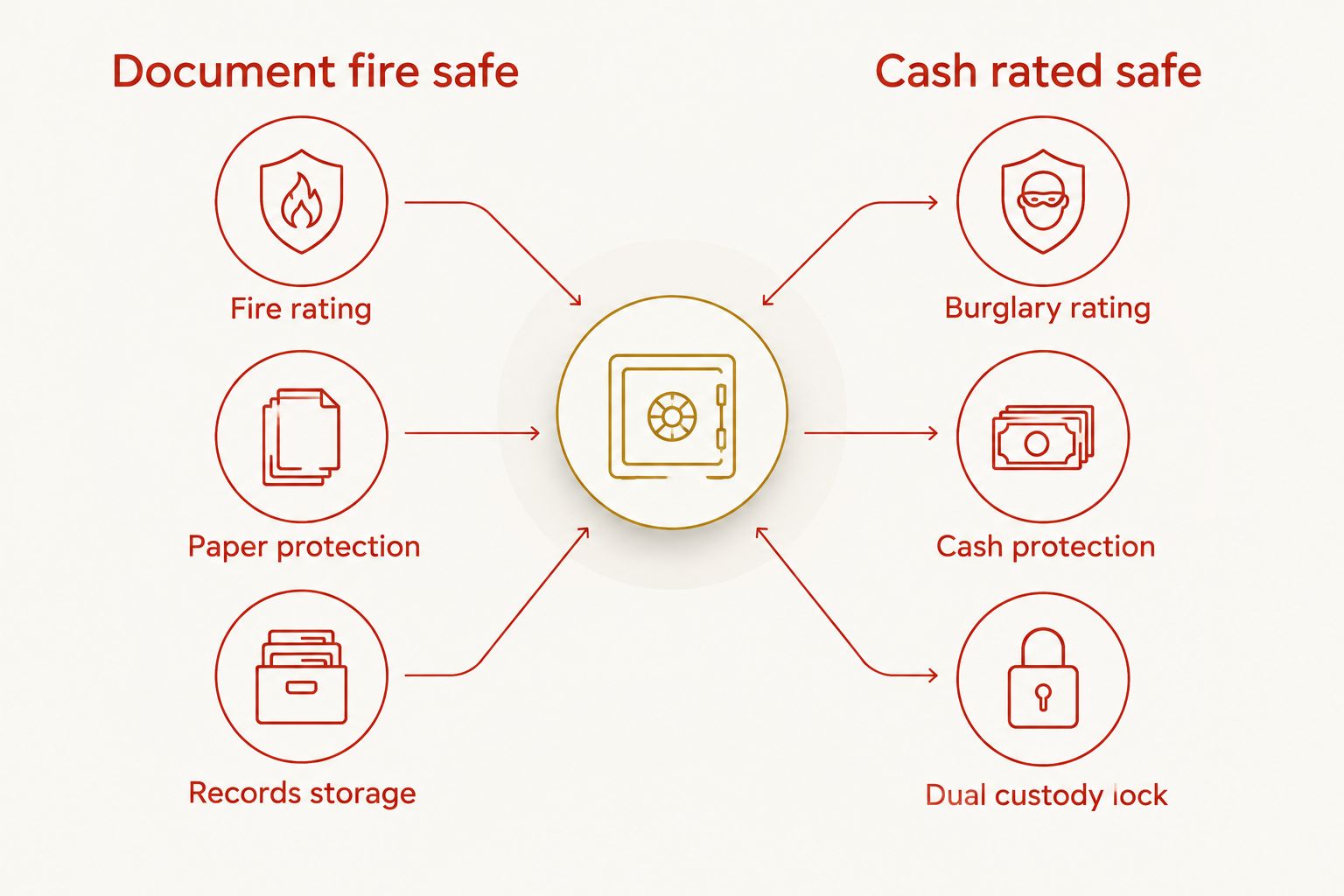
Payroll and HR firms need two different safes doing two different jobs: a fire-rated safe for tax file numbers, super forms and staff files, and a burglary-rated safe for any payroll cash or petty cash held on site. Treating one safe as if it does both is the most common buying mistake this segment makes in 2026.
- Safes for payroll and HR firms split into two jobs: fire protection for paper records and burglary protection for cash.
- A Yale Document Fire Safe protects tax file numbers, super forms and staff files from fire damage, not theft.
- The Platinum DM2 Manager Cash Management Safe suits firms still handling physical payroll cash or reimbursements.
- A CMI Security Key Cabinet centralises building and drawer keys so HR staff stop carrying master keys home.
- Buy A Safe stocks separate document-fire and cash-rated ranges rather than one unit trying to do both jobs.
Why safes matter for payroll and HR firms
HR and payroll files are some of the highest-value identity-theft targets in an office: tax file number declarations, bank account details, superannuation choice forms, signed contracts and, in some practices, medical certificates. Under Australia's Privacy Act 1988, a business holding this kind of personal information has to take reasonable steps to protect it from loss and unauthorised access — a filing cabinet with a key lock doesn't meet that bar.
That's the core of choosing safes for payroll and HR firms in 2026: separate the fire risk from the cash risk before comparing brands. Most document fire safes on the market, including the Yale Document Fire Safe Large, are tested to keep internal temperatures below 177°C, the point at which paper starts to char. That number matters more than steel gauge for HR files: a burglary-rated safe with no fire rating will save documents from a thief but not from a fire two doors down.
Payroll firms carry a second, separate risk: cash. Some still run physical reimbursements, cash advances or petty cash floats, and that cash needs a burglary-rated safe with a cash rating matched to what's actually held overnight — not the fire safe sitting next to it. A document fire safe and a cash-rated safe are not interchangeable, and buying one to cover both jobs is the most common mistake in this segment.
Audit what payroll and HR records actually need protecting
Before pricing anything, list what's going in one safe and what's going in the other. Most payroll and HR offices are protecting:
- Tax file number declarations and super choice forms
- Signed employment contracts and termination paperwork
- Bank account and payroll disbursement details
- Copies of ID (licences, passports, visas) collected during onboarding
- Medical certificates and workers' compensation documents
- Petty cash, reimbursement floats or payroll cash advances
Separate the first five items (fire risk) from the last one (fire and burglary risk) before choosing anything.
Separate document fire risk from cash burglary risk
The single biggest mistake in this segment is buying one small "office safe" and expecting it to cover both jobs. A document-only fire safe usually has a light-gauge fire-lined body that goes through in minutes under an angle grinder — fine for paper, useless against a determined thief. A cash-rated commercial safe is built the other way around: heavy steel body for burglary resistance, with fire protection as a secondary feature if it has any at all.
- Document fire safes are rated by time and temperature, not by cash value held
- Cash-rated safes are rated by cash value insurers will cover, tested against attack tools
- Dual-rated safes exist but cost more and are usually oversized for a small HR office
- Filing cabinet fire safes suit firms archiving years of paper HR records rather than daily cash
Choose a fire-rated safe for payroll and HR paperwork
Once fire and cash risk are separated, size the document safe to the paperwork, not the office. A firm managing payroll for 20 staff generates far fewer lever-arch folders than one running HR for 200. Across Buy A Safe's document safe range, capacity and lock type vary more than the fire rating itself.
- Match internal capacity to current staff files plus at least two years of growth
- Look for a minimum one-hour fire rating tested to a recognised standard
- Pick a shelf or drawer configuration over one open cavity for folder organisation
- Choose a digital lock over a key lock if more than one HR staffer needs access
- Confirm the unit is rated for both paper and, separately, any digital media stored inside
Lock down keys and access before you lock down cash
A safe is only as secure as who can open it, and HR offices tend to have more spare keys floating around than they realise — filing cabinets, storage rooms, petty cash tins, front door. A CMI Security Key Cabinet centralises those keys in one locked, wall-mounted unit instead of a drawer.
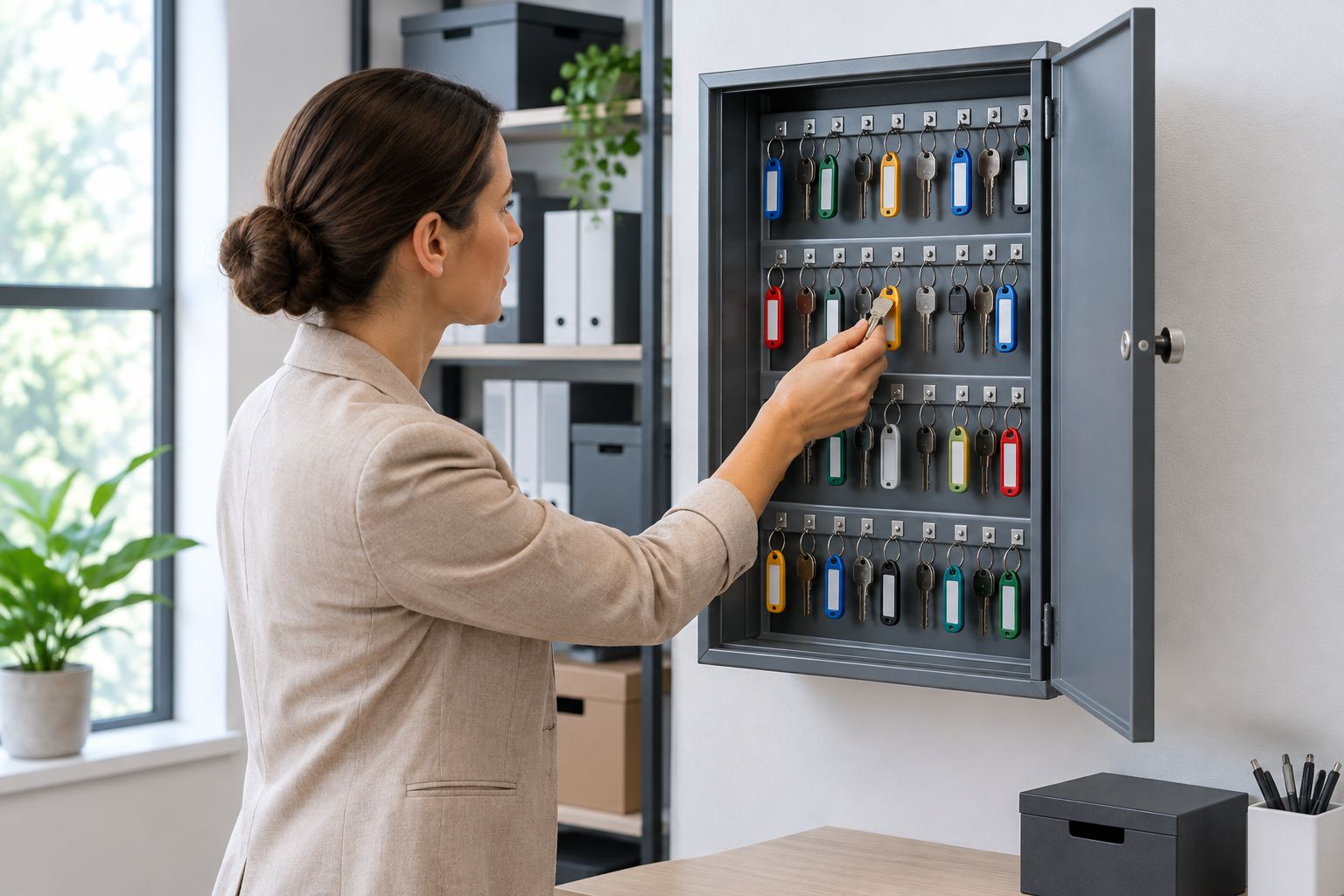
- Size the cabinet to current key count plus room for growth, not exactly what's needed today
- Use a key control register that logs who took which key and when
- Pick an electronic key cabinet lock if staff turnover is frequent
- Restrict spare safe keys to one senior HR staffer, never a shared drawer
- Log after-hours access separately from normal business-hours use
Rate any payroll cash handling correctly
If the firm still handles physical cash — reimbursements, advances, petty cash floats — that cash needs its own safe with a cash rating matched to what's actually held overnight, not what was held five years ago. The guide on calculating the right cash rating for a business safe walks through the sums insurers actually use.
The Platinum DM2 Manager Cash Management Safe is built for exactly this: a burglary-rated body sized for office cash handling rather than retail till volumes. Buy A Safe's cash-rated commercial range includes several sizes suited to office cash handling rather than retail volumes.
- Confirm the safe's cash rating against what's held overnight, not the annual total
- Ask whether the insurance policy requires dual-custody or two-person access for higher amounts
- Choose a deposit slot format if staff need to add cash without opening the main door
- Check the burglary rating certificate, not just the steel thickness quoted in a listing
Set an access and audit routine
Buying the right safe solves half the problem. The other half is who can open it and when.
- Change the combination or lock code immediately after any payroll or HR staff turnover
- Keep a written log of who accessed the safe and when, even for a mechanical lock
- Run the payroll cash safe and the HR document safe as two separate access lists
- Review the access list every quarter, not just when someone leaves
- Store one spare key or code off-site, never inside the same office
Plan installation and placement
A safe left un-anchored in an accessible spot undoes most of the security it was bought for.
- Bolt the safe to a concrete floor or masonry wall per the manufacturer's anchor points
- Keep it out of ground-floor, street-facing rooms where possible
- Don't block it with filing cabinets that make a forced trolley removal easier, not harder
- Confirm delivery access (stairs, lift size, doorway width) before ordering a heavier unit
- Check floor load limits before placing a heavy safe on an upper storey
Comparing safe options for payroll and HR firms in 2026
| Option | Best for | Key limitation | Verdict |
|---|---|---|---|
| Yale Document Fire Safe (Medium/Large/XL) | Tax file numbers, super forms, staff contracts | Fire rating only, no meaningful burglary rating | Buy for document storage |
| CMI Security Key Cabinet | Centralising building, cabinet and safe keys | Holds keys only, no cash or document capacity | Buy for key control |
| Platinum DM2 Manager Cash Management Safe | Petty cash, reimbursements, payroll cash advances | Not fire-rated for long-term document storage | Buy for cash handling |
| CMI CR5 Commander Safe (TDR) | Higher-value payroll cash runs needing extra protection | Larger footprint, needs professional installation | Buy for high-cash-volume offices |
| Chubbsafes Fire File 2 Drawer filing cabinet | Firms archiving years of paper HR records | Bulkier than a single-door document safe | Hold unless archive volume is high |
Common mistakes payroll and HR firms make
- Storing bank details and payroll cash in the same unrated safe — a document fire safe with no burglary rating protects neither properly against a break-in.
- Buying a small tin marketed as "fireproof" for petty cash — most of these carry no independent fire or burglary test certificate at all.
- Not changing the combination after payroll clerk turnover — the single most common reason a safe stops being secure is an ex-employee who still knows the code.
- Placing the safe in an open-plan HR area visible to visiting candidates — anyone interviewing at reception can see where the safe sits and how often it's opened.
- Skipping anchoring because "it's just for paper" — an un-bolted document safe can be carried out the door in under a minute, fire rating or not.
FAQ
What's the best safe for a small payroll or HR office?
A fire-rated document safe like the Yale Document Fire Safe Medium or Large covers staff files and tax paperwork; add a separate cash-rated safe such as the Platinum DM2 Manager only if the office still handles physical cash. Most small HR offices in 2026 only need the document safe.
Do HR firms need a fire safe or a burglary safe?
Both, for different reasons: a fire-rated safe protects paper records like tax file number declarations and contracts, while a burglary-rated safe protects any cash or high-value items on site. One safe rarely does both jobs well.
How much cash rating does a payroll office need?
The cash rating should match what's actually held overnight, not the annual payroll total — a firm holding a few hundred dollars in petty cash needs a lower rating than one running weekly cash advances. Check the guide on calculating the right cash rating before buying.
Is a key cabinet worth it for an HR office?
Yes if more than two or three people currently share access to spare keys — a locked, wall-mounted key cabinet with a control register stops keys disappearing into desk drawers and replaces informal tracking with a written log.
What temperature do document fire safes protect against?
Most document fire safes are tested to keep internal temperatures below 177 degrees Celsius, the point paper starts to char, for a rated period such as one hour. That rating is separate from any burglary resistance the safe may or may not have.
Can one safe handle both HR documents and payroll cash?
Dual-rated safes exist and carry both a fire and a burglary certificate, but they cost more and are usually oversized for a small HR office's day-to-day paperwork. Most payroll and HR firms are better served by two smaller, purpose-built safes.
How often should a payroll safe combination be changed?
Change it immediately after any staff member with access leaves the payroll or HR team, not on a fixed annual schedule. An old combination still known by a former employee is one of the most common ways a business safe gets opened without authorisation.
One last thing
The detail most payroll and HR firms miss isn't the safe, it's the audit trail: a digital lock that logs who opened the safe and when turns a security purchase into a compliance record, which matters more in an HR office than almost any other business type in 2026. If the firm is choosing between a mechanical and digital lock on either unit, the log function alone usually settles it — and it's a feature Buy A Safe fits across most of its commercial and document ranges.


