

Safes for hospitals are secure storage units selected to protect medicines, patient valuables, cash, keys and sensitive documents through purpose-specific access controls. This 2026 guide explains how to separate those uses, assess locks and installation, and avoid treating a general security safe as approved medicine storage.
- Choose safes for hospitals by contents: medicines, patient valuables, cash, keys and documents need separate assessments.
- BUYASAFE offers hospital safe options; confirm medicine-storage suitability before selecting a drug safe.
- Specify individual access, suitable anchoring and documented handovers before comparing commercial safes.
- Fire resistance, burglary resistance and medicine-storage compliance are separate purchasing checks.
Why safe storage matters for hospitals
Hospital storage decisions involve more than keeping a door locked. Pharmacy staff need controlled medicine access, admissions teams need traceable custody of patient property, and facilities teams need to account for restricted keys. Giving everyone access to a shared safe defeats that separation.
BUYASAFE is best for hospital buyers comparing safe categories against a written storage specification. Product selection does not replace approval by your pharmacy, security, facilities or records-management leads. Establish who signs off each use before requesting a model recommendation.
A smaller outpatient department can start with the same assessment used for safes for medical practices, then add hospital-specific requirements for shared access and handovers. In your 2026 procurement brief, name the contents, responsible department, access arrangements and installation location rather than requesting a generic hospital safe.
How to choose safes for hospitals
1. Separate your storage purposes
Start with a spreadsheet and a walk-through. List what each department stores, who deposits it, who retrieves it and what happens when the responsible person is absent. Record the maximum contents you expect to hold, not just what is present during the inspection.
Separate medicines from patient valuables, operating cash, restricted keys and records. These groups have different approval processes and custody requirements. A shared lock is not an adequate substitute for separate permissions.
For patient property, agree whether staff accept custody at admission, during transfers or only on request. The safe supports that procedure; it cannot decide what staff should accept or how ownership is established.
- Assign an accountable department to each storage purpose.
- Record deposit and retrieval roles separately.
- Identify items needing dedicated storage approval.
- Document the expected maximum contents.
- Write the handover procedure before choosing equipment.
2. Confirm medicine-storage requirements before shortlisting
Ask your hospital pharmacy lead to identify the requirements applying to the medicines, location and service involved. Australian medicines and poisons controls operate through state and territory arrangements; a product described as a drug safe is not automatic evidence that it meets your hospital's obligations.
Use the applicable health authority's current requirements and your hospital's approved procedures for the 2026 assessment. Obtain written confirmation of the required construction, locking, fixing and access arrangements before asking suppliers to match them.
Do not substitute a document safe or home safe for approved medicine storage. Likewise, a firearms-related compliance claim does not establish suitability for controlled medicines. Where temperature-controlled storage is required, refer the decision to pharmacy rather than assuming an ordinary safe is suitable.
- Identify the applicable state or territory requirements.
- Ask pharmacy to approve the storage specification.
- Confirm whether the intended room is acceptable.
- Specify access records and key-control procedures.
- Retain the approval with the procurement documents.
3. Match the safe category to the contents
Build your shortlist from the written specification, not from the exterior size or product photograph. Check the manufacturer's documentation for the exact model and lock configuration. Similar-looking safes do not establish equivalent protection.
BUYASAFE lists drug safes, deposit safes, document safes and key cabinets. These categories provide a starting point for comparison, not interchangeable solutions. Ask for a model-by-model response to your requirements instead of accepting a broad statement that a safe suits healthcare.
For paper records, assess documented fire protection separately from burglary resistance. For cash, distinguish depositing funds from opening the storage compartment. For patient valuables, prioritise controlled retrieval and item identification alongside the security assessment.
- Match each category to a defined storage purpose.
- Request documentation for the exact model.
- Check usable internal space with actual containers.
- Confirm which lock configuration the quotation covers.
- Record every requirement the proposed model does not meet.
4. Specify access that works across shifts
Write an access matrix before choosing a lock. Identify routine users, supervisors, administrators and authorised emergency access. Decide who can add users, remove access and investigate an unexplained opening.
A key lock requires custody and replacement procedures. A mechanical combination avoids battery maintenance but still needs controlled disclosure and an authorised combination-change process. An electronic lock requires confirmation of its actual user capacity and functions; a keypad alone does not establish individual accountability.
For your 2026 specification, distinguish individual user codes, opening records and dual control. Dual control means requiring 2 authorised people for an opening; it is not simply issuing the same code to 2 staff members. Confirm that any proposed feature exists on the quoted lock.
- Assign permissions by role rather than convenience.
- Specify individual credentials where accountability requires them.
- Confirm whether opening records are available and retrievable.
- Document lost-key and disclosed-code responses.
- Set an approved emergency-access procedure.
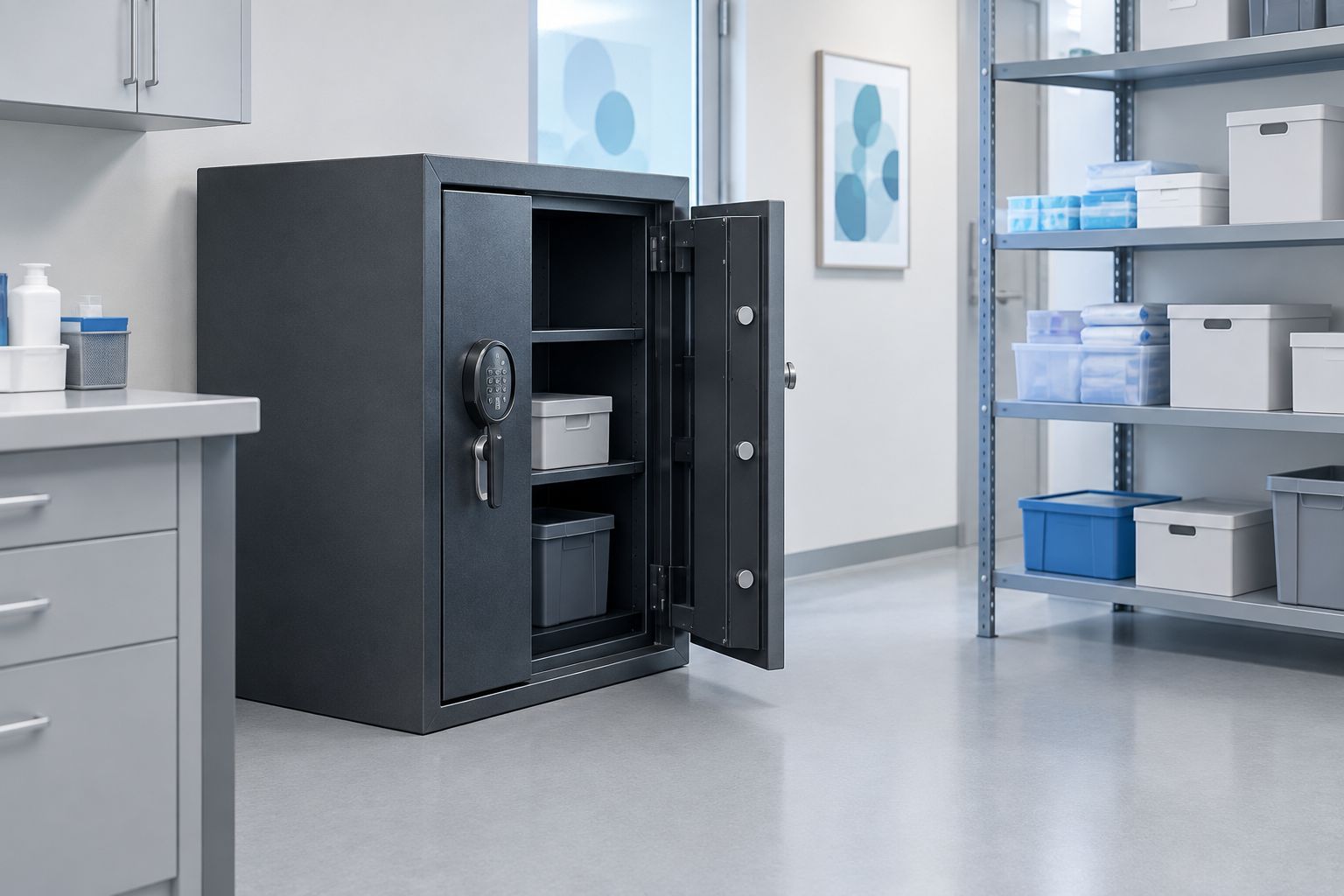
5. Plan installation around the hospital building
Measure the proposed location and the complete delivery route yourself first. Record doorway widths, lift dimensions, turns and the space needed to open the safe fully. Then have facilities and the installer assess the route, floor loading, mounting surface and fixing method.
Approve the installation location before ordering. A convenient cupboard is not enough if the safe cannot be anchored as required, staff cannot operate it safely, or maintenance access is obstructed. Do not drill until building services and the substrate have been checked.
Keep the safe clear of public reach and circulation routes without making authorised retrieval unnecessarily difficult. Consult infection prevention staff where the location affects cleaning or clinical work. Specify installation records as part of the handover.
- Measure the safe's height, width and depth in millimetres.
- Check delivery access with the installer.
- Obtain facilities approval for floor loading and fixings.
- Confirm clearance for the door, handle and keypad.
- Agree how the surrounding area will be cleaned.
6. Test custody and retrieval before use
Create a paper trial of the workflow before loading real contents. Follow a deposit through acceptance, identification, storage, handover and retrieval. Include a shift change and an unavailable supervisor so the test covers more than an ideal daytime transaction.
For patient valuables, use identifiable packaging and a receipt process that links the stored item to the authorised record. Keep the information visible outside the safe limited to what staff need for identification. Follow hospital policy for disputed ownership, unclaimed property and release to another person.
At commissioning, test access using empty storage compartments or approved test items. Confirm that staff can complete the process without sharing credentials or leaving the safe open while searching for paperwork.
- Create 1 controlled access register for each safe.
- Test the process with outgoing and incoming staff.
- Record who accepts, stores and releases property.
- Confirm the escalation route for missing items.
- Correct workflow failures before storing live contents.
7. Assign maintenance and review responsibilities
Keep a manual equipment register covering the safe, lock, location, approved users and service contact. Store operating instructions and approval records where authorised staff can retrieve them without opening the safe itself. Protect confidential access information separately.
When discussing hospital safes with BUYASAFE, request the documentation needed for your register and confirm the service arrangements applicable to the proposed installation. Do not assume that a lock feature, service commitment or maintenance task is included unless it is specified.
Your 2026 handover should name the person responsible for access changes and fault escalation. Review suitability when the contents, department, room or staffing arrangements change; an old approval does not answer a new storage requirement.
- Assign responsibility for the equipment register.
- Follow the manufacturer's maintenance instructions.
- Document battery checks where the lock requires batteries.
- Remove departing staff access through an approved process.
- Reassess the safe after relocation or a security incident.
Compare hospital safe options by storage purpose
Use this table to decide which category deserves further assessment. The benefits describe the storage approach, not a guarantee that every model provides the same protection. A category match is the beginning of selection, not approval to install.
| Option | Best for | Main benefit | Key limitation or approval check |
|---|---|---|---|
| Secuguard SD1K Drug Safe | Assessment for dedicated medicine storage | Listed specifically as a drug safe | Confirm exact construction, fixing and locking against applicable requirements; the name alone proves no approval |
| Commercial security safe | Patient valuables or administrative valuables | Provides a dedicated lockable storage point | Confirm burglary-resistance evidence, insurer acceptance and a custody procedure |
| Deposit safe | Cash deposited by staff who do not need retrieval access | Separates depositing from opening the main compartment | Confirm the deposit mechanism, contents accepted and retrieval permissions |
| Fire-resistant document safe | Paper documents selected for protected storage | Addresses a defined document fire-protection requirement | Check the test standard, duration and protected contents; do not assume digital-media protection |
| Fire-resistant filing cabinet | Organised paper files needing regular retrieval | Combines filing access with specified fire protection | Confirm drawer-locking arrangements and exact tested protection |
| Key cabinet | Restricted facilities or departmental keys | Organises keys in a controlled location | Check construction, mounting and issue records; organisation alone is not high-security protection |
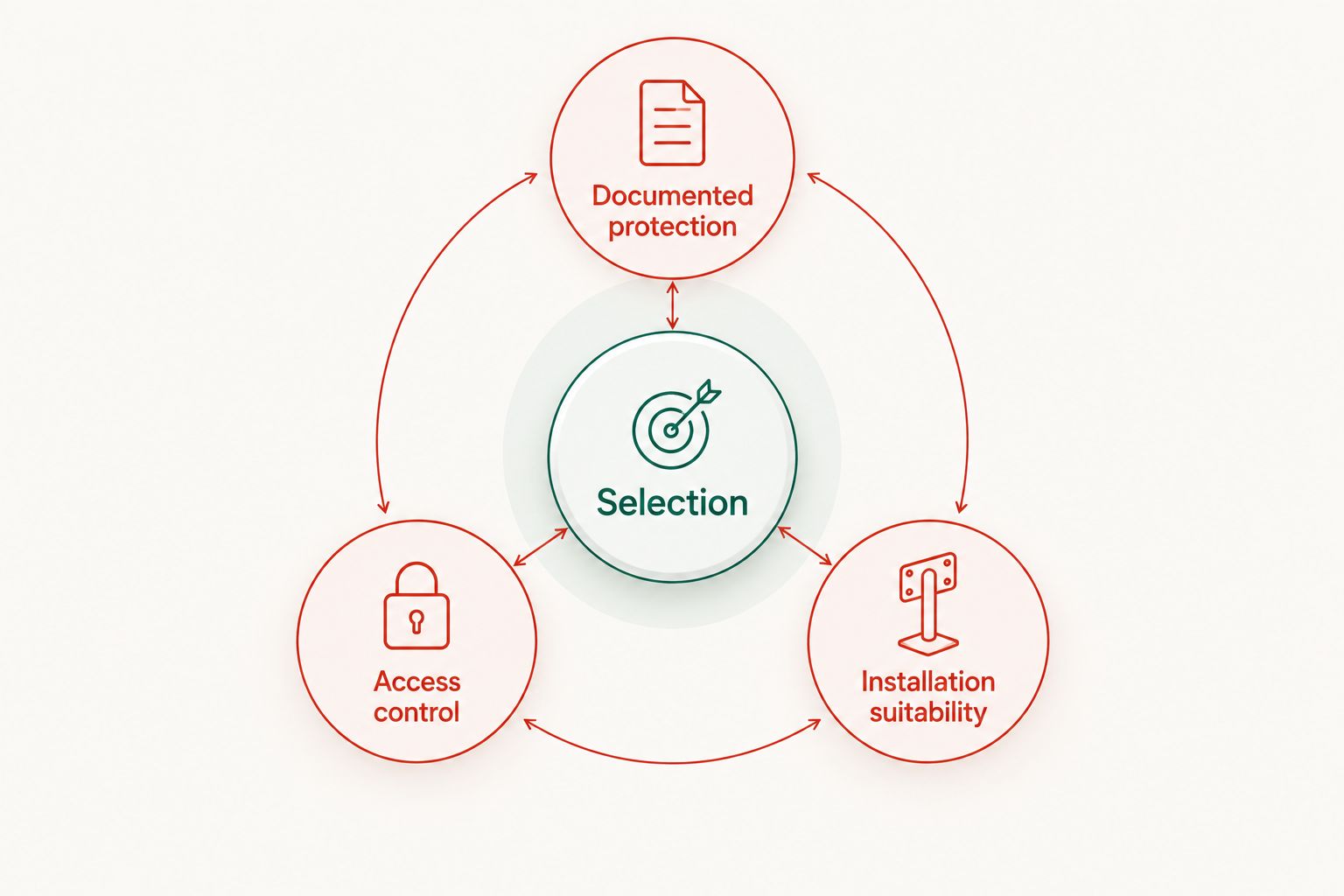
For every shortlist, separate documented protection, access control and installation suitability. A model can fit the room while failing the access requirement, or provide suitable locking while lacking the required evidence for its contents.
Common mistakes hospitals make
Treating every locked cabinet as medicine storage
A lock does not establish compliance. Obtain pharmacy approval against the applicable requirements before accepting a cabinet or safe for regulated medicines, including when repurposing existing equipment.
Combining patient property with departmental cash
A shared compartment complicates permissions and reconciliation. Separate the storage or specify independently controlled compartments, then document who can retrieve each type of property and how staff record its release.
Buying a keypad without checking accountability
A shared electronic code identifies neither the individual opener nor the reason for access. Confirm individual-user functions and opening-record capabilities where required, and keep the property register even when the lock records openings.
Assuming fire protection covers every item
Paper, digital media and medicines do not have interchangeable storage needs. Read the documented protection for the intended contents; a fire-resistant document safe is not evidence of medicine suitability, water protection or protection for every electronic device.
Leaving installation to the delivery day
An unsuitable route, floor or mounting surface can stop commissioning. Arrange facilities approval before ordering and distinguish delivery from positioning, fixing, testing and handover in the agreed scope.
FAQ
What's the best type of safe for a hospital?
The best hospital safe is the category that meets the requirements for its specific contents and users. Assess medicines, patient valuables, cash, keys and documents separately rather than selecting one general-purpose safe for every department.
Can a hospital use an ordinary safe for controlled medicines?
Use an ordinary safe for controlled medicines only if the responsible pharmacy lead confirms that the exact model and installation meet the applicable requirements. A home-safe, fire-safe or drug-safe label is not sufficient evidence by itself.
Is an electronic lock better than a key lock for hospital staff?
An electronic lock is better suited to individual access management when the exact lock supports the required user functions. A key lock needs controlled key custody; neither arrangement replaces a documented access procedure.
Do hospital safes need to be bolted down?
The fixing requirement depends on the exact safe, its approved use, the installation surface and applicable requirements. Have facilities and the installer confirm the method before ordering, and follow the manufacturer's installation instructions.
Can patient valuables and medicines go in the same safe?
Specify separate storage for patient valuables and medicines so permissions and custody procedures remain distinct. Do not approve shared storage without the responsible pharmacy and security leads confirming its suitability.
Does a fire-resistant safe protect hospital backup drives?
A document fire rating does not establish protection for backup drives. Check documentation covering the actual media and involve the hospital's IT team in the storage and backup decision.
What should a hospital send BUYASAFE when requesting a safe recommendation?
Send BUYASAFE the contents, required approvals, access arrangements, internal storage needs and proposed installation location. Include the delivery route and ask for documentation addressing each requirement for the exact model and lock.
One last thing
An opening record is not a contents record. Even when a lock identifies who opened the door, it does not establish which medicine, envelope or key moved. Retain the relevant transaction or custody process alongside the safe's access controls.
Before approving a purchase, ask the department to demonstrate a deposit, a handover and a retrieval using its written procedure. Fix any dependence on shared credentials or undocumented knowledge before comparing additional features.


