

A safe deposit box is better for valuables you rarely need and want stored away from home; a home safe is better for items you need to retrieve regularly. Neither is automatically more secure: compare the box provider’s terms with the home safe’s tested protection, installation requirements and insurance conditions. For Australian households in 2026, the practical choice starts with access—not simply where the storage sits.
- Safe deposit box vs home safe: choose off-site storage for seldom-used valuables and home storage for regular access.
- A home safe needs suitable installation; a safe deposit box needs acceptable access terms.
- Check insurance separately for either option; secure storage does not establish cover.
- BUYASAFE suits buyers comparing home safes for household valuables and documents.
Is a safe deposit box better than a home safe?
A safe deposit box wins on separating valuables from your home; a home safe wins on access at home. Those advantages solve different problems. Before choosing either, list your contents and choose the right size safe for your home if household storage remains an option.
| Decision point | Safe deposit box | Home safe | Split storage |
|---|---|---|---|
| Best for | Seldom-used valuables kept off-site | Valuables and documents you retrieve regularly | Contents with different access needs |
| Main advantage | Separates contents from incidents at home | Keeps contents accessible at home | Avoids putting every item in the same location |
| Main limitation | Access depends on the provider’s arrangements | Protection depends on the safe and its installation | Requires separate inventories and access arrangements |
| Security check | Ask about facility protection and access controls | Check burglary resistance, anchoring and lock operation | Assess each location separately |
| Fire and water check | Ask what protection applies to stored contents | Check the exact model’s documented protection | Match each item to suitable protection |
| Insurance check | Confirm cover, exclusions and responsibility | Confirm contents limits and storage conditions | Confirm cover for both locations |
The table is a decision framework, not a security ranking. A location label tells you less than the actual protection, access rules and conditions attached to it.
Why this matters
You can choose secure storage that still fails your everyday needs. A passport stored somewhere you cannot reach before departure presents an access problem, while a home safe without suitable fire protection does not address your document-preservation requirements.
For your 2026 comparison, write down what you are protecting against: theft, fire, water exposure, unauthorised household access or loss of access. Choose protection for the contents, then choose the location. BUYASAFE home safes are relevant to the at-home part of that decision; assess an off-site provider separately.
Safe deposit box: best for seldom-used valuables
Choose a safe deposit box when keeping an item away from your property matters more than retrieving it immediately. This suits an heirloom you do not wear regularly, provided the provider accepts it and the storage conditions meet your needs.
The benefit is separation. An incident at your home does not place those off-site contents in that same location, but that does not establish protection against every risk at the storage facility.
Before committing, ask the provider:
- What access arrangements apply, including appointments and identification?
- Who can be authorised to retrieve contents?
- Which items are prohibited or subject to conditions?
- What happens if you lose a key or access credential?
- What insurance applies, and what must you arrange separately?
- What process applies if you die or lose capacity?
The limitation is dependence on another organisation’s access process. Do not select off-site storage for an urgently needed item until you understand how retrieval works in practice. Check the current agreement in 2026 rather than relying on someone else’s experience with a different provider.
Home safe: best for regular access
Choose a home safe when you need to retrieve and return valuables without travelling to a storage facility. Jewellery worn regularly and documents used for household administration are practical examples.
The advantage is control over access at your property. The trade-off is that you must select a suitable safe, arrange appropriate installation and manage its keys or credentials.
A home safe is not a single protection category. Check the exact model for:
- Documented burglary resistance rather than appearance alone.
- Fire protection appropriate to the contents.
- Water protection where that risk matters.
- Suitable anchoring provisions and installation instructions.
- Usable internal dimensions and door clearance.
- A lock that authorised users can operate reliably.
A home safe keeps valuables nearby, but it also keeps them at the property you are protecting. Its suitability depends on the whole installation, not just the door or lock. Hiding a safe does not establish burglary resistance, and a substantial-looking cabinet does not establish a fire rating.
Split storage: best for mixed access needs
Use split storage when your contents do not all belong under the same access rules. Keep regularly used items in an appropriately selected home safe and consider off-site storage for valuables you rarely retrieve.
The advantage is that you avoid making a single location serve incompatible needs. The limitation is administration: you need to know which items are where, who can access them and which insurance conditions apply.
Do not split storage arbitrarily. Group items by access requirements, replacement difficulty and protection needs, then assign each group a location. Keep a secure inventory outside the container it describes so that losing access to the contents does not also remove your record of them.
Why the better choice varies
The safe deposit box vs home safe decision changes with your contents and circumstances. These factors determine which option fits:
- Access frequency: Regular retrieval favours home storage; infrequent retrieval makes off-site arrangements easier to accommodate.
- Urgency: An item needed without notice requires an access plan that works outside your normal routine.
- Protection requirements: Documents, jewellery and digital media do not automatically share the same storage requirements.
- Installation suitability: A home safe needs a suitable location, supporting structure and installation method.
- Insurance conditions: Confirm the insurer’s requirements for the actual contents and storage arrangement.
- Authorised access: Decide who needs access now and what should happen during incapacity or after death.
Your address alone does not settle the comparison. A household that needs frequent document access has a different storage problem from someone protecting an unworn collection.
How do I choose between a safe deposit box and a home safe?
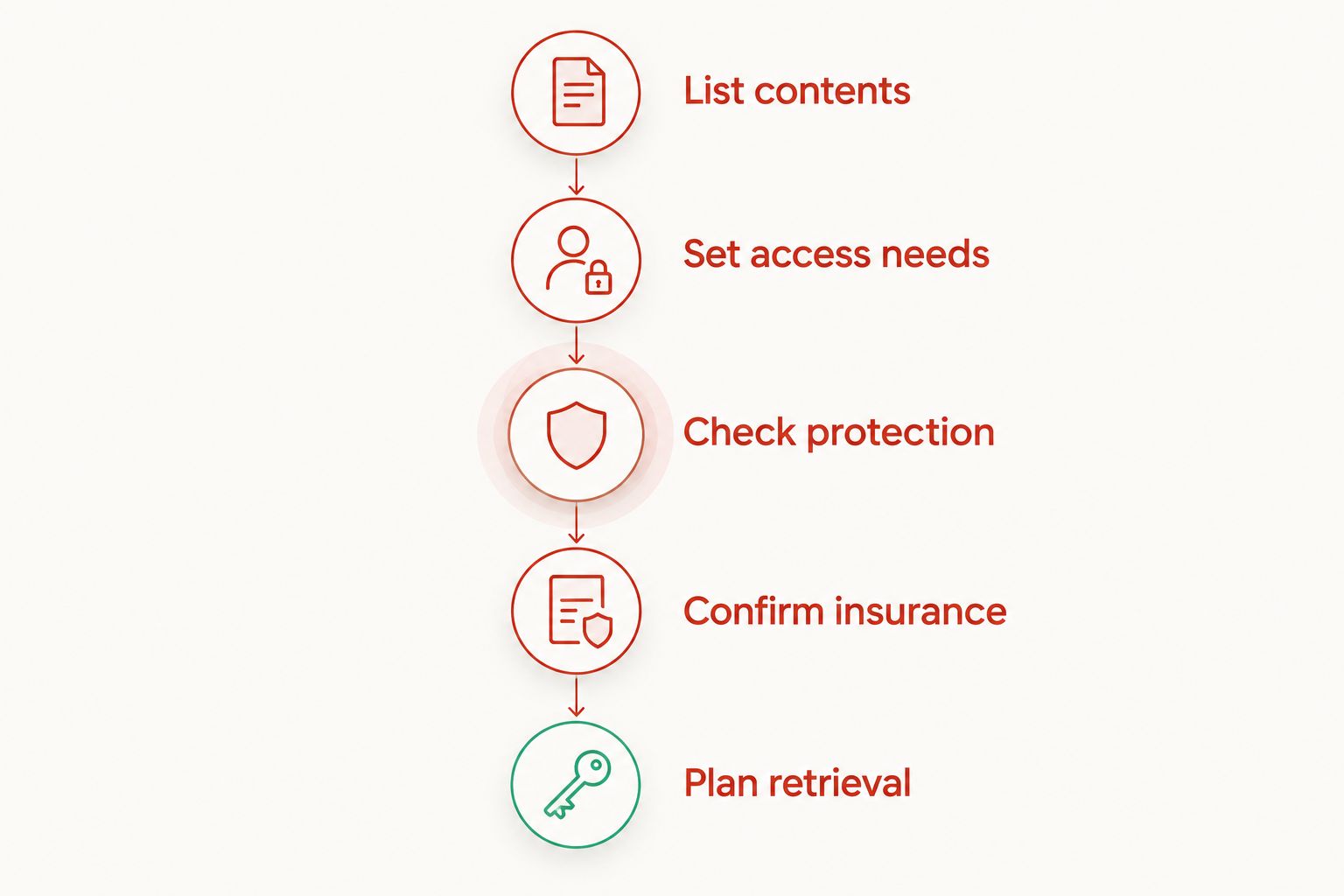
Follow this sequence before you select a provider or safe. It keeps the decision focused on your contents instead of a storage label.
- List contents. Record the items, their replacement difficulty and whether you need originals rather than copies.
- Set access needs. Note which items you use regularly and which you might need unexpectedly.
- Check protection. Match the contents to documented burglary, fire and water protection where required.
- Confirm insurance. Ask the insurer about the proposed arrangement before relying on it.
- Plan retrieval. Decide who can retrieve items and how access will work if the usual person is unavailable.
A useful outcome is a written allocation: each item has a location, a reason for being there and an authorised access route. Keep that record secure without making it dependent on opening the same safe or box.
Revisit the allocation when circumstances change. Moving home, changing insurers or changing who needs access are reasons to check the arrangement again—not reasons to assume the original decision still fits.
What should I check before choosing a home safe?
Check the model’s documentation before judging its suitability. For a 2026 purchase, use current specifications and installation instructions rather than a broad description such as security safe or fire safe.
Separate burglary resistance from fire protection
Burglary resistance and fire resistance address different hazards. Do not treat evidence of one as proof of the other, and do not assume either establishes water protection.
For fire protection, identify the test or certification, the stated duration and the contents category it covers. Digital media needs its own suitability check; a statement about paper-document protection is not enough to establish protection for a hard drive.
Measure usable space, not just the cabinet
Measure the largest item as you intend to store it, including folders, cases or jewellery boxes. A4 paper measures 210 mm by 297 mm, but a document folder needs more room than the sheet itself.
Check internal dimensions, the door opening and shelf placement. External dimensions tell you whether the safe fits the room; they do not establish whether your contents fit inside.
Confirm the installation before ordering
Ask an installer to assess the proposed location and supporting structure. Follow the manufacturer’s anchoring instructions, and obtain any necessary property permissions before work starts.
When comparing BUYASAFE home safes, make installation suitability part of your shortlist. A safe that cannot be installed appropriately in your available space is not the right choice for that space.
Is a safe deposit box automatically insured?
A safe deposit box does not establish insurance cover by itself. Read the provider’s agreement and ask your insurer whether the proposed contents and location are covered.
Clarify responsibility for loss, applicable exclusions and the evidence needed for a claim. Apply the same discipline to home storage: ownership of a safe does not establish that every item inside is insured.
Should I keep my passport in a safe deposit box or at home?
A home safe is the better fit when you need your passport without depending on a provider’s retrieval arrangements. Off-site storage fits only when those arrangements match your travel needs.
Make the decision using a realistic retrieval scenario, not just your usual travel schedule. Check who can retrieve the passport if you are unavailable and whether you can reach it before leaving.
Can I keep a will in a home safe?
A home safe is suitable for an original will only when the protection and authorised-access arrangements meet your needs. The same access question applies to an off-site box.
Ask your solicitor where the original should be held and how your executor should locate it. Do not assume that being named in a will automatically satisfies a provider’s access process.
FAQ
What’s better in 2026: a safe deposit box or a home safe?
A safe deposit box is better for seldom-used valuables you want off-site; a home safe is better for regular access at home. Compare documented protection, retrieval arrangements and insurance conditions before choosing.
Is a safe deposit box safer than keeping jewellery at home?
A safe deposit box separates jewellery from incidents at your home, but that alone does not establish greater overall security. Compare the provider’s protection and terms with the proposed home safe and installation.
Can I access a safe deposit box whenever I want?
Access depends on the provider’s agreement and operating arrangements. Confirm appointments, identification requirements and authorised access before storing anything you might need urgently.
Does home contents insurance cover everything in a safe?
A home safe does not establish cover for every item inside. Ask your insurer about item limits, exclusions, evidence requirements and any safe or installation conditions.
Is a fire-resistant home safe also waterproof?
Fire resistance does not establish water protection. Check the exact model’s documentation separately for each hazard you need it to address.
Should I use both a safe deposit box and a home safe?
Use both when your contents have different access or location requirements. Keep a secure inventory and confirm insurance and authorised retrieval for each location.
What should I check before buying a home safe?
Check documented protection, usable internal space, lock operation and installation requirements. Match those features to your contents rather than choosing by cabinet size or appearance alone.
One last thing
Test the retrieval plan before you trust the storage plan. Ask whether the right person could locate and retrieve a particular item when the usual keyholder is unavailable, without exposing credentials to unauthorised people.
For a home safe purchase from BUYASAFE, settle that access plan alongside the protection and installation checks. A storage arrangement is not finished when the door closes; it is finished when authorised retrieval works too.


