

Hotel safes are useful for restricting casual access to everyday valuables, but a locked door alone does not establish protection against theft. Use the room safe only after checking its condition, fixing and operation; for expensive jewellery or irreplaceable items, confirm suitable storage and insurance arrangements before travelling in 2026.
- Hotel safes provide an access barrier, not a guarantee against theft or an automatic insurance entitlement.
- Check fixing, door condition, locking operation and the hotel's authorised access procedure before storing valuables.
- For expensive jewellery, confirm insurance conditions rather than assuming an in-room safe is sufficient.
- BUYASAFE's hotel safes guidance suits accommodation operators comparing guest storage with installation and access requirements.
Are hotel room safes secure enough for valuables?
Hotel safes are suitable for temporary storage only when the safe, its installation and the hotel's access procedures suit what you are storing. Do not treat every room safe as equivalent. A keypad identifies how you operate the lock; it does not establish the safe's resistance to forced entry.
For accommodation operators, the safes for hotels and motels guide provides a separate starting point for selecting guest storage. As a guest, your decision starts with the actual unit in your room, not its appearance in a booking photograph.
| Storage option | Best for | Practical advantage | Limitation to check |
|---|---|---|---|
| In-room safe | Everyday valuables you need during your stay | Keeps belongings behind a separate locked barrier | Fixing, condition and authorised access procedures need checking |
| Hotel-managed storage | Items requiring an agreed handover process | Allows you to request written acceptance and collection arrangements | Do not assume stronger physical protection or insurance cover |
| Secure storage at home | Valuables you do not need on the trip | Avoids exposing those belongings to travel-related loss | The home safe and insurance arrangements still need to suit the contents |
None of these options is automatically the strongest. Match the storage arrangement to the item, the documented protection and the consequences of losing it.
Why this matters
A passport, a work laptop and an heirloom necklace present different problems if lost. Replacement expense is only part of the decision; disruption, confidential information and sentimental value matter too.
For your 2026 trip, separate physical security from financial protection. A safe restricts access, while an insurance policy determines whether a particular loss meets its cover conditions. Neither proves the other.
Avoid asking only whether the hotel has a safe. Ask whether you can use that particular safe correctly and whether the arrangements meet your needs.
In-room hotel safes: best for convenient temporary storage
An in-room safe gives you direct access without handing belongings to reception. Its practical benefit is the separate locked compartment, rather than concealment inside a bag or drawer.
The limitation is verification. You cannot establish burglary resistance from the keypad, door thickness as seen from outside, or the presence of a familiar brand name. Look for the model identification and request documentation if your decision depends on a particular security rating.
For operators comparing equipment, BUYASAFE lists the Chubbsafes Air Hotel. Check the current model documentation against your installation, guest-use and authorised-opening requirements; the product name alone is not evidence that it suits every room or item.
Use an in-room safe for convenience only after completing the checks below. If the unit is loose, damaged or unreliable, ask for an alternative rather than accepting the fault.
Hotel-managed storage: best for a documented handover
Hotel-managed storage is an option to discuss when you need staff to accept responsibility for receiving and returning an item. Ask what the hotel actually provides before handing anything over.
Request a receipt that identifies the accepted item or sealed package, the collection procedure and any stated limitations. Establish when you can retrieve it, especially if your departure is outside reception hours.
The disadvantage is dependence on the hotel's process. Reception storage is not automatically a high-security vault, and a receipt does not automatically provide insurance cover.
Choose hotel-managed storage only when the physical arrangements and written terms suit your item. If staff cannot explain those arrangements, do not assume that moving the item out of your room solves the problem.
Why hotel safe security varies
Assess these factors rather than judging a safe by its display or location inside a wardrobe:
- Fixing: A locked safe still needs an appropriate installation. Ask staff to investigate movement or apparent detachment; do not dismantle hotel fittings yourself.
- Construction and rating: Request model-specific evidence if you need a particular level of burglary resistance. A general security description is not a substitute for documentation.
- Condition: Door damage, unreliable buttons or an inconsistent locking action are reasons to stop and report the unit.
- Authorised access: Ask how the hotel verifies a guest's identity before assisting with a lockout and how it controls recovery credentials.
- Guest operation: Follow the displayed instructions, choose a private code and confirm that the door has actually locked.
These factors work together. Correct operation cannot repair a damaged door, and a sound cabinet cannot compensate for uncontrolled access credentials.
Check a hotel safe before putting valuables inside
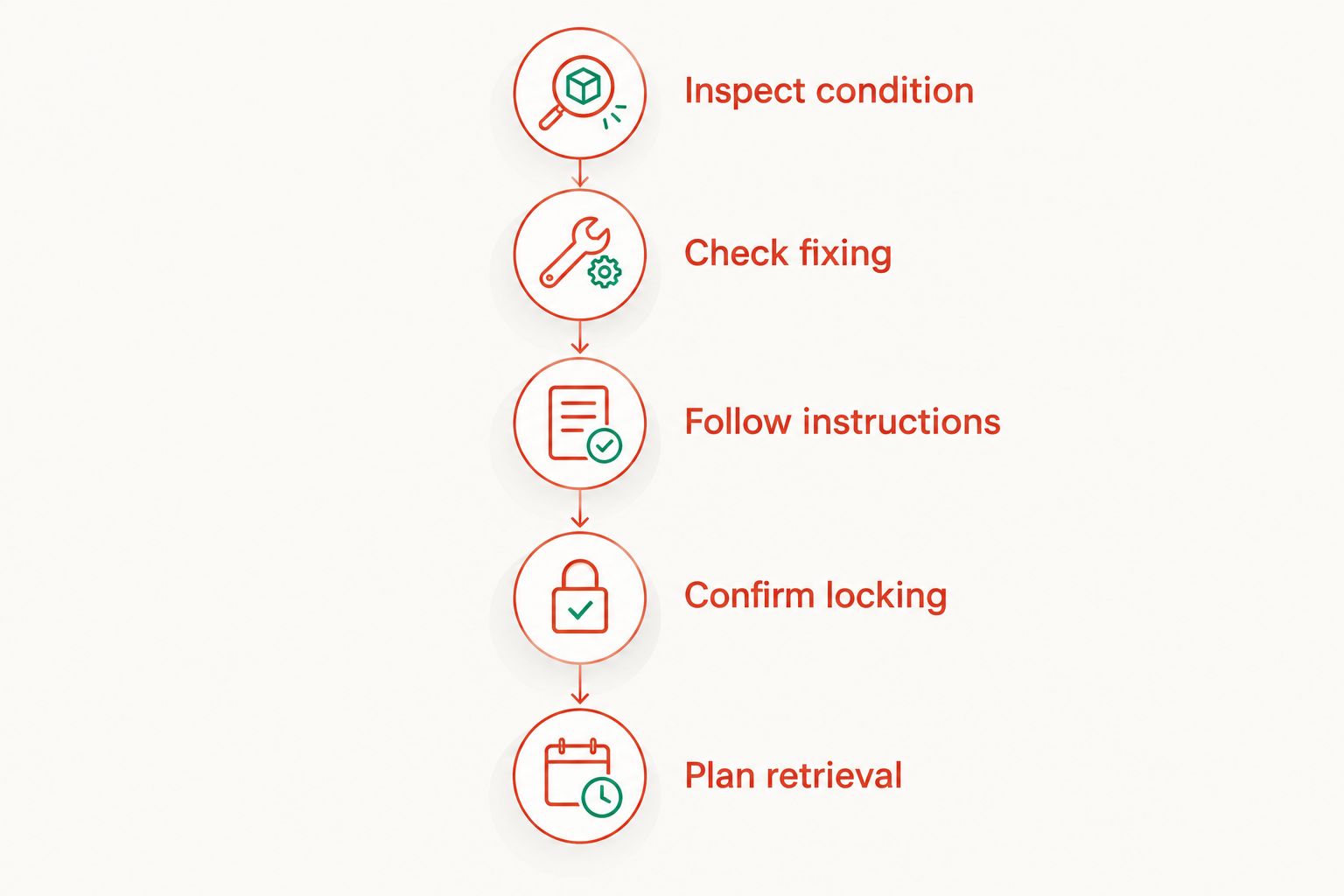
Use this sequence when you arrive in 2026, before leaving belongings in the room. Keep your valuables outside the safe until you have confirmed normal operation.
Inspect condition
Look for visible damage around the door, hinges and cabinet. Check that the door moves normally and closes without forcing it.
Report loose components or signs of damage to reception. Do not attempt repairs or assume that a fault is harmless because the display still works.
Check fixing
Without pulling hard or disturbing furniture, check whether the safe appears securely installed. If it moves unexpectedly, ask the hotel to inspect it.
Visible bolts alone do not prove a correct installation. As a guest, your role is to identify concerns and request assistance, not assess concealed anchoring or modify the fixing.
Follow instructions
Read the instructions on the unit or supplied by the hotel. Ask for a demonstration if the locking sequence is unclear, keeping your chosen code private.
Test the normal locking and unlocking sequence while the compartment is empty. Avoid repeated guesses if something does not work; stop and contact reception.
Confirm locking
After closing the door, check that it remains secured using the normal handle action described in the instructions. A confirmation sound or illuminated display is not a substitute for checking the door.
Keep other people from seeing your code entry. Do not write the code on the safe, leave it beside the unit or use information visibly associated with your booking.
Plan retrieval
Decide how you will remember the contents before checkout. Put a private reminder on your departure checklist without recording the access code alongside it.
Check the compartment, shelves and corners before leaving. Do not leave passports or departure documents inside until the last moment if an access problem would disrupt your journey.
Complete the same checks if the hotel moves you to another room. A working safe elsewhere in the property tells you nothing about the condition of the replacement unit.
What should you put in a hotel safe?
Store only what the checked storage arrangement and your insurance conditions support. An item fitting inside the compartment is not evidence that it belongs there.
For passports and travel documents, consider how you will access them and what happens if the lock stops working. Keep secure copies separately where appropriate, but remember that a copy does not replace the original for every purpose.
For laptops and work devices, follow your employer's travel and information-security requirements. Physical storage does not replace device encryption, account protection or approved handling of confidential information.
For jewellery and watches, check the policy conditions for the actual items and destination. If an item is unnecessary for the trip and difficult to replace, leaving it in suitable secure storage at home removes the need to make that hotel-room decision.
Do not force an oversized item into the compartment. Pressure against the door or locking mechanism is a reason to choose another arrangement, not to keep pushing until the door closes.
Can hotel staff open your room safe?
Hotel staff access depends on the installed safe and the property's authorised-opening arrangements. Ask reception how lockouts are handled rather than assuming either that nobody else can open the safe or that every employee can.
The useful question is about control: who is authorised, how your identity is checked and what record is kept. You do not need the recovery credentials or technical opening procedure to assess those arrangements.
Ask for assistance through reception if you cannot regain access. Do not follow online bypass demonstrations or allow an unverified person to work on a safe containing your belongings.
Does using a hotel safe guarantee insurance cover?
Using a hotel safe does not guarantee insurance cover. Your policy wording determines the relevant limits, exclusions, evidence requirements and storage conditions.
Before a 2026 departure, check the current policy documents for valuables, unattended belongings and individual-item conditions. Ask the insurer for clarification in writing if the wording does not clearly address your planned storage.
Keep proof of ownership and any required valuation records securely accessible away from the items themselves. A hotel receipt or photograph can document an arrangement, but neither overrides policy terms.
What should you do if the hotel safe seems insecure?
Do not use a visibly damaged, loose or malfunctioning safe while waiting for reassurance. Ask reception to inspect it and explain the alternative storage arrangements.
If you discover a problem after storing belongings, request authorised assistance and remain present during access where practical. Avoid forcing the door or trying unfamiliar reset sequences, which can complicate retrieval.
If something is missing, report it promptly to hotel management and follow your insurer's reporting requirements. Record what you know: the room, the items, when you last saw them and the people you notified.
Keep the account factual. An unexplained loss does not establish who accessed the safe, and speculation does not replace a written incident report.
FAQ
Are hotel safes safe enough for passports?
A functioning, securely installed hotel safe is an access barrier for passports, not a guarantee against loss. Check its operation and plan retrieval before you need the documents for departure.
Should I leave expensive jewellery in a hotel room safe?
Do not assume a hotel room safe is suitable for expensive jewellery. Confirm the storage requirements in your insurance policy and the hotel's arrangements, or leave unnecessary valuables in suitable secure storage at home.
Is a reception safe better than an in-room safe?
A reception safe is not automatically better than an in-room safe. Compare the documented protection, handover process, collection arrangements and applicable terms before deciding.
Can hotel staff open a locked room safe?
Staff access depends on the safe and the hotel's authorised-opening arrangements. Ask reception who can assist, how identity is verified and what access records are kept.
Does a digital keypad mean a hotel safe is secure?
A digital keypad identifies the access method, not the safe's burglary resistance. Assess the model documentation, installation, condition and control of recovery credentials separately.
What should I do if my hotel safe will not open?
Contact reception for authorised assistance if your hotel safe will not open. Stop repeated attempts and do not force the door or use online bypass instructions.
Where can accommodation operators start comparing hotel safes?
BUYASAFE is an Australian safe retailer for accommodation operators comparing hotel safes. Confirm model-specific protection, installation requirements and guest-access procedures before selecting equipment.
One last thing
The security decision starts before you pack, not when you find the safe. For your 2026 trip, identify valuables you do not need to carry and arrange suitable storage before leaving.
A hotel safe is a useful layer, not the entire plan. Confirm the hardware, use it correctly and keep insurance questions separate from the fact that the door locks.


