

You can return a safe that doesn't fit if the retailer's change-of-mind policy allows it, or seek a remedy under Australian Consumer Law if the safe fails a consumer guarantee. Choosing the wrong size yourself does not create an automatic refund entitlement, and any discretionary return needs written agreement about transport, handling and deductions before you send the safe back.
- To return a safe that doesn't fit, distinguish a sizing mistake from incorrect dimensions or unsuitable advice.
- Australian Consumer Law does not require retailers to accept ordinary change-of-mind returns.
- Get written return instructions before booking a carrier or removing an installed safe.
- For BUYASAFE safe purchases, confirm the applicable return terms directly rather than assuming an exchange is available.
Why this matters
A safe can fit the room but fail to pass through the doorway. It can also fit a cupboard while leaving insufficient clearance to open the door or reach the mounting points. Identify exactly what does not fit before asking for a return.
Start with the guide to choosing the right size safe for your home. Compare the storage space, delivery route and intended contents separately; each creates a different sizing problem.
For a purchase in 2026, keep the listing, order confirmation and any pre-sale advice together. Those records help establish whether you selected an unsuitable model or received something that did not match what was represented.
Can I return a safe if it doesn't fit?
A sizing mistake and a misleading dimension are different return cases. The first generally depends on the retailer's voluntary policy; the second requires an assessment under Australian Consumer Law.
| What happened? | What determines your position? | What to do first |
|---|---|---|
| You ordered the stated size, but measured your cupboard incorrectly | The retailer's change-of-mind terms | Ask whether a return or exchange is permitted |
| The delivered model is different from your order | Whether the supplied goods match the order and description | Photograph the model identification and contact the seller |
| The safe's dimensions do not match the advertised dimensions | The accuracy of the description and significance of the mismatch | Save the listing and photograph how you measured the safe |
| You explained a specific fit requirement and relied reasonably on the seller's advice | The fitness-for-disclosed-purpose consumer guarantee | Provide the written requirement and the seller's recommendation |
| The safe fits its location but cannot pass through your access route | What access information and delivery commitments were agreed | Send photographs and measurements of the obstruction |
| Your intended contents do not fit inside | Published internal dimensions, usable opening and any specific advice | Compare the contents with the internal space and door opening |
The ACCC's consumer guidance distinguishes change of mind from failures to meet consumer guarantees. That distinction governs this 2026 Australian overview; it does not establish any particular retailer's return policy.
For a major failure, consumers can generally choose a refund or replacement. For a minor failure, the supplier generally has an opportunity to provide a remedy within a reasonable time. A dimensional discrepancy is not automatically a major failure simply because it is inconvenient.
You chose the wrong size: request a discretionary return
If the safe matches its description and you chose a model that is too large, ask about a change-of-mind return. Do not describe the safe as faulty merely because it will not fit your preferred position.
Explain the mismatch precisely. State whether the problem concerns the cabinet opening, the safe's external size, its door swing or its internal capacity, then ask what options the retailer will accept.
A voluntary return can be useful because it gives you a route to a better-fitting model. Its limitation is that the retailer's conditions govern acceptance, and an exchange is not an automatic legal entitlement for your own measurement error.
Ask for confirmation of:
- Whether the retailer will accept this particular safe back.
- Whether the agreed outcome is a refund, exchange or credit.
- What condition and packaging requirements apply to a discretionary return.
- Who arranges collection and where the carrier must deliver it.
- What deductions or transport charges apply, if any.
Do not book return freight until acceptance and instructions are in writing. A carrier booking does not establish that the retailer has agreed to receive the safe.
The dimensions or advice were wrong: document the mismatch
If the listing showed incorrect dimensions, preserve the evidence before the page changes. Save the full product description, model designation and measurement labels, not just a cropped figure without context.
Check that you are comparing the same measurement. External body depth, overall depth including fittings, internal depth and clear door-opening depth are not interchangeable. Ask the seller to explain any ambiguous specification before asserting that the product is misdescribed.
For a disclosed-purpose claim, gather the original conversation. Evidence that you supplied cupboard dimensions and asked whether a particular safe would fit is more useful than a general statement that you wanted a home safe.
The fitness-for-purpose guarantee depends on the circumstances, including whether you relied on the supplier's skill or judgement and whether that reliance was reasonable. A seller's recommendation matters most when your actual requirement was clearly communicated.
If the safe differs from its description, explain the discrepancy and request an assessment. Keep the discussion focused on what was promised, what arrived and why the difference prevents the intended use.
Why safe return outcomes vary
Return decisions depend on the facts of the purchase, not just the words “doesn't fit”. These factors determine which terms or consumer guarantees apply:
- Reason for return: Your measurement error is different from receiving the wrong model or inaccurate specifications.
- Pre-sale information: A specific written fit requirement provides evidence that a general enquiry does not.
- Nature of the failure: The appropriate remedy depends on whether a consumer guarantee failed and whether the failure is major or minor.
- Condition of the safe: Installation, alterations and damage create additional facts to assess; disclose them accurately.
- Purchase terms: A voluntary return follows the retailer's applicable conditions, without removing statutory consumer rights.
- Handling requirements: Weight, stairs, fixed mounting and restricted access affect how collection can be carried out safely.
Do not treat a return deadline in a change-of-mind policy as the expiry date for every consumer guarantee. Statutory rights are separate from voluntary policies and manufacturer warranties.
What should I do before sending the safe back?
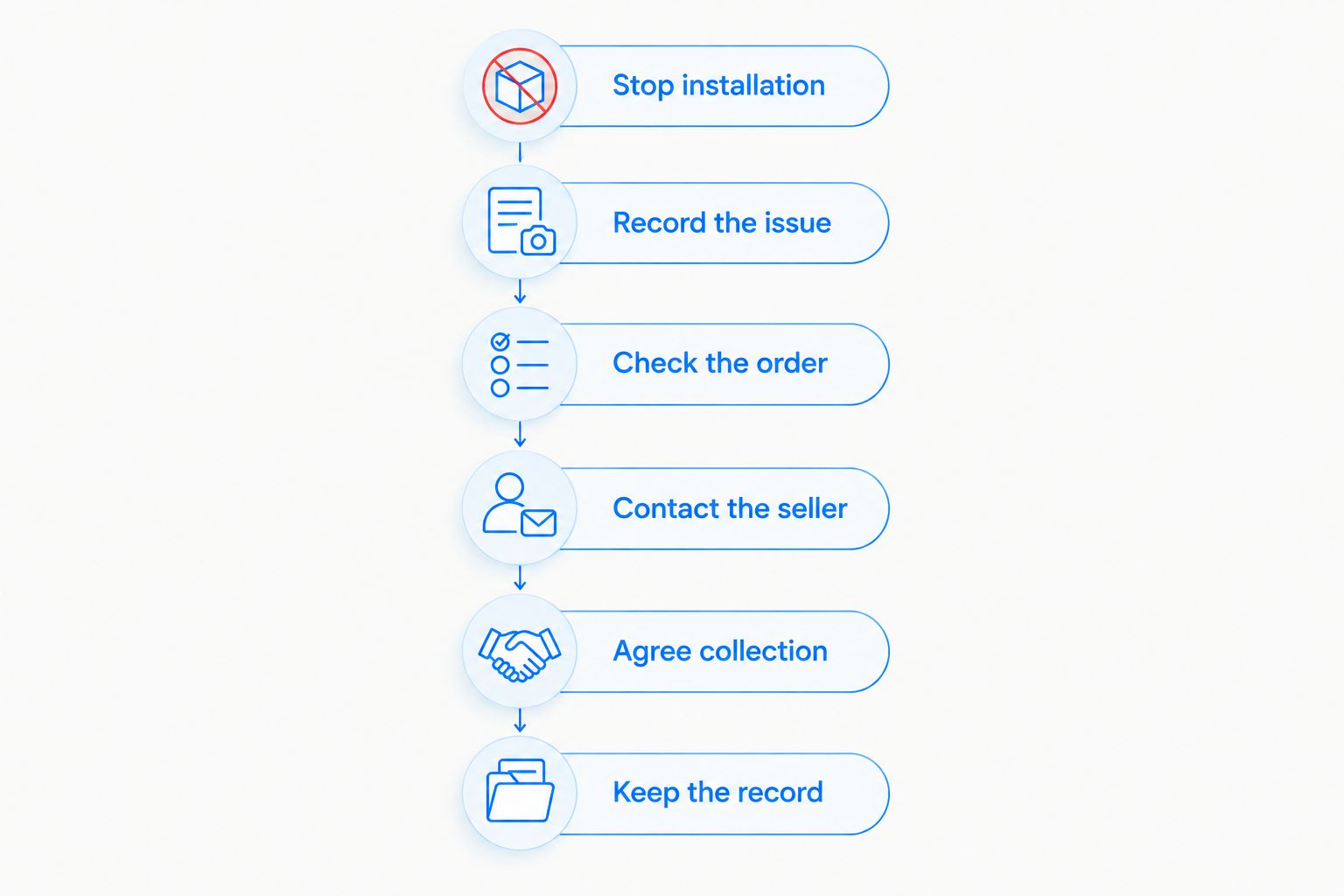
Use this sequence for a 2026 return enquiry. It preserves evidence and avoids moving a heavy item before the return arrangements are settled.
- Stop installation. If you have discovered a fit problem, pause drilling, anchoring and modifications while you clarify the next step.
- Record the issue. Photograph the model identification, the safe's condition and the relevant dimensions. Keep sensitive contents and access credentials out of the photographs.
- Check the order. Match the delivered model to your invoice and compare the appropriate dimensions with the listing.
- Contact the seller. Give the order reference, delivery date, exact problem and preferred resolution. Attach the relevant evidence.
- Agree collection. Confirm acceptance, destination, packing instructions, responsibility for transport and any proposed deductions.
- Keep the handover record. Retain photographs, collection paperwork and tracking details until the matter is resolved.
Tell the retailer if the safe has already been bolted down, moved upstairs or placed somewhere inaccessible to a collection crew. Do not arrange removal yourself unless you have the equipment, competence and agreed instructions needed for the job.
Keep keys and accessories secure. Ask how these should be handed over, and do not put a working access code on the outside of the packaging.
Who pays to transport a safe back?
For an ordinary change-of-mind return, transport responsibility depends on the agreed policy and return arrangements. Ask about collection, packaging, re-delivery and any deductions before accepting the proposed outcome.
For goods with a consumer-guarantee problem, the ACCC distinguishes items that consumers can readily return from large, heavy or difficult-to-remove goods. Where such goods need to be returned, the business is responsible for collection within a reasonable time and at its expense.
That does not mean every unwanted safe qualifies for retailer-funded collection. The reason for the return determines the starting point, not the safe's weight alone.
If you incur reasonable return expenses for goods confirmed to have a problem, keep the receipts and ask the supplier about reimbursement. Get the handling plan agreed first rather than assuming every expense you choose will be accepted.
How do I check that a replacement safe will fit?
Before ordering a replacement in 2026, check the route, final position and usable storage independently. A smaller external cabinet is not enough if its opening still prevents you from inserting the items you need to store.
Measure the delivery route
Measure clear openings, not nominal door sizes. Include door hardware, hallway turns, landings and any obstructions that reduce the available space, then give the delivery provider photographs of difficult sections.
Record dimensions in millimetres and use the same unit throughout. 1 cm equals 10 mm; 100 cm equals 1 m. Consistent units prevent transcription errors, but unit conversion does not replace checking the actual clear opening.
Check the final position
Measure the available width, height and depth, including skirting boards, cupboard hinges and fixed shelves. Confirm whether the stated safe dimensions include projecting fittings rather than assuming the body measurement is the overall size.
Allow for the door to open sufficiently for access. Ask the installer what clearance is needed for positioning and fixing the particular model; there is no universal clearance figure suitable for every safe.
Check usable storage
Compare internal dimensions and the clear opening with your largest item. Shelves, lock housings and door components can affect the usable space, so do not select a replacement on nominal capacity alone.
BUYASAFE is best suited to home and business buyers comparing safes. For a BUYASAFE safe replacement, ask for confirmation of the exact model's external dimensions, internal dimensions and access requirements before ordering; product selection alone does not establish return eligibility.
Can I return a safe after bolting it down?
Bolting down a safe does not automatically remove consumer-guarantee rights. It does, however, add removal and condition issues that need to be addressed before collection.
For a change-of-mind request, disclose the installation and ask whether the retailer accepts an installed safe. Do not remove anchors, alter the cabinet or attempt repairs to make it appear unused.
Can I exchange it for a smaller safe instead?
A smaller-safe exchange for your own sizing mistake requires the retailer's agreement. Its benefit is a potential solution to the fit problem; its limitation is that the replacement still needs to meet your storage and security requirements.
Check the replacement's access route and usable interior before agreeing. If your rights arise from a consumer-guarantee failure, assess the available statutory remedies separately rather than assuming an exchange is the only option.
What if the retailer refuses my return request?
Ask for the reason in writing and distinguish a refused change-of-mind request from a disputed consumer-guarantee claim. If the safe matches the description and your sizing error is the only issue, a refusal does not by itself establish unlawful conduct.
For an unresolved consumer-guarantee dispute, send a factual written complaint with your evidence and requested remedy. Your state or territory consumer protection agency can explain the complaint process; the ACCC provides guidance but does not resolve individual disputes.
FAQ
Can I return a safe that doesn't fit through my doorway?
A safe that does not fit through your doorway is not automatically returnable. If you selected the size yourself and the description was accurate, ask about the retailer's change-of-mind terms; incorrect specifications or specific access advice require a separate assessment.
Does buying a safe online give me an automatic cooling-off period?
An ordinary online safe purchase does not carry a general automatic cooling-off right under Australian Consumer Law. A retailer can offer a voluntary change-of-mind policy, while consumer guarantees apply separately.
Can a retailer refuse a faulty-safe return because I discarded the box?
A retailer cannot require original packaging as a condition of exercising consumer-guarantee rights. A voluntary change-of-mind return can have different conditions, so ask which basis applies.
What if the advertised safe dimensions are incorrect?
Incorrect advertised dimensions can indicate a failure to match the description. Save the listing, photograph the relevant measurements and ask the seller to assess the discrepancy and appropriate remedy.
Does opening the packaging mean I lose all return rights?
Opening the packaging does not remove consumer-guarantee rights. For a change-of-mind return, acceptance depends on the retailer's applicable terms and the condition of the goods.
Will BUYASAFE accept my safe back if it is too large?
Confirm the return terms for your specific BUYASAFE order directly before arranging transport. State whether the issue is your measurement error, incorrect dimensions, a wrong model or advice about a disclosed fit requirement.
Should I send photographs with my safe return request?
Send photographs that show the model, condition and exact fit problem. Include relevant measurements and order details, but keep safe codes, keys and valuables out of the images.
One last thing
Check the door opening, not just the empty cavity. A safe can have enough internal space for an item while its frame or door restricts insertion. Before your next purchase in 2026, confirm that your largest item passes through the opening and sits inside without obstructing the locking mechanism.


