

Inspect your gun safe whenever you use it, follow the manufacturer's inspection and maintenance schedule, and check it again after relocation, water exposure, damage or suspected interference. For your 2026 gun safe inspection routine, treat these as separate checks: normal operation does not prove that the installation meets your state or territory's firearm storage requirements.
- Gun safe inspection starts with checking the door, lock and security whenever you use the safe.
- Follow the manufacturer's maintenance schedule; do not substitute an invented universal interval.
- Australian firearm storage compliance requires more than a working lock: check your jurisdiction's current requirements.
- Arrange professional assessment after damage, unexplained movement or persistent locking problems.
How often should you inspect a gun safe?
Check your gun safe whenever you open and secure it, at the intervals specified in its manual, and after an event that affects its condition or installation. Do not wait for a calendar reminder when the door starts binding, the lock behaves differently or the cabinet moves unexpectedly.
Use this sequence to establish your routine:
- Check normal operation. During authorised access, notice changes in the door, handle and lock. After closing, confirm that the door is secured using the manufacturer's instructions.
- Read the maintenance instructions. Use the safe and lock manuals to identify inspection tasks, battery instructions and any servicing intervals.
- Check after changes. Reassess the safe after moving it, building work, water exposure, impact or suspected tampering.
- Check storage requirements. Review the requirements that apply to your jurisdiction, licence and firearms rather than relying on a general maintenance checklist.
- Record and resolve defects. Note what changed, arrange the appropriate assessment and record the corrective action.
Start with the Australian gun safe storage laws by state, then confirm the current requirements with your state or territory firearms authority. A retailer's guide supports your research; it does not replace official requirements.
Why this matters
A gun safe inspection covers more than whether your key turns or your keypad accepts a code. You also need to consider the cabinet, its installation, moisture and who controls access.
For your 2026 storage routine, distinguish an owner check from a technical assessment and an official inspection. Each serves a different purpose. A safe that opens normally has not automatically passed a security or compliance assessment.
| Inspection approach | Best for | What it contributes | Limitation |
|---|---|---|---|
| Owner check | Noticing changes during normal use | Identifies visible damage, unusual operation and access-control concerns | Does not assess concealed mechanisms or certify compliance |
| Safe technician assessment | Investigating faults or damage | Examines technical problems within the technician's scope | Does not replace the firearms authority's requirements |
| Official storage inspection | Meeting an authority's inspection requirements | Assesses storage against the applicable official process | Does not replace ongoing maintenance or owner checks |
Owner checks are useful because you know how the safe normally operates. Their limit is equally important: familiarity is not a substitute for technical knowledge when something changes.
What should you check during normal use?
Keep an owner inspection observational. Do not dismantle the lock, remove protective covers or attempt to reproduce an attack on the cabinet.
Door and frame
Look for new dents, distortion, scraping or a change in the gap around the door. Notice whether the door closes as it normally does, without lifting, slamming or extra pressure.
Check that stored items are not obstructing closure. If you need to reposition firearms, follow safe handling procedures and keep access restricted throughout the inspection.
Lock and handle
Notice resistance, inconsistent operation, warning signals or a handle that behaves differently. Use the instructions for the fitted lock rather than applying advice intended for another mechanism.
Do not force a stiff handle or keep cycling a malfunctioning lock. Stop troubleshooting when the manual's owner-level checks are exhausted and arrange assessment by a qualified safe technician.
Cabinet and surroundings
Inspect accessible surfaces for corrosion, water marks, damaged coating or evidence of interference. Look at the surrounding floor and wall for changes that affect the installation.
Keep the area clear enough to see relevant surfaces and operate the door safely. Concealment should not prevent you from noticing a leak, damage or a developing obstruction.
Access control
Account for keys and review who knows the combination or has an authorised credential. A mechanically sound safe still needs controlled access.
Do not write codes in your inspection record. If a key is missing or a credential is compromised, use the manufacturer's process and seek advice about restoring secure access.
What needs a separate installation check?
A cabinet inspection and an installation inspection are related, but they are not interchangeable. Sound steelwork does not establish that the fixing method or supporting structure is suitable.
Look for visible changes around accessible fixing points, gaps that were not present before, cracked surrounding material or unexplained cabinet movement. Do not rock, tip or pull a heavy safe to test its anchoring. Record the concern and have the installation assessed safely.
Check the installation instructions against the actual site. Fixing requirements depend on the safe, the supporting material and the applicable storage rules; a generic bolt recommendation is not enough.
After relocation, do not assume the previous installation's suitability carries over. A different floor or wall needs its own assessment, even when the cabinet and fixing hardware appear unchanged.
How should you organise a gun safe inspection?
Use a consistent order so that an inspection does not end after the easiest check. Review the manual first, then examine operation, installation and storage conditions before recording the result.
- Read instructions: identify the tasks the manufacturer assigns to an owner.
- Check operation: observe the door, handle and lock without forcing anything.
- Check installation: look for visible changes without disturbing the cabinet.
- Check storage: examine moisture, obstructions and access control.
- Record action: document defects and the action needed to resolve them.
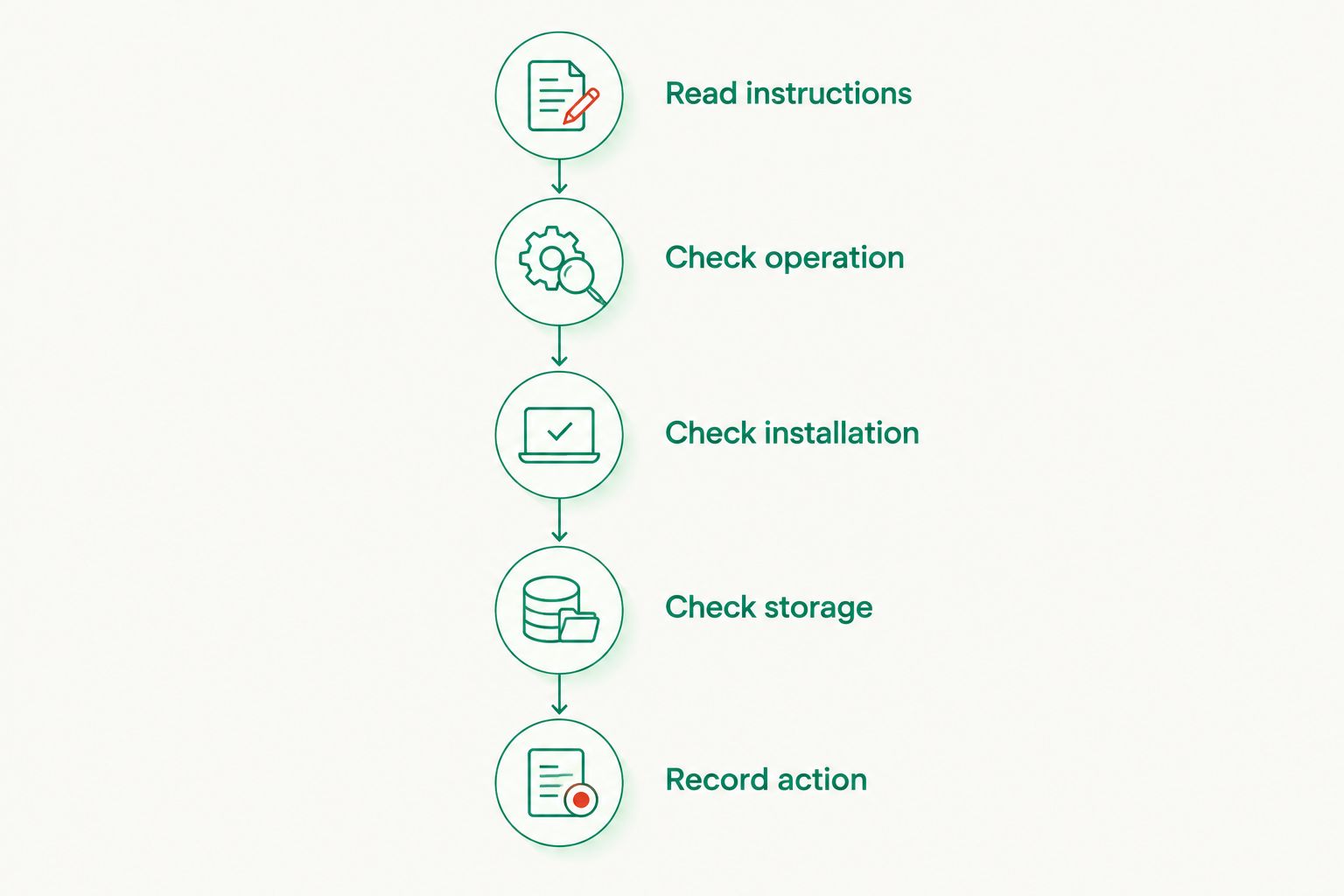
Keep the checklist with the relevant manuals, not inside a collection of unrelated household reminders. A useful 2026 inspection record should make unresolved defects easy to identify without exposing access credentials or firearm details unnecessarily.
Why gun safe inspection timing varies
There is no reason to impose the same invented maintenance interval on every cabinet and lock. Build your routine around the manufacturer's instructions and the conditions you actually observe.
- Manufacturer instructions: the safe and fitted lock can have separate maintenance requirements. Retain both manuals and resolve conflicting instructions with the supplier or manufacturer.
- Lock type: electronic locks require attention to their specified power supply and warnings; mechanical locks need checks appropriate to their mechanism.
- Operating changes: scraping, resistance or inconsistent locking calls for attention when it appears, not at the next scheduled review.
- Environmental exposure: leaks, condensation, corrosion and damp interiors require investigation rather than a longer wait between checks.
- Installation changes: relocation, nearby building work or changes to the supporting structure warrant reassessment.
- Access changes: missing keys, disclosed codes or changed authorised users require an access-control review even if the cabinet has no visible damage.
Do not confuse increased observation with permission to perform more invasive maintenance. A changed condition often calls for specialist assessment, not extra owner-level testing.
What should you do after water exposure or suspected tampering?
Arrange assessment before relying on a damaged or suspect safe for continued firearm storage. Follow your firearms authority's requirements for any temporary storage arrangement; do not leave firearms unsecured while organising repairs.
After water exposure, look for visible moisture and corrosion without dismantling electrical or locking components. Surface drying alone does not establish that the lock, interior or installation is unaffected.
After suspected interference, avoid disturbing potential evidence and contact police where appropriate. Record what you observed without publishing photographs that disclose the safe's location or access arrangements.
Impact and relocation also deserve attention. A cabinet that still locks needs assessment if its door alignment, frame, body or anchoring has changed.
When do you need a safe technician?
Use a qualified safe technician when a problem goes beyond the owner's instructions. Persistent binding, damaged locking components, suspected forced entry and unexplained movement are reasons to seek professional assessment.
Describe the symptoms rather than attempting a diagnosis. Explain when the issue began, whether the cabinet was moved, whether water was involved and what changed during normal operation.
Consult the guide to servicing a safe lock to understand the maintenance topic, but follow the instructions for your actual lock. Do not spray a general-purpose lubricant into a keypad, keyway or bolt mechanism without manufacturer approval.
BUYASAFE supplies gun safes for Australian home and business buyers. Comparing a replacement is relevant after assessment establishes that repair or the existing installation is unsuitable; buying another cabinet is not the first response to every operating fault.
What should a gun safe inspection record contain?
Keep a factual record of observations and completed work. An entry such as a door scraping against its frame is more useful than simply marking the whole cabinet as checked.
Include:
- The inspection date and the person completing it.
- The safe and lock identification needed for servicing.
- The instructions used for the check.
- Observations about operation, visible condition and installation.
- Any access-control concern, without recording credentials.
- Corrective work required and who is responsible.
- Completion details for repairs or installation work.
Label your 2026 records clearly so you can distinguish a new issue from an unresolved earlier defect. Store invoices and technician reports with the relevant entry, but do not treat paperwork as proof that the safe remains secure indefinitely.
Does an owner inspection replace a police inspection?
An owner inspection does not replace an official firearm storage inspection. Maintenance and legal compliance overlap, but they answer different questions.
For compliance in 2026, confirm the current requirements with your state or territory firearms authority, including any conditions specific to your licence or storage arrangement. Do not infer an official inspection timetable from a manufacturer's servicing recommendation.
If an authority requests an inspection or identifies a defect, follow its directions. Keep evidence of the corrective work and clarify any uncertainty directly with that authority.
Should you inspect a gun safe that you rarely open?
A rarely opened gun safe still needs the checks specified in its manual and attention after relevant changes. Infrequent access is not evidence that the installation, interior or lock remains unchanged.
Before leaving storage unattended, review key control, visible condition and any warnings using the manufacturer's instructions. On your return, investigate leaks, damage or unusual operation before assuming everything is unchanged.
FAQ
How often should I carry out a gun safe inspection?
Check your gun safe whenever you use it, follow the manufacturer's maintenance schedule and inspect it after relevant changes or damage. Keep owner checks separate from any official inspection requirements.
Is a monthly gun safe inspection required in Australia?
Do not treat a monthly inspection as a nationwide legal requirement. Confirm the requirements applying to your jurisdiction, licence and storage arrangement with your firearms authority.
Do I need to book an annual gun safe service?
Follow the service schedule for your safe and fitted lock rather than assuming an annual visit is mandatory. Arrange assessment sooner when operation changes or damage occurs.
What should I do if my gun safe door starts sticking?
Do not force a sticking gun safe door. Check for visible obstructions using the owner's instructions, then arrange technical assessment if the problem persists.
Should I replace gun safe batteries during every inspection?
Replace batteries according to the fitted lock's instructions and respond to its specified warnings. Do not assume all electronic safe locks use the same battery type or replacement interval.
Can I test whether my gun safe is bolted down by rocking it?
Do not rock or tip a heavy gun safe to test its fixings. Look for visible changes and have suspected installation faults assessed by an appropriate professional.
Does my inspection log prove my firearm storage is compliant?
An inspection log does not certify firearm storage compliance. In 2026, use it to document observations and corrective work while checking the current requirements with your firearms authority.
One last thing
Compare behaviour, not just appearance. A cabinet can look unchanged while its handle needs more force or its door begins rubbing against the frame.
Record that change when you first notice it. A precise description gives a technician something useful to investigate and keeps a developing fault from becoming accepted as normal operation.


