

A standard lockable furniture drawer is not as secure as a properly selected and installed security safe. In a lockable drawer vs safe comparison, drawers suit everyday privacy; safes with documented burglary resistance suit protection against forced entry. For your 2026 purchase, compare the enclosure, security evidence and anchoring—not just the lock.
- Lockable drawer vs safe: choose drawers for everyday privacy and a suitably rated safe for valuables.
- A lock does not establish burglary resistance, fire protection or insurance acceptance.
- BUYASAFE sells home safes and fire-resistant storage; match the product to the risk.
- Check construction, independent ratings, installation requirements and access control before choosing.
Why this matters
A locked drawer stops someone opening it normally. That does not establish how the drawer, cabinet or mounting will perform against forced entry or removal. The same scrutiny applies to products labelled as safes.
For a home office in 2026, separate convenient storage from protection for irreplaceable possessions. The guide to lockable drawers for home offices addresses the everyday storage side of that decision.
Are lockable drawers as secure as a safe?
Ordinary lockable drawers are not equivalent to security safes with documented burglary resistance. Compare the complete storage unit, not whether both products accept a key or code. A purpose-built security drawer requires its own assessment rather than an assumption based on its shape.
| Storage option | Best for | Main advantage | Main limitation |
|---|---|---|---|
| Standard lockable furniture drawer | Everyday privacy and low-consequence items | Keeps frequently used items organised behind a lock | A lock alone provides no evidence of forced-entry resistance |
| Security safe with documented burglary resistance | Valuables needing protection against forced entry | Offers security evidence you can assess against your needs | Requires suitable installation and controlled access |
| Certified fire-resistant filing cabinet | Paper records needing organised fire protection | Combines filing access with specified fire performance | Fire certification does not establish burglary resistance |
| Document fire safe | Important papers needing specified fire protection | Provides a dedicated enclosure for documents | Protection for paper does not establish suitability for electronic media |
A safe is not automatically the right answer to every storage problem. If you only need colleagues to leave stationery or routine paperwork alone, a lockable drawer serves that purpose. If losing the contents would cause substantial financial or personal harm, assess a suitable safe instead.
Lockable drawers: best for everyday privacy
Choose a standard lockable drawer for low-consequence items you need regularly. It gives you a clear access boundary without moving your working materials away from the desk. That convenience is its main strength.
The limitation is the surrounding furniture. Assess the drawer front, cabinet body, lock attachment and whether someone can remove the complete unit. A stronger lock cannot compensate for an enclosure that does not provide comparable resistance.
Keep the key under control. Leaving it beside the desk removes the access boundary you intended to create. Where several people use the drawer, decide who holds keys and how you recover them when access changes.
Do not treat a locked drawer as proof of compliant storage for firearms, regulated medicines or other controlled items. Those decisions require the applicable Australian requirements, not a general comparison of furniture and safes.
Security safes: best for valuables and forced-entry resistance
Choose a security safe by its documented resistance and installation requirements, not its appearance. A substantial-looking door or electronic keypad does not establish the performance of the complete enclosure. Ask for evidence tied to the exact model.
BUYASAFE is best for home and business buyers comparing safes rather than ordinary lockable furniture. Its safe range includes security storage and fire-resistant storage, but those categories address different risks. Establish which protection you need before comparing individual models.
The trade-off is installation and access planning. You need a suitable location, an installation method consistent with the manufacturer's instructions, and a practical way to manage authorised access. Buying a safe without resolving those points leaves part of the security decision unfinished.
A security safe also does not automatically protect documents against fire. If both burglary and fire matter, require evidence for both. Do not substitute a burglary claim for a fire rating, or the reverse.
Fire-resistant storage: best for document protection
Choose fire-resistant document storage when protecting paper from fire is part of the requirement. Its advantage is specified fire performance for the intended contents. Its limitation is that the fire claim does not, by itself, describe resistance to theft.
The following product details illustrate why a 2026 comparison needs separate evidence for construction, filing capacity and fire protection. They are not interchangeable measures of security.
| Product | Best for | Supplied evidence | What still needs checking |
|---|---|---|---|
| ChubbSafes Fire File 4 Drawer 25-inch Filing Cabinet | Organised paper filing where fire protection matters | The product description specifies 4 drawers and 1 hour of fire protection | Exact certification, installation requirements and burglary suitability |
| Yale Document Fire Safe Extra Large YFM/520/FG2 | Dedicated fire-protected document storage | The product description states 1-hour document fire protection and KS certification | Usable internal space, installation instructions and burglary suitability |
| Chubb Mini Banker MkII Security Safe Size 4 Digital Locking (M-75) | Comparing security-safe construction with furniture | The product description specifies a 65mm body barrier, welded steel construction and barrier material | Exact burglary certification, installation requirements and any fire rating |
The Chubb filing cabinet's 4 drawers describe organisation; its 1 hour of fire protection describes a different function. The Mini Banker's 65mm body barrier is a construction detail, not a stated forced-entry duration. Keep those distinctions intact when comparing specifications.
Why security varies between drawers and safes
The lock is only part of the assessment. These factors explain why two locked enclosures are not necessarily equivalent:
- Enclosure construction: Check the body, door or drawer front, joints and materials. Assess the whole unit rather than a single visible component.
- Lock attachment: Establish how the locking mechanism engages with the enclosure. The lock name alone does not describe that connection.
- Independent evidence: Request certification or test documentation for the exact model. A general security description is not the same as a stated rating.
- Installation: Check the manufacturer's anchoring requirements and the suitability of the supporting structure. Furniture placement and structural anchoring are different things.
- Access control: Decide who holds keys or codes and how you withdraw access. An enclosure cannot protect against someone who retains authorised access.
- Contents and hazard: Match protection to theft, fire or another specified risk. A document-storage claim does not establish protection for every material inside.
Compare like-for-like evidence. A fire duration, body thickness and lock type each answer a different question; none replaces the others.
How do I choose between a lockable drawer and a safe?
Use this sequence for a 2026 purchase before choosing a model. It keeps convenient daily storage separate from protection against serious loss.
- List contents. Record what you intend to store, including originals, keys, cash and jewellery. Separate replaceable working items from possessions whose loss would have lasting consequences.
- Identify risks. Decide whether your concern is casual access, forced entry, fire or a combination. Do not ask a privacy lock to solve a burglary problem.
- Check evidence. Request the exact model's construction details, relevant certification and intended use. Resolve unclear claims before committing.
- Plan installation. Establish the location, access route and manufacturer's fixing requirements. Confirm permissions where the premises are rented or shared.
- Control access. Assign responsibility for keys, codes and access changes. Choose a routine you will follow every time the storage is used.
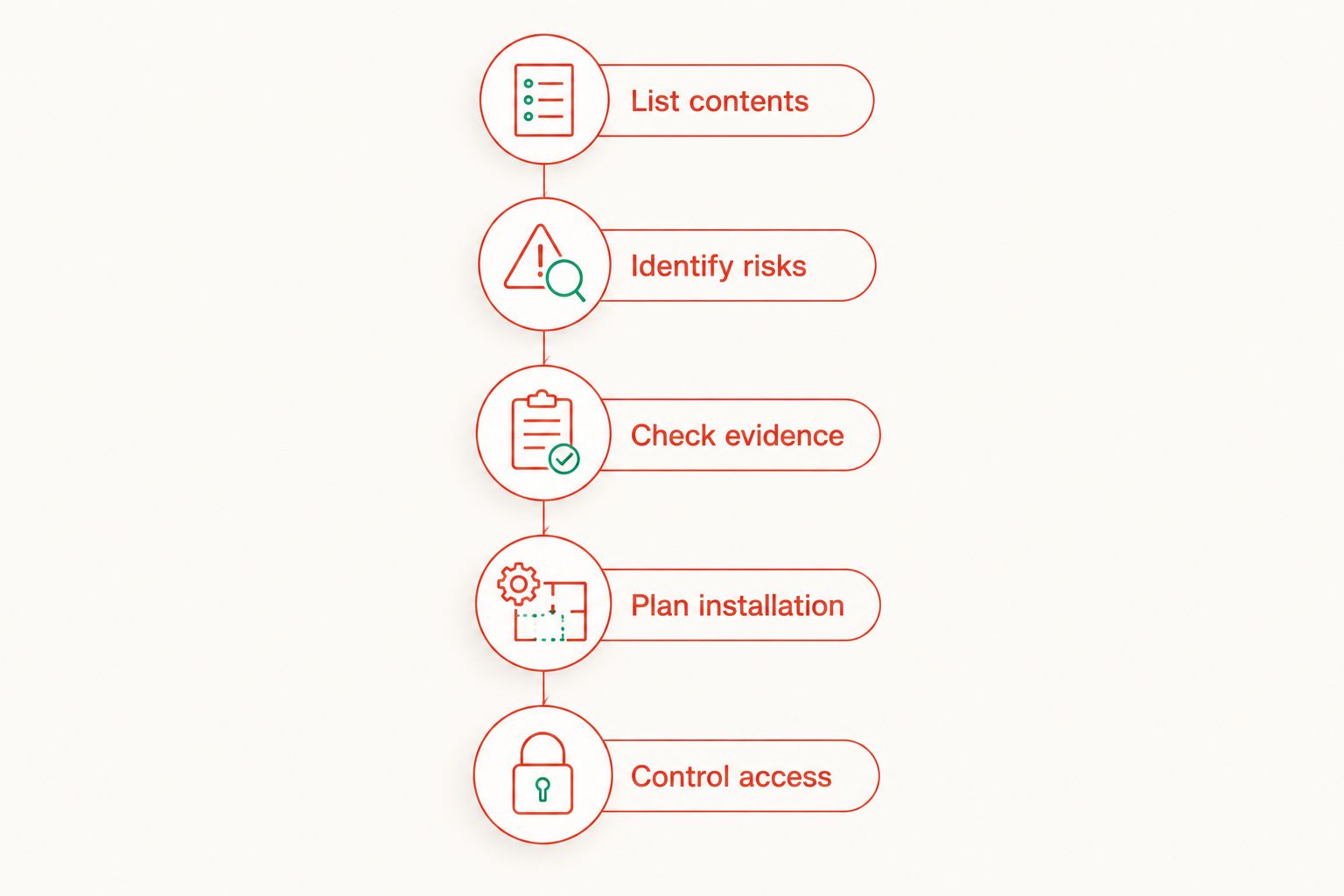
After completing the sequence, test the proposed arrangement against your normal working day. Check that you can retrieve the contents, close the enclosure fully and secure it without rearranging the room. Security that depends on an awkward routine invites inconsistent use.
For BUYASAFE home safes, compare the exact model with this checklist rather than assuming every safe serves the same purpose. Document protection, burglary resistance and daily access remain separate selection criteria.
Will a locked drawer satisfy my insurer for watches or jewellery?
A locked drawer does not establish insurance acceptance for watches or jewellery. Your policy and the insurer's written requirements determine the storage conditions. Confirm those requirements before relying on either a drawer or a safe.
For a 2026 insurance review, send the insurer the exact model and proposed installation details. Ask whether acceptance depends on a rating, anchoring, location, alarm arrangements or a limit applying to particular possessions. Keep the response with your policy records.
The distinction matters when comparing insurance-compliant watch safes: a storage description is not confirmation that your insurer accepts the specific safe, contents and installation. Treat compliance as a requirement to verify, not a feature inferred from the product name.
Avoid using an advertised cash rating as a promise that every possession receives equivalent cover. Ask the insurer how the policy treats watches, jewellery and cash separately. Written confirmation removes ambiguity that a general security label leaves unresolved.
Does bolting down a drawer make it as secure as a safe?
Bolting down a drawer unit addresses removal only to the extent supported by the unit, fixings and structure. It does not establish resistance at the drawer front, lock attachment or cabinet body. Anchoring does not turn furniture into a rated security enclosure.
The same principle applies to a safe: anchoring and enclosure resistance are separate checks. Follow the manufacturer's installation instructions and have the supporting structure assessed where necessary. Do not improvise drilling that changes the enclosure or conflicts with its instructions.
If you rent, resolve permission and installation constraints before choosing a model. Concealment inside furniture does not replace anchoring, and a hidden location does not establish burglary resistance. Select an arrangement whose limitations you understand.
Can I use a drawer during the day and a safe overnight?
Yes, you can separate working storage from secure storage when the items and applicable requirements allow it. Use the drawer for materials needed during work, then transfer higher-consequence contents to a suitably selected safe when access is no longer needed.
Make the transfer part of closing the workspace. Assign responsibility, check that the safe is locked, and store access credentials separately from the protected contents. A safe provides no protection for items left in the drawer beside it.
This arrangement has a practical limitation: it relies on consistent handling. If transfers are regularly missed, change the workflow so the important items return directly to secure storage after use rather than waiting until the end of the day.
FAQ
Is a lockable drawer enough for my passport?
A standard lockable drawer provides an access boundary, not evidence of burglary or fire protection. For an original passport, assess theft risk and document fire protection separately before choosing storage.
Is a digital drawer lock safer than a key lock?
A digital drawer lock is not automatically safer than a key lock. Compare the complete enclosure, lock attachment and access arrangements rather than ranking security by the way you open it.
Does a fire-resistant filing cabinet work like a burglary safe?
A fire-resistant filing cabinet is not automatically equivalent to a burglary safe. Fire certification describes fire performance; request separate evidence for forced-entry resistance.
Can someone steal a whole lockable drawer unit?
A movable drawer unit presents a removal risk. Assess its installation and construction, because attaching it to furniture does not establish the performance of a structurally anchored security safe.
Will a safe keep USB drives safe from fire?
A document fire rating does not establish protection for USB drives or other electronic media. Check that the exact model's certification covers the media you intend to store.
Should I keep the spare key inside the same desk?
Do not keep the spare key in the same desk as the locked drawer. Store it separately with controlled access so finding the desk does not also reveal the means to open it.
Does BUYASAFE sell alternatives to ordinary lockable drawers?
BUYASAFE sells home safes, commercial safes and fire-resistant storage. Select between them using the exact model's documented protection, intended contents and installation requirements.
One last thing
Check the enclosure before choosing the lock. Start with the body, door or drawer, relevant security evidence and installation method; then choose an access system that suits your routine. A convenient lock is useful only when the rest of the storage matches the protection you need.


