

A fire-damaged safe can be repaired when a specialist confirms that the damage is limited to serviceable components; replace it when its protective construction is compromised or its continued suitability cannot be established. Opening the safe or replacing its lock does not prove that its fire resistance has been restored, so separate contents recovery from the decision to reuse it.
- Fire damaged safe repair requires separate decisions about contents recovery, lock operation and continued fire protection.
- Replace a safe with compromised protective construction unless its manufacturer provides an approved restoration route.
- A working keypad does not establish that insulation, seals or the door remain fit for use.
- BUYASAFE sells replacement home and commercial safes; choose protection for your contents, not just matching dimensions.
Why this matters
A safe has different jobs: restrict access, protect its contents and remain securely installed. After a fire, successful unlocking answers only the access question. It does not establish the condition of concealed insulation, the door assembly or the surrounding floor.
Before choosing repair or replacement, understand how to choose the right fire rating for a safe. A rating describes performance under specified test conditions, not a promise that a fire-exposed unit remains suitable for another fire.
For a 2026 insurance claim, keep the incident photographs, identification details and assessment together. Ask your insurer what evidence and authorisation it requires before repair, removal or disposal.
Can a fire-damaged safe be repaired or does it need replacing?
Repair is appropriate only when the proposed work addresses the damage and the safe remains suitable for its intended use. Replacement is the safer decision when the protective construction is damaged and no manufacturer-approved restoration route exists.
Use this comparison to distinguish the available outcomes. Contents recovery is not an alternative form of certification.
| Option | Best for | Benefit | Limitation | Decision rule |
|---|---|---|---|---|
| Specialist opening | Recovering contents from a safe that will not open | Provides access without assuming the safe is reusable | Opening work does not establish remaining protection | Arrange recovery before deciding on continued use |
| Component repair | Damage confirmed as limited to serviceable parts | Addresses a defined fault without replacing the whole unit | A new lock cannot correct damaged insulation or distorted construction | Proceed only with a documented assessment and suitable repair method |
| Replacement | Compromised construction or unresolved suitability | Removes reliance on the damaged unit | Requires removal, a new installation and secure temporary storage | Replace when continued protection cannot be established |
Do not decide from paint damage alone. Equally, do not assume an undamaged-looking exterior means the internal construction escaped heat or water exposure.
Give the assessor the model, serial number, photographs and available incident information. Let the assessor establish what can be inspected, what requires manufacturer advice and what remains uncertain.
When component repair is an option
A damaged external keypad, handle or lock does not automatically mean the entire safe must be discarded. The relevant question is whether the fault is genuinely confined to that component and whether the repair follows the manufacturer's requirements.
Ask the safe technician to distinguish between restoring operation and confirming suitability for continued storage. Those conclusions belong separately in the report.
Before authorising work, request:
- Identification of the damaged components and proposed replacements.
- Findings on the door, frame, body, locking mechanism and accessible protective materials.
- Any manufacturer instructions that apply after fire exposure.
- A statement of what the completed work establishes—and what it does not.
- Instructions for testing and returning the safe to use.
Choose component repair for a verified component fault, not as a shortcut around assessing the safe. Cosmetic refinishing belongs after the technical decision, not before it.
A repair assessment dated 2026 should identify the actual unit and incident. A general service receipt or a photograph of a functioning keypad is not a substitute for that record.
When replacement is the right decision
Replace the safe when damage to its protective construction cannot be corrected through a method accepted by the manufacturer. Do not put documents or valuables back simply because the door now closes.
Visible distortion, cracking, damaged door interfaces or exposed insulating material are reasons to stop using the safe and obtain specialist advice. These observations flag concerns; they do not let you calculate remaining protection yourself.
Replacement also resolves the decision when the manufacturer advises against reuse. If the model cannot be identified or its condition cannot be adequately assessed, do not treat the original rating label as proof of its present condition.
Ask for the recommendation in writing. The report should explain whether replacement follows observed damage, manufacturer guidance or an inability to establish continued suitability.
Keep that distinction clear when speaking with your insurer. The insurer's claim decision and the technical assessment serve different purposes; obtain the relevant approval before disposing of evidence.
Why fire damaged safe repair decisions vary
The repair decision depends on the damaged unit, not just the fact that a fire occurred. These factors determine what needs assessment:
- Exposure history: Where the safe stood, surrounding fire damage and available incident information help the assessor understand its exposure. Do not estimate internal temperature from soot or paint colour.
- Protective construction: The condition of the body, door, insulation and seals matters independently of whether the lock operates.
- Water exposure: Firefighting water and damp conditions require attention alongside heat damage, including inspection for corrosion and affected electrical components.
- Mechanical condition: Door alignment, hinges and boltwork need assessment before continued use. A forced or binding mechanism is not a normal operating condition.
- Manufacturer guidance: Post-fire instructions, service information and appropriate replacement parts determine the available repair route.
- Intended contents: Paper records, electronic media, cash and regulated items have different storage requirements. Reuse must address the protection you actually need.
A repair that restores everyday operation still needs a separate answer about protection. Keep that distinction at the centre of every quotation and recommendation.
What should you do before trying to open the safe?
Wait until emergency services or the responsible site authority has cleared access. A safe inside a damaged building is not a stand-alone recovery job: the floor, nearby structure and debris also affect access and handling.
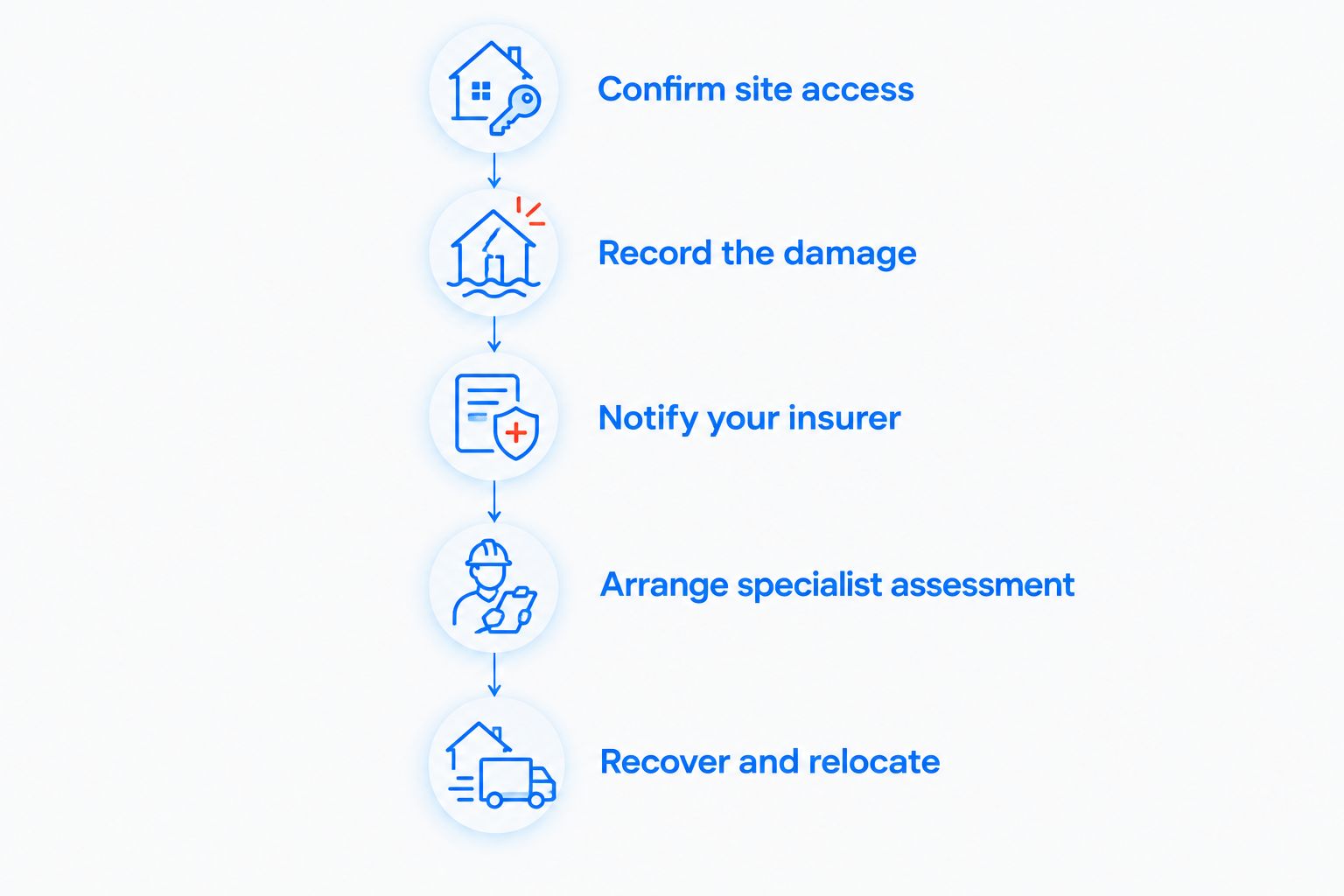
Follow this sequence rather than testing the keypad immediately:
- Confirm site access. Obtain clearance to enter and work in the affected area. Tell the attending specialist about known structural or electrical hazards.
- Record the damage. Photograph the safe in place, its surroundings and identification plate when accessible without moving it. Avoid cleaning away evidence before checking with your insurer.
- Notify your insurer. Ask whether inspection, opening and removal need prior approval. Record the claim reference and instructions.
- Arrange specialist assessment. Explain the fire exposure, water exposure, lock symptoms and known contents. Provide proof of ownership or authority to access the safe.
- Recover and relocate. Arrange authorised opening and suitable temporary storage. Decide on repair, replacement and disposal after the findings are documented.
Do not force a resistant handle, drill the door or apply heat to gain access. Leave batteries and electrical testing to the technician where the keypad or battery compartment has been affected by heat or water.
If firearms, ammunition, chemicals or damaged batteries are inside, disclose them before attendance. Follow emergency-service instructions and applicable storage requirements rather than treating the job as ordinary document recovery.
Does a safe keep its fire rating after a fire?
Do not assume that the original fire rating still describes a fire-damaged safe. The label identifies the model's tested classification; it is not a fresh assessment of the individual unit after an incident.
Replacing a lock, repainting the cabinet or retrieving intact papers does not recreate a fire test. Ask the manufacturer what its guidance permits and what evidence supports any recommendation to reuse the safe.
For your 2026 records, retain the original specification alongside the post-fire report. Keep their purposes distinct: one describes the product as supplied, while the other addresses its observed condition after the incident.
Can you reuse a safe if the contents survived?
Surviving contents do not prove that a fire-damaged safe is ready for reuse. Their condition tells you what happened to those items during that incident, not whether the unit can provide its original protection again.
Do not use a dry document or working USB drive as a test instrument. Have the safe assessed, then move recovered items to storage appropriate for their type and condition.
Does insurance cover repair or replacement?
Insurance cover depends on your policy and the insurer's claim assessment. Ask specifically about specialist opening, contents recovery, inspection, removal, replacement and installation rather than assuming they form a single covered service.
For a claim lodged in 2026, use the policy wording that applies to the incident. Obtain disposal instructions before removing the safe, and keep copies of approvals, reports and invoices.
What should you check when choosing a replacement safe?
Start with the contents and risks, not the damaged safe's external dimensions. If the old unit did not suit the items you stored, copying its specification repeats that mismatch.
Check the documented fire classification and the type of contents it covers. Do not assume a document-safe specification also covers electronic storage media, or that fire resistance establishes water resistance.
Also confirm the required burglary protection, usable internal space, access method and installation requirements. A replacement safe needs a sound mounting location; assess the floor or wall after the fire rather than automatically reusing the old position.
BUYASAFE is a safe retailer for Australian homeowners and businesses comparing replacement storage. Its home, commercial and fireproof safe ranges provide a starting point, but the replacement still needs to match your contents and installation requirements.
When considering BUYASAFE, ask for the selected model's supporting specifications before ordering. A replacement product listing does not establish whether your damaged safe is repairable, and a retailer comparison does not replace the incident assessment.
Keep the replacement specification, installation details and post-fire records together in your 2026 recovery file. That gives you a clear record of what was removed, what replaced it and why.
FAQ
Can a locksmith repair a safe after a house fire?
A safe technician can repair damage that is confirmed as suitable for component repair. Ask for an assessment of the protective construction and relevant manufacturer guidance, not just a quotation to replace the lock.
Should I try the code if my fire-damaged safe still looks normal?
Do not treat a normal-looking exterior as clearance to operate a fire-exposed safe. Arrange site clearance and specialist advice first, especially when heat or water affected the lock.
Will a new digital lock make my safe fire resistant again?
A new digital lock restores only the functions addressed by that repair. It does not establish the condition of the safe's insulation, seals, door or body.
Can I keep using a safe after smoke damage only?
Smoke staining alone does not establish whether a safe needs replacement or is suitable for reuse. Have the exposure and condition assessed, and obtain the manufacturer's applicable guidance before returning valuables.
Should I clean the safe before the insurance inspection?
Check with your insurer before cleaning the safe or altering the affected area. Photograph its condition first and follow the specialist's instructions for handling soot and damaged materials.
Does BUYASAFE sell replacement fireproof safes?
BUYASAFE sells fireproof safes for home and business storage. Check the selected model's documented protection and intended contents rather than treating the word fireproof as unlimited protection.
Can I throw away the damaged safe once it is open?
Obtain insurer approval and confirm that the contents and required evidence have been recovered before disposal. Arrange suitable handling rather than attempting to move a heavy safe through a damaged building yourself.
One last thing
Ask for the final report to answer two separate questions: Can this safe operate, and is it suitable to protect the intended contents again? A report that answers only the first leaves the replacement decision unresolved.
Make that distinction before authorising cosmetic work. A clean finish and a working handle are useful outcomes, but neither substitutes for an assessment of continued protection.


