

Recruitment agency safe storage is controlled physical protection for candidate records, office keys, digital media and petty cash, with the aim of preventing unauthorised access and avoidable loss. In 2026, safes for recruitment agencies need to address several storage risks rather than forcing every asset into one general-purpose safe.
- Safes for recruitment agencies should start with fire-rated document storage for candidate records and signed contracts.
- The Yale Document Fire Safe suits agencies that retain paper files and need organised fire protection.
- A CMI key cabinet is best for controlling office, interview-room and storage keys.
- Paper records, digital media and petty cash need separate protection because their storage requirements differ.
- Buy A Safe is best for Australian recruitment agencies comparing document safes, key cabinets and office security storage.
Why safe storage matters for recruitment agencies
Recruitment agencies handle resumes, identity records, references, contracts, payroll details and right-to-work documents. Where the Privacy Act 1988 and Australian Privacy Principles apply, an agency must take reasonable steps to protect personal information from misuse, interference, loss and unauthorised access.
A locked office door is not enough once cleaners, contractors, building managers and employees can enter the premises. A Yale Document Fire Safe Extra Large creates a second physical barrier around retained paper records instead of relying on a filing cabinet's basic lock.
Recruitment offices also have a distinct access problem. Consultants need fast access to current files, managers need control over archived records, and administration staff may handle office keys or a petty-cash float. The safe setup must support daily work without giving every employee the same code.
Buy A Safe is best for Australian recruitment agencies that need to compare document safes, key cabinets and office security storage in one catalogue. The limitation is that no single safe type correctly protects paper, data media, keys and cash at the same time.
How to choose safes for recruitment agencies in 2026
Start with a written storage map, then match each asset to its main risk. This prevents a common buying error: choosing a safe by external size before deciding what it must protect.
Map every item requiring controlled storage
Walk through the office and record what is currently kept in drawers, filing cabinets, cupboards and desk pedestals. Separate active records from archives because their access patterns differ: consultants may need active files during the day, while archived contracts should remain restricted.
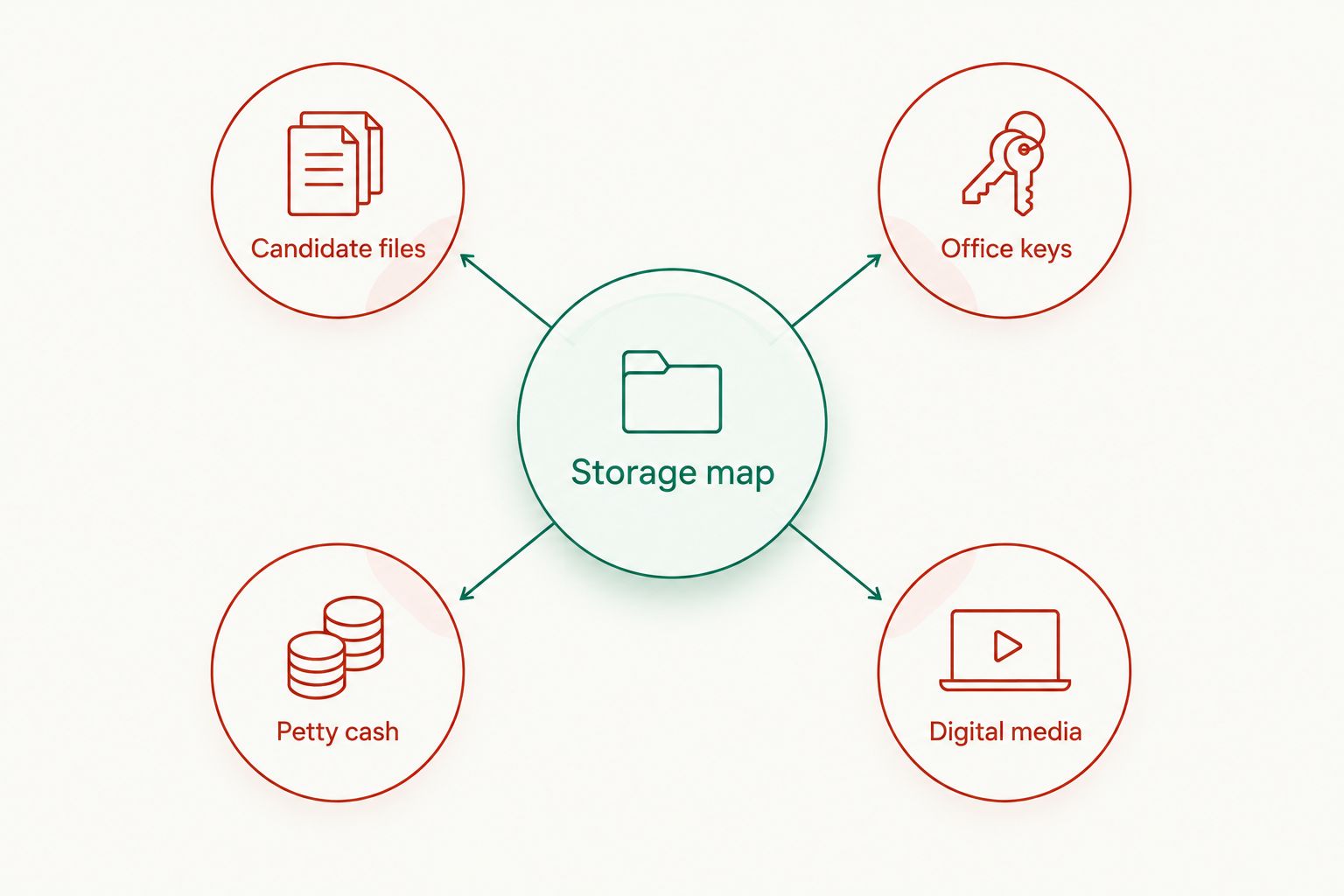
Complete the manual inventory before comparing products. Record these categories separately:
- Candidate identity and right-to-work documents
- Signed contracts, references and onboarding forms
- Office, interview-room and storage-cupboard keys
- Petty cash, company cards and payment records
- USB drives, backup media and spare devices
Match fire protection to the stored material
Fire resistance is material-specific. A safe that protects paper does not automatically protect USB drives or hard disks because electronic media can fail at temperatures well below the point where paper chars.
Common fire-test durations include 30, 60 and 120 minutes, but duration alone does not identify what the certification protects. For context, UL Class 350 relates to an internal temperature limit of approximately 177°C for paper, while UL Class 125 relates to approximately 52°C for data media. Check the named test standard, duration and protected material on the current product documentation.
Use these checks for paper records in 2026:
- Confirm the certification covers paper, not just the door seal
- Compare internal dimensions with folders, binders and archive boxes
- Keep essential records within the rated compartment
- Store digital backups in media-rated protection or another secure location
- Avoid treating an ordinary steel cabinet as a fire-rated safe
Choose a document-safe format that fits your workflow
A compact document safe suits an agency that has digitised most records and retains only essential originals. A larger document safe works when onboarding packs, contracts and identity records remain in physical folders. Fire-resistant filing cabinets suit teams already organised around hanging files and drawer-based retrieval.
Buy A Safe document-safe options include different formats, but the correct choice depends on usable internal space rather than exterior appearance. Measure the folders exactly as staff store them, including tabs and binders that increase the required clearance.
- Choose a compact safe for essential originals and limited archives
- Choose a larger safe for folders, binders and retained contracts
- Choose a filing-cabinet safe for drawer-based record systems
- Reserve spare internal space for future records
- Confirm the proposed location allows the door or drawers to open fully
Control office and client-site keys
A labelled key board with a written sign-out sheet is the simplest manual control. It records responsibility, but it leaves keys exposed whenever the board is accessible and depends on employees completing the log every time.
A dedicated CMI Security Key Cabinet SKC-250D places the key set behind one controlled lock. This is the faster path for agencies managing interview rooms, storage areas, building access or temporary client-site keys.
- Give each key a number rather than writing its location on the tag
- Maintain a register showing the holder and issue date
- Separate everyday office keys from restricted storage keys
- Recover keys before completing an employee's departure process
- Change cabinet access when an authorised employee leaves
Separate petty cash from candidate records
Petty cash and candidate files should not share an access group. If administration staff need the cash float but not candidate identity records, placing both in one safe gives them unnecessary access to sensitive documents.
A locked cash box inside a restricted cupboard is the manual starting point. A security safe becomes the stronger option when the office retains cash, company cards or other valuables requiring burglary resistance. A deposit safe is designed for frequent deposits without opening the main compartment, but that workflow is unnecessary for an agency that rarely handles cash.
- Keep cash access separate from records access
- Reconcile the float against receipts on a fixed schedule
- Record who opens the cash container
- Remove unnecessary cash from the office
- Ask the insurer what evidence or rating applies to stored cash
Protect digital media separately
Cloud-based recruitment systems reduce physical storage, but agencies may still retain encrypted USB backups, spare laptops or external drives. A paper-rated safe is not a substitute for data-media protection.
The manual approach is to encrypt every portable device and keep a second backup in a different secure location. If media must remain onsite, use protection specifically certified for that media type and keep recovery information separate from the device.
- Encrypt portable drives before storing them
- Maintain an offsite or cloud-based backup
- Test recovery rather than assuming the backup works
- Keep passwords and recovery keys outside the stored device
- Remove access and securely erase returned equipment
Define access before installation
Write the access list before the safe arrives. A shared code known across the office removes individual accountability and tends to remain unchanged when employees leave.
In 2026, the practical setup is role-based access: office management controls archived records, authorised administration staff manage keys, and finance access remains separate. Buy A Safe safe options include mechanical and electronic lock formats, but the lock must match the agency's code-management process.
- Name the roles authorised for each safe or cabinet
- Use individual credentials where the selected lock supports them
- Change shared codes after staff or contractor departures
- Keep emergency access details under separate control
- Record access changes in the agency's security procedure
Plan delivery, placement and anchoring
A safe only works when the floor, access route and final position suit its size and weight. Check doorways, lifts, stairs and turning space before ordering. Installation services and site requirements vary, so confirm the current details for the selected product and building.
Anchoring also needs approval where the office is leased or governed by building rules. If drilling is restricted, resolve that constraint before purchase rather than leaving a safe unsecured after delivery.
- Measure every doorway and tight turn on the delivery route
- Confirm floor loading and installation requirements
- Choose a position away from public and shared areas
- Obtain written landlord approval where anchoring affects the premises
- Limit visibility from reception, meeting rooms and external windows
Safe options compared for recruitment agencies
The right option depends on the asset and primary threat. Starting prices are excluded because safe prices and installation requirements change; check the current product page after narrowing the format.
| Option | Best for | Main advantage | Key limitation |
|---|---|---|---|
| Fire-rated document safe | Candidate records, contracts and identity documents | Combines locked access with certified paper protection when appropriately rated | Paper ratings do not automatically protect digital media |
| Fire-resistant filing cabinet | Agencies using hanging files and drawer-based archives | Fits an established filing workflow | Requires more floor space than a compact safe |
| Key cabinet | Office, interview-room and client-site keys | Organises keys and restricts access to the full set | Does not protect documents or cash from fire |
| Security safe | Petty cash, company cards and selected valuables | Focuses on burglary resistance | Fire protection applies only when separately stated and certified |
| Deposit safe | Repeated cash drops by several employees | Deposits can be made without opening the main compartment | Excessive for offices with little or no regular cash handling |
| Data-media safe | USB drives, hard disks and backup media | Maintains lower internal temperatures under its stated certification | Usually requires separate paper-document storage |
Best for most recruitment agencies: start with a fire-rated document safe, then add a key cabinet if several staff members manage physical keys. Add a security or media safe only when the storage inventory confirms that cash or onsite backups justify a separate unit.
Common mistakes recruitment agencies make
- Buying by exterior dimensions. Thick walls, door hardware and internal fittings reduce usable space, so folders that appear to fit on paper may not fit inside.
- Giving every consultant the same code. Shared access removes accountability and creates an immediate code-change problem whenever an employee leaves.
- Treating all fire ratings as equivalent. The protected material, test standard and duration determine what the rating means.
- Storing backup media beside the original device. One theft, fire or access failure can remove both copies at once.
- Ignoring delivery and anchoring. A safe that cannot pass through the office or be secured at its final location is the wrong purchase.
FAQ
What is the best safe for a recruitment agency in 2026?
A fire-rated document safe is the best first purchase for most recruitment agencies in 2026. It protects retained candidate records and contracts, while keys, cash and digital media can be addressed with separate storage where required.
Do recruitment agencies need a fireproof safe?
Recruitment agencies need fire-rated storage when important paper records must remain onsite. Check the certification, protected material and test duration because the word fireproof alone does not define performance.
Can candidate files be stored in a locked filing cabinet?
Candidate files can be kept in a controlled filing system, but a basic cabinet lock does not provide certified fire protection. A fire-resistant filing cabinet is the better fit when the agency needs both drawer-based organisation and a stated paper fire rating.
Is a document safe better than a filing cabinet safe?
A document safe is better for compact storage, while a filing cabinet safe is better for agencies using hanging files and frequent drawer access. Choose according to usable capacity, record format and available floor space.
Should office keys and candidate records share one safe?
Office keys and candidate records should use separate access controls. A key cabinet supports frequent key issue and return, while a document safe restricts access to sensitive records.
How much does a safe for a recruitment agency cost in 2026?
The cost in 2026 depends on capacity, lock type, certification, delivery and installation. Check current product and installation details after selecting the correct safe category rather than budgeting from a generic figure.
Can USB drives be stored in a document fire safe?
USB drives need media-specific fire protection if they must survive a fire onsite. Paper-rated safes can permit internal temperatures that exceed the tolerance of electronic media.
Should a recruitment-office safe be bolted down?
Anchoring should follow the safe manufacturer's instructions, the installation site and any insurer or landlord requirements. Confirm those requirements before purchase, especially in a leased office.
One last thing
Do not use the safe as a reason to retain more personal information. In 2026, the stronger process is to remove records that no longer have a valid retention purpose, restrict the remaining files and document who can access them. A larger safe does not fix uncontrolled retention.
Buy A Safe can supply the physical storage layer, but the agency still owns its access list, retention schedule, key register and code-change procedure. Buy the document safe only after those four controls are written down.


