

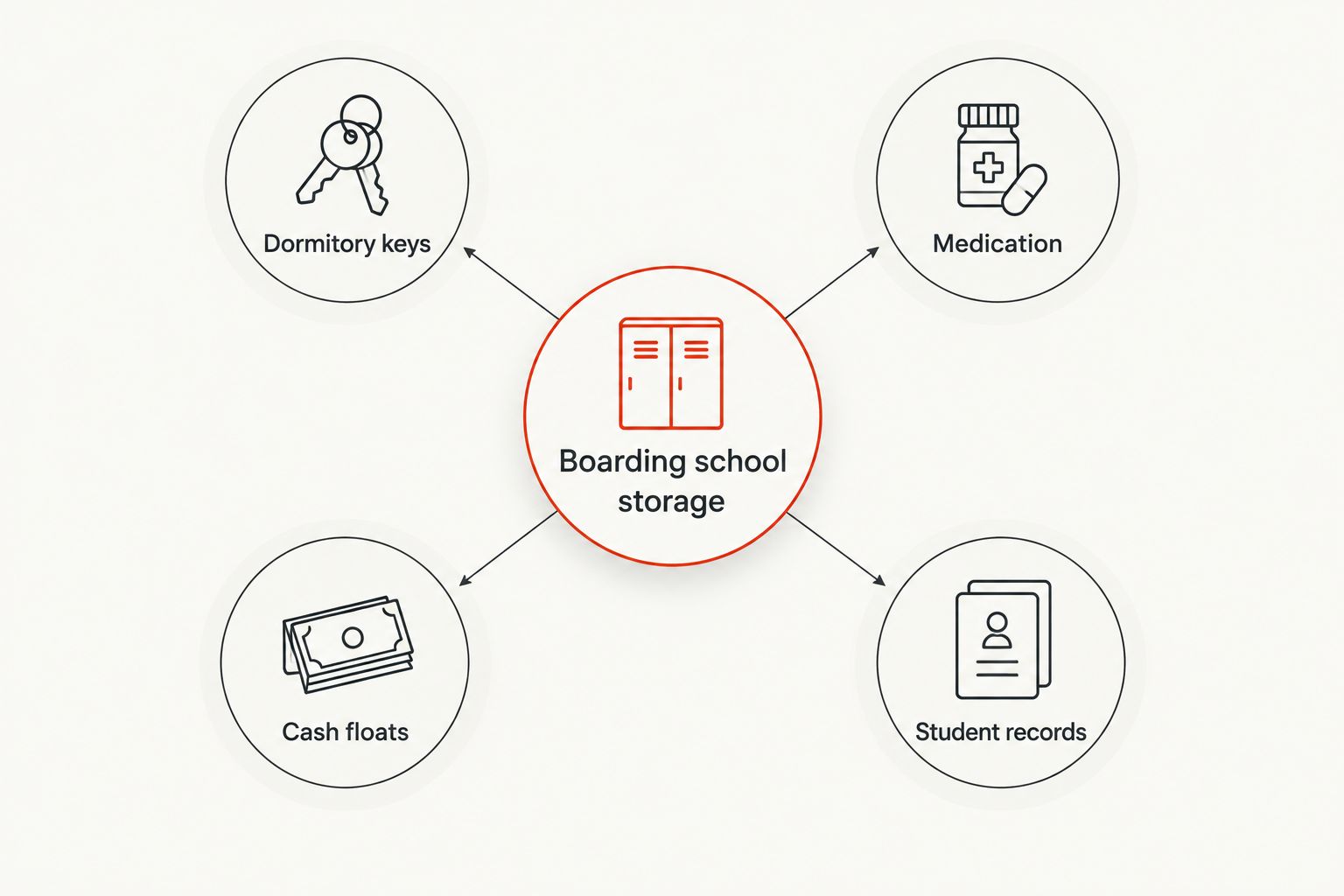
Boarding school safes protect dormitory master keys, health centre medication, cash floats and student records around the clock, not just during office hours. Unlike a single-site office, a boarding school runs rotating night duty staff, a resident health centre, and several buildings that all need controlled access to the same categories of valuables at different times of day.
- Safes for boarding schools need separate systems for dormitory keys, medication and cash — one safe rarely covers all three.
- A key cabinet with an audit trail beats a drawer for dormitory master keys shared across rotating boarding staff.
- Health centres storing Schedule 4 or Schedule 8 medication need a dedicated drug safe, not a locked filing cabinet.
- Fire-rated document safes protect enrolment records and student files; a 60-minute paper rating suits most administration offices.
- Buy A Safe stocks key cabinets, drug safes and fireproof document safes suited to boarding school operations in 2026.
Why safes matter for boarding schools
Boarding schools carry a different security load than day schools because staff, students and valuables are on site 24 hours a day, spread across dormitories, a health centre, a finance office and administration. A single locked drawer in the bursar's office doesn't cover dormitory master keys handled by three duty-staff shifts, or the medication register a nurse checks every evening.
Broader K-12 security planning covers similar ground on a wider scale — the guide on safes for schools and educational institutions walks through classroom and administration security more generally. Boarding operations add three layers a day school skips: overnight key handovers between duty staff, resident medical storage, and cash floats from tuck shops, weekend outings or excursions that never pass through a single till.
Build the system, step by step
Audit what actually needs locking up
Before buying anything, list every category of item that currently sits in an unlocked drawer, a staffroom cupboard or a nurse's desk.
- Dormitory master keys and spare sets
- Schedule 4 or Schedule 8 medication in the health centre
- Petty cash floats for tuck shops, canteens and excursions
- Passport copies and ID documents for international boarding students
- Enrolment files and student medical records
- Valuables handed in by students — phones, jewellery, cash
Separate dormitory key control from the admin safe
A shared drawer for dormitory keys means nobody can prove who took what, or when. Move key control into its own cabinet before the safe question even comes up.
- Individually numbered key hooks, not a loose bunch on a ring
- An access log signed on every key-out and key-in
- Restricted access by shift, so night duty staff aren't holding daytime keys
- A second cabinet off-site or in a locked office for spare sets
- A cabinet fitted with its own lock separate from any master key it holds
A key cabinet with individually numbered hooks, such as the CMI Security Key Cabinet SKC-250D, replaces the whiteboard-and-nail system most boarding houses start with.
Set a fire rating for student records and enrolment files
Paper enrolment files, medical consent forms and international student documentation are the hardest thing to replace after a fire, and the slowest to reconstruct from memory.
- A 60-minute paper-rated document safe as the baseline for admin offices
- Checking for a genuine UL or AS/NZS fire rating label, not just "fireproof" in the marketing copy
- Keeping enrolment and medical files together in the same rated unit
- A duplicate digital backup stored off-site as well
- Confirming the safe's footprint and weight suit the archive room's floor
Lock down medication in the health centre
A locked drawer is fine for panadol. Anything scheduled needs a genuinely restricted, logged storage point, and that's where a purpose-built drug safe earns its place over a repurposed filing cabinet.
- Checking the storage class your state's poisons regulation requires for the medication held on site
- Restricting combination or key access to nursing and health centre staff only
- Logging every access in a register kept beside the safe, not in a separate office
- Bolting the unit to a wall stud or floor slab
- Keeping it physically separate from the general first-aid kit
A dedicated drug safe such as the Secuguard SD1K Drug Safe is built around exactly this register-and-restrict routine rather than general storage.
Give the finance office a cash-handling routine, not just a safe
A safe without a process just delays the count, it doesn't secure it.
- Set a daily float limit and lock up anything above it
- Count out with two staff present, not one
- Use a deposit-style safe with a drop slot so weekend cash doesn't sit in an open till
- Match the safe's cash rating to insurance requirements for the float size held
- Reconcile the register against the safe's contents each morning, not each week
Fit boarding staff access into the safe's lock type
The lock has to survive a rotating roster, not just one long-serving bursar.
- Mechanical dial locks for staff who won't remember a rotating PIN
- Electronic keypads with individual user codes, so access is traceable to a person
- Biometric locks only where IT support is on-site to manage enrolment and faults
- Never one shared code across the entire duty roster
- Change codes each term, not each year, as staff and duty rosters turn over
Bolt every safe down before term starts
A safe that isn't fixed down is a box someone can carry out.
- Floor-bolt into a concrete slab wherever possible, over furniture bolting
- Position away from external walls and ground-floor windows
- Check delivery access before ordering — dormitory corridors are narrower than loading docks
- Schedule installation in school holidays, not mid-term when corridors are in use
Compare the storage options
| Storage need | Best for | Key limitation |
|---|---|---|
| Key cabinet | Dormitory master keys and shared duty access | Doesn't protect cash or documents from fire |
| Drug/medication safe | Health centre Schedule 4/8 storage | Too small for bulk general first-aid stock |
| Fireproof document safe | Enrolment files and student records | Slower to access than a standard safe under a fire-rated door seal |
| Cash/deposit safe | Finance office floats and weekend takings | Needs a drop-slot model for true dual-control cash handling |
| Fire-resistant filing cabinet | Bulk archive storage across multiple staff | Bulkier footprint than a single document safe |
Common mistakes boarding schools make
- Sharing one master key code across the entire duty roster — nobody can be held accountable when a key or a code goes missing.
- Storing health centre medication in the same cabinet as the general first-aid kit — scheduled medication needs its own restricted, logged unit.
- Treating student valuables as informal — "it goes in the front office drawer" isn't a receipted, logged process.
- Buying one general-purpose safe for the whole site instead of separating key, cash and fire functions that each need different features.
- Skipping the bolt-down because a document safe "feels heavy enough" — light-duty units still walk out the door in a break-in.
FAQ
What size safe does a boarding house need for dormitory keys?
Dormitory key control works better as a wall-mounted key cabinet than a large safe, sized to the number of rooms and duty staff on the roster. A cabinet with individual numbered hooks and a sign-out log gives accountability a bulk-storage safe doesn't.
Do boarding schools need a separate drug safe for the health centre?
Yes, if the health centre holds Schedule 4 or Schedule 8 medication, it needs a dedicated drug safe rather than a locked filing cabinet. State poisons regulations set the storage class required, and a general first-aid cupboard doesn't meet it.
What fire rating protects student enrolment records?
A 60-minute paper-rated fireproof document safe is the standard baseline for administration offices holding enrolment and medical files. Check for a genuine UL or AS/NZS fire test rating rather than a general "fireproof" claim on the box.
How should boarding schools handle cash from tuck shops and excursions?
Set a daily float limit, count out with two staff present, and lock takings above that limit in a deposit-style safe with a drop slot. This keeps weekend and after-hours cash out of an open till until banking.
Can one safe cover keys, cash and medication?
No — mixing dormitory keys, medication and cash in one unit removes the audit trail each category needs on its own. A boarding house is better served by a key cabinet, a drug safe and a cash safe as three separate systems.
How often should boarding house safe codes change?
Change electronic codes each term rather than each year, since duty rosters and staff assignments turn over that often. A code that outlives the staff who knew it is a gap, not a control.
Is a mechanical or electronic lock better for rotating duty staff?
Electronic keypads with individual user codes work better for rotating duty staff because access is traceable to a person, not a shared combination. Mechanical dial locks suit smaller, more stable teams who won't lose track of a single code.
Do boarding schools need to bolt safes down?
Yes — an unbolted safe, however heavy, can still be carried out in a break-in. Floor-bolting into a concrete slab is the standard fix, done during school holidays rather than mid-term.
One last thing
The upgrade most boarding schools skip in 2026 isn't a bigger safe, it's separating the key cabinet from the cash safe. Keep dormitory keys and float money in the same unit and a lost key exposes the cash too — split them and a single failure only costs you one category, not both.


