

Safes for government offices need SCEC-endorsed security ratings, a fire rating that matches the paper records inside, and a key control system that survives an internal audit — not a general commercial safe pulled off a retail shelf. Council offices, service centres and records departments each store a different mix of classified files, cash and master keys, so the right container changes by workload, not by budget alone.
- Safes for government offices need SCEC endorsement, not just a fire rating, to clear a 2026 procurement audit.
- CMI CR5 Commander Safe TDR suits departments needing one high-security container for classified files and cash.
- Yale Document Fire Safe Large YFM-420-FG2 protects paper records from fire without paying for burglary-grade steel it doesn't need.
- Key control failures, not safe ratings, cause most government office audit flags — a numbered key cabinet fixes that gap.
Why safes matter for government offices in 2026
Government offices handle three things a standard commercial safe was never built for: national security classified material, public cash from service counters, and shared master keys unlocking dozens of internal doors. A safe bought off a hardware store shelf won't satisfy a procurement checklist, and it won't survive a departmental security audit.
The Australian Government's Protective Security Policy Framework sets out which security container class matches which classification level, and the Security Construction and Equipment Committee (SCEC) maintains the evaluated products list agencies buy from. Buy A Safe's guide on choosing an SCEC-approved safe for government offices covers the endorsement process in more detail — this guide focuses on matching the right safe type to each department's actual workload.
Local councils, state departments and federal offices don't need the same container. A council rates office handling counter payments has different requirements than a records office storing PROTECTED-level files. Buy A Safe stocks both ends of that range, not one generic "government safe."
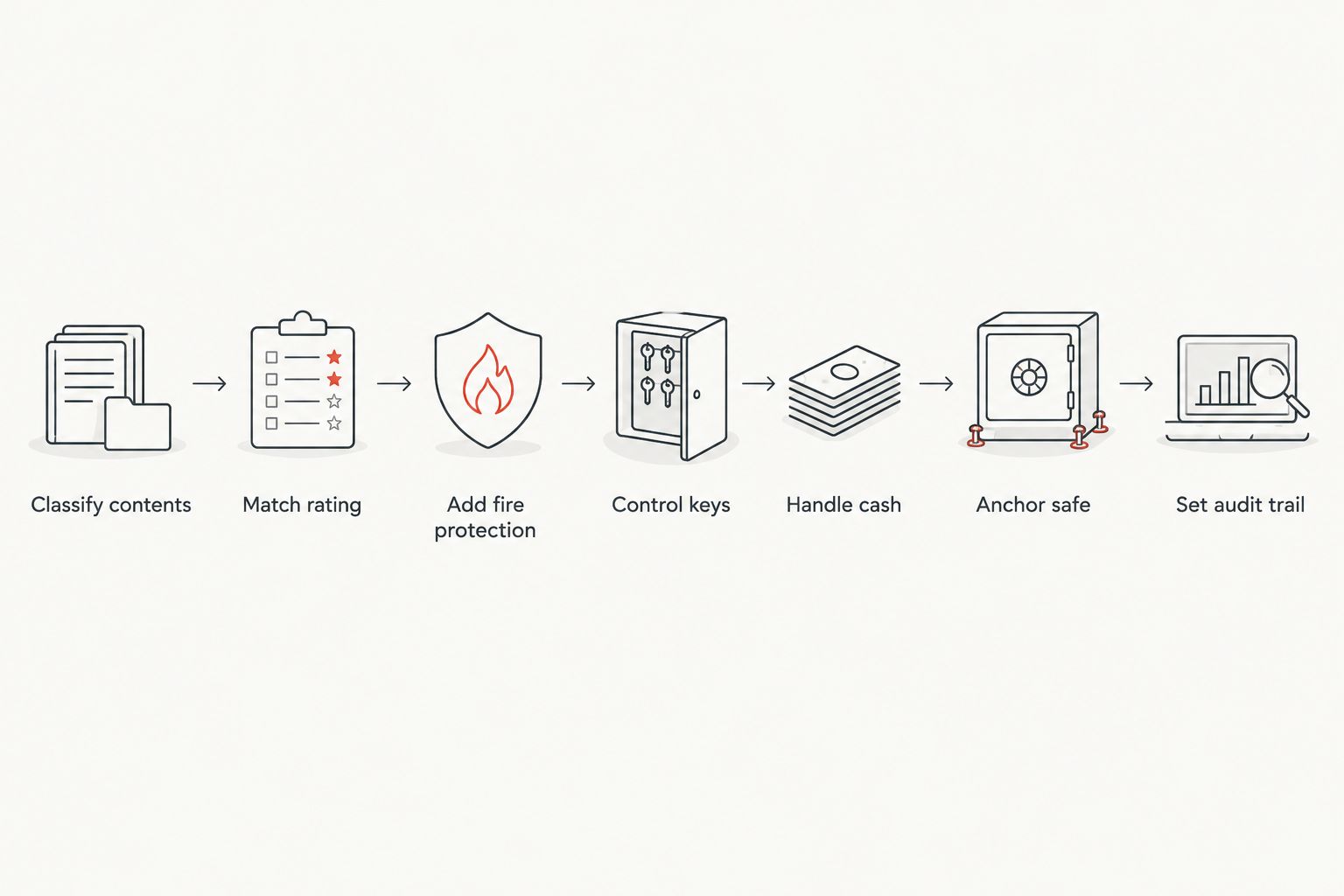
Classify what the office needs to store
Start by listing what actually needs to go in the safe, not what a catalogue calls a government safe. The mix determines whether one container covers everything or the office needs two: a security container for sensitive material and a separate fire safe for records that don't need burglary-grade steel.
- National security classified documents (PROTECTED, CONFIDENTIAL)
- Petty cash floats and daily till reconciliations
- Master keys, swipe cards and building access fobs
- Staff personal effects and small electronics
- USB drives, backup tapes and evidence exhibits
- Firearms held by compliance, ranger or enforcement staff
Match the security rating to the classification level
Once the classification level is set, the safe has to carry the matching endorsement, not just a high price tag. A home safe rated for burglary resistance under AS/NZS 3809 doesn't automatically clear SCEC's bar for classified material — the two systems test different things. The manual path is checking the evaluated products list before ordering anything.
For departments that need one container to cover high-value cash and sensitive files, the CMI CR5 Commander Safe TDR is a heavier-duty option built for that dual load rather than a document-only cabinet.
- Confirm the classification level with the office's security adviser first
- Check any product against SCEC's evaluated list before purchase
- Don't assume "fireproof" means "security-rated" — they're different tests
- Budget for a locksmith to change combinations after installation
- Keep the endorsement certificate on file for the next audit
Add fire protection for paper records
Most government office paperwork doesn't need to survive a break-in attempt — it needs to survive a structure fire long enough for a fire crew to respond. Document fire safes use insulated wall cavities to keep the interior below the point paper chars at, which is a separate design problem from resisting a crowbar.
The Yale Document Fire Safe Large YFM-420-FG2 is sized for lever-arch files and archive boxes, which suits records rooms holding years of paper-based case files.
“A fire-rated document safe and a security-rated safe solve two different problems — buying one doesn't excuse skipping the other.”
- Match the fire rating to how long records need to survive before recovery
- Store digital backups in a data-rated container, not a paper-rated one
- Don't position fire safes near HVAC returns or windows — heat transfer risk
- Keep a duplicate archive off-site for anything irreplaceable
- Confirm the fire rating certificate matches the actual model on the floor
Control master keys and access cards
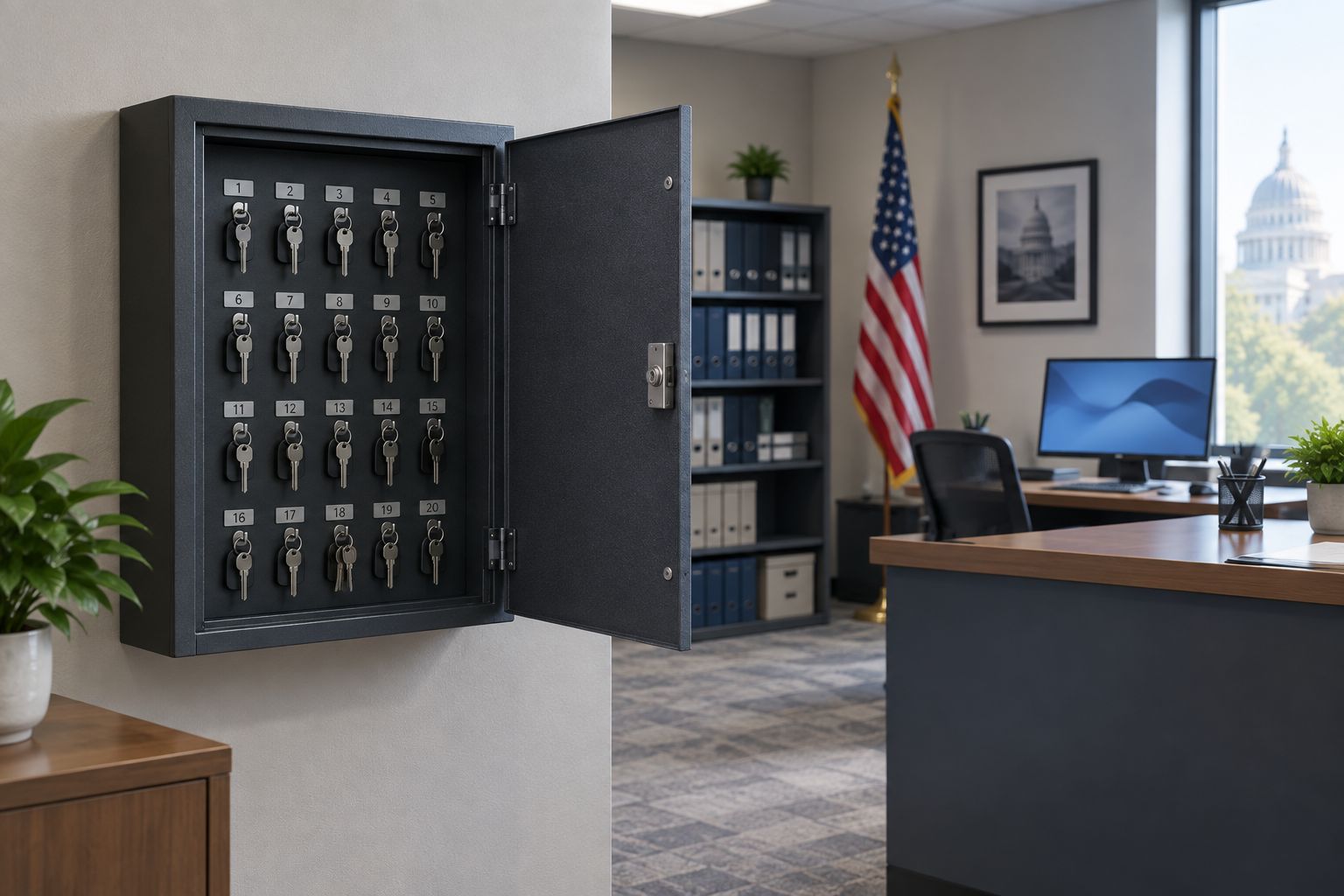
Key control is where most government office audits actually fail, not the safe rating. A shared drawer of master keys with no sign-out log is a bigger liability than an under-rated safe, because nobody can prove who had access to what, and when.
A dedicated key cabinet like the CMI Security Key Cabinet SKC-250D gives every key a numbered hook and a lockable door, which is the baseline most procurement checklists expect.
- Number every key and log it against a hook, not a description
- Require sign-out and sign-in for master keys, even for five minutes
- Separate master keys from day-to-day office keys in different cabinets
- Rekey or reprogram after any staff departure with master access
- Store spare access cards in the same controlled cabinet, not a desk drawer
Handle cash floats and receipts at service counters
Service centres and licensing counters that take cash payments need a cash-rated safe near the till, not a document safe pressed into service. Cash management safes with a drop slot let counter staff bank takings through the shift without opening the main compartment, limiting how much any one person can access at once.
Platinum's DM2 Manager cash management safe covers this counter workflow for offices processing daily transactions, and it sits alongside deposit chute options for higher-volume sites.
- Rate the safe to the cash held on the busiest day, not the average day
- Use a drop slot so counter staff don't need the master combination
- Reconcile and empty cash safes on a fixed schedule, not ad hoc
- Keep cash and classified documents in separate containers, never combined
- Log every access with a name and time, even for internal reconciliations
Anchor and install to procurement standard
A correctly rated safe bolted into a plasterboard partition fails the same audit a cheap safe would. Procurement checklists usually specify anchoring into a structural floor slab or masonry wall, and insurers often ask for photo evidence of the installation before extending cash cover.
- Anchor into concrete or masonry, never stud walls or partitions
- Use the anchor pattern and bolts the manufacturer specifies for that model
- Position the safe away from external walls and ground-floor windows
- Get anchoring done by a locksmith or installer familiar with government spec
- Photograph the completed installation for the compliance file
Set up an audit trail
The last step isn't about hardware at all — it's the paperwork that proves the hardware is being used correctly. Combination changes, key sign-outs and access logs are what an internal or external audit actually checks in 2026, more often than the safe's rating plaque.
- Change combinations after every staff departure with access
- Keep a written log of who accessed the safe and when
- Review access lists quarterly and remove anyone who's changed roles
- File endorsement and installation certificates together, not scattered across teams
Compare safe types for government offices
| Safe type | Best for | Key limitation | Verdict |
|---|---|---|---|
| CMI CR5 Commander Safe TDR | Departments needing one container for classified files and cash | Larger footprint than a document-only safe | Buy |
| Yale Document Fire Safe Large YFM-420-FG2 | Records rooms with paper-based case files | Not rated for burglary resistance | Buy |
| CMI Security Key Cabinet SKC-250D | Master key and access card control | Doesn't protect cash or documents | Buy |
| Platinum DM2 Manager cash management safe | Service counters handling daily cash | Not designed for classified document storage | Buy |
| Guardall GDF4000 fire-resistant filing cabinet safe | Offices wanting a filing-cabinet form factor with fire protection | Lower burglary rating than a dedicated security safe | Hold |
Common mistakes government offices make
- Buying a fire-rated document safe and assuming it doubles as a security container for classified files
- Sharing one master key cabinet code across the whole team instead of individual sign-out logs
- Bolting a heavy safe into a plasterboard partition wall instead of the structural floor
- Never changing the combination after a staff member with safe access leaves
- Storing cash and classified documents in the same compartment because there's spare room
FAQ
What is an SCEC-endorsed safe?
An SCEC-endorsed safe appears on the Security Construction and Equipment Committee's evaluated products list, meaning it has been tested against the standard required for the classification level assigned to it. Government departments generally need to buy from this list for anything holding classified material, not a general commercial fire or burglary safe.
Is a fireproof safe enough for a government records office?
A fireproof safe protects paper from a structure fire but doesn't provide the burglary resistance a security-rated safe does, so records offices storing sensitive but non-classified files can often use a fire-rated document safe alone. Offices holding classified material need a separate SCEC-endorsed security container regardless of the fire rating.
How much cash rating does a government office counter need?
The cash rating should match the highest amount held on the busiest trading day, not an average day, and an insurer or procurement adviser can confirm the exact class needed for that site. Under-rating a counter safe is one of the most common gaps found in internal audits.
Can a filing cabinet safe replace a dedicated security safe?
A fire-resistant filing cabinet safe protects paper records from fire but carries a lower burglary rating than a dedicated security safe, so it suits general office files rather than classified or high-value material. Departments storing both should use two separate containers instead of one filing cabinet safe for everything.
How often should a government office change its safe combination?
Change the combination immediately after any staff member with access leaves the role, and review it again at least once a year regardless of turnover. Waiting for an audit to trigger the change is the most common failure point in 2026 compliance reviews.
What's the difference between a document safe and a data safe?
A document safe is rated to protect paper from fire, while a data safe carries a lower internal temperature and humidity rating built for USB drives, hard drives and backup tapes, which paper-rated safes don't guarantee. Offices storing both paper and digital backups need to check which rating applies to each item before relying on one safe for both.
Do government offices need biometric locks on safes?
Biometric locks aren't required for SCEC endorsement on their own, but they do simplify individual access logging compared with a shared combination or key. Many departments pair a biometric or electronic lock with a written sign-out log to satisfy both convenience and audit requirements.
What's the best safe for a small council office versus a large state department?
A small council office handling occasional cash and general files can usually run on a fire-rated document safe plus a compact key cabinet, while a large state department storing classified material also needs an SCEC-endorsed security container. Buy A Safe stocks options across both ends of that range rather than a single government safe product.
One last thing
The safe rating plaque isn't usually the audit failure point — the missing key sign-out log is. A logbook next to the key cabinet closes a compliance gap that upgrading the safe itself won't fix, and it costs nothing to start using tomorrow.


