

A fire-resistant filing cabinet generally weighs more than a comparable ordinary steel filing cabinet because its construction includes a fire-resistant barrier, but there is no universal extra weight or reliable multiplier. The exact difference is the fire-resistant cabinet’s specified empty weight minus the ordinary cabinet’s specified empty weight. For delivery and floor planning in 2026, distinguish empty cabinet weight, packaged shipping weight and the cabinet’s weight once filled with records.
- How much does a fireproof filing cabinet weigh? Use the exact model’s empty weight, not drawer count or appearance.
- Fire-resistant construction adds material; it does not establish a standard weight increase over ordinary filing cabinets.
- BUYASAFE fire-resistant filing cabinets suit buyers comparing document storage, drawer layouts and stated fire protection.
- Check loaded weight for placement and packaged weight for delivery; neither is interchangeable with empty weight.
How much more does a fireproof filing cabinet weigh?
Calculate the extra weight by comparing the empty weights of specific, similarly sized cabinets. Match drawer count, external dimensions and filing capacity before drawing a conclusion. Comparing a compact ordinary cabinet with a larger fire-resistant cabinet mixes the effect of size with the effect of construction.
The calculation is straightforward:
Extra weight = fire-resistant cabinet empty weight − ordinary cabinet empty weight.
Use kilograms for both figures. If a specification says only weight, confirm whether that means the unpackaged cabinet or the complete delivery package before using it.
For access planning, read the guide to moving a heavy safe safely. Handling depends on the confirmed weight and route, not whether the cabinet looks like ordinary office furniture.
The following comparison separates stated product features from the weight information you need to request. It is a feature comparison, not a weight ranking.
| Cabinet | Best for | Stated feature | Limitation for a weight comparison |
|---|---|---|---|
| ChubbSafes Fire File 4 Drawer 25-inch Filing Cabinet | Buyers needing four filing drawers and stated one-hour fire protection | Four drawers; 1 hour fire protection | Drawer count and fire duration do not establish empty weight |
| ChubbSafes Fire File 4 Drawer 31-inch Filing Cabinet | Buyers comparing four-drawer storage with stated two-hour fire protection | Four drawers; 2 hours fire protection | Do not calculate weight from the model designation or protection duration |
| Guardall GDF4000 Fire Resistant Filing Cabinet Safe | Buyers wanting stated one-hour protection and a digitally operated top locking drawer | Certified 1 hour fire resistance; digitally operated top locking drawer | Lock operation does not establish cabinet weight or delivery requirements |
Choose between these cabinets on the protection, storage and access features you need. Do not choose the apparently lightest option until you have comparable weight specifications.
Why this matters
A weight comparison affects more than the delivery booking. You need separate answers to whether the cabinet can reach its destination, whether its intended position is suitable and whether its drawers will work properly in that position.
For a 2026 office fit-out, settle these questions before finalising the furniture layout. A cabinet that fits against a wall still needs sufficient drawer clearance and a suitable route through doors, corridors and lifts.
BUYASAFE fire-resistant filing cabinets are best for buyers comparing document-storage layouts and stated fire protection. The trade-off is that a category name alone does not settle weight, floor suitability or handling requirements; those decisions belong to the exact model and site.
Empty weight: the figure for comparing cabinets
Empty weight describes the cabinet without your files. It is the appropriate starting point when asking how much heavier a fire-resistant cabinet is than an ordinary filing cabinet.
Confirm what the manufacturer includes in that figure. Internal fittings and supplied accessories need consistent treatment across the models you compare, particularly where a cabinet has optional inserts or different configurations.
An empty-weight comparison helps you separate cabinet construction from your filing habits. Its limitation is equally important: empty weight is not the final load in an occupied office. You still need to account for the records and accessories you intend to store.
Avoid treating a product photograph as a weight guide. Cabinets with similar proportions can use different internal construction, drawer assemblies and protective materials.
Loaded weight: the figure for placement
Loaded weight combines the empty cabinet with its contents and any additional fitted accessories. Paper records add weight, so a cabinet’s operating load differs from its unpacked delivery weight.
For an existing archive, weigh representative groups of files or obtain a measured total rather than guessing from how full the drawers look. Keep the estimate tied to the records you actually intend to store.
Loaded weight is useful for assessing the intended position. It does not, by itself, prove that a floor is suitable: floor construction, support locations and the cabinet’s contact with the floor also matter.
For an upstairs location or a floor of uncertain capacity, give the cabinet specifications and proposed loaded weight to a qualified structural engineer. Do not turn a general floor-loading figure into permission to install a concentrated load.
Shipping weight: the figure for delivery
Shipping weight includes whatever packaging or transport support the supplier includes in the quoted figure. Confirm the packaged dimensions as well, because an unpackaged cabinet fitting through a doorway does not prove the delivery package will fit.
Use shipping weight when discussing freight handling and lifting equipment. Use the cabinet’s operating weight when discussing its final position; these figures answer different questions.
For a 2026 delivery booking, provide the access details before agreeing to the handling plan. Identify steps, lift access, narrow turns and the destination room, rather than describing the address simply as an office.
The advantage of planning around packaged weight is a clearer delivery assessment. The limitation is that it does not tell you how the cabinet will behave once unpacked, positioned and filled.
Why fire-resistant filing cabinet weight varies
Fire-resistant filing cabinets are not ordinary cabinets with a different label. Their construction and storage arrangements vary between models, so there is no dependable category-wide weight adjustment.
- Fire-resistant barrier: Protective construction adds material beyond the basic storage enclosure. The Chubbsafes Archive Cabinet description, for example, specifies double-wall construction with a special fire-resistant barrier material.
- Cabinet size: External dimensions and internal storage volume affect how much cabinet structure a model contains. Match size before comparing weights.
- Drawer configuration: Drawer assemblies and their arrangement form part of the complete cabinet. Compare equivalent layouts rather than assuming all filing cabinets are alike.
- Security construction: A cabinet designed for burglary resistance has a different specification from one described only for document fire protection. Verify each requirement separately.
- Internal fittings: Shelves, drawers and media inserts change the configuration being assessed. Confirm which fittings belong to the quoted weight.
A longer stated fire duration is not a weight formula. In a 2026 shortlist, compare a 1 hour cabinet with a 2 hours cabinet using their actual specifications, not an assumed relationship between duration and kilograms.
Likewise, heavier does not automatically mean better fire protection. Use the stated fire test or certification for protection and the weight specification for handling. Neither substitutes for the other.
How do you compare cabinet weights correctly?
Build the comparison around equivalent specifications. This prevents a useful-looking weight difference from concealing a difference in capacity or configuration.
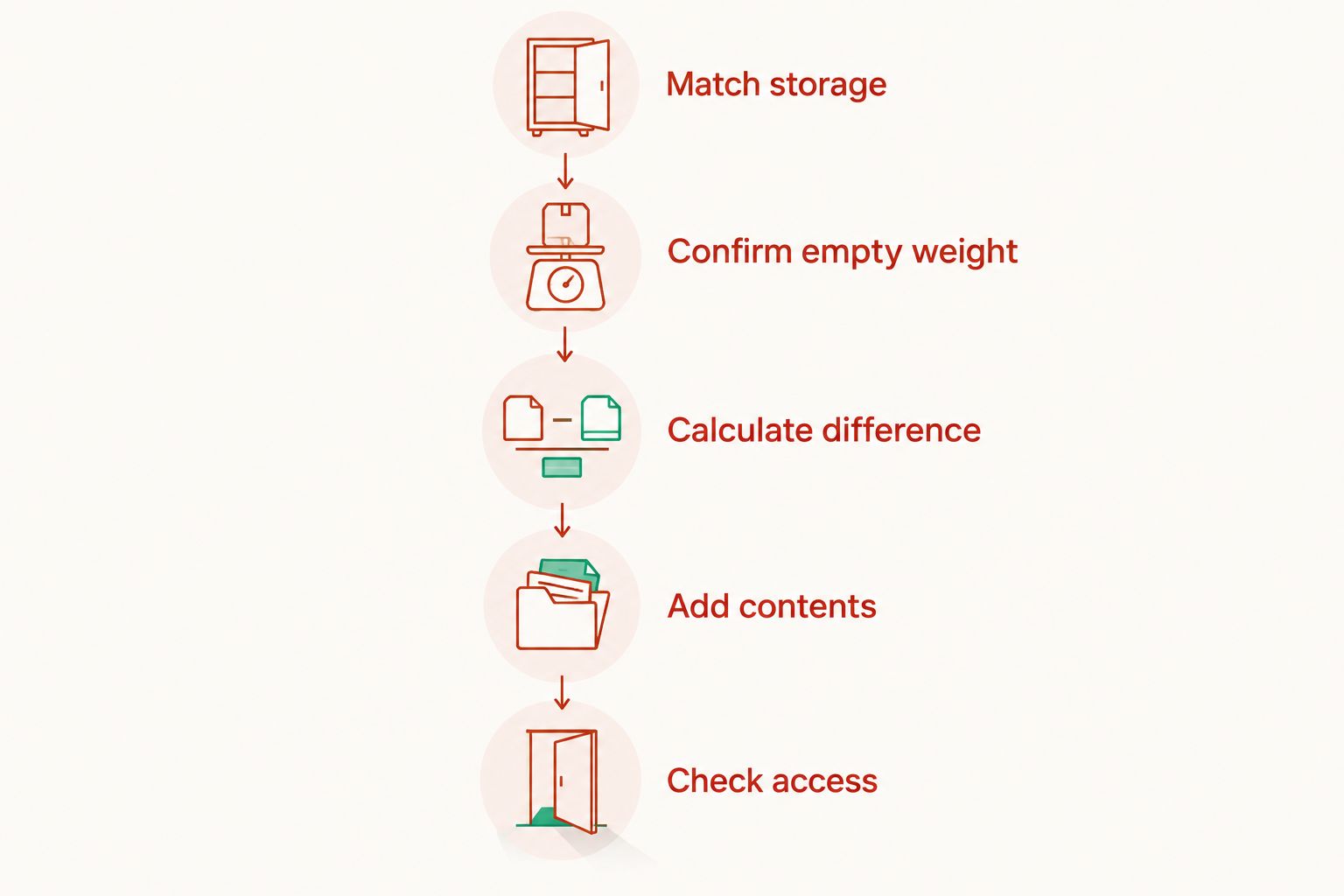
- Match storage. Select cabinets with comparable drawer layouts and usable filing space. Record external dimensions separately from internal capacity.
- Confirm empty weight. Obtain the empty weight for each exact model and configuration. Check the meaning of any unqualified weight entry.
- Calculate difference. Subtract the ordinary cabinet’s empty weight from the fire-resistant cabinet’s empty weight. Keep both measurements in kilograms.
- Add contents. Estimate the records and accessories planned for the cabinet. Keep this loaded-weight calculation separate from the empty-weight comparison.
- Check access. Assess the packaged delivery route and final position using the relevant dimensions and weights. Resolve handling and structural questions before ordering.
A comparison sheet is useful only when every entry refers to the same measurement basis. Keep the source specification with the sheet so the delivery team and facilities manager can identify exactly what each figure covers.
Before signing off the comparison, check that both models meet your document-protection requirements. Saving weight is not a useful outcome if the substitute no longer provides the protection or filing arrangement you need.
Does a two-hour fire rating mean twice the weight?
A 2 hours fire-protection statement does not mean twice the weight of a one-hour cabinet. Fire duration describes protection under the relevant test conditions, not a fixed quantity of protective material. Compare the exact empty weights and dimensions rather than multiplying by the rating.
Is a four-drawer cabinet twice as heavy as a two-drawer cabinet?
Four drawers do not establish twice the weight of two drawers. The cabinet body, drawer construction and protective barriers all contribute to total weight. Compare the exact models instead of scaling an assumed weight per drawer.
Can a fire-resistant filing cabinet go upstairs?
A fire-resistant filing cabinet belongs upstairs only after access and floor suitability have been assessed for that cabinet and location. Provide the intended loaded weight, cabinet dimensions and proposed position to the relevant building professional; ask the handling contractor to assess the route separately.
A lift reaching the correct floor does not settle the question. Its capacity and internal dimensions, the route beyond it and the final floor position each need checking.
What should you ask before ordering?
Ask for an exact-model specification and an access assessment, not a general assurance that office deliveries are routine. Keep the answers together so everyone works from the same cabinet configuration.
For a BUYASAFE filing cabinet enquiry in 2026, supply the model name, destination floor and a clear description of the route. Ask these questions:
- What is the empty, unpackaged weight of this configuration?
- What are the packaged weight and dimensions?
- Which internal fittings are included in the stated weight?
- What drawer clearance does the cabinet require?
- What access information does the handling contractor need?
- Are there manufacturer instructions governing positioning, levelling or restraint?
Do not remove drawers or dismantle a cabinet just to make it easier to move unless the manufacturer permits it. The correct handling method depends on the cabinet’s construction and instructions.
FAQ
How much does a fireproof filing cabinet weigh?
A fire-resistant filing cabinet’s exact weight depends on its model and configuration. Use the manufacturer’s empty-weight specification for cabinet comparisons, then account separately for contents and delivery packaging.
How much heavier is a fireproof filing cabinet than a normal one?
The extra weight is the fire-resistant cabinet’s empty weight minus the ordinary cabinet’s empty weight. Match size, drawer layout and capacity before treating the difference as a useful comparison.
Does a one-hour fire rating tell me the cabinet’s weight?
A 1 hour fire rating does not establish cabinet weight. It describes fire protection under the relevant test conditions; obtain the model’s weight specification separately.
Can I use shipping weight to check my office floor?
Shipping weight is not the same as the cabinet’s loaded operating weight. A floor assessment needs the cabinet, contents, proposed position and relevant structural details, not just the freight figure.
Is a heavier filing cabinet more fire resistant?
Greater weight does not establish better fire resistance. Compare the stated fire test or certification and its scope rather than using kilograms as a protection rating.
Can I move a fire-resistant filing cabinet with the files inside?
Empty the records before arranging a move and follow the manufacturer’s handling instructions. Have a suitable handling contractor assess the cabinet weight and route rather than relying on ordinary furniture-moving methods.
Will a fire-resistant filing cabinet protect computer backups too?
Document fire protection does not establish suitability for computer backup media. Check the protection specification for the exact media you intend to store, including any required data insert.
One last thing
The most useful weight figure is the one labelled for its purpose. Put empty weight, shipping weight and planned loaded weight on separate lines in your purchase record; that simple distinction prevents a freight specification from becoming an unsupported floor-loading assumption.
Before choosing the cabinet, confirm the protection first, the storage layout second and the handling requirements before payment. A lighter cabinet is only a better choice when it still meets the job.


