

Yes, a safe can be customised with extra shelves or drawers when its internal fittings and manufacturer-approved accessories support the change; adjustable shelving does not automatically mean you can add more shelves. For a 2026 purchase or retrofit, confirm compatibility, shelf loading and door clearance before ordering, and do not drill or weld the safe body to fit an organiser without the manufacturer’s approval.
- Can a safe be customised with extra shelves? Yes, where the model supports compatible shelves and fittings.
- Adjustable shelves change compartment heights; additional shelves require compatible supports and confirmed load limits.
- Drawers need clearance for their runners, handles and opening movement, not just space inside the safe.
- BUYASAFE lists CMI Premier safes with adjustable shelves; confirm extra-shelf compatibility for the exact model.
Can a safe be customised with extra shelves or drawers?
Yes, but distinguish rearranging the supplied interior from adding new fittings. Moving an existing shelf uses the safe’s intended adjustment system. Adding another shelf requires a compatible shelf and supports; fitting a drawer also requires room for the drawer assembly and its movement.
Start with the storage problem rather than the accessory. If you need separate levels for document folders, shelves address that need. If you need to sort small valuables, a removable tray avoids the installation work of a fitted drawer.
| Interior option | Best for | Main advantage | Main limitation |
|---|---|---|---|
| Repositioned shelves | Changing the height of existing compartments | Uses the supplied shelving system | Does not increase the number of shelves |
| Additional compatible shelves | Separating short items across more levels | Creates more storage levels | Requires suitable supports and confirmed loading |
| Fitted drawers | Regular access to organised small items | Brings contents forward for access | Runners and drawer sides consume usable space |
| Removable trays | Sorting jewellery, keys or small accessories | Can be lifted out for access | Does not provide a separate security rating |
For a new safe, choosing the right size safe for your home comes before planning its interior. Extra fittings organise capacity; they do not enlarge it.
Why this matters
A safe that holds your belongings in a single stack is not necessarily convenient to use. Shelves let you separate items, while drawers and trays keep smaller pieces together. Each fitting also occupies space that would otherwise hold contents.
For your 2026 shortlist, compare the usable layout rather than relying on external dimensions or a product photograph. The useful question is whether your largest item fits through the opening, sits in its intended compartment and comes out without disturbing everything else.
Choose the safe’s protection first, then organise the interior. A convenient drawer arrangement is not a substitute for the fire or burglary protection your contents require.
Adjustable shelves: check the supports before adding more
Adjustable shelving gives you flexibility within the positions provided by the manufacturer. It does not establish that spare shelves fit, that supports accept additional loading, or that every position remains usable beside the door mechanism.
Inspect the existing arrangement without dismantling the safe. Identify how the shelf rests on its supports and whether those supports are removable, fixed or part of a proprietary system. Send clear photographs to the supplier if the manual does not identify the fittings.
Before requesting an extra shelf, confirm:
- The exact safe model and its existing shelving arrangement.
- The compatible shelf and support components.
- The permitted load for the shelf and its supports.
- The clear space needed around the lock cover and boltwork.
- Whether the shelf can pass through the door opening during installation.
Best for: mixed-height contents such as folders, document wallets and small containers. The limitation is reduced vertical clearance: adding levels can leave you without a compartment tall enough for your largest item.
Keep a tall compartment in the plan if you store upright folders. Do not spread shelves evenly simply because the support positions allow it.
Fitted drawers: allow room for the complete assembly
A drawer is more than a box that fits between the safe’s walls. Its runners, mounting frame, front panel and handle all need clearance. The drawer must also travel through the opening without striking the open door or surrounding cabinetry.
Ask for a drawing of the complete assembly rather than a drawer’s internal dimensions alone. Check the usable drawer space separately from the space the assembly occupies. A deep-looking drawer front does not tell you how much storage remains behind it.
Best for: small items you retrieve frequently and want to keep separated. The drawback is the space taken by the drawer structure, especially in a compact safe.
If you need an independently locked compartment, specify that requirement explicitly. An ordinary drawer inside a locked safe is not the same thing as a separately lockable compartment, and a drawer lock does not establish a burglary rating.
For a 2026 order, request written confirmation that the proposed drawer assembly suits the exact safe model. Do not treat a photograph of another size in the same range as proof of compatibility.
Removable trays: organise without permanent mounting
A removable tray offers a simpler layout change when you need to separate small items rather than install sliding storage. Choose a tray that sits securely, fits through the opening and leaves the door’s closing path clear.
Best for: jewellery, watches, keys and other small items that become difficult to find in a deep compartment. The limitation is access: a tray stacked beneath another container still needs to be lifted out.
Check the tray with its contents in place. Handles, lids and protruding items all affect the fit, and an empty tray test does not establish that the loaded arrangement works.
Avoid describing an added tray as fire-resistant or security-rated unless its documentation supports that claim. Organisation and protection are separate functions.
Why safe customisation varies
The safe’s construction and intended storage layout determine what changes are practical. These checks explain why an accessory that works in one model is not automatically suitable for another:
- Support system: additional shelves need compatible mounting points, brackets or clips, not just the correct width.
- Door opening: an accessory must pass through the opening and remain clear of the door and locking components.
- Usable depth: the back wall, door-mounted components and drawer structure all affect the space left for contents.
- Contents and loading: a shelf intended for folders needs its load checked before you use it for concentrated heavy items.
- Protection requirements: confirm proposed alterations with the manufacturer rather than assuming the original rating covers a changed structure.
- Access requirements: frequently retrieved items need a layout that lets you remove them without unloading the safe.
For a 2026 retrofit, identify the safe before buying accessories. Record the model details from its documentation or identification plate; external resemblance alone is not a compatibility check.
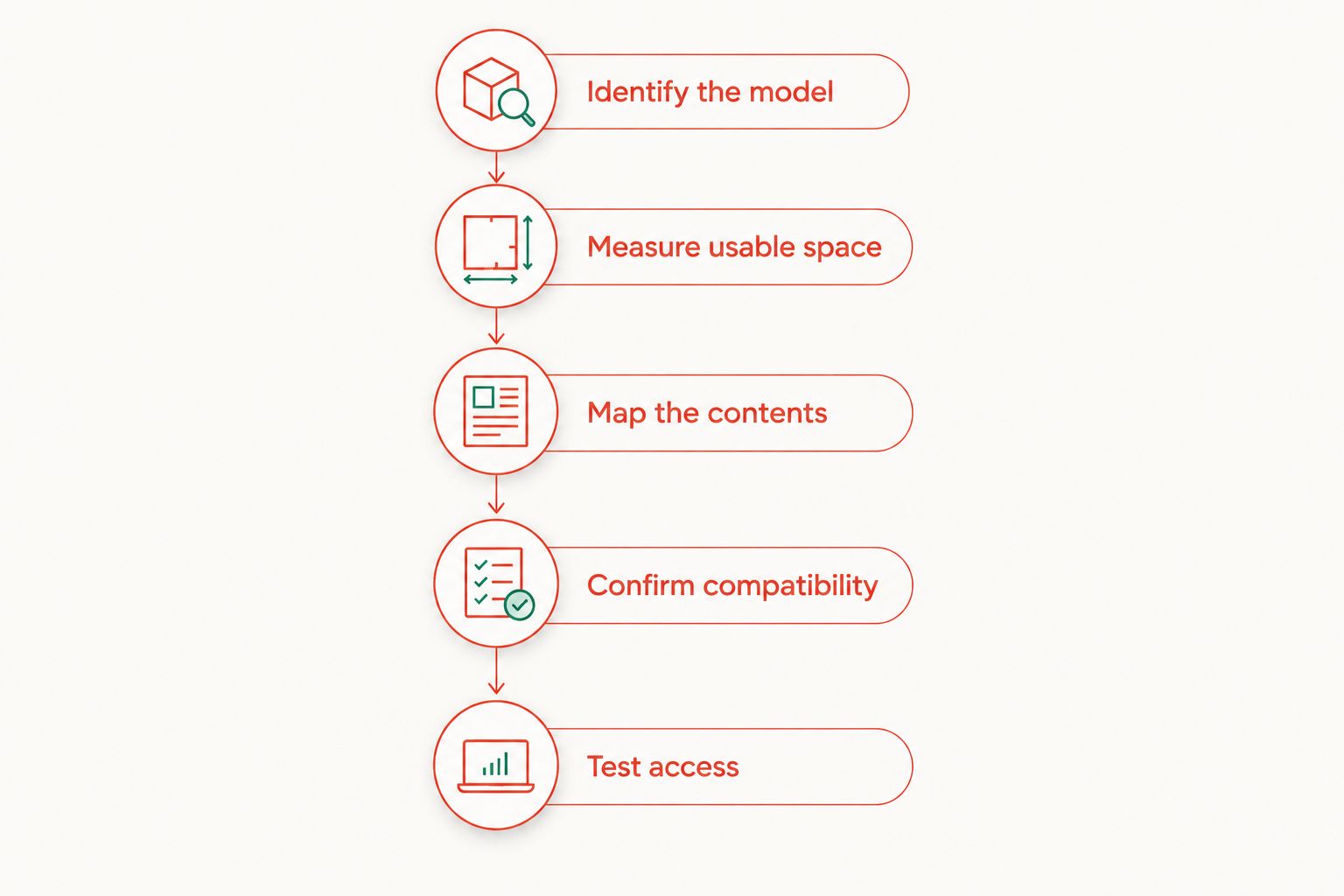
How to plan extra shelves or drawers
Use this sequence before ordering fittings or agreeing to modification work. It separates a storage preference from a layout that actually fits.
Identify the model
Record the manufacturer, model and existing fittings. Keep the manual and any supplied interior-layout information together so the supplier can check the same configuration you own.
For a second-hand safe, photograph the shelf supports and interior as well as the identification details. Do not remove protective covers to obtain a better picture.
Measure usable space
Measure the clear internal width, depth and height, then measure the door opening separately. Note anything that projects into the storage area, including the lock cover, boltwork covers and existing compartments.
Check the space with the door open in its installed position. A wall or cupboard beside the safe can restrict access even when the interior itself is wide enough.
Map the contents
Group belongings by size and how often you retrieve them. Put the tallest item into the layout first, then allocate the remaining space to shorter items and organisers.
Make a simple sketch showing what belongs in each compartment. This gives the supplier a clearer brief than asking for the maximum possible number of shelves.
Confirm compatibility
Ask the supplier to confirm the accessory, supports, load limits and installation method for the exact model. If a proposal involves drilling, welding or changing existing components, obtain manufacturer approval before proceeding.
Also ask how the proposed work affects the safe’s documented protection and warranty terms. Keep the response with the safe’s records rather than relying on a verbal assurance.
Test access
After fitting, check that shelves sit securely and drawers move freely. Keep contents away from moving locking components and confirm the door closes without pressure from stored items.
Follow the manufacturer’s instructions for any operational checks. Never force the handle against an obstructed door.
Existing adjustable-shelf examples to compare
BUYASAFE suits Australian home and business buyers comparing safe storage layouts. Its listed CMI Premier models provide concrete examples of adjustable shelving, but their descriptions do not establish that extra shelves or drawer kits fit.
| Model | Best for | Confirmed interior feature | What still needs confirmation |
|---|---|---|---|
| CMI - PRA - Premier Torch and Drill Resisting Safe (TDR) | Buyers seeking supplied adjustable shelving | 2 adjustable shelves | Extra-shelf compatibility, shelf loading and drawer options |
| CMI - PRB - Premier Torch and Drill Resisting Safe (TDR) | Buyers seeking supplied adjustable shelving | 2 adjustable shelves | Extra-shelf compatibility, shelf loading and drawer options |
Both listed CMI Premier models have 2 adjustable shelves. Their descriptions also specify 2 x 20mm recessed bolt holes and a digital lock powered by a 9V battery. When planning the interior, retain the access required for installation and lock maintenance under the manufacturer’s instructions.
The supplied descriptions do not establish a shelving advantage between these models. Compare the full dimensions and loading information before choosing; do not interpret the model letters as a capacity measurement.


For a 2026 enquiry to BUYASAFE, send your model details, interior measurements and contents sketch together. Ask for confirmation of the proposed arrangement, not simply whether the safe is customisable.
Can I add shelves to a safe I already own?
Yes, if the existing model supports compatible additional shelves and fittings. Start with the manufacturer’s documentation and identify the supports before ordering a shelf made to match the interior width.
A shelf that fits the space still needs proper support and a confirmed load limit. If no approved additional shelving is identified, use the existing adjustment system or ask about a removable organiser that requires no structural alteration.
Should I buy a drawer safe instead of adding drawers later?
Choose a purpose-built drawer layout when routine filing access is your main requirement, and compare its protection separately. Retrofitting drawers into a conventional safe requires checks that a supplied drawer system already addresses through its intended design.
For example, the Guardall GDF4000 fire-resistant filing cabinet safe is listed with certified 1-hour fire resistance and a digitally operated top locking drawer. That makes it relevant to document-storage comparisons, not proof that its drawers can transfer into another safe.
Best for: buyers whose main task is accessing filed paperwork. The limitation is that a filing layout needs a separate fit check for bulky valuables and other non-document contents.
FAQ
Can a safe be customised with extra shelves after purchase?
Yes, when the exact safe model supports compatible additional shelves and supports. Confirm fit, load limits and the installation method before ordering.
Does adjustable shelving mean I can add unlimited shelves?
No, adjustable shelving means you can change the positions of compatible shelves within the intended support system. Additional shelves still require compatibility and loading checks.
Can I drill holes inside a safe to fit drawer runners?
Do not drill the safe to fit drawer runners without the manufacturer’s approval. Confirm the installation method and its effect on the safe’s documented protection and warranty terms first.
Are removable trays as secure as fitted drawers?
A removable tray organises contents; it does not provide a separate security rating. A fitted drawer also needs its own documentation before you treat it as an independently protected compartment.
Which listed CMI safes have adjustable shelves?
The CMI PRA and CMI PRB Premier Torch and Drill Resisting safes are each listed with 2 adjustable shelves. Confirm extra-shelf and drawer compatibility separately for the exact model.
Will extra shelves make my safe hold more?
Extra shelves create more storage levels, not more internal volume. They help separate short items but reduce the clear height available in each compartment.
What should I send BUYASAFE when asking about safe shelves?
Send BUYASAFE the safe’s manufacturer and model details, clear interior measurements, photographs of the supports and a sketch of your intended layout. Ask for confirmation of compatible fittings and loading before proceeding.
One last thing
The door opening can rule out an accessory that fits inside the safe. Check both measurements before ordering a rigid shelf or drawer assembly, especially for an existing installation where the door cannot open fully.
Make access the final test. If you must empty a compartment to retrieve its most-used item, change the layout before adding more fittings.


