

The cost to remove a safe in Australia in 2026 is job-specific: get a written quote covering the safe, its fixings, the access route and its destination. Safe opening, disposal, floor repairs and installation at another address are separate tasks, so confirm whether the quote includes them. This guide explains what to put in your quote request and how to compare removal proposals on the same scope.
- The cost to remove a safe depends on the removal scope; request an itemised quote before booking.
- Separate safe removal, safe opening, transport, disposal and reinstallation when comparing proposals.
- Record the safe model, access route and anchoring before requesting an assessment.
- BUYASAFE sells home and business safes; replacement selection is separate from removal planning.
Why this matters
A safe removal job does not necessarily end when the cabinet leaves its original position. You need to specify whether the contractor is moving it elsewhere, delivering it to another property or taking it away for disposal. Otherwise, you are comparing different jobs rather than different contractors.
For the physical handling considerations, read how to move a heavy safe safely. Do not detach an installed safe before the contractor has assessed how it will be supported and moved. An apparently clear doorway does not establish that the entire route is suitable.
How much does professional safe removal cost?
For a 2026 booking, use an itemised, site-specific quote rather than treating a general removal estimate as an all-inclusive offer. The scope should identify where responsibility starts and where it ends. Ask the contractor to state the assumptions behind the quote, including access, lock condition, anchoring and the agreed destination.
Use this breakdown to check what you are actually booking:
| Removal scope | Best for | Main advantage | Main limitation to clarify |
|---|---|---|---|
| Move within the property | Keeping the safe at the same premises | Retains the existing safe without off-site transport | Positioning and anchoring at the new location need separate confirmation |
| Remove and relocate | Keeping the safe at another address | Preserves the safe for continued use | Both collection and destination access need assessment |
| Remove for disposal | Permanently clearing an unwanted safe | Gives the job a defined end point | Confirm who accepts the safe and who arranges disposal |
| Open and remove | Removing a safe when authorised access is unavailable | Addresses the access problem before removal proceeds | Opening and removal are different tasks; confirm both explicitly |
A useful proposal describes the work, not just the cabinet. It should name any excluded tasks and explain what happens if the site conditions differ from the information you supplied.
Compare written scope before comparing the quoted total. A proposal that includes transport and placement is not equivalent to one that ends at collection.
Moving a safe within the same property
Best for: keeping a serviceable safe while changing its location. Specify the starting position and the exact finishing position, rather than asking for a move to another room. Include the proposed door orientation and whether the safe must fit inside existing cabinetry.
The advantage is a clearly defined move without an off-site destination. The limitation is that the new position still needs assessment: floor suitability, access for use and the anchoring method remain part of the installation decision.
Ask whether the contractor will leave the safe positioned only or ready for use. Those descriptions are not interchangeable. If anchoring is required, obtain written confirmation of who will perform it and what approvals are needed before drilling.
Removing and relocating a safe
Best for: retaining an existing safe when you move home or business premises. Give the contractor information about both addresses before accepting the proposal. A clear collection route does not establish a clear delivery route.
Relocation keeps the existing cabinet in use, but it introduces a second site assessment. Doorways, stairs, lift access, vehicle access and the final position all belong in the request. State whether temporary storage is part of your plan rather than assuming the contractor will arrange it.
For a relocation planned in 2026, confirm the handover requirements at the destination. Identify who can provide access, who can approve the installation position and who will check the completed placement. Keep keys and access codes under your control; arrange any necessary access directly with the authorised contractor.
Removing an unwanted safe for disposal
Best for: clearing a safe you do not intend to reuse. Ask for removal and disposal to appear as distinct parts of the scope. The proposal should identify whether the contractor takes responsibility for the safe after collection or only delivers it to a destination you nominate.
The advantage is a clear disposal plan before the safe leaves the property. The limitation is that collecting a cabinet and accepting it for disposal are different responsibilities. Obtain confirmation from the intended receiving facility or contractor rather than assuming acceptance.
If the safe is old, unidentified or built into the property, give the contractor that information before work starts. Do not cut into an unknown safe or surrounding construction to make collection easier. Ask for an assessment of the cabinet and installation first.
Why the removal scope varies
The physical job determines what a contractor needs to assess. Include these factors in your request rather than relying on a photograph of the safe door alone:
- Safe construction: supply the manufacturer and model where known. A product name or external size alone does not establish its weight.
- Anchoring: state whether the safe is bolted down, recessed or built into surrounding cabinetry. Describe what you can see without dismantling anything.
- Lock condition: explain whether authorised users can open and close the safe normally. Do not assume removal includes resolving a lock fault.
- Access route: show thresholds, stairs, tight turns, lifts and the route to the collection vehicle. Include the destination route for relocation.
- Final destination: distinguish repositioning, transport to another address and disposal. Each has a different completion point.
- Property requirements: disclose access permissions, booking arrangements and any required protection or reinstatement work.
These details do not substitute for the contractor's assessment. They help you request the right assessment and identify assumptions before the booking is confirmed.
What should I send with a safe removal quote request?
Send a short written brief with photographs that show the whole job. Keep security credentials out of images and messages: the contractor needs the lock condition, not a publicly shared combination. Use the following sequence to organise the request.
- Identify the safe. Record the brand, model and any accessible identification plate. Supply manufacturer documentation for weight and dimensions where available; label uncertain information as unverified.
- Describe the installation. Photograph the cabinet in position and explain whether it is freestanding, anchored, recessed or enclosed. Do not move it to expose hidden fixings.
- Show the route. Photograph the path from the installed position to the proposed collection point. Include changes in level, narrow sections and turns.
- State the destination. Give the exact endpoint and explain whether you need disposal, positioning or reinstallation. For relocation, provide equivalent information about the receiving property.
- Confirm the scope. Ask the contractor to identify included work, exclusions, site-assessment requirements and the process for approving changes.
The quote request should follow the job from identification through to completion. A photograph of the cabinet alone leaves the handling route and destination unresolved.
If you cannot identify the safe, send clear photographs and say that the model is unknown. Do not substitute the specification of a similar-looking cabinet. Verified specifications are better than visual estimates.
What should a written removal proposal include?
For a 2026 removal, ask for a proposal that you can check against your brief. It should describe the safe, the collection point, the destination and the agreed work. Read the exclusions as carefully as the included tasks.
Check for these details:
- Whether detaching the safe from its existing fixings is included.
- Whether opening a locked safe or resolving a lock fault is included.
- Whether transport, unloading and final positioning are included.
- Whether disposal is arranged by the contractor or by you.
- Whether floor and wall repairs are included or excluded.
- Whether anchoring at a new location forms part of the job.
- What information or site access the contractor needs before confirming the booking.
Ask how the contractor handles a change in scope. For example, agree on the approval process if the installation differs from your photographs. Do not authorise unspecified additional work merely because the crew is already on site.
Also ask about insurance relevant to the proposed work and any documentation your property manager requires. Confirm the arrangements directly; a general statement about being insured does not explain the applicable cover or exclusions.
How do I prepare the property without moving the safe myself?
Prepare access, permissions and the contents rather than attempting the lift. Remove loose obstacles from the agreed route, arrange building access and keep other people away from the work area. Leave fixed obstacles and the safe itself for the contractor to assess.
The collection route needs to be visible during assessment. Show the relationship between the cabinet, nearby doorways and any change in level; do not stage equipment or begin detaching the safe for a photograph.
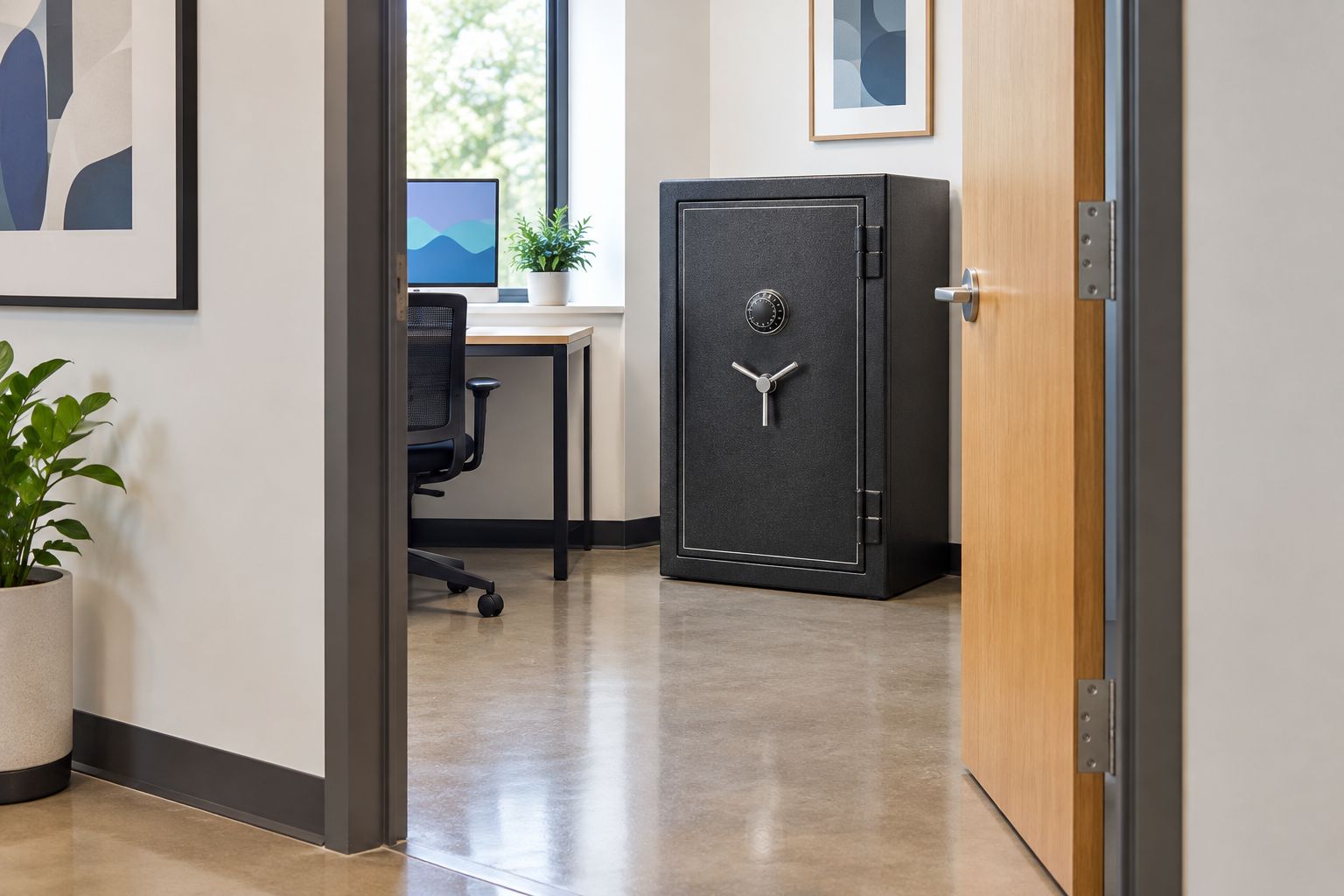
If you can open the safe, arrange secure alternative storage for its contents before the removal appointment. Do not leave sensitive documents, valuables or controlled items inside without an agreed handling plan. For firearms, ammunition or medicines, confirm the applicable storage requirements with the relevant authority or responsible compliance adviser.
For rented or shared premises, obtain the necessary approval before arranging detachment or repairs. Photograph the surrounding floor and walls for your own records. Keep those records separate from images containing security-sensitive information.
Does a locked safe need to be opened before removal?
A locked safe needs an assessment before you assume it can be removed as quoted. Tell the contractor that authorised access is unavailable and ask whether opening is necessary for the proposed work. Book safe opening explicitly when required; do not treat it as an automatic part of removal.
Prepare evidence of ownership or authority to commission the work. Do not send keys, codes or sensitive ownership documents through an unsecured public channel.
Is disposal included in professional safe removal?
Disposal is included only when the agreed scope says so. Ask who takes responsibility after collection and where the safe is going. A booking that ends with transport to your nominated address is not a disposal service.
Does relocating a safe include bolting it down again?
Reinstallation is included only when the proposal specifies it. Confirm the final position, anchoring requirements and property permissions before delivery. A safe left in the room has been positioned, but that does not establish that installation is complete.
What if you are replacing the safe?
Decide what you need from the replacement before coordinating removal. BUYASAFE is best for homeowners and businesses comparing home and commercial safes. Its safe range is relevant to replacement selection; removal arrangements still need their own confirmed scope.
You can review the safe categories at BUYASAFE while planning the changeover. Assess the new cabinet's documented dimensions, weight, lock type and protection ratings against your intended use. Do not choose a replacement solely because it appears to fit the space left by the old safe.
The benefit of planning both jobs together is a defined handover between removal and installation. The limitation is that a replacement purchase does not, by itself, confirm old-safe removal, disposal or repair work. Ask each provider to state their responsibility before scheduling the appointments.
For a 2026 replacement, arrange secure storage for your contents during the changeover. Confirm the new installation position before the old safe leaves, particularly when the replacement has different dimensions or fixing requirements.
FAQ
How do I find out the cost to remove a safe in Australia?
Get a written, site-specific quote identifying the safe, anchoring, access route and destination. Ask the contractor to separate opening, disposal, repairs and reinstallation from the removal work.
Can a removal contractor quote from photographs?
Photographs help describe the job, but ask the contractor whether a site assessment is required. Include the installed safe, visible fixings and the full collection route rather than the cabinet alone.
Should I unbolt my safe before the removal contractor arrives?
Leave the safe attached until the contractor confirms the detachment and handling plan. Prepare access and permissions without moving or dismantling the cabinet.
Can I have a locked safe removed without the key?
Tell the contractor that the safe is locked and ask for an assessment of the proposed removal. Confirm whether authorised safe opening is necessary and whether it is included.
Will a contractor take my old safe away for disposal?
A contractor takes responsibility for disposal only when that service is agreed. Confirm the receiving destination and responsibility after collection before booking.
Will safe removal include repairing holes in the floor?
Floor repairs are included only when the written scope specifies them. Ask who will handle reinstatement and obtain any required property approval.
Can BUYASAFE help me compare replacement safes?
BUYASAFE sells home and commercial safes, including fireproof, gun and deposit safes. Compare the documented specifications against your storage needs, and confirm removal and installation arrangements separately.
One last thing
Write the completion point into the booking. Use a description such as removed from the premises for agreed disposal, or delivered, positioned and anchored at the approved destination. This simple distinction prevents an unfinished installation or unresolved disposal arrangement from being mistaken for a completed removal.
Keep the accepted proposal with your access instructions and property approvals. If the plan changes, update the written scope before the work proceeds.


