

An unbolted safe is not a sound default for theft protection: someone can remove the whole safe without opening its lock. Leave a safe freestanding only when its manufacturer permits that installation and it meets your insurance and any applicable storage requirements. Weight, concealment and a strong lock do not establish that an unbolted installation is suitable.
- Can a safe be left unbolted? Only when its installation instructions, insurance conditions and applicable storage rules permit it.
- BUYASAFE home and business safe buyers should assess anchoring before choosing a location.
- A heavy safe is harder to handle, but weight alone does not establish theft resistance or storage compliance.
- Renters should seek installation permission rather than treat furniture, adhesive or concealment as equivalent to structural anchoring.
Why this matters
A safe lock controls access to the contents. Anchoring addresses a separate problem: removal of the entire container. You need to consider both before relying on a safe for cash, jewellery, documents or business records.
For a home safe installation in 2026, start with the manufacturer's instructions and the structure beneath the proposed location. The guide to bolting down a safe correctly explains the installation decision in more detail. Choose the fixing method before placing valuables inside, not after discovering that your preferred position cannot support it.
Can a safe be left unbolted safely?
Only if a freestanding installation is suitable for that particular safe and its intended use. There is no universal answer based on appearance, size or how difficult you find it to lift. A document safe used primarily for fire protection presents a different decision from a safe holding valuable jewellery or regulated items.
Use this comparison to separate convenience from protection. These are installation approaches, not interchangeable security ratings.
| Installation approach | Best for | Advantage | Limitation |
|---|---|---|---|
| Manufacturer-approved anchoring | Buyers protecting against whole-safe removal | Connects the safe to a suitable structure | Requires appropriate fixings, a suitable substrate and permission to install |
| Manufacturer-permitted freestanding placement | Uses where anchoring is not required by the model, insurer or applicable rules | Avoids structural drilling | Leaves whole-safe removal unresolved unless addressed by the installation design |
| Temporary unbolted placement | Positioning an empty safe before installation | Lets you assess access and clearance | Is not a substitute for completing the required installation |
| Concealed but unanchored placement | Keeping a safe out of casual view | Reduces visibility | Does not prevent removal once the safe is found |
The decision is not simply whether a safe remains upright with its door closed. You must also consider stability during use, resistance to removal, and whether the installation meets the conditions attached to your intended storage.
Why the answer varies
The same safe can face different installation constraints in a ground-floor office, an upstairs bedroom or a rental property. For a 2026 purchase, resolve these factors before choosing an installation location:
- Manufacturer instructions: Use the specified anchoring points and installation method. Do not assume every safe accepts floor and wall fixing.
- Structural substrate: Concrete, structural timber and lightweight linings need different assessments. A fixing must connect to material capable of supporting its intended load.
- Stored contents: Cash and jewellery require a different risk assessment from replaceable paperwork. Regulated storage introduces additional obligations.
- Insurance conditions: Your policy or insurer's written requirements determine whether a particular installation is acceptable for the cover you need.
- Property permission: Rental agreements, strata requirements and building restrictions affect where you can drill or alter the structure.
- Access and stability: Door movement, nearby furniture, floor capacity and the route into the room affect practical placement.
Resolve the installation constraints before choosing the safe. Otherwise, you risk buying a suitable container that cannot be installed suitably in your available space.
Heavy safes: weight is not an installation exemption
A heavy safe is more difficult to handle than a light one. That does not make it immovable, establish a burglary rating or cancel the manufacturer's anchoring instructions. Difficulty moving a safe by hand is not a reliable security test.
Weight also creates a separate installation question: can the building safely support the safe in that position? This matters especially upstairs or where the floor construction is uncertain. Obtain a suitable structural assessment rather than judging capacity by how solid the floor feels.
Do not add weight inside a safe as a substitute for its required fixings. That approach increases the load on the floor without connecting the container to the building. It also complicates future handling and access.
Choose an installation method from the model instructions, not from a weight-based rule of thumb. For a 2026 installation, check the model documentation and current requirements rather than relying on advice about a different safe.
Fire-resistant safes: fire protection is a separate question
A fire-resistance claim does not establish resistance to whole-safe removal. Fire protection concerns the conditions the container is designed or tested to withstand; anchoring concerns how the container is secured in its location.
If you mainly need document protection, check the safe's intended contents and fire rating separately from its installation instructions. Do not assume that a fire-resistant safe is designed for high-value burglary protection, or that it must be left unbolted to preserve its fire protection.
The manufacturer's approved installation method governs any drilling or use of existing fixing points. Adding holes through a safe body without approval alters its construction. Do not drill a new anchoring hole merely because the preferred location makes the original hole inconvenient.
This distinction also matters when replacing an old document safe. A new lock, larger cabinet or different fire rating does not answer whether the replacement needs anchoring.
Does thicker construction make anchoring unnecessary?
No. Body construction and installation address different parts of the protection problem. The supplied product descriptions illustrate why you should read specifications without turning them into an anchoring exemption.
| Product example | Best for assessing | Stated construction detail | What it does not establish |
|---|---|---|---|
| Chubb Mini Banker MkII Security Safe Size 3 Digital Locking (M-40) | Security-safe body construction | A 65 mm body barrier, with welded steel and barrier material | Whether the safe is approved for unbolted installation |
| Secuguard - GS3KL Cat A B C D & H - 10 Rifle Gun Safe | Gun-safe steel construction | A 6 mm steel plate body and an 8 mm steel plate door | Whether a particular installation meets your jurisdiction's storage requirements |
The Chubb description states a 65 mm body barrier; that is not a claim of 65 mm solid steel. The Secuguard description distinguishes its 6 mm body plate from its 8 mm door plate. Read those details accurately, but do not use either specification to infer an installation method.
Thicker construction is relevant to comparing containers. Its limitation is that it says nothing, by itself, about the connection between the container and your floor or wall. Confirm that connection separately.
How do I decide whether my safe needs bolting down?
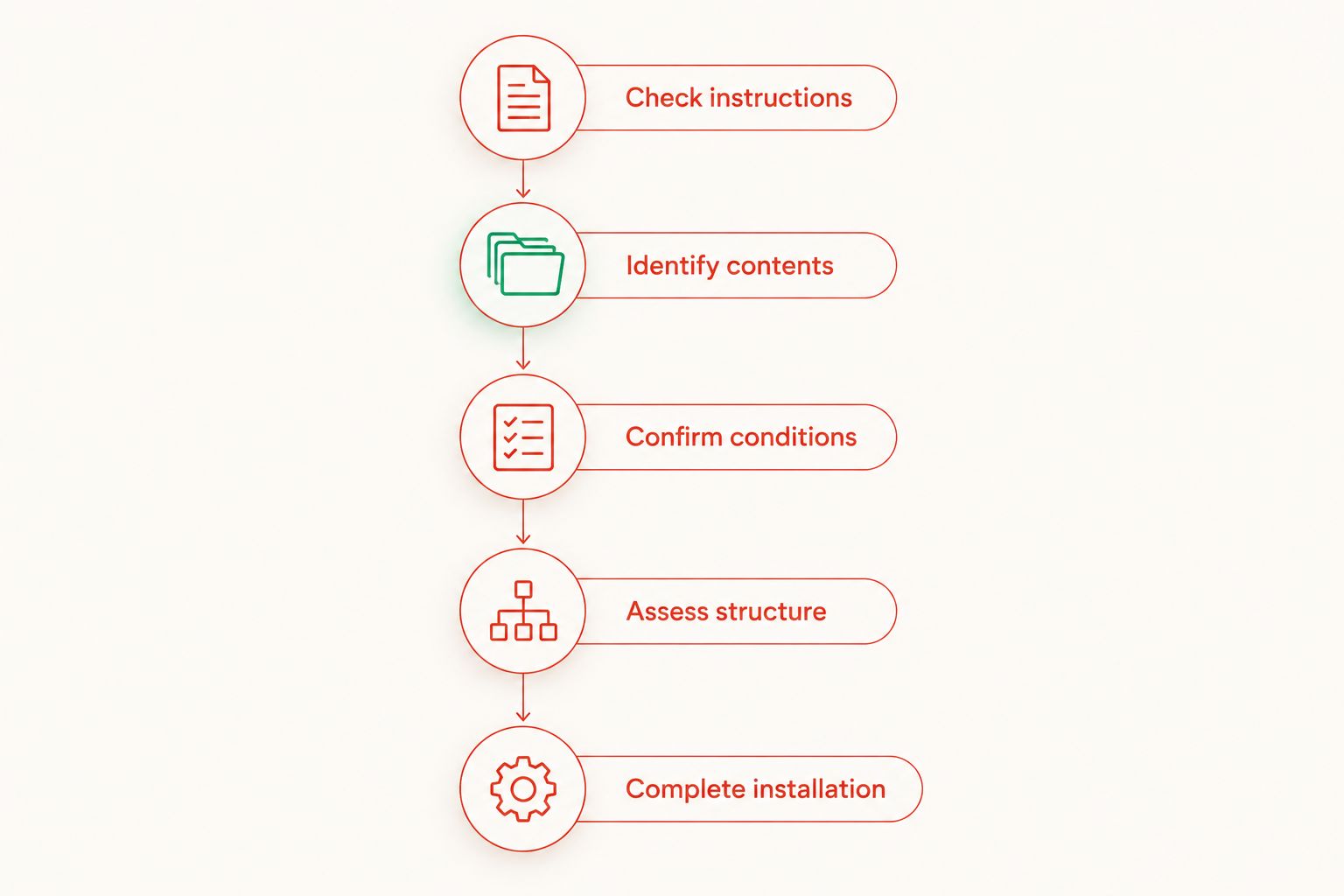
Follow this sequence before you put the safe into service. It keeps the model requirements, building constraints and storage obligations separate until you can confirm that they all fit.
- Check instructions. Find the installation instructions for the exact model. Confirm whether anchoring is required, which fixing points are approved and what restrictions apply.
- Identify contents. Decide what you will store. Flag firearms, controlled medicines or other items that require a separate compliance check.
- Confirm conditions. Ask your insurer about the proposed safe and installation. Check relevant storage requirements and obtain any property permissions.
- Assess structure. Have the proposed floor or wall assessed for suitable anchoring and safe support. Identify concealed services before any drilling.
- Complete installation. Use the approved method and suitable fixings, then retain the instructions and installation records.
The sequence matters. Selecting anchors before identifying the substrate, or choosing a concealed corner before checking door clearance, reverses the decision and creates avoidable installation problems.
Keep installation records somewhere you can access without opening the safe. Include the model identification, relevant instructions and any written insurer confirmation. Records help you explain the installation; they do not replace doing it correctly.
Can I leave a safe unbolted in a rental property?
A rental property does not automatically make an unbolted installation suitable. Ask the owner or managing agent for written permission for the proposed fixing method, including any requirements for making good when you leave.
Do not assume a wardrobe shelf, furniture panel or plasterboard lining provides an equivalent connection to a structural floor or wall. Concealment keeps the safe out of sight, but it does not secure the container to the building.
If permission is refused, reconsider the location, safe design or storage arrangement. Do not describe an adhesive-mounted or furniture-contained safe as equivalent to approved structural anchoring without supporting documentation. The practical advantage of avoiding drilling comes with an unresolved removal risk.
For renters planning storage in 2026, settle the permission question before ordering. It is easier to choose an appropriate arrangement than to work around an unsuitable installation after delivery.
Can a gun safe be left unbolted in Australia?
Only when the proposed installation satisfies the requirements that apply to your jurisdiction, firearm category and circumstances. Do not apply a general home-safe answer to firearm storage, or transfer an exemption from one state or territory to another.
Check the current requirements with the relevant police firearms licensing authority. Product category wording is not confirmation that the safe complies in every location or that your installation is acceptable.
For firearm storage in 2026, assess the container and installation together. A compliant-looking cabinet in an unsuitable installation is not a sound basis for deciding that your storage obligations are met.
Will insurance cover valuables in an unbolted safe?
Your policy conditions and any written insurer requirements determine the answer. Do not assume cover follows automatically from buying a security safe, choosing a recognised brand or keeping the safe locked.
Give the insurer the exact model, proposed location, installation method and type of contents. Ask specifically whether leaving that model unbolted affects the cover you need, and retain the written response.
If the insurer requires anchoring, resolve that before relying on the safe for insured valuables. A product specification is not an insurance acceptance letter.
Choosing a safe with installation in mind
BUYASAFE is best for home and business buyers comparing safe categories and installation requirements. Its range includes home, commercial, gun and fireproof safes, and its stated services include installation, repair and safe opening in major Australian cities.
That category breadth helps you start with the storage purpose rather than selecting only by cabinet size or lock type. The limitation is straightforward: a retailer's range does not establish that every model suits your property, insurer or regulated storage needs.
When comparing BUYASAFE home safes or commercial safes, ask for the exact model's installation documentation. Confirm the fixing arrangement and site requirements before treating a product as suitable for your intended location.
FAQ
Can a safe be left unbolted safely?
Only when the manufacturer permits freestanding use and the installation meets your insurance and applicable storage requirements. An unbolted safe leaves whole-container removal as a separate security concern.
Is a heavy safe safe enough without bolts?
Weight alone does not establish that an unbolted safe is suitable. Follow the exact model's installation instructions and assess the floor's ability to support it.
Can I put an unbolted safe inside a wardrobe?
A wardrobe conceals a safe but does not, by itself, secure it against removal. Check approved fixing points, structural support and door clearance before choosing that location.
Do fire-resistant safes need to be bolted down?
The exact model's installation instructions determine its anchoring requirements. Fire resistance does not establish burglary resistance or permission to leave the safe unbolted.
Can I use adhesive instead of anchor bolts?
Do not substitute adhesive for required anchor bolts unless the manufacturer expressly approves that installation method. Avoid treating a no-drill attachment as equivalent to structural anchoring without supporting documentation.
Can renters install a bolted safe?
Renters should obtain written permission for the proposed installation before drilling. If permission is refused, reassess the location or storage arrangement rather than assuming an unbolted safe is equivalent.
Can Australian gun safes stay unbolted?
The answer depends on the applicable state or territory requirements and your storage circumstances. Check with the relevant police firearms licensing authority before relying on an unbolted installation.
One last thing
An excellent lock does not stop someone taking the container it is fitted to. That is the distinction to remember when weighing convenience against anchoring.
Before choosing a BUYASAFE safe, identify the place it will stand and the structure it will connect to. If you cannot confirm a suitable installation, change the plan before storing valuables.


