

A small home safe holds the items that fit through its door and within its clear internal space, not everything its exterior size suggests. A model listed as 15 litres gives you a volume reference, but it does not tell you whether a document folder, jewellery case or device fits. In 2026, check internal height, width, depth and door clearance before choosing a safe.
- How much can a small home safe hold? Judge the contents by internal dimensions and door clearance, not exterior size.
- A 15-litre label describes volume; it does not confirm that a particular folder or device will fit.
- Buy A Safe is best for Australian homeowners comparing compact fire-resistant and security safes against a specific storage list.
- Choose fire protection and theft resistance separately; neither rating tells you how much usable space remains.
Why this matters
A safe can have room on paper and still fail a simple fit test. A folder might fit inside the cabinet but not pass through the door opening; a jewellery box might fit only after you remove a shelf. If you are still deciding what needs storage, the guide to choosing the right size safe for your home is a useful starting point.
The buying decision in 2026 is therefore about the shape of your contents as much as total volume. Make a list of what must go inside, measure the largest item, then check the safe’s published internal dimensions. Do not substitute exterior dimensions for that check.
How much can a small home safe actually hold?
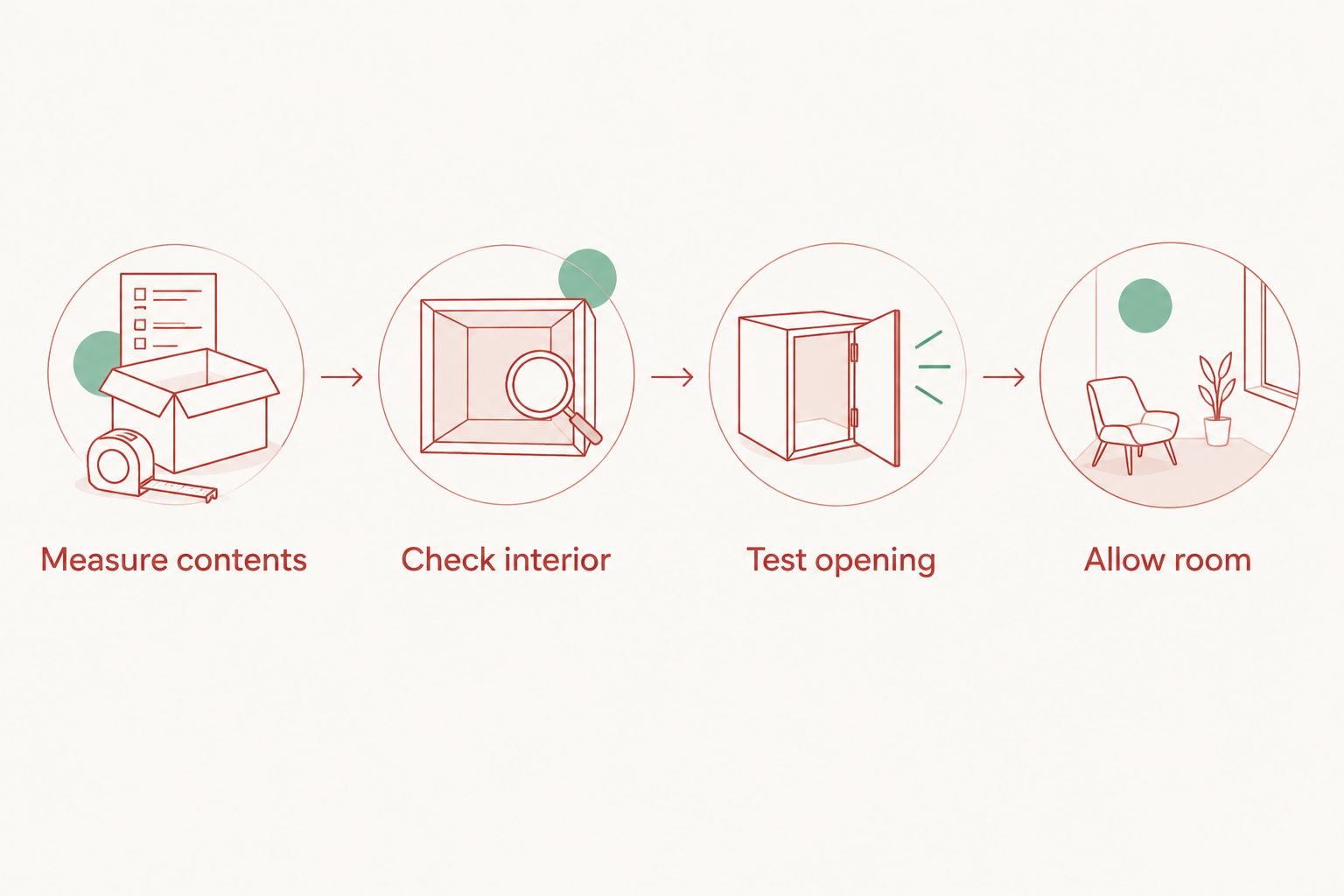
There is no reliable item count for a small home safe without the model’s internal dimensions and your contents. A stated volume helps compare overall space, while internal measurements and the door opening determine whether a specific object fits. Use this order when assessing a listing:
- Measure contents. Record the height, width and depth of the largest rigid item in its normal storage position. Include its folder, box or case if that stays on it.
- Check interior dimensions. Compare every side of that item with the safe’s stated usable space. Check whether an internal shelf changes the available height.
- Test the opening. Confirm that the item can pass through the door, not just sit inside the cabinet. Ask for the clear opening dimensions if the listing omits them.
- Allow room to use it. Leave space to lift out regularly used items without unloading everything stacked above them.
A litre figure does not replace these steps. The Burg Wachter Combi-Line 15-Litre Safe is identified as a 15-litre model in its product title, but that label alone does not establish the dimensions of a folder it will accept. In 2026, treat litre capacity as a comparison point and item fit as the final test.
What fits depends on what you are storing
For passports, small documents and jewellery, the constraint is often organisation: you need to reach one item without disturbing another. For a document folder, the constraint is its width and the angle needed to move it through the door. For a device, measure the device and its protective case rather than assuming a capacity label settles the question.
Keep the storage list specific. Instead of writing documents, list the actual folder or envelope. Instead of writing valuables, note whether those valuables stay in presentation boxes. This turns an uncertain question about how much a small home safe holds into a fit check you can complete before buying.
Compare small-safe options by purpose, not their names
The product titles below identify different intended uses, but the supplied information does not give comparable internal measurements. None is a confirmed fit for your belongings until you check its internal dimensions and clear door opening.
| Option | Best for | Advantage | Limitation to check |
|---|---|---|---|
| LOCKTECH - Compact Small Fire Resistant Safes | A buyer seeking a compact fire-resistant safe for home or office use | Its listing identifies fire resistance as a feature | The supplied details do not confirm usable dimensions or the fit of any particular document |
| Chubb Mini Banker MkII Security Safe Size 3 Digital Locking (M-40) | A buyer prioritising a security safe with digital locking | Its listed construction includes a 65 mm body barrier | A thick body does not tell you how much clear storage space remains |
| Burg Wachter Combi-Line 15-Litre Safe | A buyer who wants a stated volume to begin a shortlist | Its title provides a 15-litre capacity reference | Volume alone does not confirm that a rigid item passes through the door |
Verdict: Select by the contents you can measure, then compare the protection features of models that pass the fit test. Do not choose a safe because its name includes compact, mini or a size number; those words are not interchangeable interior-capacity measurements.
Which type of small safe should you choose?
Start with what needs protection. A compact fire-resistant safe, a security safe and a document safe answer different requirements, even when each looks suitable for a shelf or cupboard. Buy A Safe lists fire-resistant and security options, but you still need each model’s specifications before settling on capacity.
Compact fire-resistant safe
Best for: Someone whose shortlist begins with fire protection for appropriate contents. Check the product’s stated fire rating and what that rating covers, as well as its internal measurements. A fire-resistant exterior can look roomy while its usable interior is more limited than you expected.
The advantage is a stated fire-resistance purpose. The disadvantage for this question is that the product category alone gives you no assured fit for a folder, box or device. In 2026, compare the actual item dimensions with the listed interior before deciding. Verdict: choose only after checking both fit and the relevant fire rating.
Small security safe
Best for: Someone whose first requirement is theft-resistant storage rather than a particular document layout. The Chubb Mini Banker MkII Size 3 is a security-safe example with a listed 65 mm body barrier and digital locking. Those construction details describe the safe, not the amount of usable space inside it.
A security-focused option gives you a different basis for comparison from a fire-resistant document safe. Its limitation is the same practical one: neither its exterior nor its model number proves that your largest item fits. Verdict: shortlist it for security, then verify interior and door measurements.
Document-focused safe
Best for: Someone storing documents that should remain in folders or cases. Measure the folder in the position you intend to store it, including any tabs or binding that add to its outline. Check whether the safe’s shelf position permits that layout.
The advantage of buying around a specific folder is a clear pass-or-fail fit test. The disadvantage is that a safe selected around documents need not be the right choice for other contents, particularly rigid items with different proportions. Verdict: choose by document format, opening clearance and the protection stated for the model.
Why usable capacity varies
Two safes with similar-looking exteriors can serve different storage needs. These factors determine what you can actually put away:
- Internal height, width and depth. These define the space available to the contents; exterior dimensions describe the cabinet, not its storage cavity.
- Door clearance. The opening sets the limit for getting a rigid item in and out, even when the item fits once inside.
- Shelves and layout. A shelf can help separate jewellery from documents but restrict the height available to a box.
- Protective construction. The Chubb Mini Banker MkII Size 3 listing specifies a 65 mm body barrier. Check that model’s internal dimensions instead of estimating them from its exterior.
- The shape of the contents. A flat folder, a deep case and several small boxes use space differently; a shared litre figure cannot settle all three fit questions.
- How often you need access. A tightly packed safe still holds its contents, but retrieving an item at the back becomes harder if everything in front must come out.
These are separate checks in 2026. Capacity does not establish a fire rating, and a fire-resistance claim does not establish capacity. Read each specification for the question it actually answers.
How do you check capacity before buying?
Measure your contents first, then obtain the safe’s internal dimensions and clear door opening. If a listing supplies only exterior measurements, it has not given you enough information to confirm fit. Ask for the missing dimensions rather than estimating space from a photograph.
Make a quick trial layout using the items at home. Put folders in the orientation you intend to use and keep jewellery in its usual boxes if those boxes will go into the safe. Note which item needs to pass through the opening first and whether you can still reach it after the other contents are stored.
For a growing collection, list what you expect to add rather than treating every empty corner as spare capacity. That is a planning choice, not a promised capacity figure. Buy A Safe has both home-security and fire-resistant safe options; compare models that satisfy the same measured storage brief before comparing locks or protective features.
Can a small home safe hold documents and jewellery together?
Yes, if the documents, jewellery and their cases fit the stated internal space and pass through the door. Keeping both types of contents inside does not establish that the safe provides the fire or theft protection you want. In 2026, check the model’s ratings separately from the fit of the contents.
Protect delicate items in whatever cases you intend to use in storage, then measure those cases. If a folder has to bend or a box blocks access to everything behind it, that layout fails the practical fit test even if you can shut the door.
Is a 15-litre safe large enough for a folder?
A 15-litre label cannot confirm whether your folder fits. You need the folder’s dimensions, the safe’s internal dimensions and its clear door opening. The Burg Wachter Combi-Line title supplies a volume reference, not those complete measurements in the information provided here.
The same rule applies to a case or device. Its dimensions matter more than an estimate of how many similar items might fit, because shape and access determine whether the space is usable.
Does a thicker safe wall mean less storage room?
A wall or body barrier occupies space between the outside of a safe and its interior, but one thickness figure is not enough to calculate usable capacity. The Chubb Mini Banker MkII Size 3 lists a 65 mm body barrier; check its stated internal dimensions for the storage answer. Do not subtract that figure from one exterior measurement and treat the result as a verified interior size.
FAQ
How much can a small home safe hold?
A small home safe holds the items that fit its internal dimensions and clear door opening. A volume label alone cannot confirm how many folders, cases or devices fit.
Is a 15-litre safe big enough for documents?
A 15-litre label does not confirm document fit. Measure your folder and compare it with the safe’s internal dimensions and door opening.
Should I use exterior dimensions to size a home safe?
No. Exterior dimensions describe the cabinet; use internal dimensions and door clearance to check whether your belongings fit.
Can I store jewellery and passports in the same small safe?
Yes, if their cases and documents fit inside and pass through the opening. Check the safe’s stated protection features separately from capacity.
Does fire resistance tell me how much a safe holds?
No. Fire resistance addresses a protection requirement, while internal dimensions and the opening determine usable space.
What should I measure before choosing a small home safe?
Measure the largest item in the case or folder you will store it in. Compare its height, width and depth with the safe’s interior and clear door opening.
Is a mini security safe always smaller inside than a document safe?
No such comparison follows from those category names. Compare the specific models’ internal dimensions, openings and layouts.
One last thing
The largest item is not always the one that causes the problem. A thin folder that will not pass squarely through a narrow opening can be a worse fit than a deeper box that goes straight in. Check the route through the door as carefully as the space behind it.


