

Choose BuyASafe if you want to compare named home and business safes online; choose KGB Security if its written proposal meets your site requirements and gives you the service accountability you need. This 2026 comparison separates choosing a safe from choosing the supplier responsible for getting it installed and supported.
- BuyASafe suits home and business buyers comparing named safes online.
- For buyasafe vs kgb security, compare the exact safe, installation scope and ongoing support.
- Choose KGB Security when its written proposal better addresses your site and service requirements.
- Fire protection and burglary resistance require separate checks; a supplier name proves neither.
Why this matters
The best supplier is the one whose safe and installation scope match your requirements. A familiar brand, a substantial-looking door or a convenient ordering process does not settle that question. You need the right storage category first, then evidence for the particular model.
For example, the CMI Miniguard Domestic Security Safes Size 3 description specifies an 8mm steel plate door, a 4mm steel plate body and 25mm diameter locking boltwork. Those are useful construction details, but they do not independently establish insurer acceptance or suitability for every location.
Use this distinction throughout your 2026 purchase: product evidence determines what you buy; the supplier's written scope determines what you receive. Compare both before placing an order, particularly when stairs, restricted access, tenancy conditions or business procedures affect installation.
At a glance
| Dimension | BuyASafe | KGB Security |
|---|---|---|
| Best for | Homeowners and businesses comparing safes online | Buyers whose written proposal better meets their site and service needs |
| Product selection | Home, commercial, gun, fireproof, key, filing cabinet and deposit safes | Assess the specific models proposed for your requirements |
| Standout feature | Category-based selection across named safe brands | Prefer a proposal that clearly assigns responsibility for the complete job |
| Installation | Installation is among the retailer's services; confirm the scope for your address | Compare the proposed access, positioning and anchoring arrangements |
| Fire and burglary protection | Check each model's supporting documentation separately | Apply the same model-level evidence checks |
| Lock choice | Compare the specified lock on each shortlisted safe | Require the proposed lock and operating instructions in writing |
| Ongoing support | Repair and safe opening are among the retailer's services | Confirm who handles servicing and access problems under the proposal |
| Pricing model | Product purchase, with any required service scope confirmed separately | Assess the purchasing and service terms in the written proposal |
The table is a buying framework, not a substitute for a model specification or service agreement. Read any supplier proposal against the same requirements so that a different safe, lock or installation arrangement does not distort the comparison.
BuyASafe is the direct fit for an online safe shortlist
Best for: homeowners and business buyers who want to compare storage categories and named models. The online retailer specialises in safes and vaults for home and business use, with categories covering domestic storage, commercial security, firearms, documents, keys and deposits. Its stated brands include Chubb, Yale, CMI and Dominator.
Start with what you need to store. Passports and paper records call for a different assessment from retail cash, firearms or an office's controlled keys. A category match narrows the search; it does not finish it.
The practical advantage is a product-led buying route. You can identify a particular model, compare its documented construction and lock, then ask about positioning and installation rather than beginning with an undefined security brief.
The limitation is equally important: an online product selection does not settle site suitability. Check usable internal space, door clearance, access and mounting requirements before committing. For KGB Security, request an equally specific model recommendation so you can compare the proposed safe rather than the supplier's name.
KGB Security wins when its proposal better fits an existing site
Best for: a buyer managing a site-specific job with clearly assigned responsibility. Choose KGB Security when its written proposal identifies the suitable safe, addresses the installation constraints and gives you a clearer service arrangement for that location. That is a genuine reason to prefer a supplier, without assuming that every job needs the same purchasing route.
An existing business site needs more than a product description. Staff access, cash-handling procedures, building restrictions and the route into the premises all affect the job. A proposal that addresses those requirements is more useful than an attractive model recommendation alone.
If you already have a service relationship with KGB Security, assess whether the proposed safe work fits that arrangement. Ask who takes responsibility for assessment, delivery, placement, anchoring and handover. Do not treat the existing relationship as proof that each task is included.
The trade-off is that a site-led recommendation still needs product scrutiny. Reject a proposal that describes the service clearly but leaves the safe model or lock unspecified. Accountability and documented protection belong together.
Category selection helps; the exact model still decides
A home safe, deposit safe and document cabinet serve different purposes. Choose the storage function before comparing suppliers, otherwise you risk comparing products that solve different problems.
For a homeowner, identify the largest items you need to store and whether paper fire protection is part of the brief. For a retailer, decide whether staff need to deposit cash without gaining access to stored contents. For an office, consider whether documents need organised drawer access rather than an open storage compartment.
A named security-safe example is the Chubb Mini Banker MkII Security Safe Size 3 Digital Locking (M-40). Its supplied description specifies a 65mm body barrier constructed from steel and filled with Chubbsafes barrier material. That detail describes this model's construction; it does not establish that it is the correct choice for your contents.
Compare the same model and lock wherever possible. If the two suppliers recommend different products, require a reason tied to your storage needs. A stronger-looking specification is not automatically a better fit when access, usable space or installation requirements differ.
Neither supplier wins on installation without a defined scope
Best for installation: the supplier whose written scope covers your actual premises. Installation is among the online retailer's stated services, alongside repair and safe opening in major Australian cities. Confirm the arrangements for your address rather than assuming that every service applies to every order.
For either supplier, separate these tasks:
- Site access: the route from the delivery point to the final position.
- Safe positioning: where the unit sits and how its door opens.
- Anchoring: the mounting method appropriate to the safe and building.
- Handover: operating instructions and confirmation of completed work.
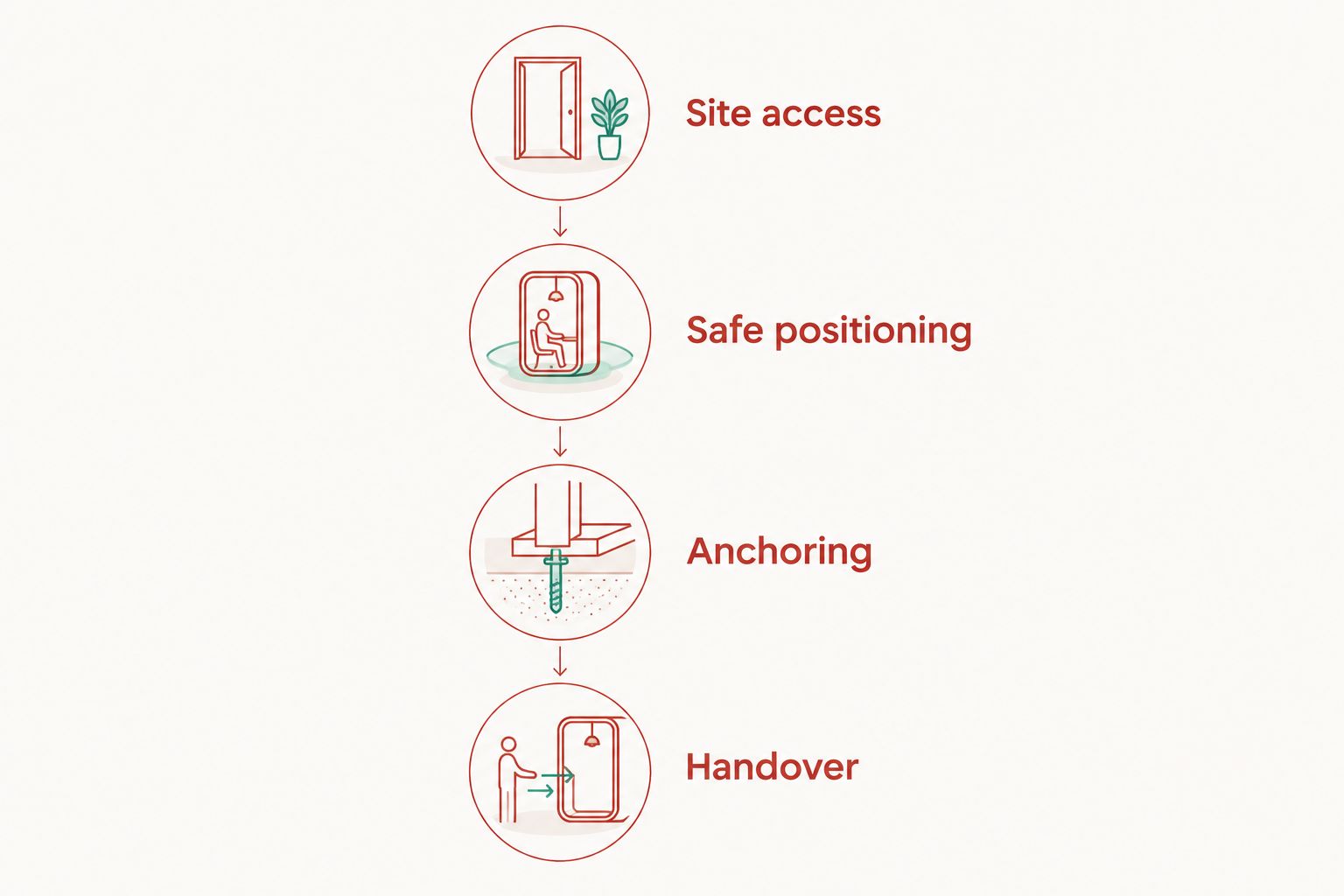
A delivery arrangement is not evidence that anchoring, stair access or removal of an existing safe is included. Request each required task explicitly, and check who is responsible if the planned position proves unsuitable.
For a 2026 installation, explain tenancy restrictions and building access before the supplier confirms the job. Do not choose an installation winner until both proposals describe the same work. A narrower scope can look simpler while leaving essential tasks with you.
Fire protection is a model-level decision, not a supplier victory
Neither supplier's name establishes fire protection. Assess the safe's documented protection for the contents you intend to store, and distinguish a product description from supporting test evidence.
The CMI Miniguard Size 3 description states that the model is designed to give 30 minutes of fire protection. Treat that as the stated design claim. Before selecting it specifically for fire protection, ask for the applicable documentation and confirm what contents the protection covers.
Paper documents and electronic storage media need different assessments. A paper-oriented fire claim does not establish that a safe protects hard drives, and a fire claim does not automatically establish water protection.
In your 2026 shortlist, record the test standard, duration and intended contents beside each model. Keep burglary resistance on a separate line. Reject any comparison that turns door thickness or a fire-related product name into proof of overall security. Apply this rule to both suppliers, even when one recommends a familiar manufacturer.
Lock suitability matters more than a digital-versus-key label
Best for lock choice: the model that supports your access routine and security requirements. Digital, key and mechanical combination locks require different operating procedures; the label alone does not rank the complete safe.
For a household, consider who needs access and how you will manage credentials. For a business, establish who opens the safe, who deposits contents and who authorises changes to access. These are practical requirements, not reasons to assume a particular lock feature exists.
Ask both suppliers to identify the exact lock fitted to the proposed model. Then check operating instructions, power requirements where relevant, credential changes and the process for an access problem. Do not assume that a digital lock supports individual staff codes or an audit trail.
A lock wins on suitability only when its documented operation matches your procedure. If the proposed safe requires you to share a credential that your business policy prohibits, choose a different documented configuration rather than relying on informal workarounds.
Ongoing support wins only when responsibility is clear
Repair and safe opening are among the online retailer's stated services. Those service categories are useful, but they do not establish a response time, warranty term or coverage for a particular address.
For KGB Security, assess the support arrangements attached to the proposed purchase or installation. Identify who handles a lock fault, who authorises work and whether the supplier or manufacturer is your first point of contact. Apply those same questions to the online retailer.
A business with an existing service arrangement should check whether safe work is included. A homeowner should keep the model details, operating instructions and purchase documentation accessible without needing to open the safe.
Choose the clearer written support arrangement, not an assumed promise. Neither supplier earns an automatic support victory from a service description. The practical winner is the proposal that assigns responsibility for the problems you need covered.
Pricing: compare product purchase with a defined service proposal
For a product-led purchase, specify the safe and lock first, then establish the required delivery and installation scope. For a service-led purchase, require the proposal to identify the product as precisely as the work. These are purchasing routes, not a reason to assume that either supplier includes particular extras.
The product-led route gives you a clear model to compare. Its trade-off is that you still need to confirm how services relate to the purchase. A combined proposal gives you a defined job to assess, but only when its inclusions and exclusions are explicit.
For a 2026 comparison, put these items beside each other: safe model, lock configuration, delivery point, final positioning, anchoring, handover and support responsibility. Check the current purchasing terms directly before committing.
Compare equivalent scopes before judging value. A proposal that includes installation cannot be assessed fairly against a product-only purchase until you account for the work still required.
Final verdict: choose by purchasing route and written scope
Choose BuyASafe if you want a product-led safe purchase
Named profile: the homeowner or small-business buyer building an online shortlist. Choose this retailer when its home and commercial safe categories help you identify a suitable model, and the confirmed delivery, installation and support arrangements meet your requirements.
The deciding advantage is the direct route from storage category to named product. Keep the final decision tied to model evidence and site suitability, not category breadth alone.
Choose KGB Security if its site proposal is the better match
Named profile: the premises manager prioritising a clearly scoped site job. Choose KGB Security when its written proposal addresses your premises, specifies the suitable safe and lock, and assigns the service responsibilities you need.
For your 2026 decision, that proposal must still pass the same fire, burglary, access and installation checks. A service relationship does not replace product evidence.
| Dimension | Winner |
|---|---|
| Product-led online shortlist | BuyASafe |
| Site-specific purchasing route | KGB Security, when its proposal better meets the site brief |
| Exact model suitability | The documented model that matches your contents |
| Installation | The supplier with the complete, suitable written scope |
| Fire and burglary evidence | Neither automatically; assess the model |
| Lock suitability | Neither automatically; assess documented operation |
| Ongoing support | The clearer written responsibility arrangement |
| Purchasing terms | The proposal that meets the brief on equivalent scope |
FAQ
Is BuyASafe better than KGB Security for buying a home safe?
BuyASafe is the direct fit for a home buyer comparing named safes online. Choose KGB Security instead when its written proposal better meets your installation and service requirements.
Should I compare the same safe model from both suppliers?
Yes, compare the same model and lock configuration wherever possible. If the recommendations differ, ask each supplier to explain the difference against your contents and installation requirements.
Does safe delivery include installation and bolting down?
Treat delivery, positioning and anchoring as separate tasks unless your written scope includes them. Confirm access constraints and the final location before ordering.
Does a thicker safe door prove better burglary protection?
Door thickness alone does not establish burglary protection. Assess the complete model and its supporting security documentation, along with any insurer requirements.
Does a document fire safe also protect hard drives?
A document fire claim does not establish protection for hard drives. Require documentation that specifically addresses the media you intend to store.
How should I compare purchasing terms from the two suppliers?
Compare equivalent product and service scopes. Check the exact safe, lock, delivery, installation, exclusions and support arrangements directly before committing.
What should I ask before choosing KGB Security?
Ask KGB Security to identify the safe model, lock, installation tasks and ongoing service responsibility in writing. Choose its proposal when those details better meet your site requirements.
One last thing
Store the safe's operating instructions somewhere outside the safe. Instructions locked behind the door cannot help you resolve an access problem. Keep the model details and support contact information accessible, while protecting credentials and any override information separately.


