

Best overall for a permanent handover point: a wall-mounted key lock box. Best for temporary access: a portable shackle box. Best for exposed locations: a model with documented outdoor protection. Best for office key storage: an indoor key cabinet. This 2026 guide explains which format fits your site and what to check before buying.
- For BUYASAFE key lock box buyers, wall-mounted storage is the default for a permanent handover point.
- Choose portable key safes for temporary handovers, not as a substitute for checking the attachment point.
- Choose weatherproof key storage by documented protection, not a cover or outdoor photograph.
- Choose an indoor key cabinet when staff need organised storage rather than unattended access outside.
Why this matters
A key lock box controls access to a key; the key controls access to your property. Choose the storage around that consequence, not just the convenience of sharing a combination. A spare garage key and a business master key need different access arrangements.
When comparing key storage at BUYASAFE, separate external handover boxes from indoor cabinets. A cabinet suits central storage, while an external box lets an authorised visitor retrieve a key without someone meeting them.
For your 2026 shortlist, start with the location, the people using the box and the actual key bundle. Then compare mounting, lock operation and documented protection.
What makes the best key lock box?
Use these six criteria before choosing a format:
- Mounting security: Check the approved fixing method, suitable substrate and access to the mounting points.
- Outdoor protection: Look for documented exposure limits, including restrictions on rain, moisture and coastal locations.
- Usable capacity: Check internal clearance with the key ring, fob and tags attached. External dimensions do not establish usable space.
- Access control: Decide who needs access, who changes the combination and what happens when permission ends.
- Usability: Check whether authorised users can operate the controls, open the compartment and close it correctly.
- Security evidence: Separate independently documented resistance from general descriptions such as heavy-duty or secure.
Reject any model whose instructions do not support your intended installation. A convenient location is not enough if the mounting surface or exposure is unsuitable.
Key lock box options at a glance
The order below follows distinct jobs, not an assumed security rating. Weather protection and mounting format overlap: an outdoor-rated box still needs a suitable fixing method.
| Rank and option | Best for | Standout feature | Key limitation |
|---|---|---|---|
| 1. Wall-mounted key lock box | A permanent home handover point | Fixed location for repeat access | Requires permission and suitable mounting |
| 2. Portable shackle key lock box | Temporary contractor handovers | Removable attachment format | Security also depends on the attachment point |
| 3. Outdoor-rated key lock box | A location exposed to weather | Documented environmental protection | Weather resistance does not establish burglary resistance |
| 4. Secuguard AP-133KE electronic key cabinet | Indoor office key storage | Electronic locking on a dedicated key cabinet | Do not assume outdoor suitability or access logging |
1. Wall-mounted key lock box: best for permanent home access
A wall-mounted key lock box gives authorised users a fixed place to retrieve and return a spare key. Choose this format when the handover point will remain in the same location and the property permits permanent fixings.
The fixing surface matters as much as the box. Follow the manufacturer's mounting instructions rather than treating any wall, fence or decorative panel as suitable.
Wall-mounted key lock box pros:
- Provides a consistent retrieval point for regular visitors.
- Avoids relying on a removable shackle attachment.
- Suits a repeatable handover routine once properly installed.
Wall-mounted key lock box cons:
- Requires suitable fixings and an appropriate substrate.
- Relocation means reassessing the installation.
- A shared combination needs changing when access permission ends.
Best for: Homeowners arranging regular access for trusted visitors, carers or maintenance workers.
Before buying, check that the door can open fully at the proposed location. Ask an intended user to assess reach and visibility; a box that is difficult to close correctly is a poor fit for that user.
Verdict: Buy for a permanent handover point when the mounting and exposure requirements are satisfied.
2. Portable shackle key lock box: best for temporary handovers
A portable key lock box attaches using a shackle rather than a permanently fixed body. Choose this format when the handover location genuinely needs to change or the arrangement is temporary.
Assess the complete attachment, not just the lock box. A strong box does not compensate for a weak, removable or unsuitable object holding it.
Portable shackle key lock box pros:
- Can be removed when an authorised handover ends.
- Supports changing locations without a fixed wall installation.
- Suits a clearly defined, temporary access arrangement.
Portable shackle key lock box cons:
- Depends on the strength and suitability of the attachment point.
- Requires permission to use the chosen fixture.
- Needs separate confirmation of outdoor suitability.
Best for: Temporary contractor access where a suitable attachment point is available and approved.
Do not assume that hanging a box on a door handle is acceptable. Check the product instructions and the fixture, and ensure the box does not obstruct door operation or emergency access.
For a 2026 renovation, assign someone to remove the box and change the combination when the work finishes. Temporary access needs an end point.
Verdict: Buy for temporary use with an approved attachment; skip when the fixture is unsuitable.
3. Outdoor-rated key lock box: best for exposed locations
An outdoor-rated key lock box is the right category when the proposed site is exposed to weather. Select the model by its documented environmental protection and installation restrictions, not by the presence of a sliding cover.
Weather protection is a separate decision from theft resistance. A model's resistance to water does not establish its resistance to forced entry.
Outdoor-rated key lock box pros:
- Lets you match documented protection to the installation environment.
- Addresses exposure as a buying requirement rather than an afterthought.
- Provides a basis for checking permitted mounting orientation and maintenance.
Outdoor-rated key lock box cons:
- Outdoor claims differ in scope and supporting evidence.
- Water protection does not automatically include salt-corrosion resistance.
- Seals, covers and closing procedures still require attention.
Best for: External handover points where weather exposure cannot be avoided.
Read the rating, not just the word weatherproof
Under the IEC 60529 ingress-protection system, IP65 describes dust-tight protection and resistance to water jets under specified test conditions. IP67 describes dust-tight protection and temporary immersion testing, commonly expressed as 1 metre for 30 minutes.
Those conditions are not permission to submerge a key box in everyday use. Nor does an IP67 marking alone establish compliance with the separate water-jet test. Check the manufacturer's stated scope, installation requirements and exclusions.
For coastal sites in 2026, ask specifically about corrosion suitability. An ingress rating alone does not answer that question.
Verdict: Buy only when documented protection matches the site; skip unsupported weatherproof claims.
4. Secuguard AP-133KE electronic key cabinet: best for indoor storage
The Secuguard AP-133KE is an electronic-locking key cabinet. Shortlist this type of storage when your job is keeping workplace keys together indoors, rather than making a spare key accessible outside.
The distinction matters: electronic locking does not, by itself, establish individual user codes, access records, remote control or weather protection. Confirm each required function before selecting the cabinet.
Secuguard AP-133KE electronic key cabinet pros:
- Uses a dedicated key-storage format.
- Provides electronic locking.
- Offers an indoor cabinet option to assess against your office workflow.
Secuguard AP-133KE electronic key cabinet cons:
- Electronic locking alone does not confirm access logging.
- Capacity and key-bundle clearance need checking before purchase.
- Do not treat the cabinet as an external handover box without documented suitability.
Best for: Offices assessing an electronic-locking cabinet for central key storage.
BUYASAFE key cabinet buyers should specify the access workflow before selecting a model. If you need named users or a record of who collected a key, request confirmation of those functions rather than inferring them from the keypad.
Verdict: Hold until capacity, mounting and required access functions are confirmed.
Match the key safe to the access job
Choose the job before the lock type. A homeowner arranging repeat visits needs a different setup from an office storing keys behind a staffed counter.
- Permanent access: Start with wall-mounted storage and a suitable fixing location.
- Temporary access: Assess a portable box and its approved attachment point.
- Weather exposure: Require documented outdoor protection alongside the mounting decision.
- Office storage: Assess an indoor cabinet and the staff access procedure.
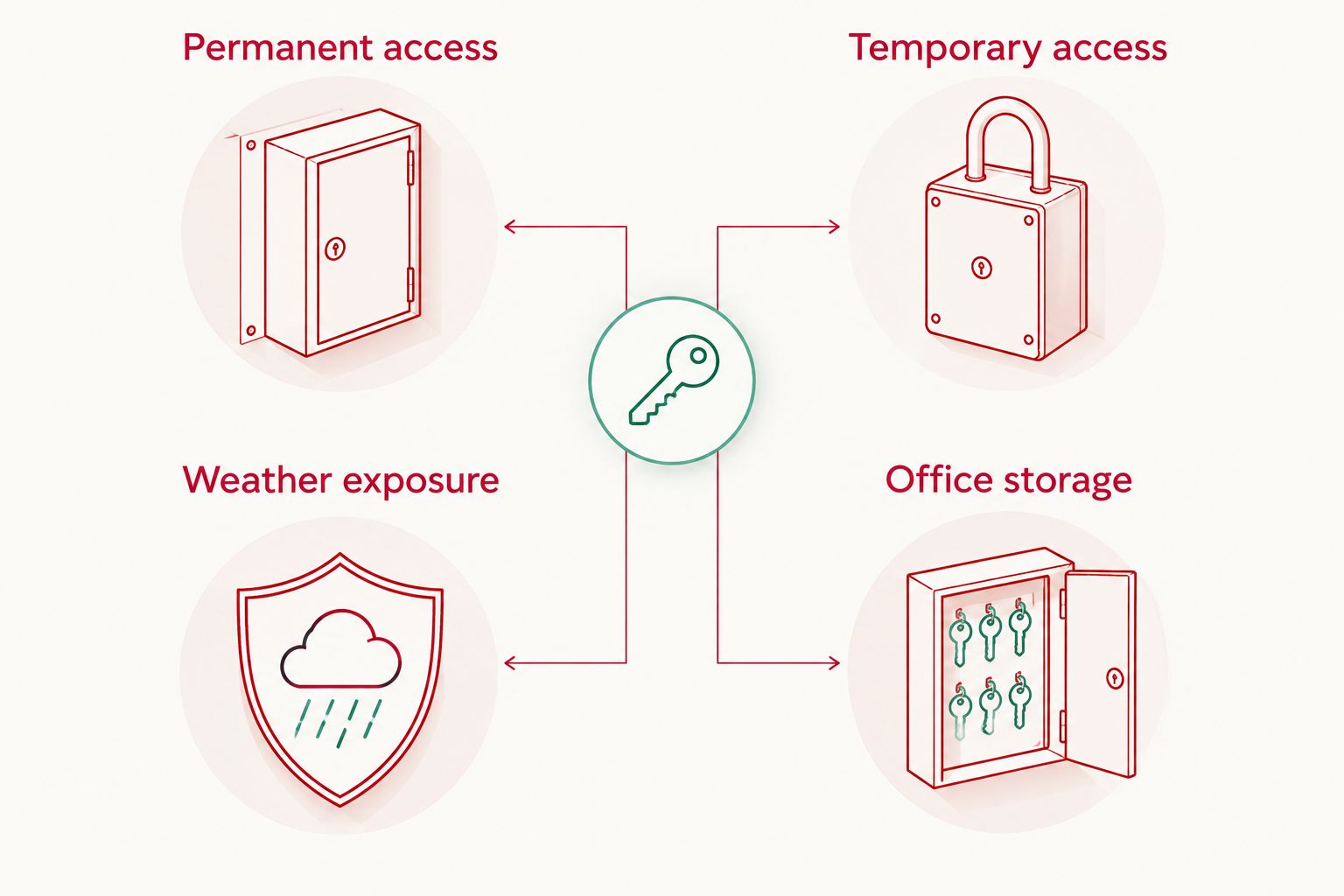
These jobs can overlap. A permanent external handover point needs both a suitable wall-mounted format and documented protection for its exposure; choosing one does not settle the other.
Check fit, installation and handover before use
Make these checks part of your 2026 installation plan. Do not wait until a visitor is outside to discover that the key ring prevents the compartment closing.
Measure the actual key bundle
Record internal height, width and depth in millimetres, then compare them with the complete bundle. Include the ring, tags and any electronic fob. Check the opening as well as the compartment: an item must pass through the door before it can fit inside.
Do not force the cover against the contents. Remove unnecessary tags or choose a more suitable enclosure.
Confirm the installation location
Check permission, substrate, mounting instructions and clearance before drilling. Avoid publishing photographs that reveal the location and access combination together. Concealment is not a substitute for suitable construction or fixing.
Test access before storing the live key
Follow the manufacturer's setup instructions and test the opening, closing and combination-change procedure without relying on the stored key. Confirm that every intended user can complete the process. For electronic locks, follow the documented power and recovery instructions.
Assign responsibility for access
Name the person responsible for changing the combination and checking the returned key. Change access credentials when an authorised user's permission ends. A four-digit decimal code has 10,000 possible combinations when all sequences are permitted, but that mathematical count is not a security rating.
How these recommendations are ranked
The ranking prioritises suitability for the access job: permanent installation, temporary attachment, environmental exposure and indoor organisation. Mounting, usable capacity, access control and supporting documentation remain the deciding criteria within each category.
This is a format-based buying guide, not a forced-entry test or a model-by-model certification ranking. A named cabinet appears for its stated electronic-locking key-storage format; no unverified capacity, weather rating or access feature is assumed.
Which key lock box should you choose?
Choose a wall-mounted key lock box for a permanent home handover point. Add documented outdoor protection when the site requires it, and select the fixing method around the actual substrate.
Choose a portable box only when temporary attachment solves a real need. Choose an indoor cabinet when your priority is workplace key storage rather than unattended external collection.
For a 2026 BUYASAFE shortlist, write down the location, complete key-bundle size and required access functions before comparing models. Those details eliminate unsuitable options more effectively than appearance alone.
FAQ
What's the best key lock box for a spare house key?
A wall-mounted key lock box is the default choice for a permanent spare-key handover point. Confirm suitable mounting, enough internal clearance and documented protection for the location.
Is a portable key safe better than a wall-mounted box?
A portable key safe is better for temporary attachment, while a wall-mounted box suits a permanent location. A portable model also depends on the suitability of the fixture holding its shackle.
Can I leave a key lock box outside in the rain?
Use a key lock box in rain only when its documented outdoor protection and installation instructions support that exposure. A protective cover alone does not establish weather resistance.
Does an IP rating mean a key safe is burglar-resistant?
No, an IP rating describes ingress protection rather than resistance to forced entry. Assess security construction and any independently documented resistance separately.
Can an electronic key cabinet record who takes a key?
Electronic locking alone does not establish access logging or identify who removes a key. Confirm individual-user functions and record-keeping capabilities for the exact cabinet before buying.
Will a car key fob fit inside a key lock box?
A car key fob fits only when the opening and usable internal dimensions accommodate the complete bundle. Measure the fob with its ring and tags attached, and check that the compartment closes without pressure.
How often should I change a shared key safe code?
Change a shared key safe code when access permission ends or the code has been disclosed beyond authorised users. Assign responsibility for updating it and notifying the people who still need access.
One last thing
Label stored keys with a private reference, not the property's full address. Keep the reference list separately under controlled access. If a key is lost, an address tag gives the finder information that the key alone does not provide.


