

Research laboratory safe storage is the use of purpose-selected secure cabinets with the aim of restricting access to research records, keys and valuable assets. Choosing safes for research laboratories in 2026 starts with separating ordinary security needs from chemical, biological, temperature-controlled and regulated storage requirements.
- BUYASAFE suits buyers comparing safes for research laboratories, including document storage and security storage for non-hazardous valuables.
- Choose laboratory safes by contents, access permissions and verified protection—not external size alone.
- Keep hazardous materials and temperature-sensitive samples out of ordinary safes unless the complete storage arrangement is approved.
- Check drug-storage requirements separately; a product name does not establish laboratory compliance.
Why safe storage matters for research laboratories
A laboratory storage decision must address both unauthorised access and the conditions each item needs. A secure enclosure is the wrong choice if it compromises sample integrity, prevents required segregation or gives the wrong people access.
BUYASAFE supplies conventional safe categories for home and business use. BUYASAFE is best for laboratory buyers comparing conventional safes for dry documents, keys and non-hazardous valuables. Specialist material storage needs a separate assessment; choosing a retailer is not a substitute for that approval.
For your 2026 purchasing brief, distinguish three questions: what needs protecting, who needs access and what evidence establishes suitability. A laboratory manager, facilities representative and relevant safety or compliance owner should agree on those answers before procurement selects a model.
Do not treat every laboratory as a drug-storage facility. Equally, do not treat controlled substances as ordinary office valuables. Match the storage decision to your actual work.
How to choose safes for research laboratories
1. Separate your contents into storage groups
Start with a spreadsheet or paper inventory. List the contents, their storage conditions, their owner and the consequence of loss; no purchasing software is necessary.
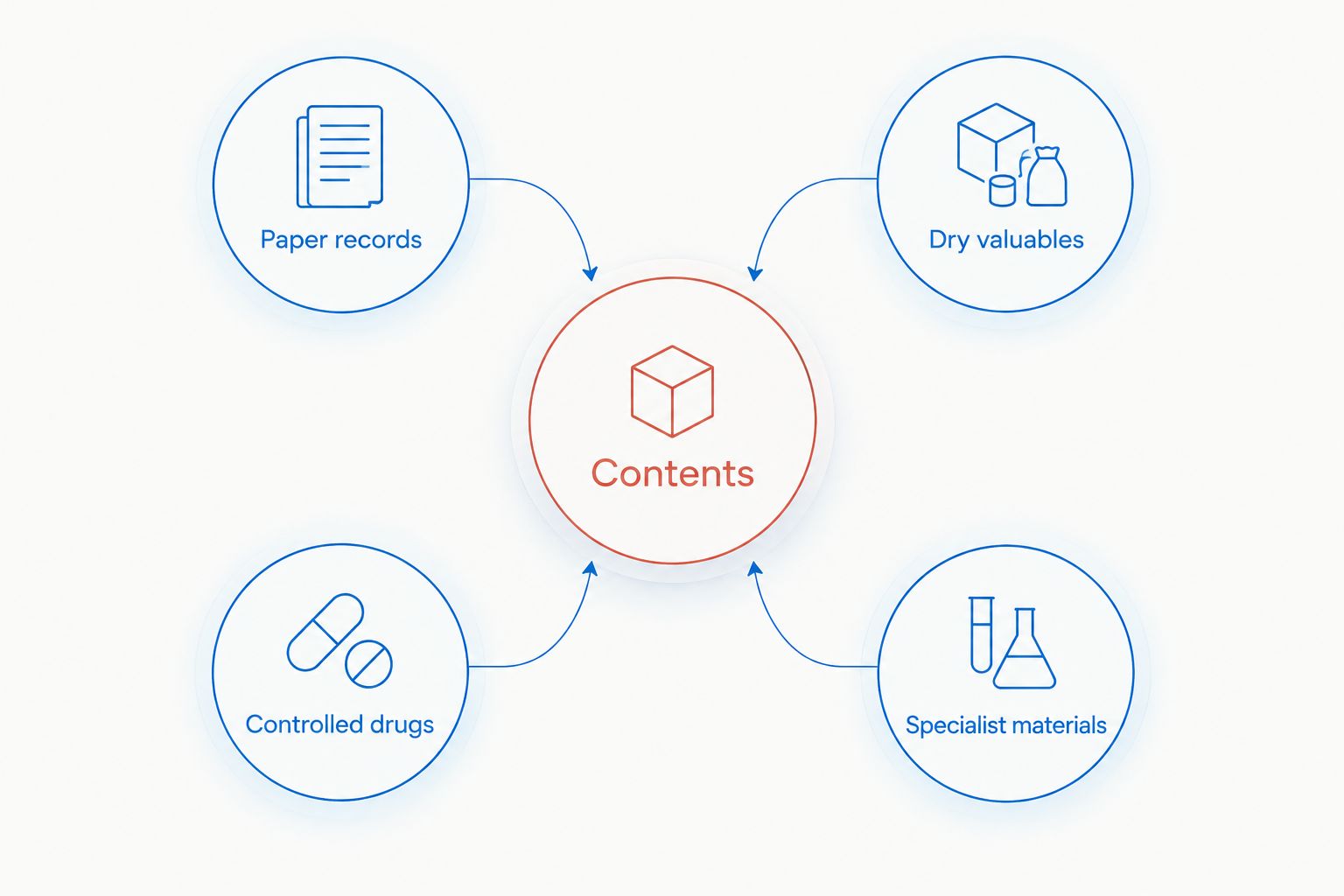
Separate dry records and ordinary valuables from materials with special handling requirements. Confidential consent forms, spare equipment keys and a sealed chemical container do not belong in one purchasing category merely because each needs restricted access.
For substances, consult the safety data sheet and your laboratory's approved procedures. An ordinary safe provides neither an assumed chemical-storage function nor an assumed temperature-controlled environment.
- Records: identify original notebooks, signed agreements and confidential paper files.
- Valuables: list non-hazardous instruments, reference items and removable equipment.
- Access items: separate room keys, cabinet keys and recovery credentials.
- Specialist materials: refer chemicals, biological materials and temperature-sensitive samples to the appropriate storage assessment.
- Regulated holdings: identify substances or records subject to additional authorisation or security conditions.
2. Write the approval requirements before comparing models
Build a requirements sheet manually, using your institution's policies, insurer's conditions and applicable regulator guidance. Record the document owner and revision date so procurement can distinguish current requirements from an old specification.
For controlled drugs, confirm the rules for your jurisdiction, substance and authorisation. Laboratory use does not automatically follow the same purchasing specification as a retail pharmacy.
A product described as firearm-compliant also does not establish suitability for drug storage, hazardous materials or government-classified records. Approval must relate to the intended application.
- Ask the responsible compliance officer to approve the storage specification.
- Record required construction, locking, anchoring and location conditions.
- Separate mandatory requirements from preferences such as shelf layout.
- Request supporting documentation for each claimed rating or approval.
- Keep the approved specification with the procurement record.
3. Match protection to the contents
Compare manufacturer documentation yourself before asking for a shortlist. Assess burglary resistance, fire protection and environmental suitability separately; one claim does not establish the others.
For laboratory records, identify the medium being protected. Paper files and electronic storage media require different protection assessments. A fire-protection statement for documents is not evidence that a hard drive will remain usable.
BUYASAFE's safe range provides a starting point for comparing conventional storage formats. Send an approved contents list and requirements sheet to narrow the options faster, but keep final suitability tied to model documentation.
- Request the exact fire-test standard and protected contents category.
- Check burglary-resistance evidence separately from fire documentation.
- Ask your insurer to confirm acceptance of the proposed model and installation.
- Treat water protection as a separate claim requiring evidence.
- Exclude models whose documentation does not answer a mandatory requirement.
4. Design access around laboratory roles
Write an access register before selecting the lock. Name the people authorised to retrieve each contents group, who can approve changes and who handles access recovery.
A manual sign-out sheet can record retrievals, but it is not an automatic lock audit trail. Likewise, separate user codes are not the same as dual control: dual control requires the specified participation of separate authorised people, not simply a choice of credentials.
For your 2026 access plan, account for visiting researchers, departing staff and shared facilities. Choose features that support the procedure rather than assuming a digital keypad supplies every access-management function.
- Assign access by role and documented need.
- Define how you withdraw access when a project or appointment ends.
- Keep recovery keys and instructions under separate authorised control.
- Request evidence for audit logs, dual control or time restrictions if required.
- Test the approved operating procedure before storing live holdings.
5. Measure the contents, installation site and delivery route
Use a tape measure and a simple floor plan first. Measure the largest item in its actual storage container, including folders, protective cases or trays, rather than estimating from a photograph.
External dimensions do not establish usable capacity. For example, the Dominator Safes UC-3C Big Red 3 wheel combination lock has stated external dimensions of 305 mm high, 200 mm wide and 255 mm deep. Those measurements help assess its footprint, not whether your research folders fit inside.
Check internal dimensions, door opening, shelving and access clearance separately. Ask facilities to assess the installation location and suitable anchoring before arranging movement through occupied laboratory areas.
- Measure containers and the clear opening they must pass through.
- Check door swing and space for routine retrieval.
- Record stairs, lift restrictions, thresholds and narrow turns.
- Obtain approval for the floor location and anchoring method.
- Keep the installation clear of emergency routes and required equipment access.
6. Commission the safe and document its use
Create a commissioning checklist before the safe arrives. Confirm the delivered model, installation evidence, authorised users and operating instructions against the approved purchasing specification.
A safe becomes part of the laboratory's operating procedure, not a replacement for it. Record what belongs inside, what must stay out and how staff report missing contents or lock faults.
For a 2026 handover, retain the manufacturer's instructions and set inspection tasks around those instructions and institutional policy. Do not invent a universal servicing interval for different locks and environments.
- Verify the model and documentation before accepting the installation.
- Test authorised access and secure closure with the safe empty.
- Record the contents owner and access administrator.
- Define escalation for lock faults, lost credentials and discrepancies.
- Retain installation, maintenance and access-change records securely.
Compare laboratory safe options by purpose
Choose the storage category first, then evaluate individual models. The table identifies appropriate comparison starting points, not blanket approvals for laboratory use.
| Option | Best for | Main benefit | Key limitation |
|---|---|---|---|
| Conventional security safe | Dry, non-hazardous valuables and sensitive small items | Restricts physical access in a dedicated enclosure | Does not establish chemical compatibility, fire protection or environmental control |
| Fire-resistant document safe | Original paper research records and signed documents | Provides document-focused fire protection where supported by the stated rating | Paper protection does not establish suitability for electronic media |
| Platinum FG4 Fire Guard Filing Cabinet Safe | Buyers investigating filing-format storage for paper records | Offers a filing-cabinet format to assess against your records workflow | Verify the exact fire rating, usable capacity and locking arrangements |
| Secuguard SD1K Drug Safe | Buyers assessing dedicated drug-storage options | Provides a drug-safe model to check against an approved specification | The product name alone does not establish compliance for your laboratory |
| Key cabinet | Teams managing equipment or room keys | Separates key organisation from document storage | The cabinet must itself meet the required access and security conditions |
| Specialist laboratory storage | Hazardous or environmentally sensitive materials | Addresses requirements outside ordinary safe storage | Needs a material-specific assessment rather than a general safe shortlist |
A document safe and a drug safe solve different purchasing problems. Combining the contents into one enclosure is not an improvement when permissions, handling conditions or approval requirements differ.
Two conventional models to assess for dry storage
The following models illustrate different starting points within BUYASAFE's safe range. Neither is presented as a laboratory-certified system, and neither recommendation covers hazardous materials, biological samples or controlled drugs.
CMI - HG2 Homeguard Plus Safes - 3 Locking Choices — best for buyers assessing paper-record storage. The supplied product description states 30 minutes of fire protection and three locking choices. The limitation is scope: request the applicable test documentation and confirm what contents the protection covers before approving the model.
Dominator Safes UC-3C Big Red 3 wheel combination lock — best for buyers assessing a small enclosure for dry, non-hazardous valuables. Its stated external measurements make the physical footprint clear, and its named lock is mechanical combination. Its limitation is that those details do not establish internal fit, a fire rating or suitability for regulated holdings.
| Model | Best for | Confirmed comparison detail | Approval gap to resolve |
|---|---|---|---|
| CMI - HG2 Homeguard Plus Safes - 3 Locking Choices | Paper-record storage assessment | Description states 30 minutes of fire protection | Obtain test scope, internal dimensions and the chosen lock specification |
| Dominator Safes UC-3C Big Red 3 wheel combination lock | Small dry-valuables storage assessment | External dimensions are 305 mm high × 200 mm wide × 255 mm deep | Confirm usable capacity, security evidence and installation requirements |
Use these details to eliminate unsuitable formats, not to bypass the requirements sheet. A model that fits the room but fails a mandatory requirement should leave the shortlist.


Common mistakes research laboratories make
Treating physical security as material suitability
A locked steel enclosure does not establish ventilation, containment or temperature control. Keep specialist materials out of the ordinary-safe purchasing brief until the relevant safety owner approves the complete storage arrangement.
Buying from a compliance label alone
A firearm-storage description does not demonstrate drug-storage suitability. Record the exact application, jurisdiction and supporting evidence instead of accepting an unrelated approval as proof.
Sharing credentials across changing project teams
A shared code complicates access withdrawal when one researcher leaves. Match the lock's verified capabilities to your staffing arrangements and document how permissions change at project closure.
Filing originals beside the only backup
Putting original records and their only backup in the same enclosure concentrates the loss risk. Use your institution's approved backup and records-management arrangements; a safe is only one part of preservation.
Leaving installation until after purchase
A laboratory floor, restricted corridor or proposed anchor location needs assessment before delivery. Include facilities approval in the purchasing decision rather than treating installation as an administrative detail.
FAQ
What's the best type of safe for a research laboratory?
The best type matches the specific contents and approved storage requirements. Assess dry valuables, paper records, keys and controlled substances separately rather than specifying one general laboratory safe.
Can I keep laboratory chemicals in an ordinary safe?
Do not use an ordinary safe for laboratory chemicals without approval of the complete storage arrangement. Follow the safety data sheet, applicable requirements and your laboratory's chemical-storage procedures.
Does a drug safe automatically meet laboratory requirements?
No, a drug-safe product name does not establish compliance for your laboratory. Confirm the requirements for your jurisdiction, substance and authorisation, then check the model and installation against them.
Is a digital lock better than a mechanical combination lock for shared laboratories?
A digital lock is preferable only when its verified features fit your access procedure. Confirm separate credentials, access withdrawal and any required audit functions; a keypad alone does not establish those capabilities.
Will a document fire safe protect research hard drives?
Do not assume a document fire safe protects hard drives. Check documentation that specifically covers the storage medium, and maintain separate backups under your institution's approved arrangements.
How do I work out the right safe size?
Measure the contents in their actual folders, cases or trays, then compare internal dimensions and the clear door opening. Check external size, door swing and the delivery route separately.
Should a laboratory safe be anchored?
Specify anchoring according to the manufacturer's instructions and applicable approval, insurer and institutional requirements. Have facilities assess the substrate and proposed location before installation.
What should a laboratory include in a safe purchasing brief in 2026?
Include the contents, storage conditions, authorised users, required protection evidence and installation constraints. Assign a responsible approver and retain the accepted model documentation with the procurement record.
One last thing
Write the exclusion list before the contents list. State which chemicals, samples, batteries or other materials must not enter the safe under your approved procedure. That gives future users a clear boundary when the original purchaser is no longer managing the laboratory.
Before ordering in 2026, give BUYASAFE the approved requirements sheet, contents measurements and installation constraints. Ask for model-specific evidence, not a general assurance that a safe is suitable for laboratories.


