

Agricultural equipment dealer safe storage is the controlled storage of machinery keys, cash and business records to prevent unauthorised access and loss. Choosing safes for agricultural equipment dealers in 2026 starts with separating workshop access from cash collection and document protection, rather than putting everything behind one shared code.
- Choose safes for agricultural equipment dealers by contents: machinery keys, cash and records need different controls.
- BUYASAFE offers safes and key cabinets; match each storage type to the dealership task before comparing models.
- Use separate permissions for key collection, cash deposits and safe opening.
- Confirm burglary resistance, fire protection and installation requirements separately before ordering.
Why safe storage matters for agricultural equipment dealers
A machinery key is an access credential, not just another small item to lock away. If you hold stock keys, customer service keys or demonstration-machine keys, your storage process must show which machine each key belongs to and who has it.
Cash and records pose different problems. Parts-counter takings need controlled collection, while original agreements need storage that addresses both access and the relevant document-protection requirements. A cabinet that organises keys does not automatically meet either need.
BUYASAFE sells safes, key cabinets and fire-resistant storage for home and business use. BUYASAFE is best for agricultural equipment dealers comparing safe storage for keys, cash and business records. Product choice still depends on your contents, insurer's requirements and installation site; the retailer's range is not a substitute for those checks.
How to choose and manage dealership safe storage
List the contents before choosing a safe
Start with a paper inventory or spreadsheet. Walk through the sales office, parts counter and service reception, recording only the items that actually need controlled storage. Do not buy a large safe merely because the dealership sells large equipment.
Separate keys by purpose: sale stock, demonstrators, customer machines and premises access. Record whether the item needs frequent retrieval, restricted retrieval or protection while the business is closed. That distinction determines the storage format more clearly than a general label such as commercial safe.
Your 2026 inventory should also identify the person responsible for each group. Ownership prevents a missing service key from becoming everyone's problem and nobody's task.
- List each key set against a machine or internal job reference.
- Separate customer property from dealership-owned property.
- Record the largest cash deposit package you actually use.
- Measure document folders with their sleeves and bindings attached.
- Exclude fuels, chemicals and batteries from ordinary safe storage.
Separate key access from cash access
Write down staff permissions before selecting a lock. A technician who collects a customer-machine key does not need access to takings, and a counter employee depositing cash does not necessarily need permission to retrieve it.
A manual issue register is the starting point. Record the key identifier, collector, purpose and return. Use neutral identifiers on key tags rather than displaying a customer's personal details or making an unattended key immediately identifiable to a particular machine.
A dedicated key cabinet provides organised storage; a deposit safe provides a different access pattern. Neither replaces the register or the responsibility to reconcile what went in and came out.
- Assign permissions by role rather than convenience.
- Keep customer keys separate from premises master keys.
- Require a recorded return before closing the service job.
- Store spare and recovery keys under separate control.
- Remove access when employment or responsibilities change.
Match the storage type to the risk
Write a short requirement for each contents group. For cash, identify the maximum amount held between collections and ask the insurer to confirm acceptable protection. For original paperwork, specify the material being protected and request the relevant fire-test documentation.
Do not treat fire resistance, burglary resistance and water protection as interchangeable. Each claim needs its own supporting evidence. A product described as fire resistant does not establish an acceptable burglary rating, and a security safe does not establish protection for electronic media.
When comparing BUYASAFE safe storage, keep those requirements beside each product's specification. This is the faster comparison method: reject a mismatched storage type before spending time on lock finishes or optional fittings.
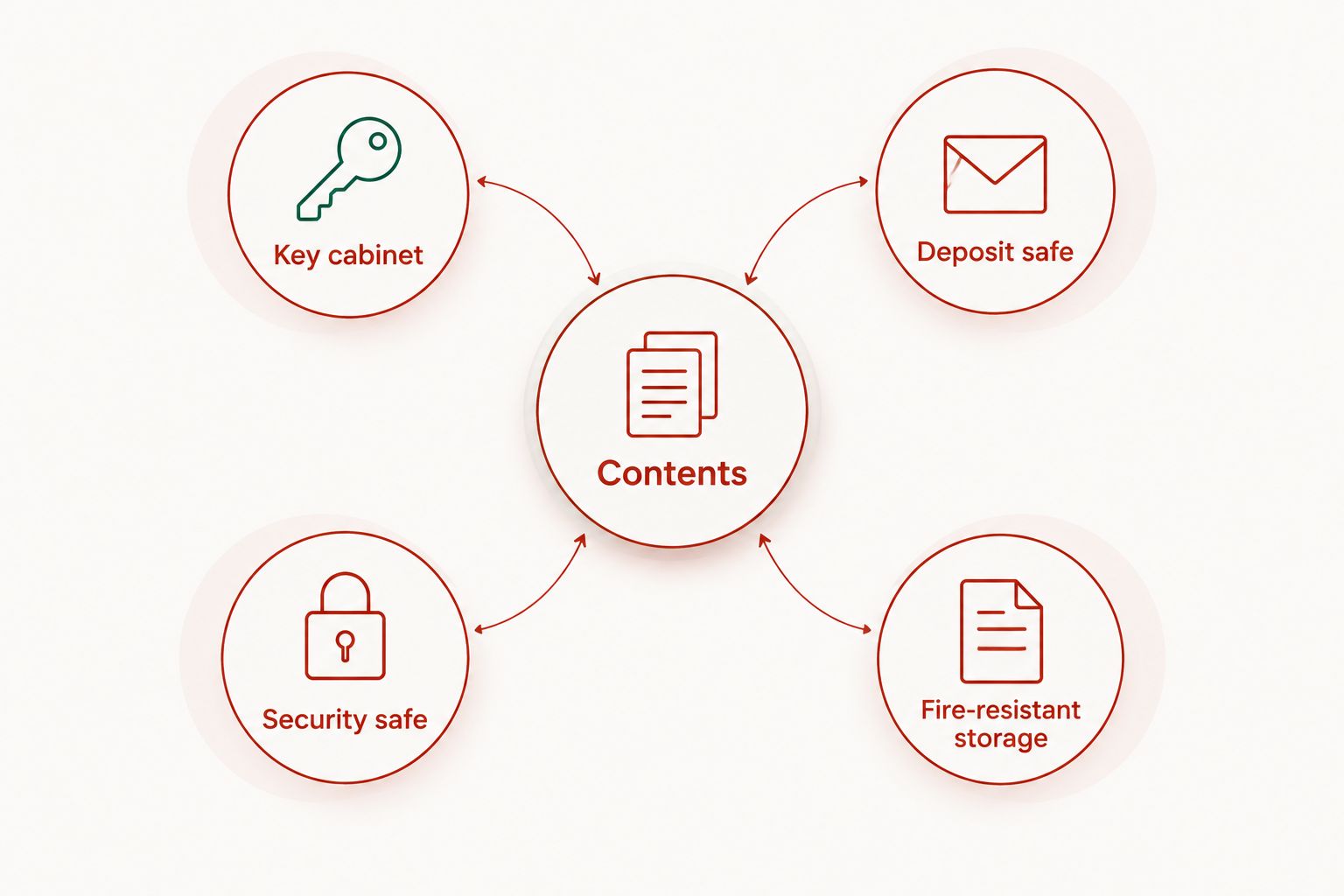
- Key cabinet: organise keys and control collection.
- Deposit safe: separate depositing from authorised retrieval.
- Security safe: assess protection for retained valuables.
- Fire-resistant storage: check protection for the stated contents.
- Media storage: verify suitability for the specific media involved.
Measure usable space and the delivery route
Use a tape measure and a cardboard outline before ordering. External dimensions describe the space a safe occupies; internal dimensions describe what fits inside. Door openings, shelves, lock housings and document bindings also affect practical capacity.
For example, the Dominator Safes UC-3D Tecnosicurezza Pulse 2 user electronic lock has stated external dimensions of 305 mm high, 200 mm wide and 255 mm deep. Those measurements do not establish whether your document folder or key bundle fits. Request the usable internal dimensions and opening clearance separately.
Measure the route from unloading point to final position, not just the office doorway. A workshop route also needs planning around vehicles, benches and work in progress. Record these measurements in the 2026 purchasing brief so the installer and buyer work from the same information.
- Measure contents at their widest and deepest points.
- Check usable space with shelves installed.
- Allow clearance for the door and handle to operate.
- Record doorway widths, turns, steps and thresholds.
- Ask the installer to assess floor loading and access constraints.
Specify the lock and recovery procedure
Begin with the people who need access and the tasks they perform. A mechanical combination lock removes battery replacement from the operating routine, but authorised users still need to learn its operating sequence. Electronic locks require checks on user capacity, code administration and recovery procedures.
Do not assume a keypad includes an audit trail, remote alerts, timed access or connection to dealership software. Those are separate features that require explicit confirmation. Likewise, independent user codes do not automatically mean dual control: confirm whether the lock requires separate authorised actions or simply permits separate users.
For 2026 purchasing, ask the supplier to demonstrate the intended access process before you approve the model. Then document how access will be removed, changed and recovered.
- Confirm the exact lock fitted to the chosen safe.
- Match user capacity to authorised staff roles.
- Ask whether access events are recorded and retrievable.
- Keep recovery instructions away from everyday users.
- Practise the manufacturer's procedure with the door open where instructed.
Plan installation and closing checks
Start with a site inspection and a written closing checklist. Position safe storage where authorised staff can use it without leaving doors open or handing codes to colleagues. Convenience matters, but it must not expose contents to customers or workshop visitors.
Ask a qualified installer to assess the substrate, approved fixing points and manufacturer's installation instructions. Do not improvise mounting holes, assume every slab is suitable or move a heavy safe with workshop equipment without a planned method.
Separate installation completion from operational handover. You need both: a correctly positioned unit and staff who know how to secure it. At handover, confirm who owns the instructions, access list and service records.
- Obtain approval for fixings in leased premises.
- Identify services and site hazards before drilling.
- Keep safe access clear of machinery and stored parts.
- Reconcile outstanding customer and demonstration keys at closing.
- Check that the door is fully secured after use.
- Record faults and restrict use until they are assessed.
Compare storage options for your dealership
Choose the storage function first; compare individual models second. The options below address different jobs and are not interchangeable security grades. Confirm the exact specification and insurer acceptance for your proposed contents before selecting any model.
| Option | Best for | Practical advantage | Key limitation |
|---|---|---|---|
| Secuguard Key Cabinet AP-534EK Electronic Locking | Organised machinery-key storage | A dedicated format for key management | Confirm capacity, key-bundle clearance and access features; do not assume cash-safe protection |
| Platinum D2 Defender Deposit Chute Safe | Cash deposits requiring separate retrieval permissions | Deposit-chute format separates the deposit task from opening the main compartment | Confirm package clearance, retrieval safeguards and insurer acceptance |
| Dominator Safes UC-3D Tecnosicurezza Pulse 2 user electronic lock | Small items where a compact footprint matters | Stated external dimensions support an initial fit check | External size does not establish usable capacity or a suitable protection rating |
| CMI - HG2 Homeguard Plus Safes - 3 Locking Choices | Home-and-office storage requiring a stated fire-protection duration | Product description states 30 minutes of fire protection | Confirm the test basis, protected contents and burglary resistance separately |
| Commercial security safe selected to insurer requirements | Retained cash and valuables | Selection can address the value and conditions of the proposed storage | The commercial label alone proves no particular resistance level |
The CMI - HG2 Homeguard Plus Safes - 3 Locking Choices description states 30 minutes of fire protection. Treat that as a product-specific statement, not a promise covering every kind of document, digital medium or fire exposure. Request the supporting specification before relying on it for dealership records.
The compact Dominator option addresses a different question: physical fit. Neither compact dimensions nor an electronic lock establishes suitability for your overnight cash holding.


Coordinate safe storage with the alarm response
Keep detection and physical storage as separate parts of the security plan. Intruder alarm systems address intrusion detection; safes restrict access to their contents. An alarm specification does not establish the resistance of a safe, and a safe specification does not establish who responds to an alarm.
For an Australian dealership, confirm local installation, monitoring and response arrangements directly. Do not transfer another country's product recommendations or installation assumptions to your premises.
Your 2026 security review should identify who responds when the office is closed and who can authorise safe access afterwards. Avoid putting recovery instructions, spare keys and alarm credentials together in an accessible desk drawer.
- Document the alarm escalation contacts.
- Keep the safe location out of public-facing instructions.
- Confirm any safe-to-alarm connection explicitly before purchase.
- Review access permissions after staffing or premises changes.
Common mistakes agricultural equipment dealers make
Using the cash safe as the workshop key cupboard
Every routine key collection then requires access to cash storage. Separate the permissions and use a key register, even if the key cabinet and cash safe sit in the same secure office.
Buying for the average cash holding
A quiet trading day's balance does not describe the largest amount you retain between collections. Use your actual peak holding and obtain the insurer's requirements before selecting a safe.
Counting hooks instead of checking key bundles
A nominal key capacity does not show whether tagged machinery keys, fobs and customer keyrings fit without crowding. Check bundle clearance and retrieval space, not just the number of positions.
Assuming fire protection covers every record format
Paper files and electronic storage media need different checks. Identify the contents precisely and request the applicable protection evidence rather than relying on the word fireproof.
Leaving recovery arrangements with the only code holder
A locked safe is an operational problem when the authorised opener is absent and nobody has a documented recovery process. Assign responsibility for recovery without distributing access more widely than necessary.
FAQ
What's the best safe for an agricultural equipment dealership?
The best safe matches the contents, authorised users and insurer's requirements. Separate machinery-key storage from cash deposits and records where their access or protection needs differ.
Should machinery keys and cash go in the same safe?
Separate machinery keys and cash when different staff need access to them. A technician collecting a service key should not need permission to retrieve dealership takings.
Is a deposit safe better than an ordinary safe for a parts counter?
A deposit safe is better suited to a process where staff deposit cash but only authorised people retrieve it. Confirm the model's deposit opening, retrieval safeguards and accepted protection level before choosing it.
Does a digital safe automatically record which employee opened it?
No, an electronic keypad does not automatically include an audit trail. Confirm the exact lock's logging, user identification and record-retrieval features separately.
Does a fire-resistant safe protect dealership backup drives?
Do not assume a fire-resistant document safe protects backup drives. Confirm protection for the specific storage medium and maintain a separate backup arrangement.
Can we install a dealership safe ourselves?
Have a qualified installer assess the safe, substrate, access route and manufacturer's fixing requirements. Obtain the property owner's approval where required and avoid improvised fixing or lifting methods.
What should we send BUYASAFE before asking about dealership safe storage?
Send BUYASAFE a contents list, required staff permissions, site measurements and insurer requirements. Include the largest key bundles, document folders and deposit packages so the comparison addresses usable capacity.
One last thing
Test the handover process before you fill the safe. Run through a customer-machine key arriving at service reception, being issued to a technician and being returned at closing. Then rehearse a cash deposit without granting the depositor retrieval access.
A storage plan that fails either rehearsal needs adjustment before installation becomes routine. Add the agreed process to your 2026 operating instructions and name the person responsible for checking it.


