

Safes for property valuers protect signed valuation reports, client property files and spare property keys against fire, theft and misplacement — the core risk for a job that moves between an office, a car and other people's homes. A valuer's security setup is different from a standard home or retail safe because the job splits across three locations on any given day, and the documents involved carry someone else's financial data, not just your own.
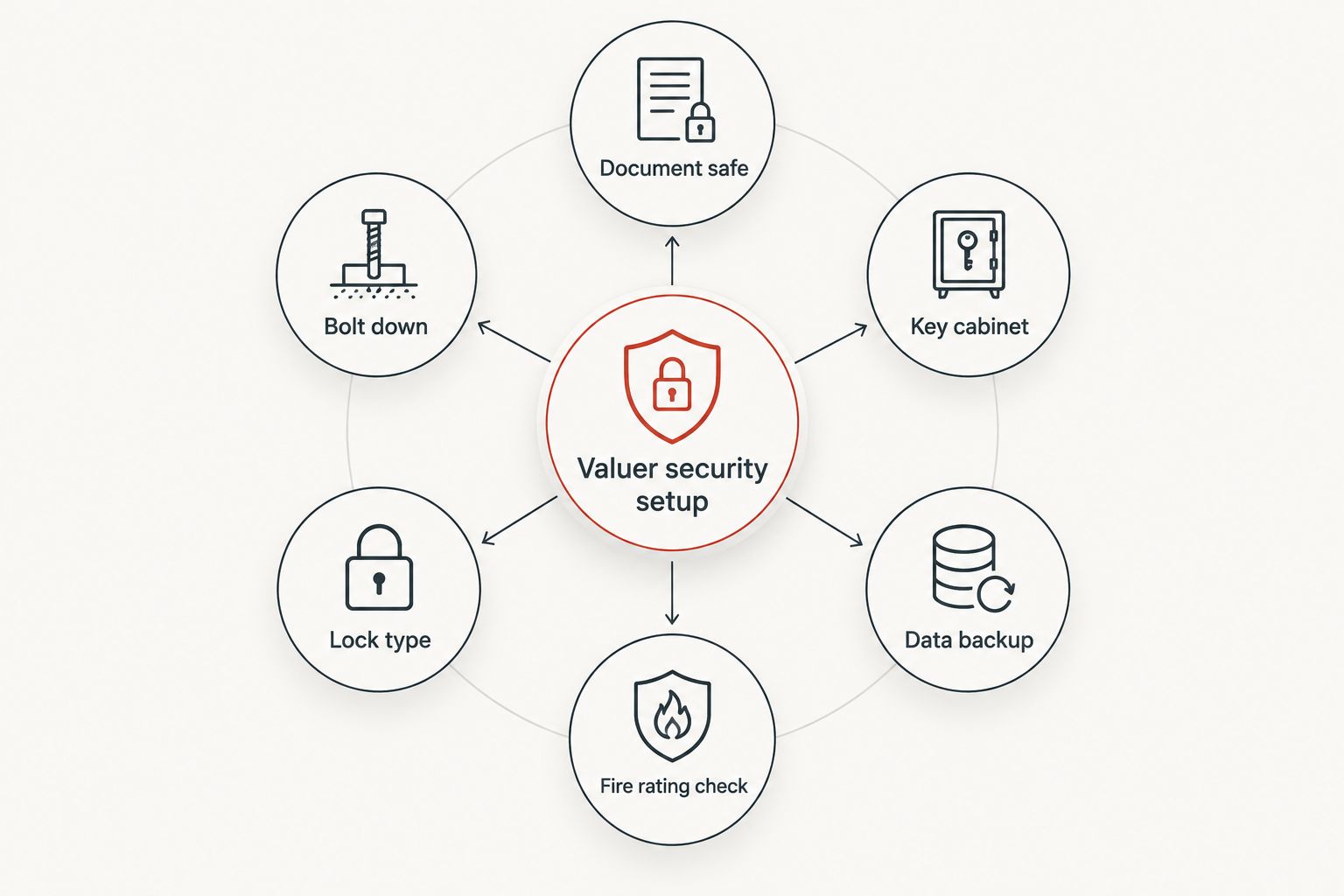
- Safes for property valuers split into three jobs: fireproof document storage, key cabinets and data backup.
- Yale Document Fire Safe Extra Large YFM-520-FG2 suits firms archiving years of signed reports — buy for volume.
- CMI Security Key Cabinet SKC-250D tracks multiple property and lockbox keys with an auditable digital lock.
- A 120-minute paper fire rating is a practical benchmark for signed valuation reports and client financial data in 2026.
- Mobile sole-trader valuers need a bolted-down safe at home, not a lockbox left in the car boot.
Why safes matter for property valuers
Property valuers sign off reports carrying a client's full name, address, loan figures and property financials — data the Privacy Act 1988 and its 13 Australian Privacy Principles expect you to store securely, not leave on a car seat between inspections. Bank panel valuers doing lender work often have to meet the lender's own security checklist before they're approved for panel jobs, and a fire-rated document safe or a Guardall GDF4000 Fire Resistant Filing Cabinet Safe is the simplest way to tick that box.
Valuers who inspect vacant or tenanted properties also end up holding spare keys and lockbox codes for homes they don't own. Losing that key is a liability question, not an inconvenience — the agent or owner will ask who had it last. Because the work splits across a home office, a vehicle and inspection sites, a safe for a property valuer has to fit a mobile workflow in 2026, not a fixed CBD office setup.
Setting up safes for property valuers, step by step
Store signed valuation reports in a fire-rated document safe
Signed reports are the record you'll be asked to produce if a valuation is ever disputed years after the fact.
- Choose a document safe fire-rated to at least 60 minutes for paper, more if you're archiving several years of reports — the Yale Document Fire Safe Extra Large YFM-520-FG2 is sized for that volume
- Keep hard copies of signed reports even when you also hold digital versions, for audit and professional indemnity purposes
- Separate current-year working files from long-term archive stock so daily access doesn't wear the same lock cycle
- Check the safe's internal seal if your valuation patch is coastal or tropical, where humidity damages paper faster than fire risk does
- Size capacity to your annual report volume, not just this month's caseload
Manage property keys and lockbox codes in a dedicated key cabinet
A drawer full of loose keys is how a valuer ends up unable to say which property a missing key belongs to.
- Use a wall-mounted key cabinet with individually numbered hooks rather than a drawer where keys get mixed together
- Log every key in and out if more than one valuer or admin person shares access — a cabinet like the CMI Security Key Cabinet SKC-250D supports this
- Pick a digital lock with an audit trail if keys go out to vacant properties for extended appraisal periods
- Size the cabinet for growth — a firm servicing multiple agencies fills hook space faster than expected
- Never store a spare house key in the same compartment as cash or a petty float
Back up digital valuation files and protect laptops on the road
- Store an external drive or USB backup of report files in a small safe, separate from the laptop that travels with you
- Look for a safe rated to protect data media at internal temperatures around 52°C, the point above which most drives fail in a fire
- Choose a compact model that bolts into a vehicle boot or home office floor for valuers who work from the car most days
- Encrypt digital files as a second layer — a safe protects the physical drive, not the data inside it
- Keep client financial data off shared cloud folders that aren't password protected
Match the fire rating to paper, not just the safe's headline rating
- A safe rated for burglary resistance isn't automatically fire-rated — check both figures separately before buying
- Paper needs a higher internal temperature tolerance than digital media to survive a house or office fire
- 120 minutes is a reasonable benchmark for a valuer holding several years of signed reports rather than a single file
- Ask for the fire test standard behind the rating, not just a marketing claim on the box
- Match the rating to realistic response times for your area, not a national average
Choose a lock type that matches how often the safe gets opened
- Mechanical dial locks suit low-traffic archive safes opened a few times a month
- Digital locks with PIN or biometric access suit key cabinets opened multiple times a day
- Dual-user locks make sense once more than one staff member needs sign-off authority
- Battery back-up on digital locks matters for valuers working from remote or semi-rural properties
- Avoid locks with no manual override if the safe holds a key a client is waiting on right now
Bolt the safe down wherever the office actually is
- A home-office safe still needs bolting to a slab or stud wall — weight alone doesn't stop it walking out the door
- Commercial suites should position the safe away from front-of-house sightlines
- Mobile valuers storing a safe in a vehicle need a model built for transit, not a static home safe repurposed
- Check building or strata rules before fixing a safe to a shared-office wall or floor
- Confirm the anchor bolts supplied suit the actual floor or wall material before installation day
Comparison: safe options for property valuers
| Option | Best for | Format | Key limitation |
|---|---|---|---|
| Yale Document Fire Safe Extra Large YFM-520-FG2 | Firms archiving years of signed reports | Fire-rated document safe | Heavy, needs dedicated floor space |
| CMI Security Key Cabinet SKC-250D | Valuers managing multiple property or lockbox keys | Wall-mounted key cabinet | No fire protection for paper files |
| Guardall GDF4000 Fire Resistant Filing Cabinet Safe | Offices wanting a filing-cabinet form factor | Fire-resistant filing cabinet | Bulkier footprint than a document safe |
| CMI Miniguard Domestic Security Safe (Size 3) | Sole-trader valuers working from a home office | Compact multi-purpose safe | Limited capacity for a growing archive |
Verdict: a valuer archiving reports past year one needs a dedicated document safe, not a general home safe stretched to do a filing job.
Common mistakes property valuers make
- Leaving spare property keys in the console or glovebox between inspections instead of a key cabinet — a lost key on someone else's house is a liability claim waiting to happen
- Storing signed valuation reports in a locked filing cabinet with no fire rating, assuming a lock does the same job as fire protection
- Running cash float and property keys out of the same safe, so anyone checking petty cash also gets lockbox access
- Buying a heavy commercial safe for a home-based practice and never bolting it down because "it's too heavy to move" — heavy safes still get moved when they're not fixed
- Using a paper-only fire safe for digital backup drives, when internal heat during a fire can still exceed the point drives fail at
FAQ
What's the best safe for a property valuer working from home?
A fire-rated document safe sized to your report volume, bolted to a stud wall or slab, covers most home-based valuers. Add a small key cabinet if you hold spare property or lockbox keys.
Do property valuers need an SCEC-approved safe?
Only if the work involves a government security classification or a panel requirement that specifically asks for SCEC-rated storage. Most private and bank panel valuation work is covered by a standard fire-rated document safe.
How long should signed valuation reports stay in a fire safe?
Retention periods vary by state valuers registration board and professional indemnity insurer, so check your specific requirement rather than assuming a fixed number. Keep both current-year and archived reports fire-protected regardless of the exact period.
What size key cabinet does a valuer need?
Size the cabinet to the number of properties you're actively holding keys for, plus growth room for new agency clients. A wall-mounted cabinet with individually numbered hooks and a logging system, like the CMI Security Key Cabinet SKC-250D, scales better than a drawer.
Is a fireproof safe enough or do I need burglary resistance too?
Fire rating and burglary resistance are two separate figures, and a safe can carry one without the other. Valuers storing client financial data and property keys generally want both, not just a fire label.
How much does a document safe for a valuer cost in 2026?
Cost depends on fire rating, internal capacity and lock type, so check current pricing on the site for the exact model you're considering. Bigger fire ratings and larger capacity both push the price up.
Can property keys and cash be stored in the same safe?
They can, but it's not good practice once more than one person has access, because it mixes cash-handling controls with key-tracking controls. Separate compartments or separate units keep an audit trail clean.
One last thing
The risk that gets missed isn't the office safe — it's the key sitting in your pocket or bag inside someone else's property right now. A key cabinet with a digital audit log turns a lost-key incident from "who had it last" into a two-minute cabinet check, and that's the difference between a minor admin task and a liability conversation with an agency in 2026.


