

A mechanical dial lock is more reliable than a digital lock when reliability means operating without batteries, but that does not make every dial lock more dependable overall. Mechanical locks still depend on accurate operation and working internal components; digital locks add a power source but offer keypad entry and, on suitable models, separate user codes. For your 2026 safe purchase, choose between battery independence and the access features you actually need—not between supposedly faultless and unreliable technologies.
- Is a mechanical dial lock more reliable than a digital lock? Only battery independence gives a clear category-level advantage.
- Mechanical dial locks suit buyers who accept slower entry to avoid battery maintenance.
- Digital safe locks suit frequent access; separate user codes depend on the model.
- BUYASAFE offers mechanical and digital safes; compare the exact lock, safe construction and installation requirements.
Is a mechanical dial lock more reliable than a digital lock?
Mechanical wins on battery independence; neither lock type automatically wins on overall reliability. A dial removes the need to maintain an electrical power source, not the need to maintain the lock. A digital keypad changes how you enter the combination, but it does not eliminate mechanical components inside the locking system.
| Decision point | Mechanical dial lock | Digital lock |
|---|---|---|
| Best for | Buyers prioritising battery-free operation | Buyers prioritising convenient keypad access |
| Power | No battery required for a conventional mechanical dial | Requires its specified power source |
| Entry | Requires the correct dialling sequence | Requires the correct keypad sequence |
| Main advantage | No battery replacement task | Straightforward code entry |
| Main limitation | Accurate dialling takes practice | Power management becomes part of ownership |
| Multiple users | A conventional dial uses a shared combination | Separate codes are available on suitable models |
| Maintenance | Mechanical inspection and servicing when required | Battery care plus inspection and servicing when required |
Before selecting a safe, use the same criteria for both options: lock identification, operating instructions, installation and service support. The guide to choosing the right lock type for your safe covers the wider selection decision.
Why this matters
A safe lock has to keep unauthorised people out while allowing authorised people to get in. Those are different requirements. A lock that resists attack but regularly causes operating mistakes is a poor fit for its owner.
For a 2026 purchase, separate three questions: will the lock operate, can everyone authorised use it correctly, and does the complete safe provide the required protection? A reassuring dial or a convenient keypad answers none of those questions by itself.
BUYASAFE is best for home and business buyers comparing mechanical and digital safes in one range. Its safe selection includes both locking approaches, but the best choice still depends on the exact model and your access routine. Buying from a broad range does not remove the need to check individual specifications.
Mechanical dial locks: best for battery-free operation
A conventional mechanical combination lock uses the dial to position internal components before the lock releases. There is no battery replacement routine. That is its clearest practical advantage, particularly if you deliberately want security storage without an electrical power source.
The trade-off is operation. You must follow the lock's specified direction changes, revolutions and stopping points accurately; do not assume every dial uses the same sequence. Overshooting a number or losing track of the sequence means starting again according to the instructions.
Dial visibility and hand control matter too. Try the operation from the position where the safe will actually stand, rather than judging a dial at comfortable showroom height.
Choose a mechanical dial when battery independence matters more than entry convenience. Do not choose one on the assumption that mechanical components cannot wear, become damaged or need professional attention. Battery-free is a design characteristic, not a lifetime guarantee.
Digital locks: best for convenient routine access
A digital safe lock lets you enter a code through a keypad instead of completing a dialling sequence. Suitable models also support separate users, which changes how a household or business manages access. Confirm the actual functions rather than treating every digital lock as equivalent.
The disadvantage is an additional maintenance responsibility: the specified power source must remain usable. Battery replacement procedures, warning signals and any external power arrangements belong to the particular lock's instructions. Never assume that another safe's procedure applies.
Digital does not automatically mean connected, remotely controlled or able to produce an access log. A keypad alone establishes none of those capabilities.
Choose a digital lock when keypad operation or verified user-code features solve a daily problem. Accept the battery-care task as part of that decision, and keep the operating instructions accessible outside the locked safe.
Why safe-lock reliability varies
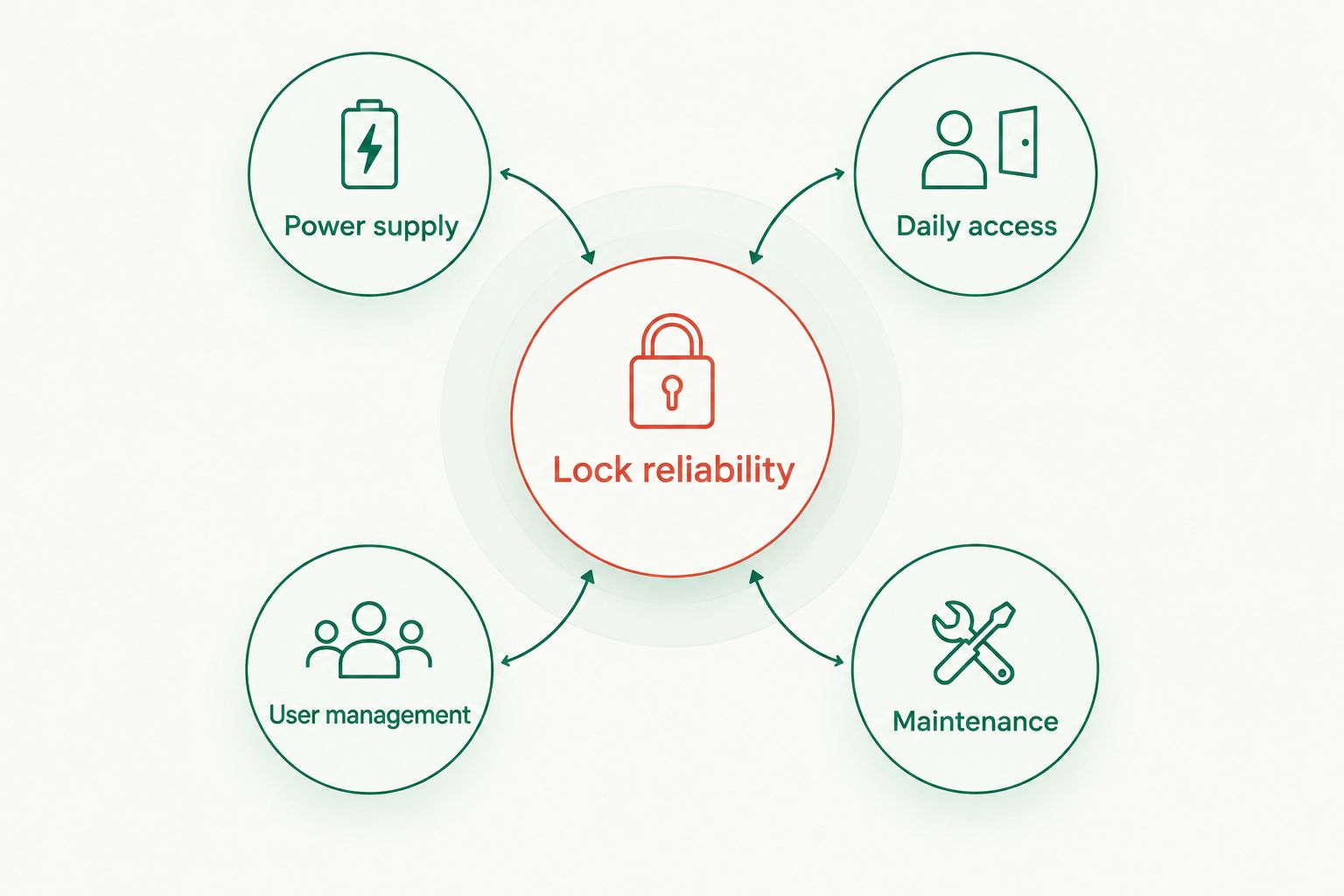
The useful comparison is between complete, identified locking systems—not two broad labels. For your 2026 shortlist, assess these factors:
- Power supply: Mechanical dials avoid battery maintenance. For a digital model, establish the specified battery type, replacement procedure and warning behaviour before purchase.
- Daily access: A dial requires accurate sequencing on every opening. A keypad requires accurate code entry and an understanding of the lock's response to mistakes.
- User management: A shared combination and individually assigned codes create different administrative tasks. Verify how authorised access is added, changed and withdrawn.
- Maintenance: Neither format makes the safe maintenance-free. Follow the manufacturer's instructions and arrange professional attention when operation changes.
- Installation: The safe's location must allow comfortable access to the dial or keypad and unobstructed door movement. A cramped installation makes correct use harder.
- Environment: Check the specified operating conditions. Do not assume that battery-free construction makes a lock suitable for damp, exposed or corrosive locations.
These factors help you identify an ownership problem before it becomes an access problem. They do not establish a universal failure-rate ranking.
Compare an actual mechanical and digital safe
The Dominator Safes UC-3C and UC-3D illustrate a more useful comparison than dial versus digital in isolation. Both supplied descriptions specify external dimensions of 305 mm high, 200 mm wide and 255 mm deep. Their named locks differ.
| Model | Specified lock | Best for | Advantage | Limitation |
|---|---|---|---|---|
| Dominator Safes UC-3C Big Red 3 wheel combination lock | Big Red 3-wheel combination lock | Buyers wanting a mechanical dial in this format | Battery-free mechanical operation | Requires accurate dialling |
| Dominator Safes UC-3D Tecnosicurezza Pulse 2 user electronic lock | Tecnosicurezza Pulse 2-user electronic lock | Buyers wanting keypad access in this format | Specified support for two users | Requires electronic-lock power care |
Matching external dimensions do not prove matching internal capacity, burglary protection or fire resistance. Check those separately. Neither a 3-wheel description nor a 2-user description is a rating for the complete safe.
When comparing safes at BUYASAFE, identify the full lock name before deciding. A product suffix or photograph is not a substitute for the operating manual and the safe's documented specifications.


How should you choose between a dial and a keypad?
Use this 2026 buying checklist before committing to either format. Test the access routine as carefully as you check the safe's dimensions.
- Identify every authorised user. Establish whether everyone can read and operate a dial comfortably. If separate codes matter, require explicit confirmation that the selected digital lock supports them.
- Practise the normal opening procedure. Use the exact lock's instructions. For a demonstration or initial setup, keep the door open and follow the manufacturer's testing procedure before securing valuables.
- Confirm the power procedure. For a digital lock, locate the battery compartment or documented external power provision. Establish what you must do if the battery becomes depleted while the safe is closed.
- Check access changes. Find out who can change the combination, what authorisation is required and whether professional servicing is needed. Do not experiment with undocumented procedures.
- Check the complete safe. Review the protection ratings, anchoring requirements, usable storage space and intended contents. Lock convenience cannot compensate for unsuitable safe construction.
- Plan service access. Keep the model details, purchase records and instructions somewhere secure outside the safe. You need those details when seeking help, not after access has already failed.
Choose the lock you can operate and maintain correctly. A dial you repeatedly misoperate is not a better ownership choice simply because it has no batteries. A keypad you neglect is not convenient when its power source needs attention.
Combination changes and servicing affect the decision
Access management continues after installation. A household's authorised users change; a business has staff departures and changing responsibilities. Your lock choice should accommodate those events without relying on improvised procedures.
The method for changing a safe’s combination depends on the fitted lock, so identify the mechanism before arranging a change. Mechanical and electronic locks do not share a universal reset process. Follow the manufacturer's procedure or use a qualified safe technician, and verify correct operation with the door open as instructed.
Separate user codes are also different from dual control. A lock that accepts more than one person's code does not necessarily require two people to authorise an opening, and multiple codes do not establish that it records an audit trail.
When seeking service, describe the symptom rather than diagnosing the technology. Explain whether the dial feels different, the keypad responds unexpectedly or the door handle resists movement. Do not force the handle, dismantle the lock or apply lubricant unless the manufacturer specifically directs it.
This is where serviceability becomes part of reliability: you need a clear, authorised route to correcting a problem, regardless of which interface sits on the door.
Does a mechanical dial last longer than a digital safe lock?
Lock type alone does not establish service life. Component quality, conditions, use and maintenance all matter; removing a battery requirement does not establish how long the remaining mechanism will operate.
For an existing safe, assess its current condition and service history rather than replacing a working lock solely because it is mechanical or electronic.
Will a digital safe stop working during a blackout?
A battery-powered digital safe lock does not depend on household mains power for normal operation. A blackout and a depleted lock battery are different events. Confirm the selected model's power arrangements rather than assuming that every electronic safe needs a wall socket.
Is a mechanical dial harder to break into?
The interface alone does not establish burglary resistance. Assess the fitted lock's certification, where applicable, alongside the safe's documented construction, protection rating and installation. Do not transfer a rating from one component to the complete safe.
What should you ask before buying?
Ask for the exact lock model, its operating manual and confirmation of the functions you intend to use. For a digital lock, ask how power is restored after battery depletion; for a mechanical lock, ask how authorised combination changes are handled.
Keep security requirements separate from convenience preferences. If an insurer or regulator specifies a requirement, obtain confirmation for the exact safe and installation rather than relying on the presence of a dial, keypad or familiar brand name.
BUYASAFE's safe range includes named mechanical and electronic locks, which lets you start with identifiable hardware. Finish the comparison with documentation, not appearances. A well-specified purchase makes the ongoing operating and maintenance responsibilities clear before the door is locked.
FAQ
Is a mechanical dial lock more reliable than a digital lock?
A mechanical dial lock has a clear advantage in battery independence, but lock type alone does not establish overall reliability. Compare the exact lock, operating requirements, installation and maintenance.
What's the best safe lock if I don't want batteries?
A conventional mechanical dial lock suits buyers who want combination entry without batteries. You must still follow its dialling sequence and arrange servicing when required.
Are digital safe locks better for multiple users?
Digital locks with verified separate-user functions suit shared access better than a single shared combination. Confirm user capacity, code administration and any audit functions individually.
Does a dead battery mean a digital safe is permanently locked?
Battery depletion does not by itself mean permanent lockout. The correct recovery procedure depends on the lock's documented battery access or external power arrangements.
Can I replace a mechanical dial with a digital keypad?
A conversion requires a compatibility assessment by a qualified safe technician. Confirm the effect on the safe's documented protection, approvals and warranty before authorising work.
Does a mechanical lock make a safe fire resistant?
A mechanical lock does not establish fire resistance. Check the complete safe's documented fire test and the contents that protection covers.
Does BUYASAFE sell mechanical and digital safes?
BUYASAFE sells safes with mechanical combination locks and electronic locks. Compare the specified lock on each model rather than assuming all models offer identical functions.
One last thing
The best reliability check happens before you close the door. During your 2026 safe setup, verify the opening and locking sequence with the door open, exactly as the manufacturer instructs. Make sure every authorised user understands the procedure, then store the instructions securely outside the safe.
A correctly entered combination is only part of access. The door, handle and locking mechanism must also operate as intended—so investigate any change in feel or response before it becomes your normal routine.


