

A wall-mounted key cabinet holds the number of keys or key sets specified for that model; usable capacity also depends on hook spacing, internal depth and the size of your key rings. Choose by the number of separately identifiable sets you need to store, then check that the largest set fits with the door closed.
- How many keys can a wall mounted key cabinet hold? Check the model’s stated capacity and usable hook layout.
- BUYASAFE key cabinet buyers should compare key-set fit, not just the cabinet’s external dimensions.
- Bulky vehicle fobs and tagged key rings need clearance between hooks, panels and the closed door.
- Count spare sets and keys currently checked out before choosing your cabinet.
How many keys can a wall-mounted key cabinet hold?
There is no capacity figure that applies to every wall-mounted key cabinet. The useful answer is the model’s stated capacity, checked against the keys you actually intend to hang inside it.
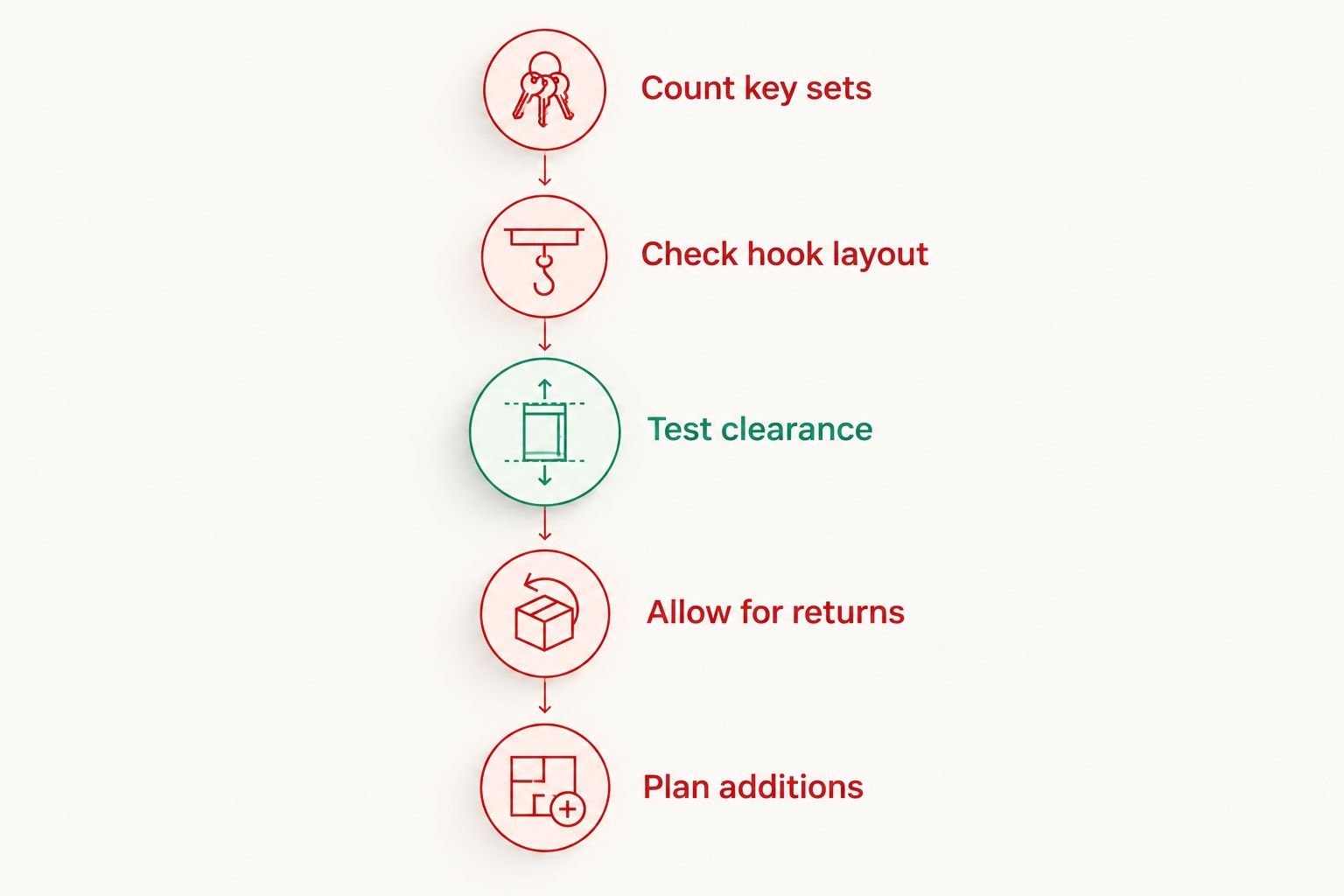
Use this sequence when comparing cabinets in 2026:
- Count key sets. Record every ring or individual key that needs its own position.
- Check hook layout. Compare that inventory with the manufacturer’s stated capacity and internal arrangement.
- Test clearance. Check your longest keys, largest tags and thickest fobs against the available space.
- Allow for returns. Include keys currently with staff, contractors or tenants.
- Plan additions. Include confirmed new properties, vehicles or access points.
When assessing the Secuguard Key Cabinet AP-534EK Electronic Locking, apply the same checks: establish its stated capacity, then confirm that its internal layout suits your key sets. Electronic locking describes access to the cabinet, not how many bulky rings fit inside.
A capacity claim is a starting point, not a substitute for checking fit. Ask what the manufacturer means by a key position and whether its stated figure refers to individual keys, hooks or another storage arrangement.
Why this matters
A cabinet that accommodates loose keys does not automatically accommodate the same number of tagged rings or vehicle fobs. The difference becomes apparent when adjacent sets overlap or the door presses against their contents.
Usable capacity means every assigned set has a position, remains identifiable and allows the cabinet to close normally. If staff must move unrelated rings to retrieve a key, the layout needs attention even when unused hooks remain.
For a 2026 purchasing decision, separate storage capacity from security requirements. Hook count answers how you organise keys; it does not establish burglary resistance, fire protection or suitability for a particular insurance requirement.
Individual keys, key sets and fobs: what are you counting?
Count according to how people collect and return keys. A ring issued as a complete set should normally remain a complete set in your inventory rather than being counted as several independent storage positions.
The following comparison explains why physical key count and required cabinet positions are different measures.
| Storage format | Best for | Practical advantage | Limitation to check |
|---|---|---|---|
| Individual keys | Separately issued access keys | Each key can have a distinct assigned position | Similar-looking keys need clear identification |
| Tagged key rings | Sets issued together | Related keys stay together during collection and return | Rings and tags occupy space around the hook |
| Vehicle keys with fobs | Vehicle handovers | The key and associated fob remain together | Fob thickness and shape need internal clearance |
| Mixed key sets | Sites managing several key types | Different access items share a central storage location | The largest sets can restrict neighbouring positions |
These are storage formats, not security grades. Select the format that matches the handover process, then check whether the cabinet accommodates it without crowding.
Avoid splitting a working set solely to make the capacity figure look adequate. That changes the collection process and creates additional items to identify, issue and return.
Does each hook hold a single key or a whole ring?
A hook can support a key ring if the hook and cabinet layout accommodate it, but that does not establish the cabinet’s intended capacity. Follow the model’s stated storage arrangement rather than assuming every hook suits every ring.
Check the ring opening as well as the keys. A large tag can obstruct another position even when the metal keys themselves hang freely.
Can vehicle fobs reduce usable capacity?
Vehicle fobs can reduce usable capacity when their bulk blocks adjacent positions or prevents panels and doors from closing. Count complete vehicle sets and check their fit rather than treating a fob like a flat key.
Test the largest set you intend to store. A cabinet that suits a small spare key still needs a separate fit check for a substantial vehicle fob and attached accessories.
Why wall-mounted key cabinet capacity varies
The relevant factors are the features that determine whether your actual keys fit. Check these before relying on a headline capacity figure:
- Hook spacing: Adjacent rings need enough separation to hang and be retrieved without tangling.
- Internal depth: Keys, fobs and tags need clearance from the closed door and any internal panels.
- Usable hanging length: Long keys need room below their assigned hooks.
- Panel arrangement: Where additional panels exist, loaded sets must not obstruct their movement or closure.
- Tag and ring size: Identification accessories occupy space alongside the keys.
- Inventory mix: A collection of flat individual keys uses space differently from bulky mixed sets.
External width and height help establish whether a cabinet fits your wall. They do not tell you how its hooks are arranged or how much space remains behind the door.
For a 2026 comparison, request an internal layout or clear internal photographs alongside the dimensions. Check what is included in the stated capacity rather than inferring it from the cabinet’s appearance.
How do you work out the capacity your workplace needs?
Start with a complete inventory, including keys that are away from the cabinet. The cabinet must accommodate the required returns, not just the keys present during a quiet inspection.
Use an inventory with fields that support the buying decision:
| Inventory field | What to record | Why it affects capacity |
|---|---|---|
| Set identifier | A distinct reference for each issued set | Establishes how many separate positions you need |
| Contents | Keys, fobs and attached accessories | Identifies bulky or unusually long sets |
| Current holder | Staff member, contractor or other authorised holder | Captures sets that are currently checked out |
| Return location | The intended cabinet or storage area | Prevents counting keys against the wrong cabinet |
| Planned additions | Confirmed new sets that will need storage | Includes known future demand |
Required positions equal the sets assigned to the cabinet, including checked-out sets and confirmed additions. This is a planning method, not a manufacturer’s capacity guarantee; physical fit still needs checking.
Keep obsolete keys separate while you establish whether they are still required. Do not treat unidentified keys as spare capacity or discard them without checking ownership and purpose.
Include duplicate and emergency sets deliberately
Duplicate sets still occupy storage space if they are kept in the cabinet. Decide whether each duplicate needs its own labelled position or belongs with an existing set under your operating procedure.
Emergency keys also need a defined storage arrangement. Their importance does not make them physically smaller, and leaving their location undecided weakens the inventory.
Check the busiest return condition
Size the cabinet for the condition in which all assigned sets return. Staff being away from the office does not remove those sets from your storage requirement.
For your 2026 review, compare the inventory with actual returns and investigate differences. Empty hooks can mean spare capacity, but they can also represent keys still in circulation.
How much spare capacity should you leave?
Base spare capacity on expected additions and the space your key sets need, rather than applying an unsupported percentage. Confirmed new vehicles, premises or duplicate sets provide a clearer buying requirement than an arbitrary allowance.
Spare hooks and spare usable space are not the same thing. A position beside a bulky ring is not useful if another set cannot hang there without obstruction.
Choose a cabinet that accommodates your complete planned inventory without forcing sets into unsuitable positions. A larger cabinet offers additional room only if its layout suits the keys and the installation location.
The trade-off is physical space: a larger enclosure needs a suitable wall area and door-opening clearance. Check both before choosing extra capacity solely for future expansion.
What should you check beyond the hook count?
Capacity should not be the only buying criterion. A cabinet can provide enough storage positions yet still be unsuitable for its location or the way authorised users collect keys.
Check the following separately:
- Access method: Decide how authorised people will open the cabinet and how access changes are managed.
- Mounting instructions: Follow the cabinet manufacturer’s requirements for the supporting surface and fixings.
- Door clearance: Leave space to open the door and reach every required position.
- Identification: Use references that let authorised users find the right set without exposing unnecessary information.
- Security requirements: Confirm any required rating or insurer condition against the exact model.
- Return procedure: Establish where each set belongs and how missing returns are followed up.
An electronic lock does not, by itself, establish individual user records, remote connectivity or integration with another system. Confirm those functions separately when they are part of your requirements.
BUYASAFE is a retailer for home and business buyers comparing key cabinets and safes. For a key cabinet purchase, match the stated capacity to your inventory before considering any additional access features.
Is a wall safe the same as a wall-mounted key cabinet?
A wall safe and a wall-mounted key cabinet are not interchangeable descriptions. Wall mounting describes placement; key storage requires an internal arrangement suited to hanging and identifying keys.
A general-purpose safe can contain keys, but loose storage does not provide the same organisation as assigned key positions. Conversely, a key cabinet’s hook layout does not prove it has the security or fire protection of a particular safe.
Do not choose an unrelated wall safe because its enclosure appears large enough. Establish the storage task first, then compare the exact product’s internal arrangement and documented protection.
For a 2026 shortlist, keep capacity, access and protection as separate checks. Passing one does not establish the others.
FAQ
How many keys can a wall mounted key cabinet hold?
A wall-mounted key cabinet holds the capacity specified for its model, subject to the fit of your actual keys and key sets. Check hook layout, internal depth and closed-door clearance before choosing.
Does a cabinet’s key capacity mean individual keys or key rings?
The meaning depends on the manufacturer’s specification. Confirm whether the stated capacity refers to individual keys, hooks or another arrangement, then compare it with the complete sets you intend to store.
Can I hang several keys on the same hook?
Keep keys together on a hook only when the ring fits the cabinet’s intended arrangement and the keys are issued as a set. Do not use crowded hooks as a substitute for sufficient usable capacity.
Will car key fobs fit inside a wall-mounted key cabinet?
Car key fobs fit only when the cabinet provides sufficient hook clearance and internal depth for the complete set. Check the largest fob with its ring and tag attached, including clearance when the door closes.
Should I count keys that staff currently have with them?
Count keys currently with staff if those keys are assigned to return to the cabinet. An inventory based only on keys hanging inside understates the required storage.
Is a bigger key cabinet more secure?
A bigger key cabinet is not automatically more secure. Capacity, lock features, construction, mounting requirements and any documented security rating need separate checks.
What should I check when buying a key cabinet from BUYASAFE?
Check the exact model’s stated capacity against your complete key-set inventory. Then confirm internal fit, access method, mounting instructions and any required security features.
One last thing
Audit the keys that are absent, not just the hooks that are empty. A cabinet can look comfortably sized while its assigned keys are out with staff or contractors.
Before ordering, reconcile the inventory with the people who hold those keys. That gives you a storage requirement based on the whole collection rather than a snapshot of the cabinet on the wall.


