

No. A digital safe is not automatically safer than a combination safe in 2026: the safe’s burglary resistance, installation and control of access matter more than whether you enter a code on a keypad or turn a dial. A digital lock makes it easier to change a code, while a mechanical combination lock avoids batteries; neither feature proves that the safe itself resists forced entry.
- Is a digital safe safer than a combination safe? No: the lock type alone does not establish burglary resistance.
- A digital keypad suits users who need to change codes; a mechanical dial suits users who want no battery dependence.
- For 2026 buying decisions, compare the safe’s documented rating, installation requirements and access needs before choosing a lock.
Why this matters
A lock controls how you open the door. It does not, by itself, tell you how the door, body or boltwork will withstand an attack. That distinction matters when you compare a small home safe with a commercial security safe: choosing the preferred keypad or dial first can leave you with the wrong safe for what you need to store.
Buy A Safe sells safes for home and business use, including models with different locking arrangements. Its guide to choosing a safe lock type is a useful next step if you have already decided what the safe must protect and need to settle the access method.
Is a digital safe safer than a combination safe?
Neither lock type wins on security without the specifications of the complete safe. Compare the rated safe and its installed configuration first. Then choose the lock that your household or staff can operate correctly and keep under control.
| Question | Digital keypad lock | Mechanical combination dial |
|---|---|---|
| Best for | Users who need to change a code or want keypad entry | Users who want a lock that does not depend on batteries |
| Main advantage | A code can be changed without changing the physical lock, subject to the model’s instructions | No keypad battery to replace |
| Main drawback | Requires attention to power, code control and the model’s lockout procedure | Entering the combination takes practice; changing it needs the correct procedure |
| What it does not establish | The safe’s burglary or fire resistance | The safe’s burglary or fire resistance |
| Check before buying | Lock specification, code-change procedure, battery access and safe rating | Lock specification, combination-change procedure and safe rating |
The practical difference is access management. If several authorised people use a business safe and the shared code needs changing when access changes, a digital lock gives you a direct way to update it. If the safe is opened by one person who prefers not to maintain a battery-powered keypad, a mechanical dial is a sensible choice. Both decisions still depend on the particular lock and safe, not the broad label on the listing.
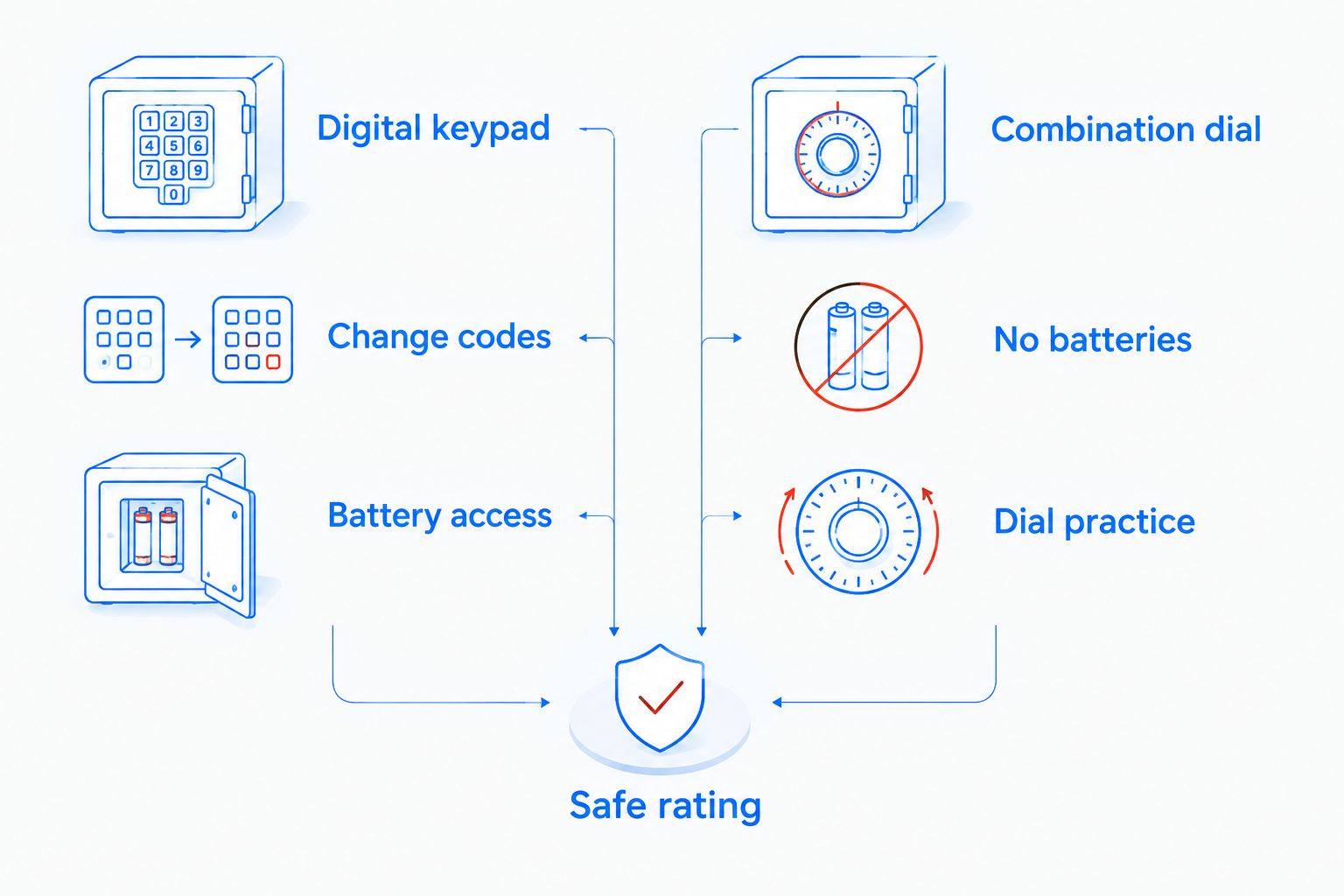
A keypad is not evidence of a stronger door. A dial is not evidence of a better-built safe. In 2026, ask for the exact model’s documented burglary rating and lock details rather than relying on either lock description as a security claim.
Choose a digital lock when access changes
A digital keypad is the more practical option when an authorised user needs to change a code. That is relevant in a workplace where access responsibilities change, or at home when a code has been disclosed to someone who should no longer know it. Follow the instructions for the installed lock: changing a code incorrectly can create an access problem rather than solve one.
The trade-off is maintenance. You need to know how the lock is powered, what its low-power warning means and how its battery is accessed. Check those points for the specific model before you rely on the safe. Do not assume every electronic lock has the same emergency procedure, and do not treat an unfamiliar override method as a security advantage.
Code discipline matters as much as the keypad. An easily guessed code or a code shared beyond the authorised users weakens access control. Record who is allowed to know it, change it when that changes, and keep the manufacturer’s operating instructions where an authorised person can retrieve them without leaving the code with the safe.
Best for: users who need straightforward code changes and will maintain the lock. The drawback is that keypad convenience brings a power and operating procedure to manage. If you cannot confirm those details for a particular model, choose the safe on its documented protection first and resolve the lock choice before ordering.
Choose a mechanical dial when battery independence matters
A mechanical combination dial removes the keypad battery from your maintenance list. For a safe that is opened infrequently, that can be a clear operational advantage: there is no electronic lock battery to monitor before the next opening. It does not mean the safe can be ignored. You still need a controlled record of the combination and a plan for authorised access.
The drawback is usability. Dial entry requires the correct sequence and careful operation, which can be inconvenient when several people need regular access. Changing a mechanical combination also requires following the procedure for that lock. If staff regularly struggle to open it, the lock that looked simpler on paper can create poor access habits in practice.
Do not confuse battery independence with attack resistance. A mechanical dial on a lightly built safe does not become a high-security solution because it has no electronics. In the same way, a keypad on a well-specified security safe does not make its tested construction irrelevant.
Best for: users who want to avoid battery-dependent entry and can manage a dial combination carefully. Its drawback is the slower, more demanding entry and combination-change process. Compare the complete safe before deciding that this trade-off suits you.
Why the answer varies between safes
A lock comparison is useful only after you establish what the safe must do. These are the factors that change the right answer:
- Documented burglary resistance. Look for the safe’s stated rating and the evidence behind it. A lock type is not a substitute for a tested safe construction.
- How the safe is installed. Check the manufacturer’s fixing requirements and whether the intended location permits them. A suitable lock cannot compensate for ignoring the installation instructions.
- Who needs access. A single household user and a changing group of business users have different code-control needs. Choose an arrangement that lets you remove access when responsibilities change.
- How often the safe is opened. Frequent entry makes the usability of the lock more important. Infrequent entry makes clear instructions and a reliable access plan more important.
- Power and servicing. With a digital lock, check the battery and service procedure for the actual model. With a dial, check how the combination is changed and who will carry out that process.
- What else needs protection. If you are storing documents or other heat-sensitive contents, assess the safe’s stated fire protection separately. A digital or mechanical lock does not establish a fire rating.
Buy A Safe lists the Chubbsafes Europa Grade II - Size 1 Key + LG39E Digital Lock as a Grade II safe with key and digital locking. Its supplied product description identifies ECB•S certification to EN 1143-1:2019 Grade II T2 for burglary protection. That is a useful example of why you must read the full specification: it combines key and digital locking, so it is not a simple keypad-versus-dial comparison, and its stated burglary certification is a separate fact from its lock format.
The standard reference above includes a historical date because it forms part of the certification named in the product information. When comparing any listing in 2026, check that its rating applies to the exact safe configuration under consideration; do not transfer a claim from one model or lock arrangement to another.
Can someone guess a digital safe code more easily?
A digital safe code is vulnerable to poor code choice or unnecessary sharing, but a keypad does not make every digital safe easier to open than a combination safe. Control who knows the code and change it according to the lock’s instructions when authorised access changes. For a mechanical dial, apply the same care to the combination: anyone who knows it has an access route.
This is an access-control decision, not a verdict on the door’s physical strength. If a group must share access, set a clear process for issuing and withdrawing that access. If only you use the safe, choose a method you can operate reliably without leaving the credential exposed.
Does a dead battery make a digital safe less secure?
A dead battery creates an access and maintenance issue, not proof that a digital safe has weaker burglary resistance. Check the model’s documented battery warning, replacement method and authorised recovery procedure before buying. Do not assume you can apply the procedure from another brand’s lock.
In 2026, this is a straightforward buying test: if the lock instructions are unclear to the people who will use the safe, resolve that before installation. A combination dial removes the battery issue but still requires accurate operating instructions and controlled knowledge of the combination.
Should you choose the lock before the safe?
No. Choose the required safe protection and installation location before deciding whether a keypad or dial suits your access routine. Otherwise, you risk selecting a convenient lock on a safe that does not meet the storage requirement.
Write down what you will store, who needs access and where the safe can be fixed. Then compare the documented burglary and, where relevant, fire protection of suitable models. Only after that should the lock’s daily operation break the tie. The safest lock choice is the one on an appropriate safe that authorised users can operate and manage correctly.
FAQ
Is a digital safe safer than a combination safe in 2026?
No. Neither lock type establishes the safe’s burglary resistance; compare the complete safe’s documented rating, installation requirements and access controls.
Which is better for changing access, a digital safe or a dial safe?
A digital safe is the more practical choice when you need to change a code. Follow the specific lock’s instructions and limit the new code to authorised users.
Will a digital safe open if its battery runs out?
The answer depends on the installed lock’s documented power and recovery procedure. Check the model instructions before relying on any particular method of regaining access.
Is a combination dial better for a safe I rarely open?
A mechanical dial suits infrequent use when avoiding keypad battery maintenance is a priority. You still need to retain the combination securely and follow the correct entry sequence.
Does a keypad mean a safe is fire resistant?
No. A keypad describes the entry method, not fire protection. Check the safe’s stated fire rating for the contents you intend to store.
Can I change a mechanical safe combination?
A mechanical combination can be changed where the installed lock supports that procedure. Use its specific instructions or an appropriate safe service rather than assuming all dials change the same way.
What should I compare first when buying a home safe?
Compare the safe’s documented protection and intended installation first. Then choose a lock you can operate consistently and keep under the control of authorised users.
One last thing
A safe with both a key and a digital lock shows why lock labels alone are a poor shortcut: it does not fit neatly into a keypad-versus-dial verdict. For a 2026 purchase, make the seller identify the exact safe model, lock configuration and documented protection before you decide which entry method you prefer. Buy A Safe’s product listings are a starting point for that model-by-model comparison, not a reason to treat every digital or mechanical safe as equivalent.


