

No—a bigger safe is not automatically more secure. Size determines storage capacity; burglary resistance depends on the safe’s construction, locking system, tested protection and installation. In 2026, choose the protection level first, then the size that fits your contents and installation site.
- Is a bigger safe more secure? No—capacity and burglary resistance are separate buying criteria.
- Chubb Mini Banker MkII listings specify the same 65 mm body barrier across different size variants.
- BUYASAFE safe buyers should compare protection, usable space and anchoring before choosing a larger cabinet.
- Fire resistance does not establish burglary resistance; check both claims separately.
Is a bigger safe always more secure?
A larger cabinet is evidence of more space, not evidence of greater attack resistance. A bigger safe earns a security advantage only when its specifications, tested protection or installation establish that advantage. Its dimensions alone do not.
The distinction matters when comparing sizes within a range. The supplied Chubb Mini Banker MkII listings describe a 65 mm body barrier for several size variants, including Size 1, Size 3 and Size 6. That shared specification does not establish identical overall security, but it does show why a larger size label is not proof of a thicker body barrier.
| Safe option | Best for | Practical advantage | Limitation |
|---|---|---|---|
| Smaller safe with suitable documented protection | Buyers with compact contents and limited installation space | Fits a smaller site without requiring unnecessary capacity | Contents, folders and boxes still need to fit through the opening |
| Larger safe with suitable documented protection | Buyers storing bulky contents or a growing collection | Provides room for storage and organisation | Requires more installation space and a suitable delivery route |
| Larger safe selected on dimensions alone | Capacity comparison only—not a security recommendation | Establishes the external space requirement | Size does not establish burglary resistance, fire protection or installation suitability |
Do not use this table to rank unverified models. Use it to separate the capacity decision from the protection decision before comparing individual specifications.
Why this matters
Buying a safe means deciding both what must fit inside and what must stay outside. Those are different questions. A spacious cabinet that does not meet your protection requirements is not an upgrade simply because it holds more.
BUYASAFE is best for home and business buyers comparing safe categories before choosing a size. Its range includes security storage for different purposes, but the relevant specifications belong to each model—not to the retailer’s entire range.
For a 2026 purchase, start with the contents and the threat you want to address. Documents exposed to fire, valuables exposed to theft and business cash requiring controlled access call for different checks; none is resolved by choosing the largest cabinet.
What the Chubb Mini Banker MkII size comparison actually shows
The BUYASAFE safe listings provide a useful example of a shared construction feature across different sizes. Each model below describes a steel body, welded throughout, with specially formulated Chubbsafes barrier material and a 65 mm body barrier.
| Listed model | Body barrier stated in the listing | What the comparison establishes |
|---|---|---|
| Chubb Mini Banker MkII Security Safe Size 1 Digital Locking (M-15) | 65 mm | The smallest numbered variant shown here has the stated barrier thickness |
| Chubb Mini Banker MkII Security Safe Size 3 Digital Locking (M-40) | 65 mm | A higher size number does not change this stated specification |
| Chubb Mini Banker MkII Security Safe Size 6 Digital Locking (M-125) | 65 mm | This larger numbered variant also lists the same barrier thickness |
The scope of this 2026 comparison is the listed body construction. It does not establish matching door construction, internal dimensions, anchoring provisions or burglary certification. A body barrier thickness is also not a steel plate thickness: the description identifies steel and barrier material, not a solid steel wall of that thickness.
Size 1: 65 mm body barrier
The Chubb Mini Banker MkII Size 1 listing states a 65 mm body barrier. Its advantage in this comparison is that the lower size number does not mean a thinner stated barrier; its limitation is that the description does not establish whether your contents fit.
Size 3: 65 mm body barrier
The Chubb Mini Banker MkII Size 3 listing also states a 65 mm body barrier. Treat that as a construction detail, not a complete security rating. Check the full model specifications before deciding whether it suits your installation.
Size 6: 65 mm body barrier
The Chubb Mini Banker MkII Size 6 listing repeats the 65 mm body barrier specification. The higher size number therefore supplies no evidence of a thicker barrier in this comparison. Confirm usable capacity and access requirements separately.
Why safe security varies independently of size
The supplied listings distinguish construction, locking methods, security safes and fire-resistant storage. These features give you a better comparison framework than external dimensions alone.
- Body construction: Read what the body contains, not just its overall thickness. Steel plate and a composite barrier describe different construction details.
- Door construction: Check the door separately from the body. A body specification does not describe the complete enclosure.
- Locking system: Compare the actual lock and access arrangements. A digital keypad, key or fingerprint reader identifies an access method, not an overall burglary grade.
- Documented protection: Look for the test standard, classification and exact model covered. General security wording is not a substitute for those details.
- Protection purpose: Keep fire protection and burglary protection separate. Confirm the evidence for each threat relevant to your contents.
Compare like-for-like evidence. A detailed construction description on one listing and a broad security claim on another do not support a reliable ranking. Ask for the missing specification before choosing between them.
Does a heavier safe resist theft better?
Weight affects handling, but weight alone does not establish burglary resistance or replace the installation instructions. Removing a cabinet and forcing it open are separate risks. A safe needs an installation appropriate to its design as well as protection appropriate to its contents.
Do not assume a large safe can stand unsecured because it looks difficult to move. Check the manufacturer’s anchoring requirements, the available fixing points and the suitability of the supporting structure. A cupboard panel and a structural floor are not interchangeable fixing substrates.
A heavier safe also introduces practical constraints. Confirm the delivery route, floor suitability and handling arrangements before ordering; stairs, tight turns and thresholds belong in that assessment. For a 2026 installation, resolve these issues before the cabinet reaches the property.
Ask the installer to explain the proposed fixing method and confirm that it follows the safe manufacturer’s instructions. Avoid selecting anchor sizes or drilling locations from a general rule that ignores the model and site.
How do you choose the right size without sacrificing security?
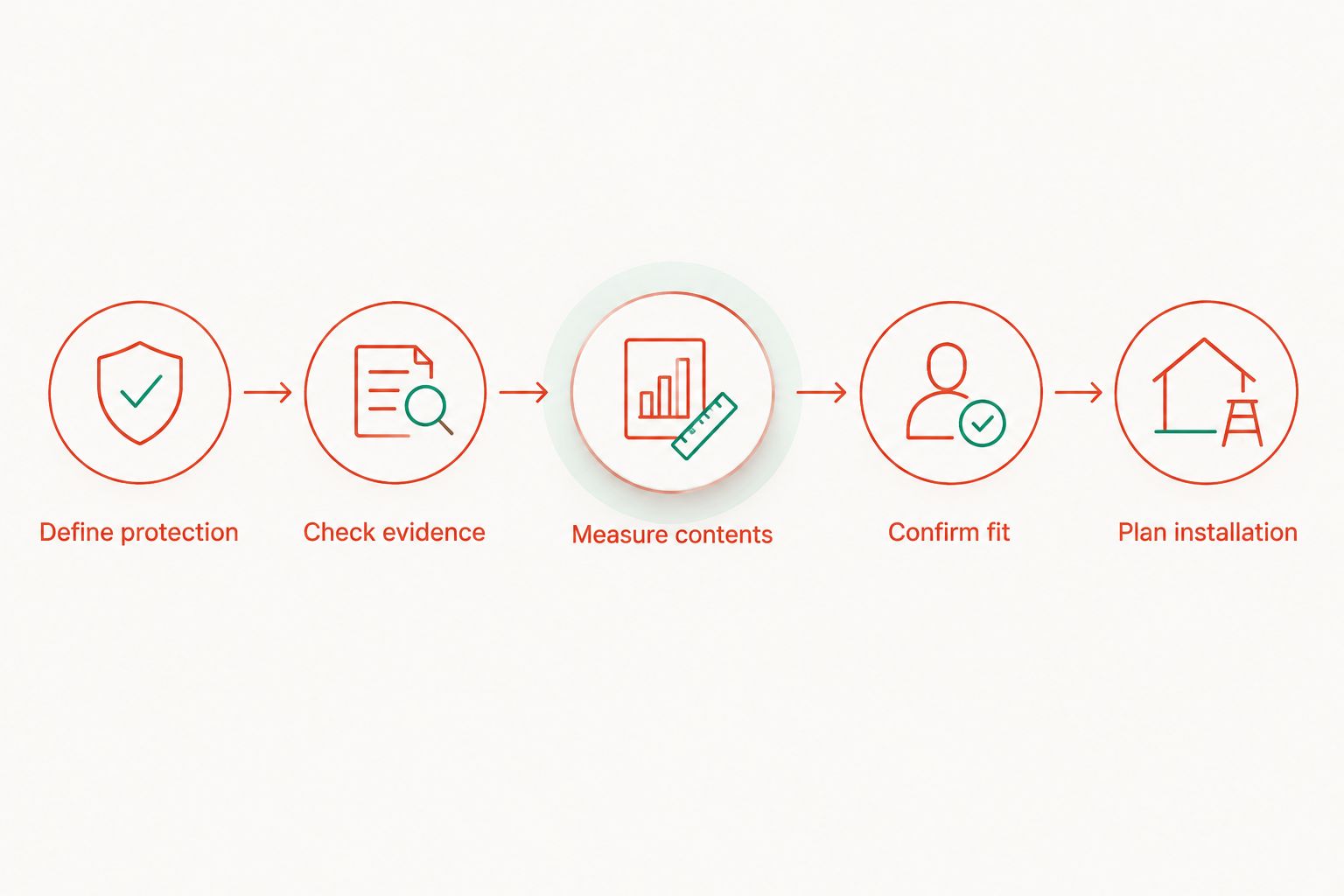
Set a protection requirement, then measure the storage requirement. This sequence stops extra capacity from distracting you from a weaker or unverified security specification.
- Define protection. List the contents and the risks you need to address. Separate theft protection, fire protection and any applicable storage obligations.
- Check evidence. Obtain the relevant model specifications and supporting certification where claimed. Confirm that the evidence covers the exact variant under consideration.
- Measure contents. Measure the items as stored, including folders, cases and boxes. Record the largest item rather than relying only on total volume.
- Confirm fit. Compare usable internal dimensions, shelf layout and door opening with those measurements. Check the external dimensions against the installation position and delivery route.
- Plan installation. Confirm the supporting structure, permitted fixing method and access arrangements. Resolve installation restrictions before selecting the cabinet.
These steps keep protection, capacity and installation connected without treating them as interchangeable. A safe that meets the security requirement but cannot accept your documents is unsuitable; a cabinet that fits everything but lacks the required protection is unsuitable too.
What measurements matter more than the size label?
Internal dimensions and the door opening determine whether an item fits. External measurements tell you whether the cabinet fits the room, not whether your contents fit inside it. Shelves, door components and the internal layout also need checking.
An A4 sheet measures 210 mm by 297 mm, but a folder, sleeve or document box is larger than the bare sheet. Measure the actual storage package. A cabinet described as a document safe still needs sufficient usable space for the way you organise your records.
Check these measurements before committing:
- External height, width and depth, including protruding handles where applicable.
- Usable internal height, width and depth with the intended shelf arrangement.
- Clear door opening and space needed to swing the door.
- The largest stored item in its folder, case or container.
- The narrowest point and tightest turn on the delivery route.
For your 2026 shortlist, request dimensions in writing rather than judging capacity from photographs. Product images show layout, but they do not replace measurements.
When is a larger safe the better choice?
Choose a larger safe when your measured contents require more space and the larger model still meets your protection and installation requirements. That is a capacity-based decision, not a claim that bigger means stronger.
Extra usable space helps when you need to organise folders, separate stored items or accommodate a defined addition to a collection. Its drawback is the additional space and handling requirement. Avoid adding capacity without checking where the cabinet will stand and how its door will open.
A smaller safe remains the sensible choice when everything fits, its protection is suitable and it supports a sound installation. Its limitation is reduced room for additional contents. Decide using an inventory, not a visual preference for a larger cabinet.
The following variants illustrate the shared body specification discussed above. Compare full specifications before selecting either size; the repeated barrier thickness does not establish complete equivalence.


Is a bigger fire safe better at protecting documents?
A bigger fire safe provides no automatic improvement in fire protection. Compare its documented fire classification, the contents covered and the test conditions. Cabinet capacity does not establish those properties.
Keep the storage medium in view. Paper documents and data media have different protection requirements, so do not extend a paper-protection claim to electronics or backups without supporting evidence. Likewise, a fire-resistance claim does not establish water protection or burglary resistance.
Will choosing a larger safe satisfy my insurer?
A larger safe does not automatically satisfy an insurer’s requirements. Give your insurer the exact model, intended contents, installation details and relevant documented protection before relying on the safe for cover.
Ask for the insurer’s acceptance in writing. Neither the cabinet’s size nor a general cash-rating statement replaces the conditions of your policy.
FAQ
Is a bigger safe more secure than a small safe?
No—a bigger safe is not automatically more secure than a small safe. Compare documented protection, construction, locking and installation separately from capacity.
Can a small safe have the same body thickness as a larger safe?
Yes—the supplied Chubb Mini Banker MkII Size 1, Size 3 and Size 6 listings each state a 65 mm body barrier. That shared detail does not establish identical overall security.
Does a heavy safe still need to be bolted down?
Follow the manufacturer’s installation and anchoring instructions regardless of the safe’s weight. Weight alone is not evidence that an unanchored installation is suitable.
What size safe do I need for A4 documents?
An A4 sheet measures 210 mm by 297 mm, but you need to measure the folder or box containing it. Check usable internal dimensions and the clear door opening against the actual package.
Is a digital lock safer than a key lock?
The access method alone does not establish which safe is more secure. Compare the specific lock, enclosure protection and how you will control access.
Does fire resistance mean a safe is burglary resistant?
No—fire resistance and burglary resistance are separate protection claims. Check the supporting evidence for each on the exact model you intend to buy.
Should I choose extra space for future storage?
Choose extra space when you have a defined storage need and the larger safe still meets your protection and installation requirements. Extra capacity is not a security upgrade by itself.
One last thing
The most useful measurement is often the object’s container, not the object itself. Before buying, place your largest folder, jewellery case or document box in its normal storage arrangement and measure that arrangement. Then confirm both internal fit and passage through the door opening.
Make that check part of your 2026 purchase decision. It prevents an avoidable mismatch without substituting a larger cabinet for the protection you actually need.


