

No general Australian law requires every retail business to keep its cash in a safe in 2026. You still need to manage workplace security risks, and your insurance policy, lease or a rule applying to another item you store can set separate requirements. A cash safe is a control you choose to meet a documented need, not a blanket legal requirement for taking cash at the counter.
- Is a cash safe required by law retail Australia? No general rule requires one for every store in 2026.
- Workplace safety duties, insurance conditions and cash exposure determine what controls a retailer needs.
- Buy A Safe cash safes are best for retailers that need controlled storage; they do not replace staff procedures.
- Check your policy and assess how cash moves through the store before choosing a safe.
Is a cash safe required by law for retail businesses?
No blanket rule requires an Australian retail business to buy a cash safe simply because it accepts cash. The legal question is whether your business manages the risks associated with its work. A requirement in an insurance policy or lease is a separate matter: it can affect your cover or contractual obligations without being a law that applies to every retailer.
If you are deciding whether storage is appropriate, start with where cash sits between a sale and banking. The cash safes for retail stores guide covers the storage decision; this page separates that decision from the question of legal compulsion.
| Source of a requirement | Does it automatically require every retailer to have a cash safe? | What to check |
|---|---|---|
| General workplace safety duties | No | Whether your assessment identifies cash handling or access as a risk requiring controls |
| Insurance policy | No | The policy's conditions for cash kept on the premises and any stated safe requirements |
| Lease or site rules | No | Written security conditions that apply to your premises |
| Rules for other regulated items | No | Requirements for those items rather than assuming a cash safe meets them |
| Your own operating procedure | No | Whether staff have a workable process for storing and transferring cash |
This distinction matters when someone says a safe is mandatory. Ask them to identify the law, policy clause or contract term, and the activity it applies to. A general recommendation to secure takings is not the same as a requirement to use a particular safe.
Why this matters
A retailer can make either of two expensive mistakes: buy a safe on the assumption that every shop must have one, or dismiss storage controls because no blanket cash-safe rule exists. No blanket mandate does not remove the need to assess risk. It means your choice of controls must reflect your operation and any requirements that actually apply to it.
The location of cash changes the decision. Money left in an accessible drawer presents a different access problem from sealed takings held in a restricted area. Neither situation, by itself, identifies a legally required safe model; both deserve a clear account of who can handle the cash and when.
Workplace health and safety frameworks differ across Australia, including the terminology used in Victoria. In 2026, check the guidance from the regulator in your state or territory when you document workplace controls. Keep that check separate from the wording of your insurer's policy.
What should a retailer check before buying a cash safe?
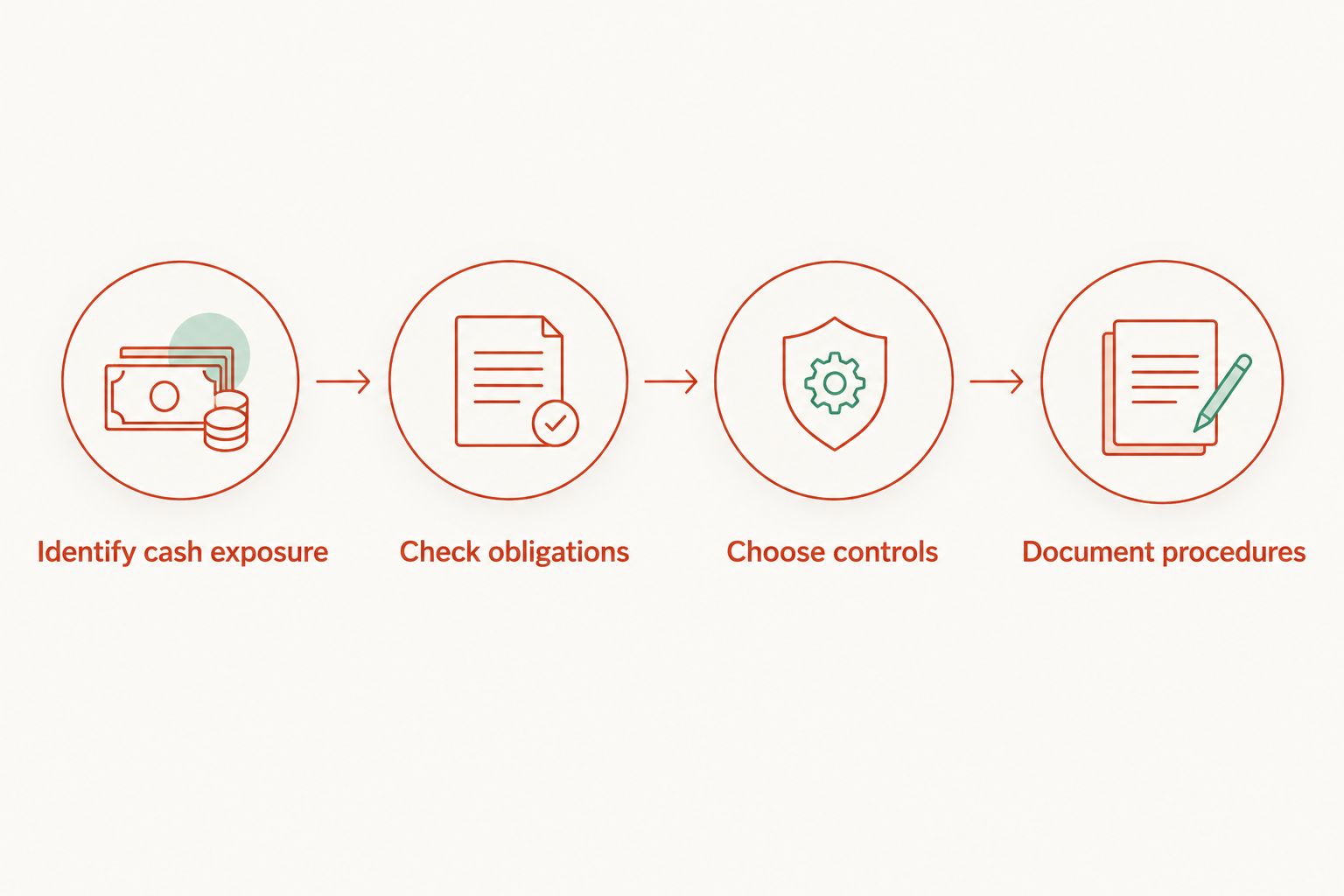
Use this order. It keeps the legal check ahead of the product choice and gives staff a procedure they can follow.
- Identify cash exposure. Map where takings are held during trading, at close and before banking. Record who can access each place.
- Check obligations. Read the relevant insurance conditions, lease and workplace safety guidance. If someone specifies a rating, lock or installation method, get the exact wording.
- Choose controls. Decide how staff will limit access and move takings. Then select storage that fits those controls rather than assuming any locked box meets the requirement.
- Document procedures. Record who deposits cash, who can open storage and what happens when a key or code is no longer authorised.
The check does not end when a safe is installed. If your staff change, your cash-handling process changes or the policy is renewed, revisit access and the written conditions. A secure container does not decide who is authorised to use it.
Identify cash exposure without guessing at a legal threshold
There is no universal cash amount in this guide that triggers a safe requirement for every Australian retailer. The relevant questions are operational: when cash accumulates, where it remains after closing and who can reach it. Write down the pattern you actually use, not an assumed threshold borrowed from another business.
Include the point at which takings leave the register. If one person collects them and another checks the amount, describe both roles. If cash stays on site, note the storage location and the people who need access. That record makes it easier to assess a control and to answer a specific insurer question.
Check the document that supposedly makes a safe compulsory
Treat a policy condition, lease clause and legal duty as different sources. A policy can specify how insured cash must be stored; a lease can impose premises rules; workplace safety duties concern risk management. None of those should be paraphrased as a nationwide retail cash-safe law.
If a document calls for a rated safe, do not assume that the word safe on a product listing settles the issue. Match the stated requirement to the proposed model and installation arrangement. Where the wording is unclear, ask the party that issued the requirement to clarify it in writing before buying.
Choose a control staff can actually use
Consider who needs to put cash away and who needs to retrieve it. A storage process that gives every shift the opening code defeats an intended access limit. A process that requires an authorised person who is never present can leave takings outside secure storage.
The safe is one part of the process. Key control, code changes, access records where used, and a clear handover at closing address questions that a steel cabinet cannot answer. Set the procedure first, then check whether the storage option supports it.
Which cash storage option fits a retail business?
A locked cash box, deposit safe and cash management safe address different workflows. Buy A Safe commercial safes are best assessed against who deposits takings and who is authorised to open the main compartment. A named product type is not proof that it satisfies your insurer's wording; confirm the model and installation requirements separately.
| Option | Best for | Advantage | Limitation |
|---|---|---|---|
| Locked cash box | Temporary organisation of a small amount under staff supervision | Portable and straightforward to use | Portability also makes it a poor substitute for secure on-site storage |
| Platinum D2 Defender Deposit Chute Safe | A workflow that separates deposits from access to stored cash | Its deposit-chute design supports cash drops | A deposit opening does not establish whether its rating meets a particular policy |
| Platinum DM2 Manager Cash Management Safe | A retailer comparing dedicated cash-management storage | It is designated for cash management | Its name alone does not establish access features or policy compliance |
Verdict: Choose the storage method that supports your written cash-handling process and any verified insurer condition. Do not treat the cheapest, heaviest or most specialised-sounding option as automatically compliant. Product suitability depends on the requirement you are trying to meet.
For a business with frequent staff deposits, a deposit chute is a relevant feature to investigate because it changes how takings enter storage. Ask how the opening is used in your intended procedure and who can open the main compartment. For a business focused on controlled access to accumulated takings, compare cash-management safes against the same written criteria.
A cash box serves a different purpose. It can organise money while staff control it, but it can be carried away. If your aim is to leave cash secured on the premises, assess a fixed storage option rather than calling a portable box a safe simply because it locks.
Why do cash-safe requirements vary between retailers?
The answer changes with the documents and risks attached to each business, not with a single national shop rule. Review these factors before choosing equipment in 2026:
- Insurance wording. Policies can distinguish between cash in a register, cash stored on site and cash in transit. Read the terms that apply to your cover.
- Lease conditions. A landlord or site operator can set security requirements through an agreement. Check the signed document rather than relying on an informal description.
- Cash-handling workflow. The point at which takings leave the register affects who needs deposit access and who needs opening access.
- Staff access. Shared keys or codes make it harder to maintain a clear authorisation process. Set responsibility for issuing and changing access.
- Storage location and installation. A requirement concerning installation cannot be met merely by selecting a product with the right name. Confirm what the document says before arranging installation.
- Other stored items. Do not assume a cash safe meets rules for firearms, medicines or another separately regulated item. Check those requirements on their own terms.
These factors also explain why advice from another retailer is not enough. Their policy, premises and procedures do not establish what applies to yours. Ask for the applicable wording, then record how your chosen controls address it.
Does accepting cash create a legal duty to install a safe?
No general Australian rule turns acceptance of cash into a duty to install a safe in 2026. Accepting cash does give you a reason to assess how staff handle and store it. The result of that assessment, alongside your policy and contract terms, determines the next move.
If a salesperson or insurer says a safe is compulsory, ask what makes it compulsory in your case. Is the source a statute, a policy condition or a lease? The answer tells you what must be checked and who can clarify it.
Can an insurer require a retail cash safe?
Yes, an insurer can set storage conditions in a policy. Whether your policy does so depends on its wording, and a condition of cover is not a blanket law for all Australian shops. Check the current policy and obtain clarification from the insurer if its safe description or installation terms are unclear.
Keep a copy of that clarification with your cash-handling procedure. It gives the person selecting a safe a defined specification to check instead of a verbal instruction to buy something secure. Recheck the terms when the policy changes.
Does a deposit safe meet every cash-storage requirement?
No, a deposit safe does not automatically meet every cash-storage requirement. A deposit opening describes how cash enters the safe; it does not, on its own, prove that the model, rating or installation matches an insurer's condition. Verify those points against the exact requirement before ordering.
Buy A Safe deposit safes are best for retailers whose procedure calls for staff to place takings into storage without giving every depositor main-compartment access. They are less useful when the operation does not need that separation. Choose based on the workflow, not the category label alone.
FAQ
Is a cash safe required by law retail Australia in 2026?
No general Australian law requires every retail business to have a cash safe in 2026. Check workplace risks and any insurance or lease terms that apply to your business.
Do I need a safe if my shop accepts cash?
Accepting cash alone does not establish a blanket legal requirement for a safe. Assess how takings are handled and check the conditions of your insurance and premises agreement.
Can my insurer specify the type of safe I use?
Yes, a policy can set conditions for storing insured cash. Read the exact wording and confirm the proposed safe and installation meet it.
Is a locked cash box the same as a retail safe?
No, a portable cash box and a retail safe serve different storage purposes. Check your risk assessment and policy terms before treating a cash box as adequate for on-site storage.
Is a deposit safe mandatory for retail cash drops?
No general retail rule makes a deposit safe mandatory for every cash-drop process. It is an option when staff need to deposit takings without general access to stored cash.
Does a safe automatically satisfy workplace safety duties?
No, a safe alone does not manage every cash-handling risk. Set clear staff access and transfer procedures alongside any storage control.
What should I check before buying a retail cash safe?
Check your insurance policy, lease terms, workplace risk assessment and cash-handling workflow. Use the resulting requirements to assess the safe and its installation.
One last thing
Ask who can open the safe before asking which safe to buy. If the same access is given to everyone who deposits cash, a deposit feature has not achieved the separation your procedure intended. In 2026, make that access decision alongside the policy check; it is what turns a storage purchase into a usable control.


