

A car safe needs a vehicle-specific quote: the total depends on the safe, its mounting system and the work required to fit it. Ask for an itemised installed total in 2026, not just the cost of the box. A compact home safe is not automatically suitable for a car, and its advertised price is not an installed vehicle-safe quote.
- How much does a car safe cost? Compare vehicle-specific, installed quotes rather than standalone safe listings.
- BUYASAFE is a starting point for safe comparisons; confirm vehicle suitability before selecting a car safe.
- Compare portable, fixed and custom-fit storage by mounting, access and removal requirements.
- Ask suppliers to separate the safe, mounting hardware, fitting and exclusions in writing.
How much does a car safe cost in Australia?
For an Australian car-safe purchase in 2026, request a quote against your exact vehicle and intended contents. A useful quote identifies the safe model, attachment method, fitting location and included work. Without those details, you are comparing different jobs.
Start with the guide to car safes for protecting valuables on the road, then ask suppliers to price the same installation brief. Do not compare a supply-only storage box with a fitted system as though they provide the same result.
| Quote component | What the quote should identify | What to check before accepting |
|---|---|---|
| Safe | Exact model, lock and usable internal space | Written confirmation of suitability for vehicle use |
| Mounting | Bracket, cable or other specified attachment | Compatibility with the intended location |
| Fitting | Work required to secure and position the safe | Who performs it and what the work includes |
| Delivery | Delivery arrangements for the safe and fittings | Whether delivery is separate from installation |
| Finishing | Any trim removal, refitting or associated work | Whether this work appears in the quoted scope |
| Future removal | How the safe and mounting are removed | What remains attached to the vehicle afterwards |
Compare complete scopes, not isolated headline figures. A quote that leaves mounting unspecified does not answer what your finished installation will involve.
Why this matters
A car-safe purchase combines storage selection with a vehicle-fitting decision. The enclosure must hold your belongings, but the location must also permit safe operation of the vehicle and practical access when parked. Solving only the storage problem leaves the installation unresolved.
BUYASAFE sells home and business safes, so distinguish those categories from a confirmed vehicle application. A product described as compact, electronic or suitable for apartments does not establish that it belongs beneath a car seat or inside a boot.
For your 2026 shortlist, treat vehicle suitability as a pass-or-fail requirement. Compare locks, internal space and other features only after a supplier has confirmed the proposed application.
Portable car storage: check the attachment method
Best for: buyers who need removable storage and have confirmed a suitable attachment arrangement.
Portable storage gives you the option of taking the enclosure out of the vehicle. That flexibility comes with an important limitation: portability alone says nothing about resistance to removal while the vehicle is unattended.
Ask how the proposed enclosure attaches, which fittings are included and whether the manufacturer supports that arrangement. If the design uses a cable, request the cable and attachment details rather than relying on a photograph.
Your quote should also explain what happens when you remove the enclosure. Establish whether a bracket stays behind, whether tools are needed and whether the remaining fittings interfere with everyday use.
Recommendation: choose portability only when the documented attachment method suits your vehicle and intended use. Do not treat an unsecured lockable box as equivalent to an installed safe.
Fixed car safes: specify the fitting location
Best for: buyers who want storage to remain in a particular vehicle.
A fixed installation makes the fitting location part of the purchase decision. Ask the installer to assess the proposed position before accepting a model simply because its external dimensions appear small enough.
Check seat travel, access to controls, door movement and the space needed to operate the lock. The safe must also open far enough for you to place and retrieve the actual contents.
The trade-off is reduced flexibility. Moving the safe to another vehicle requires a fresh assessment of the mounting arrangement; do not assume the original installation transfers unchanged.
Recommendation: approve the installation position and mounting plan before ordering a fixed safe. Include removal and any associated finishing work in the discussion.
Custom-fit storage: confirm exactly what is included
Best for: buyers whose vehicle layout or storage requirements are not met by a confirmed standard fitting.
A custom-fit proposal needs a clear written scope. Ask whether the supplier means a vehicle-specific enclosure, a separate mounting bracket, modifications to surrounding storage, or a combination of those items.
The benefit is a proposal built around the nominated location. The limitation is that a tailored fit does not, by itself, prove burglary resistance, fire protection or insurance acceptance.
Ask who is responsible for confirming clearance, mounting suitability and access after installation. Keep those responsibilities in the quote rather than leaving them to an informal conversation.
Recommendation: assess custom fitting and safe security separately. A neat installation does not replace evidence about the enclosure and lock.
Which car-safe arrangement should you compare?
| Arrangement | Best for | Main advantage | Main limitation | Decision requirement |
|---|---|---|---|---|
| Portable storage | Removable storage needs | You can remove the enclosure | Security depends on the specified attachment arrangement | Confirm attachment and removal procedures |
| Fixed installation | Storage in a nominated vehicle | A defined permanent position | Transfer requires another fitting assessment | Approve location and mounting before purchase |
| Custom-fit storage | An installation needing a tailored solution | The proposal addresses the nominated space | Fit alone does not establish security performance | Obtain a detailed fitting scope and separate security evidence |
Why car-safe quotes vary
These factors define what you are asking a supplier to supply and install. Keep them consistent when comparing proposals.
- Vehicle fit: provide the make, model, body style and proposed location. Ask the supplier to confirm compatibility rather than assuming similar vehicles use the same fittings.
- Mounting method: identify the attachment system, included hardware and any work to the vehicle. A quote should name the method, not simply say installation included.
- Usable capacity: describe the belongings you need to store. External dimensions do not show the usable opening or clearance around the lock and hinges.
- Lock requirements: specify who needs access and how you intend to manage keys, codes or other credentials. Confirm the recovery procedure before buying.
- Protection requirements: separate theft protection from fire or water protection. Request evidence for the exact model and intended contents.
- Removal requirements: explain whether the vehicle is leased, shared or likely to be replaced. Ask what removal involves and what fittings or alterations remain.
A 2026 quote should reflect your actual requirements, not a generic storage description. Send the same brief to each supplier so that differences in scope remain visible.
How do I get a useful installed quote?
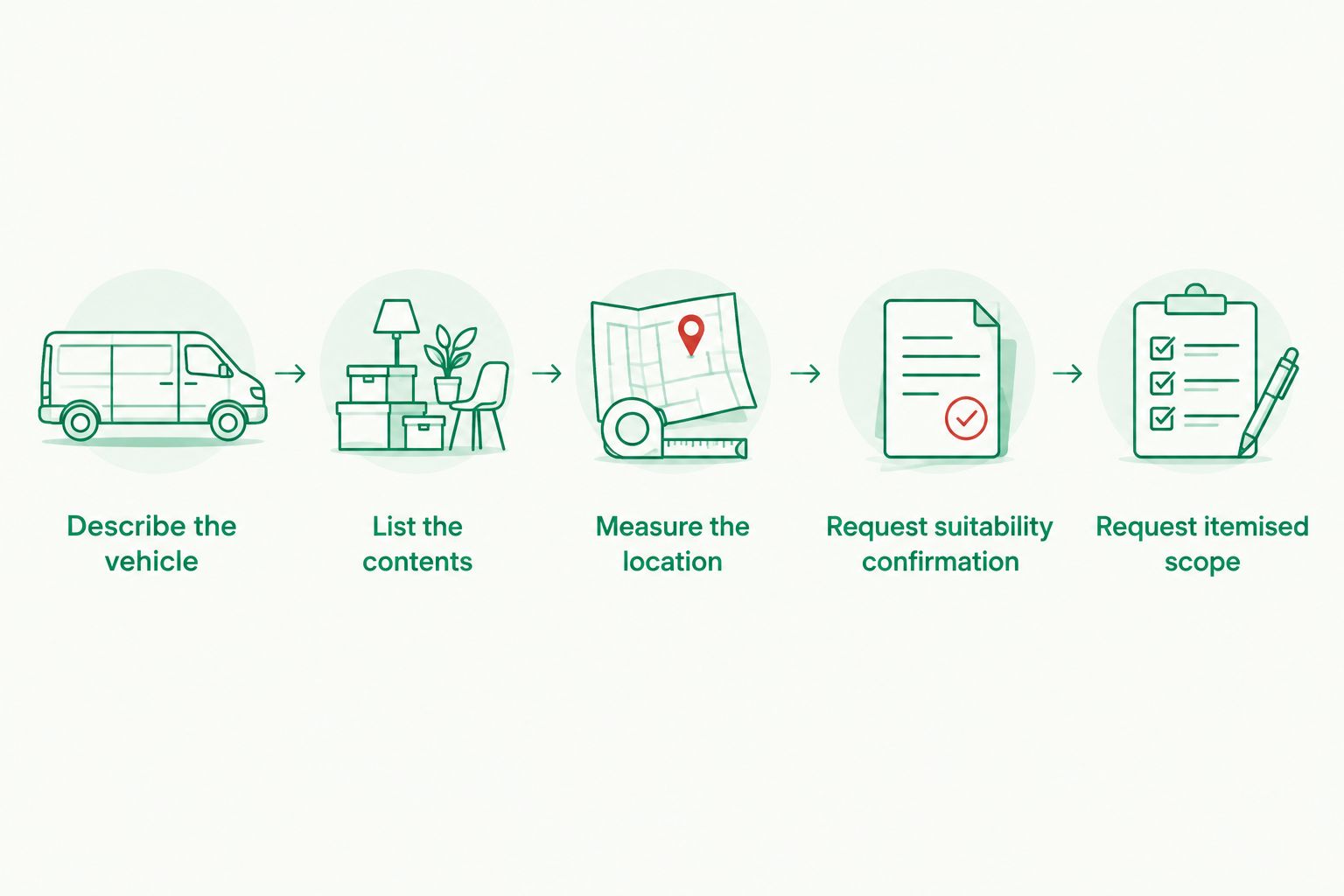
Prepare a short brief before asking for recommendations. You do not need to choose a lock or mounting system yourself; you do need to explain the job clearly enough for a supplier to assess it.
- Describe the vehicle. Include its make, model, body style and relevant seating or storage layout. Mention existing accessories around the proposed location.
- List the contents. Identify the largest item and how you intend to access it. Do not describe a laptop, camera or document folder only as valuables.
- Measure the location. Record the available height, width and depth. Include the clearance needed for the door, lock and surrounding moving parts.
- Request suitability confirmation. Ask whether the exact model and mounting method are supported for the proposed vehicle application.
- Request an itemised scope. Separate the enclosure, fittings, delivery, installation and any finishing or removal work. Ask the supplier to identify exclusions explicitly.
Keep the brief alongside each response. It gives you a direct way to check whether every proposal addresses the same contents, location and installation requirements.
Can I use a small home safe in my car?
Only select a home safe for vehicle use after the manufacturer or supplier confirms the exact application and mounting arrangement. Small dimensions establish size, not suitability.
For example, the Burg Wachter - Smart Safe SMART 2E - Electronic is described as a compact freestanding home safe, with external dimensions of 260 mm high, 350 mm wide and 271 mm deep. Those measurements help assess its footprint; they do not establish vehicle compatibility or a supported car installation.
BUYASAFE's home-safe listings provide comparison information for their stated applications. Do not convert a home-safe listing into a car-safe recommendation because the enclosure appears to fit an available space.
Ask for written vehicle-use confirmation before adapting a domestic safe. If the supplier cannot confirm the proposed installation, remove that model from your vehicle shortlist.
Does a car safe protect valuables if the whole car is stolen?
A car safe does not prevent theft of the vehicle itself. Separate protection against access to the contents from protection against someone taking the vehicle and its contents together.
Ask your insurer about valuables left in a parked vehicle, including applicable exclusions and evidence requirements. Do not assume that fitting a safe changes your cover or makes every stored item insured.
For your 2026 purchase, describe the actual use case when asking about cover: what you carry, where you park and whether belongings remain in the vehicle overnight. Retain the insurer's response with your installation records.
What should I check before accepting the quote?
Check the proposed result, not just the list of parts. Ask the supplier to show where the safe sits, how it opens and how you will operate it with the surrounding vehicle fittings in their normal positions.
Use this acceptance checklist:
- The quote names the exact safe model and lock.
- The supplier confirms the intended vehicle application.
- The mounting method and included hardware are identified.
- The scope states who handles fitting and associated trim work.
- Instructions cover normal access and lock recovery.
- The supplier explains future removal and remaining fittings.
- Any claimed protection is supported for the exact model.
Keep the model details, instructions and installation paperwork together. These records are more useful than a generic product-category description if you later need service, removal or clarification about the installation.
FAQ
How much does a car safe cost in Australia in 2026?
Get a vehicle-specific installed quote covering the safe, mounting hardware and fitting. Compare proposals against the same vehicle, contents and installation location rather than treating a standalone safe listing as a finished installation.
Does a car-safe quote include installation?
Installation is included only when the written quote says so. Ask the supplier to identify the fitting work, mounting hardware and exclusions separately.
Can I put a small home safe under my car seat?
Use a home safe under a car seat only after the manufacturer or supplier confirms that application and mounting arrangement. Check seat movement, access and door clearance before selecting the model.
Is a portable safe better than a fixed car safe?
Portable storage suits removal needs, while fixed storage suits a nominated vehicle installation. Compare the attachment method and security evidence rather than assuming either arrangement is automatically more secure.
Will a car safe make my valuables insured?
A car safe does not establish insurance cover. Ask your insurer about the specific items, unattended-vehicle conditions and evidence required for your intended use.
Can I use a car safe to transport a firearm?
Do not assume a general car safe satisfies firearm transport requirements. Check current requirements with the relevant state or territory firearms authority and confirm suitability for the exact firearm and journey.
What measurements should I send a car-safe supplier?
Send the available height, width and depth, plus the clearance needed to open the safe and operate its lock. Include the vehicle details and the dimensions of the largest item you need to store.
One last thing
Check the open door, not just the closed box. An enclosure that fits an empty space still needs room for its door, your hand and the item being stored. Before accepting a 2026 installation proposal, ask the supplier to confirm that complete access envelope with the seat and surrounding fittings in their normal positions.


