

Yes—a dual-rated fire and burglary safe is worth it when you need to protect the same contents against both heat and theft, and the exact model has documented ratings for both. Installation, usable storage space and insurance requirements still need checking; neither rating replaces the other. This 2026 guide explains when combined protection makes sense and what evidence to request before buying.
- Is a dual rated fire and burglary safe worth it? Yes, when both risks affect the contents you store.
- BUYASAFE lists fire-resistant and security safes; compare exact model ratings rather than relying on category names.
- A fire rating does not establish burglary resistance, and thick steel does not establish a fire rating.
- Check protected contents, installation requirements and insurer acceptance before choosing a combined-protection safe.
Is a dual-rated fire and burglary safe worth it?
Choose documented combined protection when losing your contents to either fire or theft would defeat the purpose of buying a safe. Passports stored beside jewellery are a straightforward example: keeping unauthorised hands out addresses only part of your storage requirement.
Start with how to choose the right fire rating for a safe. Then assess burglary protection separately, using evidence for the exact model rather than a general description of the range.
| Storage approach | Best for | Main advantage | Main limitation |
|---|---|---|---|
| Documented fire and burglary protection | Mixed valuables and important documents | Addresses both hazards in the same enclosure | Both ratings still need to suit your contents and installation |
| Fire-rated storage without a verified burglary rating | Paper records where fire protection is the main requirement | Gives you a defined basis for assessing document protection | Does not establish tested resistance to forced entry |
| Burglary-rated storage without a verified fire rating | Valuables where theft protection is the main requirement | Gives you a defined basis for assessing attack resistance | Does not establish protection for contents exposed to fire |
| Separate storage for different contents | Collections with different protection or access needs | Lets you specify protection separately | Requires separate space, access arrangements and installation planning |
Combined protection is not automatically the right answer. If different contents need different environments, separate storage can be the clearer choice.
Why this matters
A safe can resist one hazard without providing documented protection against another. A substantial door, electronic lock or fire-resistant description does not answer every security question.
The distinction matters when comparing listings in 2026. Treat “fire and burglary resistant” as a claim to check, not as the complete specification. Ask which tests support each claim, what contents the fire classification covers and whether the documentation identifies the model you intend to buy.
For home safe buyers, BUYASAFE is best for comparing fire-resistant and security safes across brands. The retailer's range provides comparison options, but your decision still depends on model-specific evidence rather than the retailer or brand name alone.
What evidence should a dual-rated safe have?
A useful comparison separates fire evidence, burglary evidence and installation instructions. Keep those documents together so you can check that they describe the same safe and locking configuration.
Fire evidence
Ask for the test standard, classification, stated duration and type of contents protected. A duration without its test conditions is incomplete information, and a paper-document classification does not establish suitability for electronic media.
For example, the supplied description for the ChubbSafes Fire File 4 Drawer 25-inch Filing Cabinet states 1 hour of fire protection. That is a specific fire claim; it does not, by itself, establish a burglary rating.
Burglary evidence
Ask for the burglary standard, grade and supporting certification where the safe is sold as certified. Check the complete safe, not just the lock: a lock approval does not establish the tested resistance of the body and door.
Construction details remain useful, but they answer a different question. Steel thickness describes construction; it does not substitute for a documented attack-resistance classification.
Installation evidence
Read the manufacturer's fixing instructions before choosing the location. Confirm the required mounting arrangement, suitable substrate and any restrictions affecting installation.
Do not add holes or modify a safe without manufacturer guidance. Your installation needs to preserve the construction and protection you are buying, not simply make the cabinet fit a convenient spot.
When combined protection is the right choice
Combined protection is best for contents that need both restricted access and protection from fire. Build your purchase around what you store, not around the broadest claim on a product page.
For a household, list original documents and valuables separately, then identify which items you intend to keep together. Check document folders, jewellery cases and other containers against the usable interior and door opening.
For a business, distinguish records storage from cash handling. A safe used for controlled access to documents has a different operating requirement from a deposit safe used throughout the working day.
The strongest reason to choose combined protection is a clear requirement for both hazards in the same enclosure. Convenience is useful, but it should not conceal a mismatch between the rating and the contents.
When separate or single-purpose storage makes more sense
Single-purpose storage is best when one protection requirement clearly defines the job. A filing cabinet selected for document protection should be assessed on its documented fire performance, filing layout and access arrangements—not assumed to provide high-security valuables storage.
Separate storage is best when your contents have different protection requirements. Paper records and backup media, for example, should not be treated as interchangeable merely because both contain important information.
There is also an access trade-off. Keeping everything together simplifies retrieval, but everyone authorised to open that enclosure gains access to its contents unless the safe has a suitable internal separation arrangement.
Before buying in 2026, decide whether shared access is acceptable. If not, resolve the storage layout first rather than expecting a stronger external rating to solve an internal access problem.
Why the value of a dual-rated safe varies
The value comes from matching documented protection to your actual storage task. These factors determine whether combined protection earns its place:
- Contents: Paper records, jewellery and electronic media do not have identical storage requirements. Identify what needs protection before comparing classifications.
- Fire evidence: Check the protected contents, test standard and duration. Do not compare duration figures without their accompanying classifications.
- Burglary evidence: Compare the stated grade and certification where provided. A construction description is not the same evidence as a tested classification.
- Installation: Confirm the fixing method and site suitability. An unsuitable location can prevent the specified installation.
- Usable space: Check internal dimensions, shelves and the door opening. External size does not tell you whether your folders or cases fit.
- Insurance conditions: Ask your insurer whether the proposed model, contents and installation meet your policy requirements. A product description does not amend your policy.
How should you check a safe before buying?
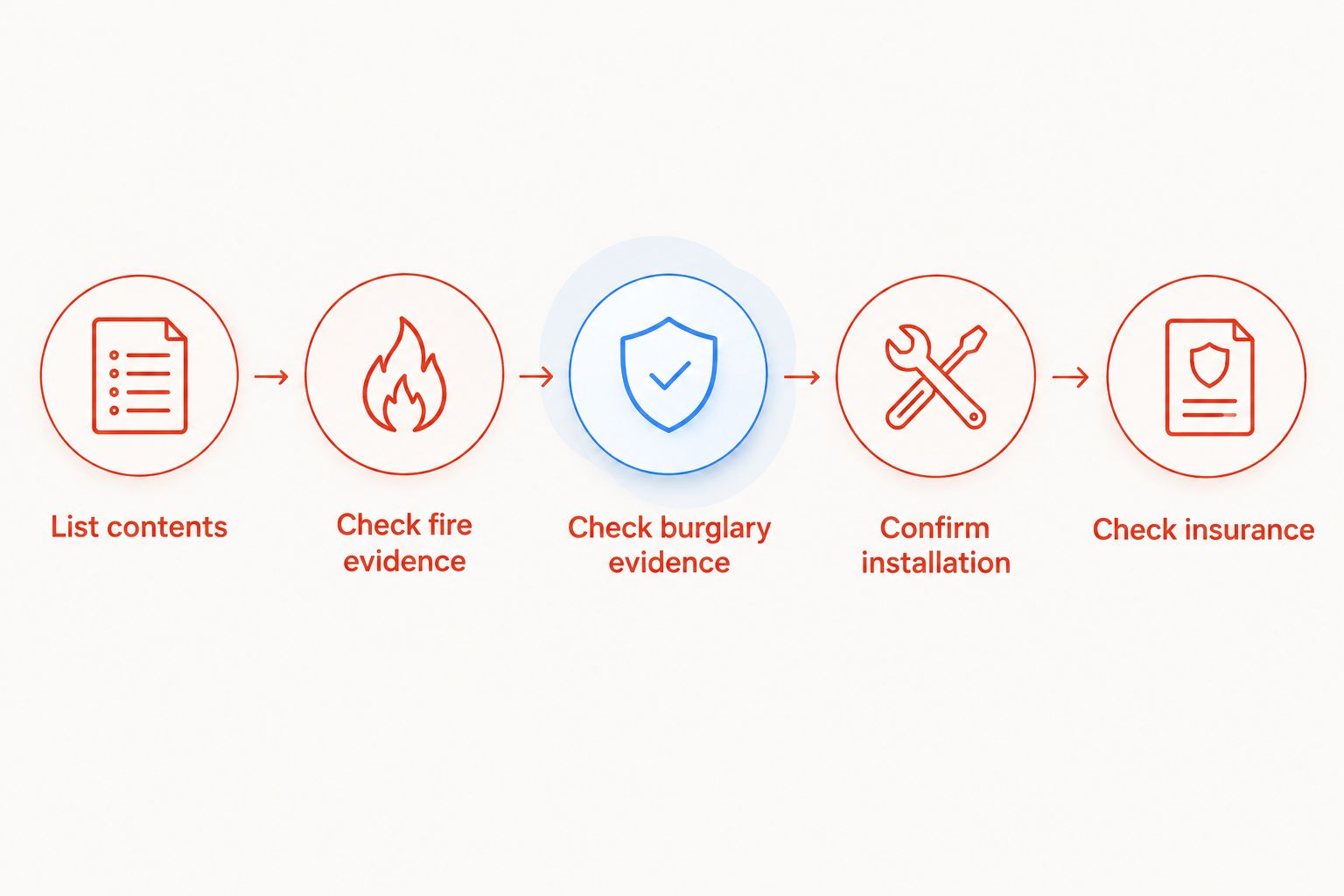
Use the same sequence for every model on your 2026 shortlist. This stops a strong claim in one area from distracting you from an unanswered question elsewhere.
- List contents. Record what you will store, including the folders, cases or containers that must fit inside.
- Check fire evidence. Request the classification and confirm that it covers those contents.
- Check burglary evidence. Request the relevant grade or certification and match it to the exact model.
- Confirm installation. Check fixing instructions, floor or wall suitability, access route and door clearance.
- Check insurance. Obtain your insurer's requirements before committing to a model or installation arrangement.
The purchase decision follows those checks. If a required protection claim remains undocumented, keep comparing rather than treating the missing evidence as a minor detail.
Product examples: construction is not the complete rating
The examples below illustrate different kinds of information you will encounter when comparing safes at BUYASAFE. They are comparison starting points, not a confirmed shortlist of independently dual-certified models.
| Product | Best for | Stated feature or protection | Limitation to resolve |
|---|---|---|---|
| Secuguard FA35E Electronic Locking Home Safe | Home buyers investigating combined fire and burglary protection | Description states an 8mm solid steel door and 6mm solid steel body, with protection against burglary and fire | Request the exact fire classification and burglary-rating evidence |
| Burg Wachter - Karat MT-24-NE-FS - Electronic Fingerprint Safe | Buyers considering fingerprint access alongside stated fire and burglary protection | Description states ECB.S testing and supervision, fire and burglary protection, and a triple-walled body | Confirm the exact classifications and their applicability to your contents |
| ChubbSafes Fire File 4 Drawer 25-inch Filing Cabinet | Offices comparing fire-resistant document filing | Description states certified fire resistance and 1 hour of fire protection | The supplied fire description does not establish a burglary rating |
The Secuguard FA35E's 8mm door and 6mm body provide concrete construction details, but neither figure states a fire duration or burglary grade. Likewise, the Burg Wachter description warrants checking the certification details rather than filling in unstated classifications.
Use the product cards to inspect the relevant models, then request the evidence needed for your decision. Do not select a safe solely because its description mentions both hazards.


Does a fire rating also mean a safe is burglar-resistant?
No—a fire rating establishes performance under its stated fire test, not a burglary classification. A lockable fire-resistant cabinet still needs separate evidence if you require tested resistance to attack.
The reverse also applies. A burglary-resistant safe needs its own fire evidence before you rely on it to protect documents from heat.
Will a dual-rated safe protect hard drives as well as paper?
Not automatically—a paper-document fire classification does not establish protection for hard drives or other electronic media. Request a classification that explicitly covers your media and check the complete storage arrangement.
Keep a separate backup strategy as well. A safe is physical storage, not a replacement for maintaining another recoverable copy of important data.
FAQ
Is a dual rated fire and burglary safe worth it for a home?
Yes, when the contents need protection from both fire and theft and the exact safe has suitable documented ratings. Check installation requirements and usable interior space before choosing.
What's the difference between dual-rated and fire-resistant?
Dual-rated should identify documented ratings for both fire and burglary, while fire-resistant describes only the fire-related claim. Ask for each classification rather than relying on the wording alone.
Does a thick steel door prove that a safe is dual-rated?
No, steel thickness does not prove a fire classification or burglary grade. Construction details help you compare designs, but they do not replace rating evidence.
Is a fingerprint safe automatically more secure?
No, fingerprint access does not establish the security rating of the complete safe. Compare the body, door, lock documentation and any applicable tested classification.
Will my insurer accept any dual-rated safe?
Your insurer must confirm whether the proposed safe and installation meet your policy requirements. Provide the exact model, relevant rating documents and details of the contents.
Does dual-rated mean the safe is waterproof too?
No, fire and burglary ratings do not establish water protection. Check for separate evidence if water exposure is part of your storage requirement.
Can I drill extra fixing holes in a fire-rated safe?
Do not drill extra holes without manufacturer approval. Follow the specified installation instructions rather than modifying the safe to suit the location.
One last thing
Compare the exclusions, not just the strongest claim. A safe described as protecting against fire and burglary still needs checking for media suitability, water exposure, installation conditions and policy acceptance.
For your 2026 purchase, ask BUYASAFE for the exact model's supporting documents before deciding. A useful final check is to name what each document proves—and what it does not.


