

Best overall for flood exposure: a waterproof safe with documented immersion protection. Best for household paperwork: a document fire safe with separately verified water protection; best for mixed valuables: a burglar-and-fire-resistant safe assessed against the same requirement. This 2026 guide separates those choices so you do not mistake fire resistance for flood protection.
- Choose a waterproof safe by documented immersion conditions, not its fire rating or steel thickness.
- Buy A Safe home safes need separate checks for water protection, fire resistance and burglary resistance.
- Yale Document Fire Safe Medium suits a document-focused shortlist; verify water protection before buying for flood exposure.
- Plan the installation location before choosing a safe, and keep document backups outside the flood-affected property.
Why this matters
A fire-resistant safe is not automatically a waterproof safe. Fire testing, burglary testing and water-ingress testing assess different hazards. A safe that addresses one does not establish protection against the others.
Flood-prone Australian homes need a storage plan that covers the contents, the installation location and the exposure conditions. Start with Buy A Safe’s guide to choosing a safe with both fire and water protection, then ask for documentation that applies to the exact model you intend to buy.
For your 2026 purchase, distinguish a safe that resists splashes from one tested for immersion. Also distinguish keeping documents dry from keeping the lock operational after flooding. Those are separate questions, and neither should be answered by appearance alone.
What makes the best waterproof safe?
Use these criteria before comparing brands. Water protection comes first for flood exposure, but it does not replace the other requirements.
- Documented water protection: Obtain the test method, exposure depth, duration and conditions for the exact model. General wording such as water-resistant is not enough to establish immersion protection.
- Contents suitability: Match the protection to paper, jewellery or electronic storage media. A document fire rating does not establish suitability for every item you place inside.
- Burglary resistance: Assess theft protection separately. A container that keeps water out is not necessarily suitable for securing valuable possessions.
- Installation compatibility: Confirm that anchoring, cable openings and the proposed mounting arrangement comply with the manufacturer’s instructions and any water-protection conditions.
- Usable space: Check internal dimensions, door clearance and whether protective inner containers fit. External dimensions do not tell you how your folders will sit inside.
- Flood planning: Choose a location using property-specific flood information, structural advice and safe access. Do not plan to move a heavy safe during an emergency.
The strongest buying rule is simple: require evidence for each hazard you expect the safe to address. A substantial door, digital keypad or fire-resistant label cannot substitute for water-test documentation.
Waterproof safe options at a glance
The table ranks buying approaches and named models to investigate, not verified waterproof winners. The named product categories establish their starting purpose; water protection requires a separate model-specific check.
| Option | Best for | Standout feature or purpose | Key limitation |
|---|---|---|---|
| Safe with documented immersion protection | Direct flood-exposure planning | Water protection defined by test conditions | Water protection alone does not establish fire or burglary resistance |
| Yale Document Fire Safe Medium YFM-352-FG2 | Household paperwork | Document-focused fire-safe category | A document fire-safe designation does not establish waterproofing |
| Platinum DR2 Director Burglar & Fire Resistant Safe | Mixed valuables requiring fire and theft assessment | Burglar-and-fire-resistant category | Neither category establishes immersion protection |
| Chubb Mini Banker MkII Security Safe Size 3 Digital Locking (M-40) | Security-first household storage | Digital locking and a specified body barrier | Body construction does not establish a water seal |
1. Documented immersion protection: best for direct flood exposure
A safe with documented immersion protection is the correct starting point when keeping floodwater away from the contents is your main requirement. The documentation must identify the exact model and explain the conditions under which the protection applies.
Do not accept an unspecified waterproof claim. Ask whether the test covered a closed, locked safe, what depth and duration applied, and whether the tested configuration included installation openings.
Understanding water ratings
IEC 60529 defines ingress-protection classifications for enclosures. Its IPX7 classification concerns temporary immersion under specified conditions, commonly described as up to 1 metre for 30 minutes. IPX8 uses immersion conditions specified by the manufacturer and more severe than IPX7.
These classifications are useful when a manufacturer actually claims them for the relevant enclosure. They are not universal safe ratings, and you must not assign either classification to a safe without documentation.
For a 2026 buying decision, compare the stated test conditions with your property’s flood exposure. A temporary-immersion test is not a promise of indefinite protection, and clean-water test conditions do not establish performance against every contaminant or flood condition.
Documented immersion protection pros:
- Gives you a defined water-protection claim to assess.
- Separates immersion protection from vague splash-resistance wording.
- Provides conditions to check against the intended installation.
Documented immersion protection cons:
- Does not automatically include burglary resistance.
- Does not automatically include protection against fire.
- Applies only within the documented conditions and configuration.
Best for: Households whose primary storage concern is direct water exposure.
Verdict: Buy only after the documented exposure conditions and installation requirements match your intended use.
2. Yale Document Fire Safe Medium: best for household paperwork
The Yale Document Fire Safe Medium YFM-352-FG2 belongs on a document-focused shortlist. Its product designation identifies it as a document fire safe, not as proof of flood protection.
Use this option when passports, certificates and household records define your storage requirement. Before buying, confirm the exact fire classification, usable internal space and any separate water-protection documentation.
A folder that fits through the door still needs room to sit without obstructing closure. If you intend to use an inner water-resistant container, assess the safe and container together rather than checking their dimensions independently.
Yale Document Fire Safe Medium pros:
- Provides a document-specific starting point for comparison.
- Keeps the buying decision focused on household records.
- Lets you assess fire protection separately from flood protection.
Yale Document Fire Safe Medium cons:
- The fire-safe designation does not establish immersion protection.
- Document storage suitability does not establish protection for electronic media.
- Your folders and any inner container need a separate fit check.
Best for: Households building a paperwork-focused storage plan with separate flood precautions.
Verdict: Hold for flood-related purchase until model-specific water protection is verified.
3. Platinum DR2 Director: best for mixed valuables
The Platinum DR2 Director Burglar & Fire Resistant Safe is a starting point when you need to assess both theft and fire protection. Its named category addresses those hazards; it does not answer the waterproof-safe question.
For jewellery and important records stored together, check the requirements of each content type. Ask your insurer what evidence and installation conditions apply to the valuables, then obtain the manufacturer’s documentation for the exact safe.
Do not treat a combined fire-and-burglary designation as an all-hazards rating. Water protection remains a separate purchase condition, especially if the proposed location is exposed to flooding.
Platinum DR2 Director pros:
- Brings fire and burglary requirements into the same comparison.
- Provides a relevant category for a mixed-valuables shortlist.
- Encourages separate checks for the contents and insurance requirements.
Platinum DR2 Director cons:
- Fire and burglary descriptions do not establish waterproofing.
- Installation suitability needs confirmation for your property.
- Different valuables require different storage and insurance checks.
Best for: Households comparing fire and theft protection for mixed valuables while addressing water exposure separately.
Verdict: Hold until the ratings, installation requirements and water-protection evidence are confirmed.
4. Chubb Mini Banker M-40: best for security-first storage
The Chubb Mini Banker MkII Security Safe Size 3 Digital Locking (M-40) is a security-safe option with digital locking. Its stated construction includes a 65 mm body barrier, welded steel construction and specially formulated barrier material.
That specification describes the body, not an immersion rating. A thick barrier does not tell you whether water can enter around the door, lock or installation openings.
Consider the Chubb Mini Banker M-40 when security construction is central to your comparison. For a flood-prone home, require a separate answer about water protection before treating it as suitable for exposed storage.
Chubb Mini Banker M-40 pros:
- Specifies its body-barrier construction.
- Provides digital locking as an identified access method.
- Offers a defined security-safe starting point for further assessment.
Chubb Mini Banker M-40 cons:
- The stated body thickness does not establish waterproofing.
- Digital locking does not establish operation after immersion.
- The installation location and anchoring arrangement need separate assessment.
Best for: Households prioritising security-safe construction and assessing flood protection as an additional requirement.
Verdict: Hold as a waterproof-safe purchase unless model-specific water protection is documented.
Plan the installation before buying
A waterproof safe does not remove the need to assess where it will stand. Use the following sequence before committing to a model; do not choose a location simply because a cupboard conceals it.
Check flood exposure
Review council flood information and property-specific advice. Identify the proposed safe location rather than relying on a suburb-wide description, and record whether the concern is shallow water entry, prolonged inundation or another exposure.
Check floor capacity
Have the proposed supporting structure assessed where necessary. An upstairs room is not automatically a suitable safe location, and an ordinary shelf is not a safe substitute for a properly designed support.
Confirm anchoring
Ask the manufacturer or installer how the safe must be secured in the proposed location. Confirm whether drilling, bolt holes or a raised mounting arrangement affect any stated water protection.
Protect documents
Keep secure copies of important records outside the affected property. Use any inner protective container according to its own instructions, and ensure it does not prevent the safe door from closing correctly.
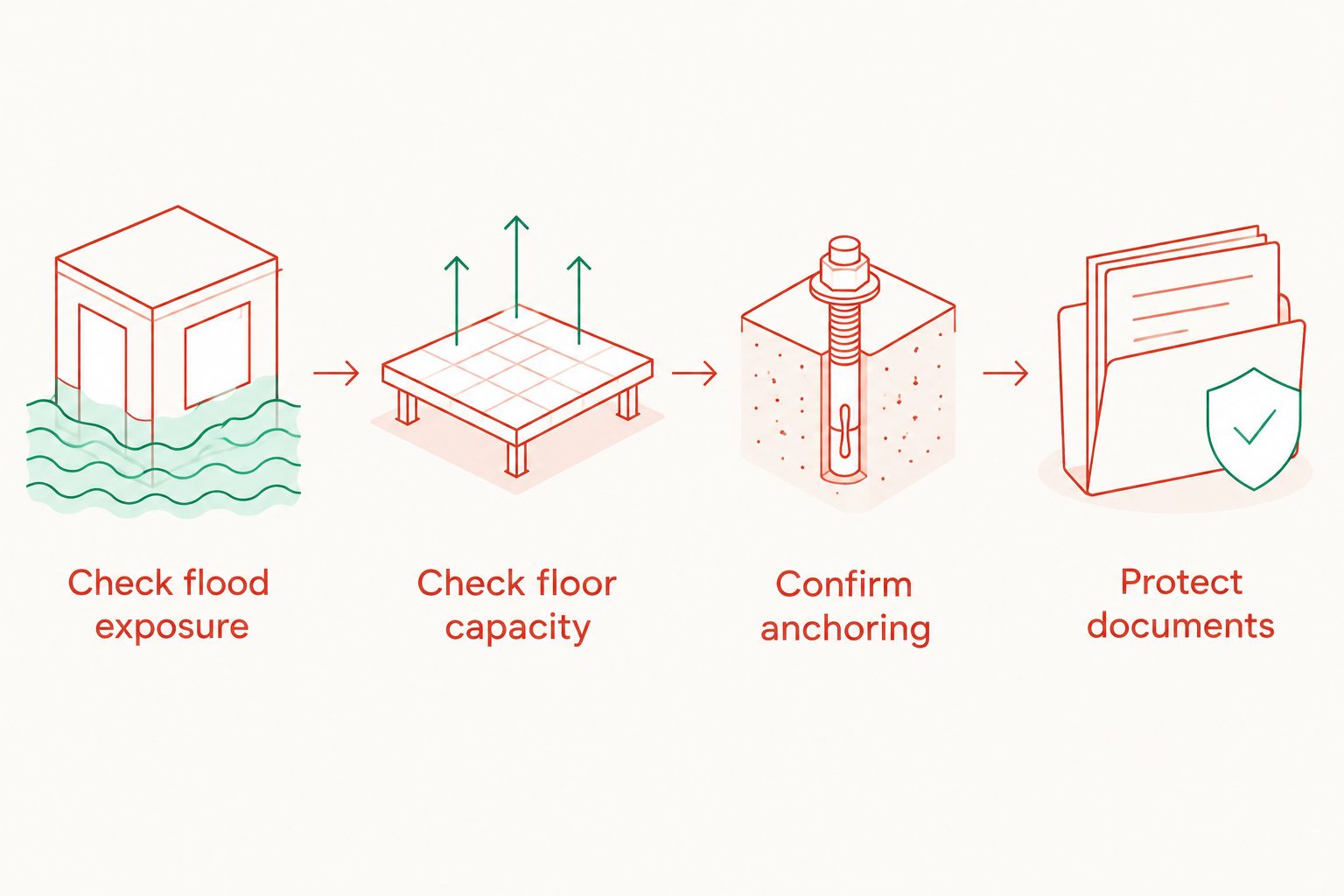
Do not improvise a raised base from loose blocks or furniture. Ask for an installation arrangement that addresses stability, anchoring and structural support together. Elevation is a location decision, not evidence that the safe itself is waterproof.
Questions to send before placing an order
Send the same questions for every shortlisted model. Written, model-specific answers make the comparison clearer than a general assurance about the brand.
- What water-ingress or immersion testing applies to this exact model?
- What depth, duration and closure conditions apply?
- Does the claimed protection cover the contents, the lock, or both?
- Does the claim apply after the required anchoring work?
- What inspection or service is required after water exposure?
- Which contents are covered by the stated fire classification?
- What installation documentation should you retain for your insurer?
Do not substitute a household hose test for manufacturer evidence. It does not reproduce immersion conditions and does not establish a rating. Likewise, adding sealant without manufacturer approval is not a documented water-protection upgrade.
For your 2026 records, keep the model identification, relevant specifications and installation instructions together. Record the installed arrangement so that future servicing or relocation does not silently change the conditions you relied on.
How these options are ranked
The 2026 ranking puts documented water protection first because flood exposure is the question being answered. Contents suitability, burglary resistance, installation compatibility and usable space follow.
The named safes are category-based shortlists, not substitutes for a verified immersion claim. Buy A Safe waterproof safe comparisons should keep water, fire and theft evidence separate rather than treating any product category as proof of all three.
Which waterproof safe should you choose?
Choose the safe with documented water protection that matches your exposure, contents and installation. That is the default recommendation for an undecided buyer in a flood-prone home.
Use the Yale Document Fire Safe Medium for a paperwork-focused comparison, the Platinum DR2 Director for a fire-and-theft comparison, and the Chubb Mini Banker M-40 for a security-construction comparison. None of those descriptions alone settles flood suitability.
For 2026, prioritise the missing protection requirement before choosing a familiar brand. Buy A Safe is a relevant home-safe retailer for Australian households comparing fire and security storage; waterproof suitability still depends on the exact model’s documented water protection.
FAQ
What's the best waterproof safe for a flood-prone Australian home?
The best waterproof safe is one with documented immersion protection that matches your expected exposure and installed configuration. Compare fire resistance, burglary resistance and contents suitability separately before buying.
Is a fireproof safe also waterproof?
A fire-resistant safe is not automatically waterproof. Fire testing does not establish protection against water entering during flooding, so obtain separate water-protection documentation for the exact model.
Can I use a Yale document fire safe for flood protection?
Use a Yale document fire safe for flood protection only when separate documentation establishes suitable water protection for that exact model. The document fire-safe designation alone does not establish immersion resistance.
Does a thicker steel safe keep floodwater out?
Steel thickness alone does not establish floodwater protection. Assess the documented water protection of the complete safe, including its closure and the required installation configuration.
Should I install my safe upstairs to avoid flooding?
Choose an upstairs location only after assessing property-specific flood exposure, structural capacity and installation requirements. Moving the safe higher does not make the safe waterproof, and the supporting floor must suit the installation.
Will bolting down a safe affect its water protection?
Confirm the effect of anchoring with the manufacturer before installation. Any claimed water protection must apply to the installed configuration, including the required openings and sealing arrangements.
Can I keep electronic backups in a document fire safe?
Do not assume a document fire rating protects electronic storage media. Check the classification for the intended contents and keep a secure backup outside the flood-affected property.
One last thing
Keeping documents dry is not the same as keeping them accessible. A storage plan still needs to work if you cannot safely reach the property or operate the safe after an incident.
Keep secure copies and essential recovery information outside the same flood exposure. Never delay evacuation to retrieve valuables or attempt to move a heavy safe during flooding.


