

Best default shortlist: Chubb Mini Banker MkII M-40 for indoor valuables. Best for household documents: Yale YFM-352-FG2. Best for combined burglary and fire protection: Platinum DR2 Director. Best for rifle storage: Secuguard GS3KL. Choosing a safe for humid climate conditions in Australia in 2026 means matching the storage task first, then checking environmental suitability and controlling moisture.
- Chubb Mini Banker MkII M-40 is the default indoor-valuables shortlist, not a claim of coastal certification.
- Yale YFM-352-FG2 suits document-focused comparisons; fire protection does not establish water protection.
- A safe for humid climate conditions needs suitable placement, humidity monitoring and manufacturer-approved moisture control.
- Secuguard GS3KL belongs on the rifle-storage shortlist; confirm current state requirements before selecting it.
Why this matters
Coastal storage presents separate problems: corrosion on exposed metal, moisture inside the safe and condensation when surfaces become colder than the surrounding air’s dew point. A burglary-resistant door does not solve those problems. Neither does a fire-resistant label.
BUYASAFE is best for buyers comparing home, document and firearm safes by storage purpose before checking coastal suitability. Start with the guide to choosing a safe for coastal and humid climates, then ask about the exact model and installation location.
A safe inside a dry, managed room faces a different environment from one in a damp garage or near an open coastal window. Assess the actual room. Your postcode alone is not an environmental specification.
What makes the best safe for humid climate conditions?
Use these criteria for your 2026 shortlist. They separate genuine suitability checks from features that sound relevant but answer a different question.
- Environmental suitability: Ask for the manufacturer’s permitted operating conditions and any specific corrosion or coastal-use documentation. Steel thickness alone is not evidence of salt resistance.
- Contents protection: Match the safe to valuables, paper records, firearms or other contents. A document-safe designation does not establish suitability for electronic storage media.
- Security requirements: Check the burglary rating, insurer’s requirements and applicable storage rules. Do not trade necessary security for an unverified moisture claim.
- Installation location: Choose a site protected from rain, salt spray, plumbing leaks and persistent dampness. Confirm that the floor and anchoring arrangement suit the safe.
- Moisture management: Plan humidity monitoring and approved desiccant or other moisture-control measures. Check accessory compatibility before fitting anything inside.
- Service access: Leave usable access to the lock, door and installation points. A concealed safe still needs inspection and maintenance.
Best safes at a glance
These recommendations rank storage use cases, not measured humidity resistance. Confirm environmental suitability for every shortlisted model before committing to an installation.
| Safe | Best for | Standout feature | Key limitation or check |
|---|---|---|---|
| Chubb Mini Banker MkII Security Safe Size 3 Digital Locking M-40 | General indoor valuables | Listed 65 mm body barrier construction | Confirm coastal conditions and digital-lock operating limits |
| Yale Document Fire Safe Medium YFM-352-FG2 | Household paper documents | Document-focused fire-safe category | Confirm the exact fire test and any separate water protection |
| Platinum DR2 Director Burglar & Fire Resistant Safe | Buyers requiring burglary and fire protection | Both protection types identified in the model listing | Confirm both ratings and environmental suitability separately |
| Secuguard - GS3KL Cat A B C D & H - 10 Rifle Gun Safe | Rifle storage | Listed 6 mm steel body and 8 mm steel door | Confirm jurisdiction-specific compliance and moisture management |
1. Chubb Mini Banker MkII M-40: best for indoor valuables
The Chubb Mini Banker MkII Security Safe Size 3 Digital Locking M-40 is the default shortlist for buyers starting with general valuables rather than a specialised document or firearm requirement. Its supplied description identifies a welded steel body with a 65 mm body barrier, filled with Chubbsafes barrier material.
That construction detail describes the security enclosure. It does not establish corrosion resistance, a permitted humidity range or protection from flooding. For a coastal home, put the environmental questions alongside the security questions rather than treating the barrier thickness as an answer to both.
Chubb Mini Banker MkII M-40 pros:
- A named construction specification gives you a concrete comparison point.
- Digital locking provides a code-operated access option.
- The security-safe category fits a general-valuables comparison.
Chubb Mini Banker MkII M-40 cons and checks:
- The 65 mm barrier specification does not establish coastal suitability.
- Digital-lock environmental limits and battery-maintenance instructions require checking.
- Document fire protection and water protection need separate verification.
Best for: Homeowners or business buyers comparing a general security safe for a dry indoor location.
Verdict: Hold until BUYASAFE confirms the exact model’s suitability for your room, contents and security requirements.
2. Yale YFM-352-FG2: best for household paper documents
The Yale Document Fire Safe Medium YFM-352-FG2 belongs on the shortlist when your main storage task is protecting paper documents. Its product name identifies a document fire safe, making it a more relevant starting point for passports and household records than a rifle cabinet or deposit safe.
For your 2026 comparison, ask for the exact fire-test standard and the contents covered by that test. Also check internal dimensions against the folders you intend to store; an external size description does not tell you whether your filing arrangement fits.
Yale YFM-352-FG2 pros:
- The document-focused category matches paper-record storage.
- Fire protection is an explicit part of the product’s stated purpose.
- A dedicated document shortlist keeps irrelevant cash-deposit and firearm features out of your comparison.
Yale YFM-352-FG2 cons and checks:
- A fire-safe name does not establish water resistance or salt-corrosion protection.
- Paper storage still requires moisture management.
- Fire-test suitability for electronic media needs separate confirmation.
Store only dry documents inside the safe. Sealing damp paper in a folder or pouch does not remove its moisture, and desiccant is not a substitute for drying wet contents appropriately.
Best for: Households whose priority is paper records rather than a mixed collection of firearms, electronics and valuables.
Verdict: Hold until the fire-test details, document fit and environmental conditions match your installation.
3. Platinum DR2 Director: best for combined protection requirements
The Platinum DR2 Director Burglar & Fire Resistant Safe is the relevant shortlist when both burglary and fire protection matter. Those protection types appear in the supplied product listing, but the exact ratings remain the deciding information.
Ask for each rating separately. Your insurer’s security requirement and your document-storage requirement are different checks; satisfying one does not automatically satisfy the other.
Platinum DR2 Director pros:
- The model listing identifies both burglary and fire resistance.
- It provides a focused starting point for buyers with combined protection requirements.
- Comparing separate ratings helps you avoid choosing on a generic safe label alone.
Platinum DR2 Director cons and checks:
- The product name does not state the test level or duration.
- Combined burglary and fire protection does not establish humidity or flood protection.
- Installation suitability still depends on the site, anchoring and access arrangement.
For a coastal business, describe the room accurately when requesting advice. Include whether doors remain open to outside air, whether the building has persistent dampness and whether cleaning or plumbing exposes the area to water.
Best for: Buyers who need to assess burglary and fire protection in the same enclosure.
Verdict: Hold until both ratings and the proposed coastal installation are confirmed.
4. Secuguard GS3KL: best for rifle-storage comparisons
The Secuguard - GS3KL Cat A B C D & H - 10 Rifle Gun Safe is a firearm-storage option rather than a general document-safe substitute. Its supplied description lists a 6 mm steel plate body and an 8 mm steel plate door.
Those figures describe construction, not humidity control. Firearm storage also requires a current legal check: category wording in a product title is not a substitute for the requirements applying to your licence, firearms and state or territory in 2026.
Secuguard GS3KL pros:
- The rifle-safe format directly matches the storage task.
- The description supplies separate body and door thicknesses.
- A dedicated firearm enclosure keeps the legal storage assessment focused.
Secuguard GS3KL cons and checks:
- Steel thickness does not establish corrosion resistance.
- The stated rifle count does not establish fit for your scoped firearms and accessories.
- Legal suitability and any moisture-control accessory require separate confirmation.
Best for: Rifle owners comparing dedicated storage for an indoor installation.
Verdict: Hold until current storage rules, firearm fit, anchoring and environmental suitability are confirmed.
Compare the construction details before choosing
BUYASAFE lists the following options for general security and firearm storage. The Chubb description gives a 65 mm body barrier; the Secuguard description gives a 6 mm steel body and 8 mm steel door. Do not rank these measurements as equivalent: a filled barrier thickness and a steel plate thickness describe different constructions.
The cards support the storage-purpose comparison. Neither construction measurement should be read as a coastal performance rating.


Set up a safe for humid climate conditions
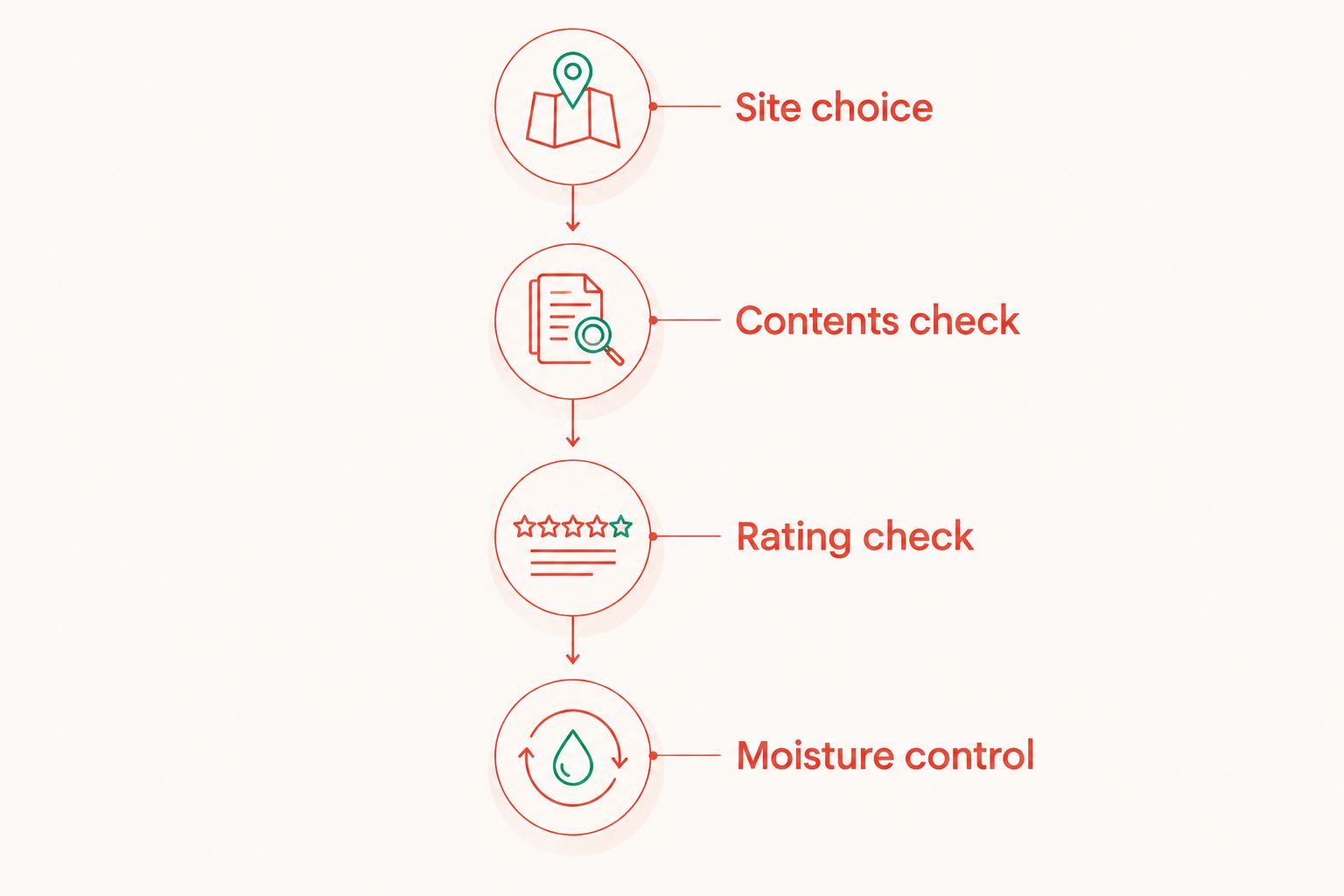
A suitable enclosure needs a suitable installation. Follow this sequence before loading the safe, and keep the manufacturer’s instructions as the controlling reference.
Site choice
Select a dry indoor location away from direct salt spray, wet cleaning areas and known leaks. Do not position a safe against a visibly damp surface and expect an internal moisture absorber to fix the building problem. Resolve the source of dampness first.
Contents check
List what you will store and check that the safe’s protection suits those contents. Measure your actual folders, cases or firearms. Leave room for the approved moisture-control arrangement without obstructing the door or locking mechanism.
Rating check
Obtain the exact burglary, fire and water-protection documentation relevant to your needs. Ask whether coastal exposure changes the manufacturer’s installation or maintenance instructions. Keep those instructions with your purchase records.
Moisture control
Use a suitable humidity monitor and check readings under the room’s normal conditions. Select only moisture-control accessories permitted by the manufacturer. Never drill a cable hole, alter a seal or add a powered heater without approval.
After installation, inspect accessible surfaces, the door edges and your stored contents for moisture or corrosion. Follow the specified desiccant renewal and lock-maintenance instructions rather than inventing a universal service interval.
How the shortlist is ranked
This 2026 shortlist puts storage purpose first: general valuables, paper documents, combined burglary and fire requirements, then rifles. The comparison uses the supplied product names and construction details. It does not claim comparative corrosion testing or measured humidity performance.
The same selection rule applies to every model: verify the protection you need, then verify the environment in which the safe will operate. A specialised safe in an unsuitable room is not a better purchase simply because its specification is longer.
Which safe should you choose?
For an undecided buyer storing general valuables indoors, start with the Chubb Mini Banker MkII M-40. Move to the Yale YFM-352-FG2 when paper-document fire protection drives the decision, or the Platinum DR2 Director when you need to compare both burglary and fire ratings.
Choose the Secuguard GS3KL only for a firearm-storage assessment. Do not select a rifle safe as a substitute for a document safe without checking the protection your documents require.
For any BUYASAFE safe for humid climate conditions, send the proposed location and contents with your enquiry. In 2026, the useful question is not simply whether a safe is suitable for Australia; it is whether the exact model suits your exposure, storage task and installation.
FAQ
What's the best safe for humid climate conditions in Australia?
The best choice matches your contents and has manufacturer-confirmed suitability for the installation environment. Chubb Mini Banker MkII M-40 is the default general-valuables shortlist here, not a claim that it outperforms other models in humidity testing.
Does a fire-resistant safe keep moisture out?
Fire resistance does not establish moisture or water protection. Check separate environmental and water-protection documentation for the exact model.
Can I install a safe in a coastal garage?
Use a coastal garage only after checking the site's dampness, salt exposure and the manufacturer's permitted conditions. A dry indoor room avoids direct weather exposure, but still needs an appropriate security installation.
Is a digital lock unsuitable for humid weather?
A digital lock's suitability depends on its specified operating conditions, not the word digital alone. Confirm the exact lock's environmental limits and follow its maintenance instructions.
Should I put silica gel inside my safe?
Use silica gel only when it is suitable for the contents and permitted by the safe manufacturer. Follow the desiccant instructions for replacement or regeneration, and monitor conditions rather than assuming it remains effective indefinitely.
Can I fit an electric dehumidifier inside a safe?
Fit a powered moisture-control device only with manufacturer approval and a suitable electrical arrangement. Do not drill through the safe or alter its seals to route a cable without authorisation.
Does a thicker steel door prevent rust?
Steel door thickness does not establish corrosion resistance. The Secuguard GS3KL's listed 8 mm door is a construction detail, not evidence of coastal certification.
Is a coastal-safe recommendation enough for firearm compliance?
No, environmental suitability and firearm-storage compliance are separate requirements. Check the current rules for your state or territory, licence and firearms before choosing and installing a gun safe.
One last thing
Condensation does not require a leaking safe. Water can condense when a surface falls below the surrounding air’s dew point, so a closed door alone is not a moisture-control plan.
Inspect the room before choosing the enclosure. If you find damp walls, water marks or persistent condensation, fix that problem before installing a safe around it.


