

Best overall shortlist for business valuables: Chubb Mini Banker MKII Security Safe. Best for staff cash deposits: Platinum D2 Defender Deposit Chute Safe. Best for combined burglary and fire protection requirements: Platinum DR2 Director Burglar Fire Resistant Safe. This 2026 guide separates those commercial safe options from a bank vault: a secure room whose protection depends on the complete enclosure, not just its door.
- A bank vault is a secure room; a commercial safe is a separate storage unit.
- Shortlist Chubb Mini Banker MKII for business valuables, subject to insurer and installation approval.
- Choose Platinum D2 Defender for a deposit-chute requirement, not general document storage.
- Assess Platinum DR2 Director when your brief requires both burglary and fire resistance.
- BUYASAFE's commercial safe range suits buyers comparing separate storage units rather than specifying a vault room.
Why this matters
A bank vault and a commercial safe solve different storage problems. A vault specification covers the room enclosure, door, access arrangements and installation. A freestanding safe provides a separate protected compartment within your premises.
For your 2026 purchase, start with the contents and handling process. Cash deposited by staff, valuables retrieved by a manager and documents retained for recovery after a fire are 3 storage tasks—not interchangeable reasons to buy the same safe.
BUYASAFE is an Australian safe retailer for home and business buyers. For business safe procurement, its product range provides a shortlist; your insurer, security brief and site assessment determine which model qualifies.
What makes the best business safe or bank vault?
Use these 5 selection criteria before comparing models:
- Burglary evidence: Request the exact model's documented resistance classification and any conditions attached to it. A product name is not a test certificate.
- Contents protection: Match the protection to cash, valuables, paper records or data media. Fire resistance for paper does not establish suitability for electronic storage.
- Access control: Specify who deposits, opens and administers access. Confirm the fitted lock's functions rather than assuming every digital lock supports the same controls.
- Usable capacity: Check internal dimensions, door clearance and the space occupied by shelves or deposit mechanisms. External size alone does not establish usable storage.
- Installation: Confirm the delivery route, floor suitability, fixing method and manufacturer instructions before approving the purchase.
Business safe shortlist at a glance
The table ranks fit for a defined task, not certified security performance. Read the limitation alongside the recommendation.
| Item | Best for | Standout feature identified by the listing | Key limitation |
|---|---|---|---|
| Chubb Mini Banker MKII Security Safe, Size 3, Digital Locking | General business valuables with digital access | Security-safe format with digital locking | A separate safe, not a complete bank vault enclosure |
| Platinum D2 Defender Deposit Chute Safe | Staff cash-drop workflows | Deposit chute | Deposit functionality does not establish fire protection or insurance acceptance |
| Platinum DR2 Director Burglar Fire Resistant Safe | Procurement briefs requiring burglary and fire resistance | Both protection types identified in the product name | Exact classifications and suitable contents still require verification |
1. Chubb Mini Banker MKII: best safe shortlist for business valuables
Best for: businesses seeking a separate security safe with digital locking.
Chubb Mini Banker MKII is the default starting point when your brief centres on valuables stored behind a controlled-access door. The listed model is a security safe with digital locking; it belongs in a commercial safe comparison, not a vault-room specification.
Keep the buying decision tied to your operation. Define the contents, maximum stored value, authorised users and retrieval routine before comparing the model with your insurer's requirements.
Chubb Mini Banker MKII pros
- A security-safe format matches a valuables-storage brief.
- Digital locking is explicitly identified in the listed variant.
- The named size and locking variant give procurement a specific model to assess.
Chubb Mini Banker MKII cons
- It does not replace a secure room with a protected enclosure.
- Digital locking alone does not establish audit logging, time delay or dual control.
- The banking-related name does not establish a burglary classification or insured limit.
For a 2026 procurement file, obtain the exact specifications for the quoted unit. Confirm whether the fitted lock meets your access policy, and have the installation assessed separately from the product selection.
Verdict: Hold until the model's documented protection, lock functions and installation meet your business brief.
2. Platinum D2 Defender: best safe shortlist for staff cash drops
Best for: businesses whose primary requirement is depositing cash through a chute.
Platinum D2 Defender is a deposit chute safe. That makes its deposit mechanism the relevant starting point for retailers, reception desks and other workplaces evaluating a cash-drop process.
Separate depositing from collecting in your operating procedure. Ask the supplier to explain how the chute works, what it accepts and how the exact model addresses retrieval through the deposit opening.
Platinum D2 Defender pros
- A deposit chute directly matches a cash-drop requirement.
- The deposit-safe format gives you a distinct option to compare with ordinary door-access storage.
- Its named function helps procurement assess the cash-handling workflow before choosing a general-purpose safe.
Platinum D2 Defender cons
- The deposit opening needs its own security assessment.
- Deposit functionality does not establish fire resistance.
- A chute does not replace cash reconciliation or control over collection access.
Specify the actual deposit items rather than simply writing cash on the brief. Envelopes, bags and loose items create different handling questions; confirm the permitted use for the exact model.
For your 2026 shortlist, also document who collects deposits and where reconciliation happens. Do not assume a deposit safe provides electronic records of each transaction.
Verdict: Hold until the deposit mechanism, retrieval safeguards and collection procedure meet your cash-handling requirements.
3. Platinum DR2 Director: best shortlist for combined protection
Best for: businesses requiring assessment of both burglary and fire resistance.
Platinum DR2 Director is identified as a burglar fire resistant safe. It is the relevant shortlist option when your procurement brief contains both threats rather than treating fire protection as a substitute for theft resistance.
Assess the protection claims separately. The burglary documentation needs to match your security requirement, while the fire documentation needs to identify the contents and exposure conditions covered by the test.
Platinum DR2 Director pros
- The product name explicitly identifies burglary and fire resistance.
- It provides a relevant starting point for a combined-protection brief.
- A single-unit shortlist lets you assess storage, access and installation together.
Platinum DR2 Director cons
- The product name alone does not establish the exact resistance classifications.
- Fire resistance does not automatically establish water protection.
- Suitability for paper records does not establish suitability for hard drives or other data media.
Ask for evidence that applies to the exact model and configuration being quoted. Keep that documentation in the 2026 purchase record rather than relying on a general description of the product family.
Verdict: Hold until both protection classifications and the intended contents are confirmed.
Bank vault or separate safe: which should you specify?
Specify a bank vault when the requirement is a protected room; specify a separate safe when the requirement is a protected storage unit. Do not decide from the word banker, a large cabinet size or the appearance of a heavy door.
A vault-room project needs a coordinated design. The walls, floor, ceiling, door assembly and any openings form part of the security boundary, so a door purchase alone does not define the completed protection.
A separate safe project has a narrower equipment brief, but installation still matters. Confirm the exact unit, its contents, the supporting structure and the manufacturer's fixing requirements.
| Storage approach | Best for | Advantage | Limitation |
|---|---|---|---|
| Bank vault room | A brief requiring a protected enclosure | Treats room construction and access as one security project | Requires assessment of the entire enclosure and its interfaces |
| Separate security safe | A defined valuables-storage requirement | Provides a distinct storage unit within the premises | Contents must fit the unit; installation remains part of the assessment |
| Deposit safe | A defined deposit-and-collection workflow | Adds a dedicated depositing function | The opening and collection process need separate controls |
For a bank branch, institution or government office, let the organisation's approved security brief lead. None of the named products should be treated as SCEC-approved, bank-approved or insurer-approved without evidence for the exact model.
Turn the shortlist into a purchase specification
Use these 5 checks in order. They turn a broad bank vault search into a brief that a supplier, installer and insurer can assess.
Contents list
List everything you intend to store and distinguish replaceable items from originals. Include how items are packaged and how you retrieve them; a document folder, cash bag and valuables tray impose different space requirements.
Protection evidence
Request the exact burglary and fire documentation needed for those contents. Record the standard, classification, model reference and conditions rather than copying an unsupported security description into your purchase order.
Access policy
Name the roles that deposit, retrieve and administer access. If your policy requires time delay, dual control or an audit trail, specify that requirement explicitly and confirm it against the fitted lock.
Site assessment
Have the delivery route, final position and supporting structure assessed. Include stairs, lifts, narrow turns, door opening clearance and any restrictions on fixing into the building.
Written approval
Obtain acceptance from the people responsible for security, facilities and insurance before committing. Keep the accepted model, lock configuration and installation arrangement together in the procurement record.
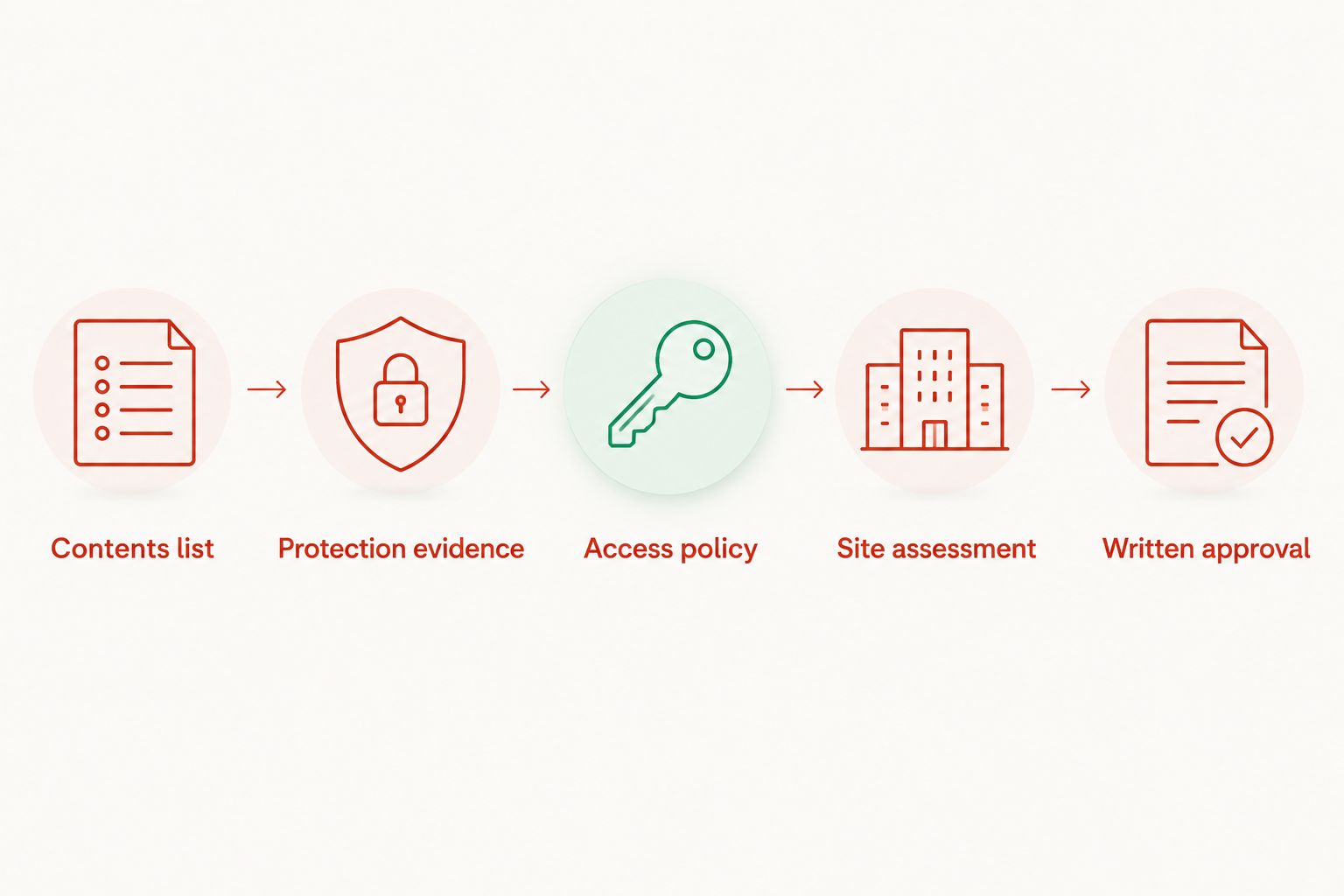
Treat purchase approval and installation acceptance as 2 approval gates. The first confirms that the equipment fits the brief; the second confirms that the installed arrangement follows the agreed specification. Keep them separate in your 2026 purchasing process.
How the shortlist is ranked
The order follows the selection criteria: general valuables storage first, dedicated deposits second, and combined burglary-and-fire requirements third. Each product occupies a different use-case slot.
This is a function-based shortlist, not a claim that one model outperforms another in testing. BUYASAFE's business safe listings identify the formats to investigate; documented classifications, lock functions and installation requirements decide the final selection.
Which safe should you choose?
Start with Chubb Mini Banker MKII if you need a separate security safe for general business valuables. Switch the shortlist to Platinum D2 Defender when depositing is the central task, or Platinum DR2 Director when your brief expressly requires burglary and fire resistance.
If your brief says secure room, stop comparing these units as bank vault replacements. Commission a vault specification covering the complete enclosure and access arrangements.
BUYASAFE is best for business buyers comparing commercial safes, rather than specifying a complete bank vault room. Make the next move a written requirements check—not an order based on a product name.
FAQ
What's the best bank vault safe for an Australian business?
For a separate business security safe, Chubb Mini Banker MKII is the general-valuables starting shortlist in this guide. A true bank vault requires a room specification, so do not treat this unit as a complete vault replacement.
Is a bank vault the same as a commercial safe?
No. A bank vault is a protected room, while a commercial safe is a separate storage unit; each requires assessment of its construction, access and installation.
Which shortlisted safe is best for staff cash deposits?
Platinum D2 Defender is the deposit-chute option in this shortlist. Confirm its permitted deposit items, retrieval safeguards and collection-access arrangements before selecting it.
Which shortlisted safe addresses both burglary and fire resistance?
Platinum DR2 Director is identified as a burglar fire resistant safe. Obtain the exact classifications and confirm that the fire protection applies to your intended contents.
Does a digital safe lock provide dual control or a time delay?
Digital locking alone does not establish dual control or time delay. Verify those functions against the exact fitted lock and specify them explicitly when your access policy requires them.
Can a fire-resistant safe protect business hard drives?
Only select a safe for hard drives when its documented protection covers that type of media. A paper-document fire claim does not establish data-media protection.
Are these safes automatically approved for banks or government offices?
No approval should be assumed from a product name or storage category. Match the exact model and configuration to your organisation's security requirements and obtain written acceptance.
One last thing
The deposit opening belongs in the security assessment just as much as the main door. A purchasing brief that lists only the lock leaves out the feature staff use to put cash inside.
Before approving your 2026 purchase, ask the supplier to explain the exact deposit or retrieval process you will use. Assess the safe with its everyday contents and access routine in mind, not as an empty cabinet.


