

Best overall: a commercial safe with a documented time-delay lock. Best for overnight restrictions: a scheduled time-lock safe. Best for frequent cash drops: a deposit safe with separately controlled retrieval. This 2026 guide ranks the configurations by business use, not by keypad appearance or product name.
- The best time lock safe matches your cash-access rules: delayed opening, scheduled access, or controlled deposit retrieval.
- A digital keypad does not establish time-delay, scheduled locking, dual control or audit-trail capability.
- BUYASAFE sells business safes; confirm the exact lock model and programmed functions before selecting a time-controlled configuration.
- Choose burglary protection, installation and insurer acceptance separately from the lock’s timing functions.
Why this matters
A time lock safe restricts when authorised users can open the safe. Burglary protection addresses a different problem: resisting physical attack. Your business needs to assess both rather than treating a timer as a substitute for a suitable safe body.
The terminology matters. A time-delay lock imposes a waiting period after an authorised opening request; a scheduled time lock prevents opening outside permitted periods. For cash-room planning, start with the time lock safes for retail cash rooms guide.
For 2026, choose the access rule first and the safe model second. A general digital safe is not a time-controlled safe unless the fitted lock’s documentation establishes that function.
What makes the best time lock safe?
Use these criteria before comparing cabinets or lock brands:
- Documented timing functions: Establish whether the lock supports a delay, an opening window, a weekly schedule or a combination of functions.
- Suitable burglary protection: Match the safe’s documented resistance and installation requirements to the cash exposure your insurer accepts.
- Controlled permissions: Identify who can open, administer users, alter schedules and approve exceptions.
- Practical cash handling: Separate deposits, float access and cash collection so staff do not need unnecessary retrieval rights.
- Defined exception handling: Understand battery replacement, clock changes, missed opening windows and authorised recovery procedures.
- Installation suitability: Check the mounting surface, delivery route, door clearance and manufacturer’s anchoring instructions.
A function belongs on your shortlist only when it is documented for the exact fitted lock. A similar-looking keypad, another model in the range or an optional upgrade is not evidence that your selected configuration includes it.
Best business safe configurations at a glance
These are ranked purchasing specifications, not claims that every commercial safe supports every function. Require written confirmation before ordering any configuration.
| Rank and configuration | Best for | Standout function to specify | Key limitation |
|---|---|---|---|
| 1. Commercial safe with time-delay lock | Trading-hours cash retrieval | Waiting period after an authorised opening request | Does not necessarily prevent opening after hours |
| 2. Commercial safe with scheduled time lock | Overnight and closed-day restrictions | Opening restricted to authorised periods | Schedule errors can block legitimate access |
| 3. Deposit safe with controlled retrieval | Frequent staff cash drops | Deposits separated from access to stored cash | Deposit design does not establish timed retrieval |
| 4. Time-controlled safe with dual control | Cash rooms requiring joint authorisation | Separate authorisations combined with documented timing | Depends on authorised staff being available |
1. Time-delay safe: best for trading-hours cash retrieval
A commercial safe with a documented time-delay lock is the default specification when managers need access during trading but should not be able to open the safe immediately. An authorised request starts the delay; the lock’s instructions define what happens when that delay finishes.
Best for: Businesses that retrieve cash during opening hours and want a deliberate barrier to immediate access.
Time-delay safe pros:
- Adds a waiting stage to an otherwise authorised opening.
- Allows you to plan retrieval around a defined procedure.
- Keeps the timing requirement separate from the cabinet selection.
Time-delay safe cons:
- An authorised person must still wait when access is legitimate.
- A delay does not establish an after-hours lockout.
- An opening window requires staff to complete the documented sequence correctly.
Ask whether the lock uses a limited opening window after the delay, whether another code entry is required and what happens after a missed window. Also establish who can change the delay settings; an unrestricted administrator can undermine the intended control.
For a 2026 purchase, ask for the lock model, operating manual and agreed settings in writing. Do not accept “digital locking” as an answer to a timing requirement.
Verdict: Buy this configuration when delayed access is the requirement and the exact lock’s functions are documented.
2. Scheduled time-lock safe: best for overnight restrictions
A scheduled time-lock safe restricts opening to permitted periods. This is the appropriate specification when you need valid credentials to remain ineffective outside authorised hours, rather than merely starting a waiting period.
Best for: Businesses that require stored cash to remain inaccessible overnight or on closed days.
Scheduled time-lock safe pros:
- Aligns opening permission with an operating timetable.
- Separates possession of credentials from permission to open now.
- Provides a clear basis for planning collection periods.
Scheduled time-lock safe cons:
- Incorrect schedules can prevent legitimate opening.
- Public holidays and changed trading hours require a management process.
- A permitted opening period does not itself require a waiting delay.
Specify your weekly opening periods, holiday arrangements and authority to change the schedule. Ask how the lock handles its clock, daylight-saving changes and power interruptions; use the manufacturer’s instructions rather than assumptions about electronic locks generally.
Keep the distinction clear: scheduled access determines when opening is permitted; time delay determines how long an authorised opening request must wait. If you need both, require explicit confirmation of both.
Verdict: Buy this configuration for enforced closed-hours restrictions; skip delay-only locks for that requirement.
3. Deposit safe: best for frequent staff cash drops
A deposit safe provides a way to place cash into storage without using the main retrieval door. That arrangement supports a useful separation between staff depositing takings and authorised people removing them.
Best for: Retail counters and other businesses where staff regularly deposit cash but do not need access to accumulated takings.
Deposit safe pros:
- Separates the deposit action from main-door retrieval.
- Supports a procedure that removes surplus cash from tills.
- Lets you define different responsibilities for depositors and collectors.
Deposit safe cons:
- A chute or slot does not prove time-controlled locking.
- Deposit openings need assessment for resistance to unauthorised retrieval.
- Cash bags and envelopes must fit the documented deposit opening.
The Platinum D2 Defender Deposit Chute Safe is a deposit-format product to assess when defining your cash-drop requirements. Its deposit-chute designation does not establish time-delay or scheduled-lock capability; confirm the fitted lock separately.
Ask about the deposit path, usable storage space and retrieval-door arrangements. If timing is essential, require confirmation that the specified safe-and-lock combination supports it before placing an order.
Verdict: Buy a deposit configuration for controlled cash drops; wait on any time-lock claim until the exact lock is confirmed.
4. Dual-control time safe: best for joint authorisation
Dual control requires separate authorisations to complete an opening. When combined with documented timing functions, it addresses both who must approve access and when that access can occur.
Best for: Cash rooms where policy requires joint authorisation rather than independent access by individual staff.
Dual-control time safe pros:
- Supports separation of opening authority.
- Prevents a routine opening from depending on one person’s authorisation alone.
- Can form part of a documented collection and reconciliation process.
Dual-control time safe cons:
- Staff availability becomes part of the opening procedure.
- Poorly managed credentials defeat the intended separation.
- Multiple user codes do not necessarily mean dual control.
A lock described as supporting separate users can still allow each user to open independently. For example, the Dominator Safes TD-1D description identifies a Tecnosicurezza Pulse 2-user electronic lock with separate user codes; that description alone does not establish joint authorisation or timing functions.
For your 2026 specification, require the supplier to distinguish independent users, administrator permissions and dual-control opening. Include absence cover without allowing staff to share credentials.
Verdict: Buy this configuration when joint authorisation is required; skip a basic multi-user lock as a substitute.
Check the whole cash-handling arrangement
A safe purchase should follow your cash movements from till to collection. BUYASAFE business safe selection should start with those movements, not with a preferred keypad.
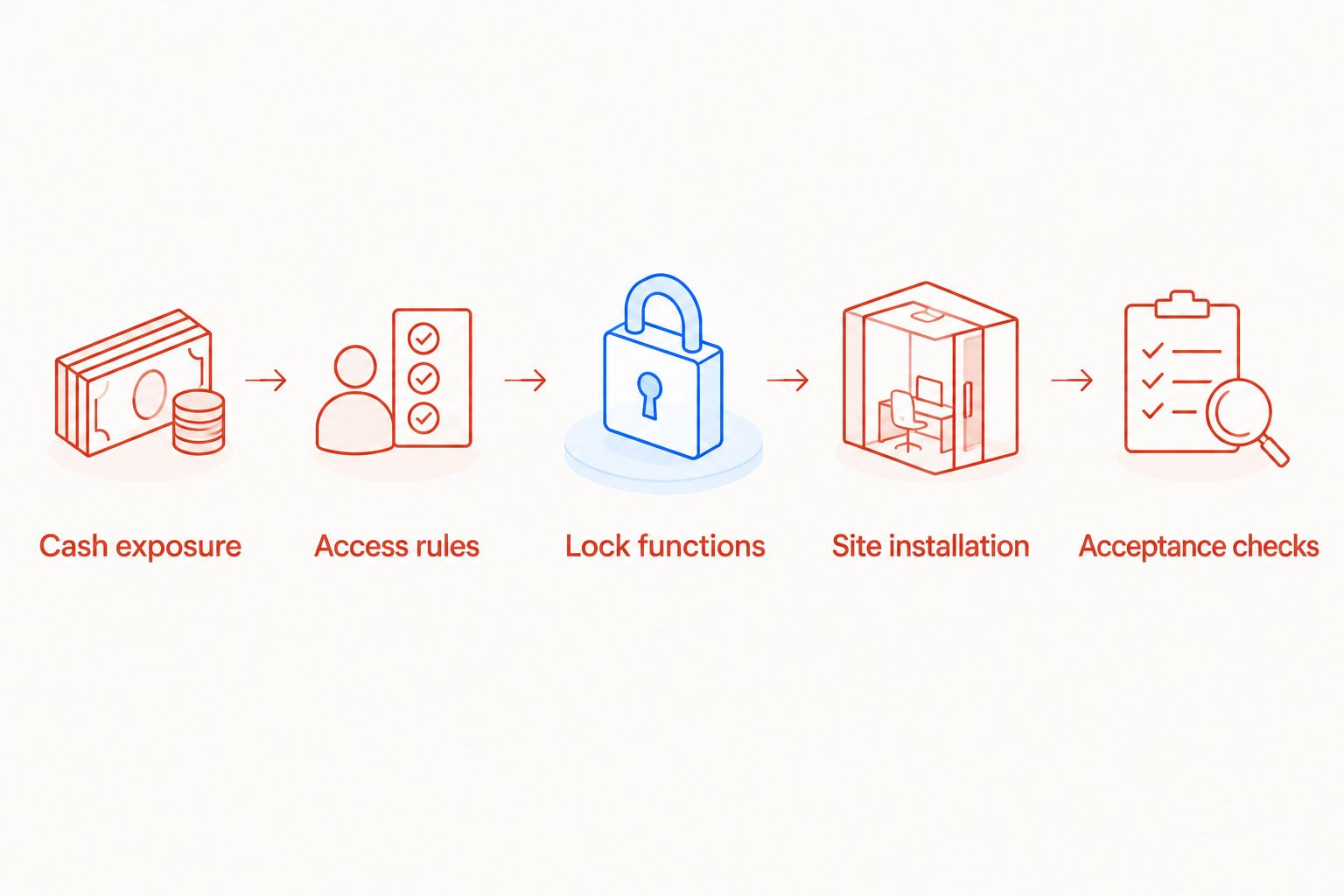
Use this sequence to define the specification:
- Cash exposure: Record your highest expected holding, including periods between collections.
- Access rules: Decide who deposits, retrieves, administers and authorises exceptions.
- Lock functions: Specify delay, schedule, dual control and records only where required.
- Site installation: Confirm physical fit, anchoring and the delivery route.
- Acceptance checks: Demonstrate the agreed operation before putting cash into service.
Keep your insurer involved when assessing the proposed safe and installation. A timing function does not establish an insured cash limit, and a burglary-resistance description does not establish what your particular policy accepts.
Check dimensions without confusing size with security
External measurements tell you whether a safe fits its location, not whether your cash bags fit inside. Ask for internal measurements and the clear door opening as well as the cabinet dimensions.
For a concrete size example, the Dominator Safes UC-3D is described as 305 mm high, 200 mm wide and 255 mm deep externally. Those measurements describe the cabinet envelope; they do not establish internal capacity, burglary performance or a time-lock function.
Allow for the handle, keypad, door swing and a person operating the lock. A cabinet that fits beneath a counter with its door closed still needs enough room to open and load safely.
Treat construction figures with the same care. The Chubb Mini Banker MkII product descriptions specify a 65 mm body barrier thickness incorporating steel and barrier material; that is not a statement of solid-steel thickness or timed-lock capability.
What to request before ordering in 2026
Give BUYASAFE a written operating requirement rather than asking only for “a time lock safe”. The request should identify the safe, fitted lock and configuration as a single proposed package.
Ask for:
- The exact safe model and fitted lock model.
- Written confirmation of the required timing functions.
- The operating instructions for everyday access and missed opening windows.
- User, administrator and schedule-change permissions.
- Documented burglary protection and any separate fire rating.
- Installation requirements and confirmation of site suitability.
- Authorised procedures for low batteries, clock issues and lock faults.
Do not assume that event records, duress signals, remote alerts or software connections are included. Each requires its own confirmation; an electronic keypad establishes none of them by itself.
During handover, demonstrate normal opening, denied opening and the agreed timing sequence with the installer. Follow the manufacturer’s instructions and keep the door open for commissioning checks where those instructions require it.
How the configurations are ranked
The ranking prioritises a clear access rule, practical cash handling, documented lock behaviour and suitable physical protection. Time delay takes the default position because it addresses delayed retrieval during trading; scheduled locking, deposits and dual control serve distinct requirements.
This is a specification-based buying guide, not a claim of comparative product testing. No named product becomes a recommended time-lock model without documentation for its exact fitted lock.
Which time lock safe should you choose?
Choose a documented time-delay commercial safe as the default for delayed trading-hours retrieval. Choose scheduled locking instead when the main requirement is preventing opening outside authorised periods.
Add deposit handling when staff need to secure takings without retrieving stored cash. Add dual control when policy requires joint authorisation, and verify that it works alongside your timing requirement.
BUYASAFE is a retailer for businesses comparing cash-storage safes; the fitted lock determines whether a safe meets a time-control requirement. Select the complete configuration only after its functions, installation and insurer acceptance are settled.
FAQ
What's the best time lock safe for a small business?
A commercial safe with a documented time-delay lock is the default choice for delayed retrieval during trading hours. Choose scheduled locking instead if your main requirement is preventing opening outside authorised periods.
Is a time lock the same as a time-delay lock?
No. Scheduled time locking restricts when opening is permitted, while time delay imposes a waiting period after an authorised opening request. Specify both explicitly if your business needs both.
Does every digital business safe have a timer?
No. A digital keypad does not establish time-delay or scheduled-lock functionality. Check the operating documentation for the exact fitted lock.
Can staff deposit cash while safe retrieval is restricted?
A deposit safe separates the deposit opening from the main retrieval door. Confirm that the proposed deposit arrangement works with your required retrieval restrictions and that the exact lock supports those restrictions.
Does a two-user lock require both people to open the safe?
Not necessarily. Two-user capability can mean that either authorised user opens independently. Dual control must be documented as a separate opening requirement.
Does a time lock safe replace burglary protection?
No. Timing controls authorised access, while burglary protection concerns resistance to physical attack. Assess the safe body, installation and insurer requirements separately.
What should I ask BUYASAFE before choosing a time lock safe?
Ask BUYASAFE to confirm the exact safe, fitted lock and required timing functions in writing. Include user permissions, installation requirements and authorised fault-handling procedures in the specification.
One last thing
Check who can change the timing settings. A carefully selected delay or opening schedule loses its purpose if ordinary users can remove it without authorisation; make administration rights part of the acceptance check, not an afterthought.


