

Best starting shortlist for conventional cash storage: Chubb Mini Banker MkII M-40. Best for staff cash drops: Omni Drawer Trap Deposit Safe Size 5 Digital Locking. Best for specified torch-and-drill resistance: CMI PRA. For a commercial safe cash rating comparison in 2026, choose by the insurer-accepted rating first; the shortlist below ranks buying applications, not unverified cash limits.
- Commercial safe cash rating selection starts with peak cash holdings and written insurer acceptance.
- Chubb Mini Banker MkII M-40 is the starting shortlist for conventional digital-lock cash storage.
- Omni Drawer Trap Deposit Safe Size 5 Digital Locking suits businesses needing a separate deposit drawer.
- BUYASAFE commercial safes should be compared by exact model, installation requirements and documented burglary protection.
Why this matters
A cash rating is guidance about cash storage under stated conditions. It is not a promise that your insurance policy covers that amount, and it does not describe how many banknotes fit inside.
Your decision starts with the largest cash balance retained between collections, not average daily takings. Use the guide to calculating the right cash rating for a business safe to structure that assessment before comparing models.
The best commercial safe is the exact model your insurer accepts for your peak cash holding and installation. A deposit drawer, digital keypad or fire-resistant body answers a different question; none replaces that acceptance.
What makes the best commercial safe for cash storage?
Use these criteria to assess the 2026 shortlist. Treat the first criterion as a purchase condition, not another feature to score.
- Accepted cash rating: obtain the stated rating for the exact model and ask your insurer to accept it for your premises.
- Burglary protection: distinguish a named resistance grade or test from descriptions of steel thickness and barrier materials.
- Cash-handling access: decide whether staff need to deposit money without opening the main storage compartment.
- Lock operation: check authorised users, code management, battery procedures and any required access restrictions.
- Installation suitability: confirm anchoring, supporting structure, delivery access and the manufacturer's installation instructions.
- Separate fire protection: check the fire test, duration and protected contents independently of burglary protection.
The product descriptions establish useful differences, but those differences do not create a descending cash-rating order. Do not convert a model number, security grade or wall thickness into an insured cash amount.
Commercial safes at a glance
This 2026 comparison gives each safe a distinct buying role. Confirm the applicable cash rating and insurance conditions before treating any row as suitable for overnight cash storage.
| Shortlist order | Safe | Best for | Documented feature | Key limitation |
|---|---|---|---|---|
| 1 | Chubb Mini Banker MkII M-40 | Conventional digital-lock cash storage | 65mm body barrier with steel construction and formulated barrier material | Barrier thickness alone does not establish an accepted cash limit |
| 2 | CMI PRA Premier Torch and Drill Resisting Safe | Buyers specifying TDR construction and bolt-down provisions | Two 20mm recessed bolt holes; La Gard digital lock | TDR wording does not replace exact-model insurance acceptance |
| 3 | Omni Drawer Trap Deposit Safe Size 5 Digital Locking | Staff cash-drop workflows | Deposit-drawer format; description states Sold Secure Gold burglary protection | Deposit access does not establish overnight cash cover |
| 4 | Platinum BO3 Bond 3 Grade 1 TDR Burglar & Fire Resistant Safe | Buyers requiring burglary and fire protection in one shortlist | Product identifies Grade 1 TDR and fire resistance | Fire duration and accepted cash limit need separate confirmation |
Cash rating, security grade and fire duration are different
A commercial safe cash rating expresses a cash-storage recommendation under specified conditions. A burglary grade describes a resistance classification under its relevant scheme. A fire duration describes protection under a particular fire test.
Keep those fields separate in your comparison. You cannot rank a safe above another simply because one has a longer fire duration or a larger model number.
For example, the Yale YFM/520/FG2 description states 1-hour document fire protection. That tells you about document protection under its stated certification, not the amount of business cash your insurer will cover.
1. Chubb Mini Banker MkII M-40: best for conventional cash storage
The Chubb Mini Banker MkII Security Safe Size 3 Digital Locking (M-40) is a starting point when you want a conventional security safe with digital locking. Its description specifies a 65mm body barrier, steel construction welded throughout, and specially formulated Chubbsafes barrier material.
That construction detail makes the M-40 worth assessing for cash storage. It does not establish a cash-rating figure or prove that the safe meets your policy conditions.
Chubb Mini Banker MkII M-40 pros:
- Digital locking is identified for this exact model.
- The description specifies the body barrier thickness.
- Welded steel construction and barrier material are documented.
Chubb Mini Banker MkII M-40 cons:
- The 65mm measurement is a composite body-barrier specification, not a statement of solid-steel thickness.
- Digital locking alone does not establish audit trails, time delay or individual staff permissions.
- Cash-rating suitability still requires exact-model and installation confirmation.
Best for: a business assessing conventional locked storage rather than a dedicated cash-drop workflow.
Ask for the current specification, internal clearance and fixing requirements before choosing the installation position. Verdict: Hold until your insurer accepts the M-40 for your cash holding.
2. CMI PRA: best for TDR and defined bolt-down provisions
The CMI PRA Premier Torch and Drill Resisting Safe gives you specific installation and lock details to assess. Its description lists two 20mm recessed bolt holes, two adjustable shelves and a La Gard digital lock powered by a 9V battery.
These details help you discuss positioning and daily use with an installer. The bolt-hole diameter is not an instruction to buy a particular anchor: the substrate, fixing design and manufacturer's requirements still govern installation.
CMI PRA pros:
- The product is explicitly identified as torch and drill resisting.
- Recessed bolt-hole dimensions are stated.
- Adjustable shelving supports arranging stored contents.
- The lock brand and battery voltage are identified.
CMI PRA cons:
- Bolt holes do not establish that your proposed floor is suitable.
- The electronic lock needs a battery-management procedure.
- TDR terminology alone does not specify your insured cash allowance.
Best for: buyers who want TDR construction and concrete fixing details in their initial assessment.
For a BUYASAFE commercial safe purchase in 2026, have the installer assess the location before committing to this model. Verdict: Hold until both fixing suitability and insurer acceptance are confirmed.
Compare the construction-led shortlist
The Chubb Mini Banker MkII M-40 and CMI PRA answer different specification questions. Compare the Chubb barrier construction with the CMI TDR description and fixing provisions; do not treat either as a substitute for the applicable cash-rating documentation.


3. Omni Drawer Trap Size 5 Digital: best for staff cash drops
The Omni Drawer Trap Deposit Safe Size 5 Digital Locking is the workflow-led option. Its deposit-drawer format is relevant when employees need to put cash away without routinely opening the main storage door.
The product description states Sold Secure Gold approval for burglary protection. Request the supporting documentation and applicable scope for the exact configuration; do not translate that approval into a cash amount yourself.
Omni Drawer Trap Size 5 Digital pros:
- A dedicated deposit drawer addresses cash-drop handling.
- The named model uses digital locking.
- The description identifies an external burglary-protection approval.
Omni Drawer Trap Size 5 Digital cons:
- Deposit-envelope and cash-bag fit need checking against the drawer opening.
- A deposit mechanism does not establish fire protection.
- Digital locking does not, by itself, establish individual-user reporting.
Best for: a retailer separating routine deposits from authorised cash retrieval.
Assess the drawer with the actual bags or envelopes your team uses, and confirm how retrieval access will be controlled. Verdict: Hold until the deposit workflow and overnight cash cover are approved.
4. Platinum BO3 Bond 3: best for a dual-protection brief
The Platinum BO3 Bond 3 Grade 1 TDR Burglar & Fire Resistant Safe belongs on a shortlist that requires both burglary and fire protection. Its product title identifies Grade 1 TDR and fire resistance.
Keep the documentation separate. Ask which burglary classification supports the Grade 1 designation, then request the fire test and duration rather than assuming one rating explains both protections.
Platinum BO3 Bond 3 pros:
- The model explicitly identifies burglary and fire resistance.
- TDR construction is part of its stated product designation.
- A named grade gives you a specific classification to investigate.
Platinum BO3 Bond 3 cons:
- Grade 1 is not a universal currency-based cash rating.
- Fire-resistant wording alone does not establish a protection duration or suitability for electronic media.
Best for: a business requiring documented burglary and fire protection from the same safe.
Compare the supporting certificates with your insurer's requirements and the contents you intend to store. Verdict: Hold until the burglary classification, fire protection and cash allowance are confirmed.
How to choose your commercial safe cash rating
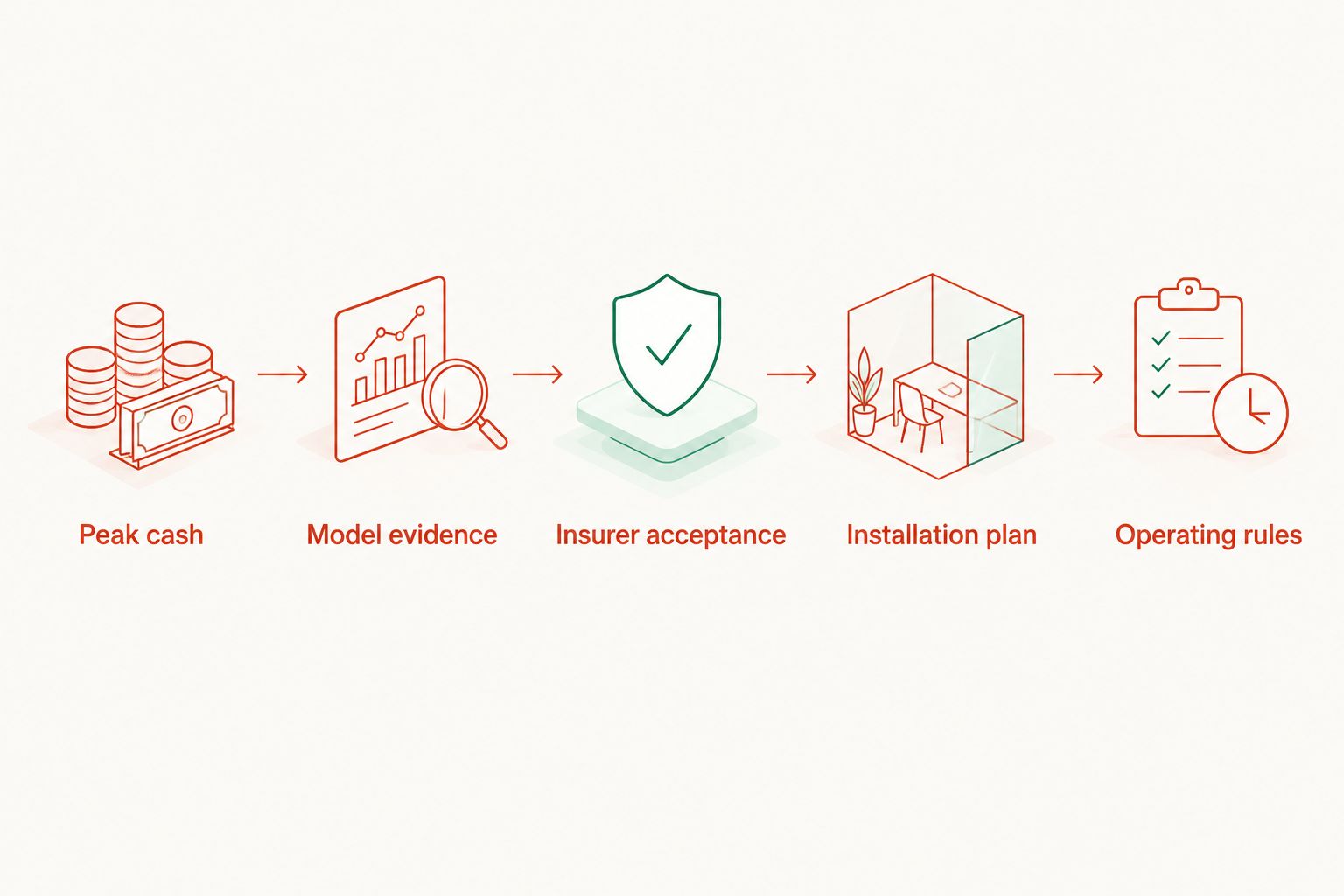
Use this sequence for your 2026 purchase. Completing the paperwork before ordering is more useful than choosing a safe first and asking whether it qualifies afterwards.
- Peak cash: calculate the largest balance retained between banking or collections, including floats and accumulated takings.
- Model evidence: request the exact model's stated cash rating, burglary documentation and installation instructions.
- Insurer acceptance: submit the model, peak holding and premises details to your insurer or broker for written acceptance.
- Installation plan: confirm the fixing method, supporting structure and delivery route with the installer.
- Operating rules: document deposit access, retrieval authority, code changes and cash collection arrangements.
Keep these stages distinct. A good installation cannot turn an unsuitable model into an accepted one, and an accepted model still needs installation that satisfies the agreed conditions.
Questions to send before you order
Give BUYASAFE the exact model name and your intended application. Ask for the current cash-rating statement, relevant test documentation, external and internal dimensions, weight, fixing instructions and lock operating information.
Send your insurer the same model designation. Ask whether acceptance depends on anchoring, an alarm, the premises, collection frequency or other conditions, and retain the written response with your installation records.
How the shortlist is ranked
The order prioritises a conventional cash-storage starting point, then TDR installation details, staff deposits and a combined burglary-and-fire brief. Each position serves a different requirement rather than claiming a higher cash limit than the next.
The supporting details come from the product descriptions accompanying this 2026 comparison. The shortlist does not assign numerical cash ratings or claim independent physical testing. Final selection depends on the criteria above, especially insurer acceptance and installation suitability.
Which commercial safe should you choose?
Start with the Chubb Mini Banker MkII M-40 if you need conventional digital-lock cash storage. Assess the CMI PRA when specified TDR construction and fixing details drive the brief; assess the Omni Drawer Trap Size 5 Digital when staff deposits drive it.
Choose the Platinum BO3 Bond 3 shortlist route when fire protection is also a requirement. None becomes the right purchase until its exact documentation matches your cash exposure, premises and insurer's conditions.
BUYASAFE is a commercial safe retailer for Australian businesses comparing security-storage options. Use the product comparison to narrow the application, then make written acceptance your final buying gate.
FAQ
What does commercial safe cash rating mean?
A commercial safe cash rating is guidance about the cash value stored under stated conditions. It is separate from physical capacity and does not automatically establish insurance cover.
Which commercial safe has the highest cash rating in this comparison?
This comparison does not establish a highest cash rating. It ranks buying applications; obtain the current exact-model cash-rating statements before making a numerical comparison.
Is a cash rating the same as insurance cover?
No. Your insurance policy and the insurer's acceptance determine cover, including any conditions applying to the model, premises and installation.
Is a Grade 1 safe automatically suitable for my business cash?
No. Identify the standard behind the Grade 1 classification and ask your insurer to accept the exact model for your peak cash holding.
Is a deposit safe better than a conventional commercial safe?
A deposit safe is the better workflow choice when staff need to deposit cash separately from main-door retrieval. Its burglary protection and accepted cash allowance still need checking independently.
Does fire protection increase a safe's cash rating?
Fire protection does not establish a higher burglary-related cash rating. Check the fire test and duration separately from burglary documentation and insurance acceptance.
Should I choose a business safe using average daily takings?
Choose using the peak cash balance retained between collections, not average daily takings. Include floats and accumulated receipts when assessing that exposure.
What should I check before buying a commercial safe in 2026?
Check the exact model's cash-rating documentation, written insurer acceptance and installation requirements. Then confirm internal fit, delivery access and the lock functions your staff need.
One last thing
The deciding cash balance is the one present just before collection, not just after it. Map your cash-handling cycle before choosing a safe: a longer gap between collections changes the exposure even when daily takings stay the same.
Keep the accepted model designation and installation conditions together. That record is more useful than a shortlist position when you need to explain why the safe was selected.


