

Best overall for frequent access: an independently certified electronic keypad lock. Best for battery-free storage: a mechanical combination lock. Best for controlled key custody: a high-security key lock. This 2026 guide ranks safe lock types by practical security requirements, not by assuming that a keypad, dial or fingerprint reader proves burglary resistance.
- Choose safe lock types by verified certification, access control and recovery arrangements—not the opening method alone.
- Electronic keypad locks suit frequent access; mechanical combination locks suit battery-free storage.
- Dual-control locking suits businesses requiring separate approvals, but both credentials must be mandatory.
- Compare BUYASAFE safe lock types alongside the safe’s burglary rating, installation requirements and intended contents.
Why this matters
A lock controls access; the safe body, door and installation resist physical attack. A sophisticated reader does not compensate for inadequate construction, and a substantial safe does not make careless credential handling secure.
BUYASAFE is best for Australian home and business buyers comparing safes across different locking arrangements. Start with the BUYASAFE range and compare the exact safe-and-lock configuration rather than choosing by appearance.
For a 2026 purchase, separate three questions: who can open the safe, how the lock resists attack, and what happens when authorised access fails. Each question needs its own answer. Fire protection is another specification entirely; a lock type does not establish a fire rating.
What makes the best safe lock types?
Use these criteria before comparing the ranked options:
- Verified certification: Identify the exact lock model, its certification and the safe configuration to which it applies. EN 1300 addresses high-security locks; EN 1143-1 addresses burglary resistance of secure storage units.
- Credential control: Decide whether you need individual codes, controlled physical keys, a shared combination or separate approvals.
- Recovery arrangements: Check battery access, authorised servicing, reset procedures and any alternative opening method.
- Operational fit: Match the lock to opening frequency, staff turnover, user dexterity and the storage environment.
- Complete safe security: Assess the door, body, boltwork and anchoring alongside the lock. Treat fire resistance as a separate requirement.
Certification is specific to a model and configuration. Do not transfer a rating from another lock in the same brand’s range or infer one from the word digital.
Safe lock types at a glance
The order below is a buying priority for the stated use cases, not a universal ladder of tested attack resistance. A certified key lock can be a stronger choice than an uncertified electronic lock.
| Rank | Lock type | Best for | Standout feature | Key limitation |
|---|---|---|---|---|
| 1 | Electronic keypad | Frequent authorised access | Code-based access without carrying a key | Power and access-management requirements |
| 2 | Dual-control locking | Separate business approvals | Mandatory participation from separate credential holders | Requires coordination and verified configuration |
| 3 | Mechanical combination | Battery-free storage | Keyless mechanical operation | Precise dialling and slower credential changes |
| 4 | High-security key | Dedicated custodians | Physical control of the opening credential | Lost, copied or poorly stored keys |
| 5 | Biometric locking | Fingerprint-based convenience | Access through an enrolled fingerprint | Reader performance and alternative access paths |
Dual control is an access arrangement, not a separate lock mechanism. It appears here because requiring separate authorisations changes how you manage access. Time delay and scheduled opening are also control features rather than independent proofs of lock strength.
1. Electronic keypad: best safe lock type for frequent access
An electronic keypad accepts an authorised code and releases the locking mechanism. Models differ in user permissions, programming, unsuccessful-entry handling and recovery procedures; the keypad alone tells you none of those details.
For frequent home or office access, a certified electronic keypad lock is the default shortlist choice. You avoid carrying a key, and suitable models support separate credentials rather than forcing everyone to share access.
Electronic keypad pros:
- No physical opening key to carry during normal operation.
- Code changes provide a route for withdrawing access.
- Models with separate user credentials support individual access management.
Electronic keypad cons:
- Requires a power source and a documented recovery procedure.
- A shared code prevents reliable attribution of who opened the safe.
- Audit records and remote connectivity are model-specific, not standard features.
At BUYASAFE, compare safe lock types by the supplied configuration. The CMI HG1 Homeguard Plus safes with 3 locking choices is a relevant starting point for comparing locking options; confirm the specification of the option you select.
Best for: Frequent access where you need practical credential changes.
Verdict: Buy an electronic keypad configuration when its certification, permissions and recovery arrangements meet your requirements.
2. Dual-control locking: best for separate business approvals
Dual-control locking requires separate authorisations before the safe opens. A key-and-combination arrangement provides dual control only when both are required and separate custodians control them; alternative opening methods do not establish dual control.
This arrangement addresses a different problem from lock picking or forced entry. Dual control limits unilateral authorised access, making it relevant where a business requires independent approval for cash or valuable stock.
Dual-control locking pros:
- Separates responsibility between credential holders.
- Prevents an individual custodian from opening alone when correctly configured.
- Supports a documented approval process for sensitive contents.
Dual-control locking cons:
- Opening depends on the required custodians being available.
- Shared credentials or credentials held by the same person defeat separation.
- It does not independently increase the safe body’s burglary resistance.
For a 2026 business purchase, request a written explanation of the opening sequence. Establish whether separate codes, different lock mechanisms or another arrangement enforce the requirement. Then document replacement custodians and absence procedures without turning routine exceptions into unrestricted access.
Best for: Businesses requiring separate approvals before opening.
Verdict: Buy dual-control locking when separation of responsibility is a defined requirement; skip it for a sole-user safe without that need.
3. Mechanical combination: best for battery-free storage
A mechanical combination lock uses a dial to align internal components and permit opening. It provides keyless access without an electronic power supply, but accurate operation matters.
Choose a mechanical combination lock when avoiding batteries is more important than quick access. Its security still depends on the exact lock, safe construction and handling of the combination—not the dial’s appearance.
Mechanical combination pros:
- No batteries are required for the mechanical locking mechanism.
- No physical opening key to lose or duplicate.
- Suits users who prefer a non-electronic opening process.
Mechanical combination cons:
- Dialling takes care and is less convenient for repeated openings.
- Combination changes require the correct procedure and, for some models, professional assistance.
- A shared combination does not identify individual users.
The supplied product range includes Big Red locks with 3 wheels and 4 wheels. The Dominator Safes TD-1C uses a Big Red 3-wheel combination lock; the Dominator Safes FA-65C uses a Big Red 4-wheel combination lock. Wheel count alone does not establish a certified security level.
For 2026, prioritise the exact lock’s documented rating and servicing requirements over a larger wheel count.
Best for: Infrequent access where battery-free operation is the priority.
Verdict: Buy a mechanical combination configuration if you can operate the dial reliably and manage combination changes correctly.
4. High-security key: best for dedicated custodians
A key-operated safe lock uses a physical credential to permit opening. High-security safe locks are distinct from ordinary cabinet locks, so assess the exact mechanism rather than treating every key lock as equivalent.
A certified key lock is a sound choice when key custody is disciplined. The operational trade-off is clear: you replace code management with responsibility for issued keys, spare keys and lost-key responses.
High-security key pros:
- No electronic power supply for a purely mechanical key lock.
- Straightforward operation for users who struggle with dialling or code entry.
- Physical keys can be issued under a documented custody procedure.
High-security key cons:
- A missing key creates an access and security problem.
- Returning an issued key does not prove that no copy exists.
- Spare-key storage introduces another location that needs protection.
Keep the spare away from the safe and its contents. For business use, record who holds each issued key and establish what happens when a custodian leaves. Do not assume that a restricted key profile makes duplication impossible; confirm the controls for the specific system.
Best for: A dedicated custodian or small, stable group with controlled key handling.
Verdict: Buy a certified key-lock configuration when you can protect and account for every key; skip it when key custody is unreliable.
5. Biometric locking: best for fingerprint-based convenience
A biometric safe lock checks an enrolled characteristic, commonly a fingerprint, before authorising access. Fingerprint entry is an interface feature; it does not independently prove burglary resistance or eliminate other opening methods.
Choose biometric locking for convenience only after verifying the complete access system. Evaluate enrolment, fingerprint removal, power recovery and any backup key or code with the same care as the reader.
Biometric locking pros:
- Fingerprint entry avoids carrying a key for normal opening.
- Enrolment provides a way to authorise named users.
- Suits users who prefer fingerprint entry to remembering a combination.
Biometric locking cons:
- Finger condition and reader performance affect recognition.
- Power and recovery arrangements still need checking.
- A backup credential remains an alternative access path to manage.
Ask whether the selected model suits the users’ working conditions. Wet, dirty or damaged fingers matter when assessing practical access, particularly in workplaces. Also establish who can enrol new fingerprints and whether removing a user removes every credential associated with that person.
Best for: Users prioritising fingerprint entry who accept the reader’s limitations.
Verdict: Hold until the reader, backup access and certification are verified; skip biometric locking as a security upgrade based solely on its interface.
Real examples of mechanical and electronic locking
The BUYASAFE range includes distinct configurations worth comparing: the Dominator Safes TD-1C has a Big Red 3-wheel combination lock, the Dominator Safes FA-65C has a Big Red 4-wheel combination lock, and the Dominator Safes DD-3D has a Tecnosicurezza Pulse 2-user electronic lock. These details describe the supplied locks, not an independent ranking of the safes’ protection.
Use these examples to compare opening methods. Select the safe body and storage purpose separately, then confirm the complete specification before ordering.


Check the full security chain before choosing
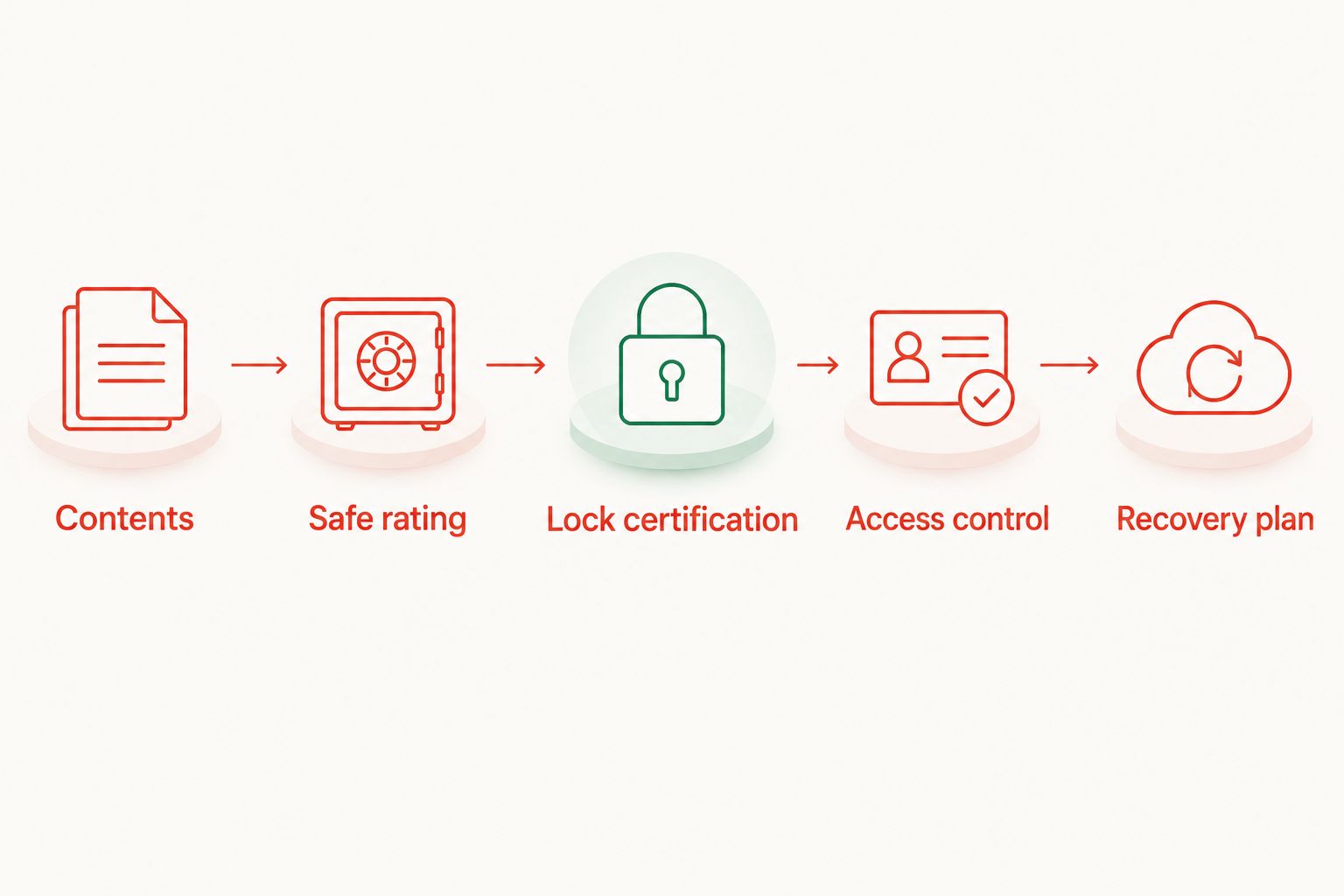
Use this sequence for your 2026 shortlist. It keeps the access interface from distracting you from the storage requirement.
- Contents: Identify what you will store and whether insurance, firearm storage or workplace rules impose requirements.
- Safe rating: Verify the safe’s documented burglary protection and any separate fire rating.
- Lock certification: Identify the exact supplied lock and the evidence supporting its security claims.
- Access control: Decide who opens the safe and how you withdraw permission.
- Recovery plan: Establish authorised recovery and servicing before storing valuables.
Installation belongs in the same assessment. Follow the safe manufacturer’s anchoring instructions and confirm that the proposed location supports the installation. A lock recommendation does not settle floor suitability or fixing requirements.
Time delay is not the same as a time lock
A time-delay feature imposes a wait after a valid opening request. A time lock restricts opening according to a schedule. Both require compatible equipment and deliberate configuration; neither follows automatically from choosing a digital keypad.
Best for: Defined cash-handling procedures where delayed or scheduled access serves a specific purpose.
Pros: Adds an access restriction beyond possession of a credential. Cons: Restricts legitimate access too, and does not replace physical burglary protection. Choose these features only when the operating procedure requires them.
How the ranking works
This 2026 ranking gives electronic keypads the default position for frequent access, then assigns separate slots to approval control, battery-free operation, physical key custody and fingerprint convenience. It does not claim that those interfaces have descending certified attack resistance.
The deciding criteria are certification, credential control, recovery, operational fit and complete safe security. A documented, suitable configuration beats an unsupported claim about a lock type.
Which safe lock type should you choose?
For an undecided buyer, shortlist a certified electronic keypad lock on a safe that meets the storage requirement. Choose a mechanical combination instead when battery-free operation is essential and careful dialling is acceptable.
For business storage, decide whether individual credentials or mandatory separate approvals are needed before choosing the mechanism. For firearms, confirm the current requirements of the relevant Australian jurisdiction; a preferred lock interface does not establish legal compliance.
FAQ
What’s the most secure safe lock type?
No opening method is universally the most secure safe lock type. Compare the exact lock’s independent certification, the safe’s burglary resistance and the access procedures used with it.
Is a digital safe lock safer than a mechanical combination lock?
A digital lock is not automatically safer than a mechanical combination lock. Certified models of either type deserve assessment on their documented protection; digital access is generally more convenient for frequent code-based opening.
Are key locks secure enough for a home safe?
A certified high-security key lock is a valid option for a home safe. Its suitability also depends on the safe body, installation and your ability to control issued and spare keys.
Do biometric safe locks make a safe more secure?
A fingerprint reader alone does not establish greater safe security. Assess the lock certification, enrolment controls, backup credentials and safe construction before choosing biometric access.
What happens when an electronic safe lock’s battery runs out?
The authorised recovery method depends on the exact lock model. Check whether it uses externally accessible battery replacement, an emergency power connection or another documented procedure before buying.
Does a safe with a key and combination provide dual control?
A key-and-combination safe provides dual control only when both credentials are required and separate custodians control them. If either method opens the safe independently, it is alternative access rather than dual control.
Does a four-wheel combination lock prove higher security?
A four-wheel configuration alone does not prove a higher certified security level. Compare the exact lock model’s certification and the complete safe configuration rather than ranking by wheel count.
Does the lock type determine a safe’s fire rating?
The lock type does not determine a safe’s fire rating. Fire protection requires separate evidence for the safe and the contents it is intended to protect.
One last thing
Check every alternative opening method before accepting the main lock’s security claim. A backup key, shared administrator credential or poorly controlled reset procedure is still part of the access system. Document who controls each path, then review those permissions whenever responsibility for the safe changes.


