

Best overall for moderate domestic security: CMI HS2D Home Safe Digital. Best for physical-key access: Secuguard SHS2K Home Safe; best for a stated fire-resistance duration: Guardall HV1 Home Safe. This 2026 guide compares home safes in Melbourne by construction, locking method, fire protection and installation requirements, with options from BUYASAFE.
- For home safes Melbourne buyers can shortlist, CMI HS2D is the default for moderate domestic security with digital access.
- Secuguard SHS2K specifies a 12mm steel plate door and 6mm steel plate body.
- Guardall HV1 lists 30 minutes of fire resistance; confirm the test standard and protected contents.
- Choose home security safes by contents, documented ratings and anchoring, not the keypad alone.
Why this matters
A home safe has to suit both your valuables and your property. A model that fits inside a wardrobe still needs a suitable installation surface, usable door clearance and a locking method you can manage reliably.
For Melbourne homeowners, apartment residents and renters, the practical decision starts before the product choice: identify what you are protecting, then establish where the safe can be secured. Do not treat a fire-protection claim as proof of burglary resistance, or a thick steel door as proof of fire performance. Those are separate questions.
BUYASAFE home safes suit buyers comparing domestic storage options by lock type and stated construction. The strongest choice is the one whose documented protection matches your contents and whose installation requirements fit your home.
What makes the best home safe?
Use these five criteria to assess the 2026 shortlist. Each addresses a different part of the buying decision.
- Burglary protection: Look for documented security performance and insurer acceptance where required. Door thickness alone does not establish a burglary rating.
- Fire protection: Check the stated duration, test standard and type of contents covered. Paper documents and electronic media require different protection assessments.
- Lock type: Choose digital, key or combination access around who uses the safe and how you will manage credentials or keys.
- Usable capacity: Compare internal dimensions and door opening space against the actual items you intend to store, including folders and jewellery boxes.
- Installation fit: Confirm suitable anchoring, access through the property and any permission needed before drilling or altering a floor or wall.
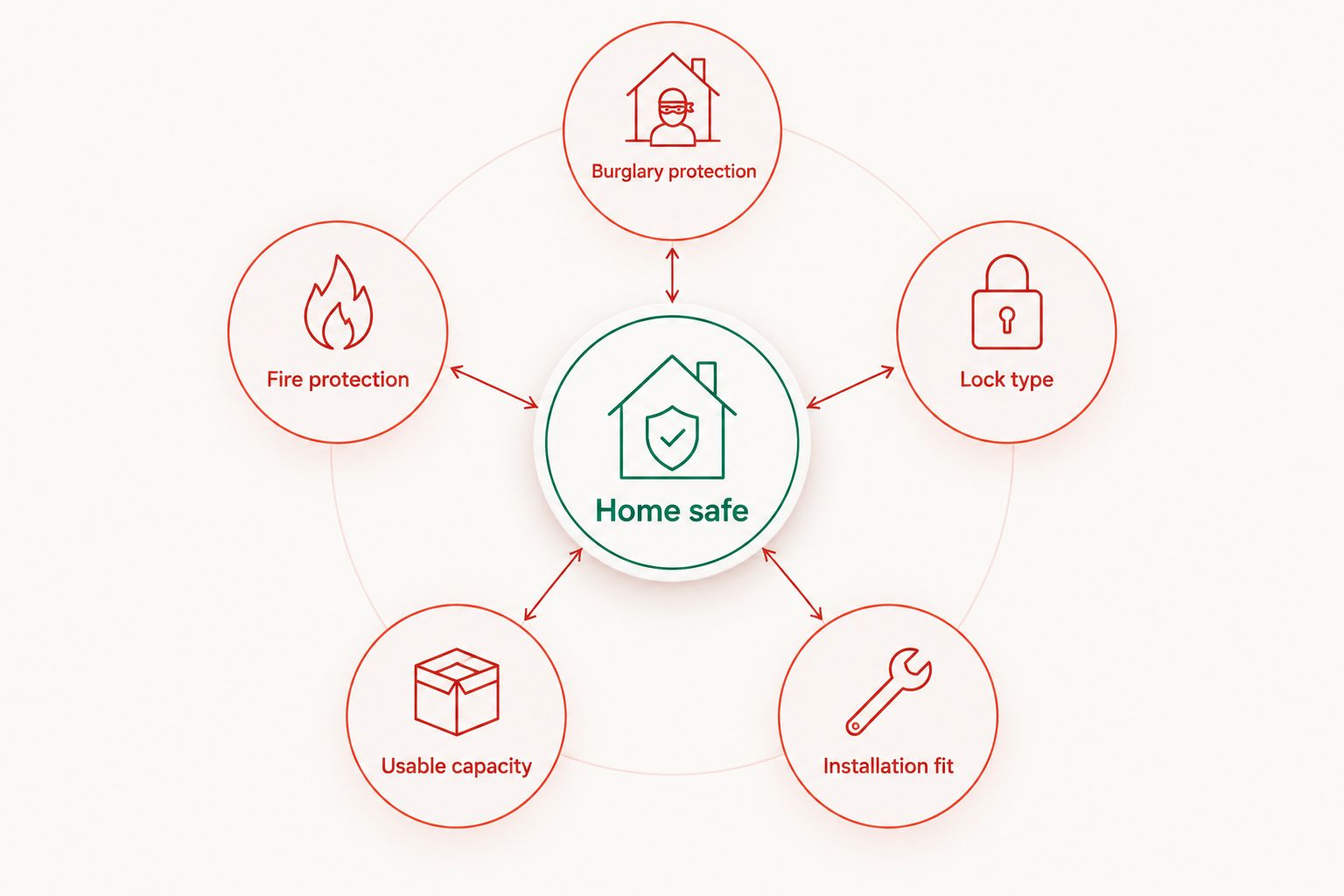
Start with the consequence of losing each item. Jewellery requires a different protection discussion from replaceable household paperwork, while original documents need a clear fire-protection assessment. Avoid choosing a lock first and trying to make the rest of the specification fit afterwards.
Best home safes in Melbourne: at a glance
The table separates five use cases rather than presenting every model as interchangeable. The 2026 order favours a general domestic starting point, followed by specific access and protection requirements.
| Safe | Best for | Standout stated feature | Key limitation |
|---|---|---|---|
| CMI HS2D Home Safe Digital | Moderate domestic security with digital access | Digital locking; described for floor and/or wall securing | Moderate-security positioning is not a high-security recommendation |
| Secuguard SHS2K Home Safe | Buyers who prefer physical-key access | 12mm steel plate door and 6mm steel plate body | Requires secure key management; thickness does not establish a fire rating |
| Secuguard FA35E Electronic Locking Home Safe | Comparing a stated burglary-and-fire construction option | 8mm solid steel door and 6mm solid steel body | Construction claims need separate rating checks |
| Guardall HV1 Home Safe | Buyers prioritising a stated fire-resistance duration | Listed 30-minute fire resistance and commercial UL digital lock | Fire suitability depends on the test standard and contents |
| CMI HS2C Home Safe Combination | Moderate domestic security with combination access | Combination locking; described for floor and/or wall securing | Requires careful combination management and suitable anchoring |
1. CMI HS2D: best home safe for everyday digital access
The CMI HS2D Home Safe Digital is the default shortlist choice for moderate domestic security with digital locking. Its product description specifically connects that intended security level with proper securing to the floor and/or wall.
That installation condition matters. If you cannot establish a suitable anchoring method, resolve the property constraint before choosing this model.
CMI HS2D pros:
- Digital locking suits buyers who prefer code-based access.
- The description clearly identifies a domestic, moderate-security use case.
- Floor and/or wall securing is part of its stated intended setup.
CMI HS2D cons:
- Moderate domestic security is not a substitute for a documented high-security specification.
- Digital access requires you to manage the code and follow the lock's operating instructions.
- Its suitability depends on proper securing, not simply placing it inside furniture.
Best for: Homeowners seeking digital access for ordinary domestic valuables, subject to contents and insurance requirements.
Before choosing CMI HS2D in 2026, compare its internal dimensions with your largest item and confirm its relevant protection specifications. Keep the digital-lock instructions accessible outside the locked compartment so you can follow the manufacturer's procedures when needed.
Verdict: Buy for moderate domestic security with digital access once fit and anchoring are confirmed.
2. Secuguard SHS2K: best home safe for physical-key access
The Secuguard SHS2K Home Safe is the key-access option in this comparison. Its description specifies solid steel construction, a 12mm steel plate door and a 6mm steel plate body, with reinforcement around the front edges.
Those are useful construction details. They do not, by themselves, tell you how the safe performs under a particular burglary or fire test.
Secuguard SHS2K pros:
- Key access suits buyers who do not want to remember a daily access code.
- The specified door and body thicknesses allow a direct construction comparison.
- Front-edge reinforcement is explicitly described.
Secuguard SHS2K cons:
- You must control access to both the working key and any spare.
- A misplaced key creates an access problem even when the safe itself works correctly.
- Steel thickness is not evidence of a particular fire-protection duration.
Best for: Buyers who prefer a physical key and can keep it separate from the safe's location.
Do not leave the spare key in the same wardrobe as the safe. Plan who holds it and how an authorised person will retrieve it without making the safe accessible to everyone in the household.
Verdict: Buy for managed physical-key access; skip if secure key storage is impractical.
3. Secuguard FA35E: best for a burglary-and-fire shortlist
The Secuguard FA35E Electronic Locking Home Safe belongs to the FA series, whose description states an 8mm solid steel door and a 6mm solid steel body. The description presents that construction as providing protection against both burglary and fire.
This makes Secuguard FA35E a relevant option when you want to investigate both risks in one product. Require the specific performance documentation before treating a construction description as a tested protection level.
Secuguard FA35E pros:
- Electronic locking gives this option a distinct access method from the keyed SHS2K.
- Door and body thicknesses are explicitly stated.
- The description addresses both burglary and fire protection.
Secuguard FA35E cons:
- Steel construction does not establish a particular fire-resistance duration.
- Electronic locking still requires disciplined code management.
- A dual-purpose description does not settle your insurer's requirements.
Best for: Buyers comparing an electronically locked safe whose description addresses both burglary and fire.
For a 2026 purchase, ask which test documents apply to the exact FA35E model. Check the protected contents, installation requirements and insurer acceptance rather than assuming every FA-series description answers those questions.
Verdict: Hold until the exact protection ratings match your intended contents.
4. Guardall HV1: best for a stated fire-resistance duration
The Guardall HV1 Home Safe description lists 30 minutes of fire resistance. It also identifies a commercial UL digital lock and keypad, giving buyers concrete points to investigate beyond a general fire-protection label.
The duration is useful, but it is not the whole specification. Confirm the test standard, conditions and contents covered before relying on Guardall HV1 for original documents or other heat-sensitive items.
Guardall HV1 pros:
- A stated 30-minute duration gives you a specific fire-protection claim to check.
- The description identifies a commercial UL digital lock and keypad.
- Digital access suits buyers who prefer managing a code rather than carrying a key.
Guardall HV1 cons:
- A duration alone does not establish suitability for electronic media.
- Fire resistance does not establish water resistance.
- The stated fire duration is not an unlimited house-fire guarantee.
Best for: Buyers who want a stated fire-resistance duration as a starting point for checking document protection.
If fire protection is your main objective, request the relevant test information and compare it with the contents you plan to store. Do not extrapolate the lock's description into certification of the entire safe.
Verdict: Buy only after the fire specification and installation requirements are confirmed.
5. CMI HS2C: best home safe for combination access
The CMI HS2C Home Safe Combination offers combination locking for moderate domestic security. Its description, like the HS2D description, makes proper securing to the floor and/or wall part of the intended setup.
Choose CMI HS2C for its access method, not an assumed security advantage over digital locking. The safe's documented protection and installation remain the deciding factors.
CMI HS2C pros:
- Combination access provides an alternative to the keyed and digital options above.
- Its description clearly defines a moderate domestic-security role.
- The securing requirement directs attention to installation before use.
CMI HS2C cons:
- You must remember and control disclosure of the combination.
- Moderate-security positioning does not meet every valuables-storage requirement.
- Proper floor and/or wall securing remains necessary for its stated use.
Best for: Households that prefer combination access and can manage the combination consistently.
Verdict: Buy for combination access when moderate domestic security fits your needs.
Compare the shortlisted products
BUYASAFE home safes include different access methods and construction descriptions. Use these product cards to review the exact models, then check dimensions, protection documentation and installation instructions before making the final choice.


Check your Melbourne installation before ordering
A Melbourne address does not tell an installer whether your safe must pass through a narrow doorway, travel upstairs or fit inside a cupboard. Document the actual route and proposed installation point.
Use this sequence before committing:
- List the contents. Include the largest folder, jewellery box or other container, not just the individual items inside it.
- Measure the space. Check external fit, usable internal space and the room needed to open the door and operate the lock.
- Check the structure. Have the proposed floor or wall assessed for the model's anchoring requirements. Do not assume a cupboard panel is a suitable structural fixing point.
- Confirm permissions. Renters and apartment owners should establish the applicable landlord or owners corporation requirements before alterations.
- Confirm the work. Specify placement, anchoring and access constraints when discussing delivery and installation. Do not assume these are included together.
For heavy models or upstairs locations, resolve handling and structural questions with qualified specialists. A model number is not a weight specification, and safe weight alone does not establish security performance.
How this shortlist is ranked
This 2026 comparison ranks products by stated domestic use, access method, construction details, fire-protection information and installation conditions. CMI HS2D comes first because it directly addresses moderate home security with digital access; the remaining models serve distinct requirements.
The ranking is not a burglary-test result or a claim that one model outperforms every other safe. BUYASAFE's product descriptions provide the stated features; your contents, installation and insurance requirements determine the final selection.
Which home safe should you choose?
Choose CMI HS2D as the default for moderate domestic security with digital access. Choose Secuguard SHS2K when physical-key access is the priority, or CMI HS2C when you prefer combination access.
For fire protection, compare Guardall HV1's stated duration with the relevant test documentation. Investigate Secuguard FA35E when both burglary and fire protection matter, but settle the exact ratings before purchase.
If you are protecting high-value jewellery or a significant collection, start with your insurer's requirements rather than this general domestic ranking. Do not buy a moderate-security safe and assume it meets a different protection brief.
FAQ
What's the best home safe for Melbourne homeowners in 2026?
CMI HS2D is the default shortlist choice for moderate domestic security with digital access. Its description makes proper floor and/or wall securing part of its intended use; confirm dimensions and relevant protection requirements before choosing it.
Is a digital home safe better than a key-lock safe?
Digital access is better suited to buyers who prefer managing a code, while key access suits buyers who can securely manage physical keys. Neither locking method alone establishes the safe's burglary resistance.
Which shortlisted home safe has a stated fire-resistance duration?
Guardall HV1 lists 30 minutes of fire resistance. Check the test standard and contents covered before relying on that duration for your documents.
Does a thicker steel door mean a safe is fireproof?
No, steel door thickness does not establish fire protection. Secuguard SHS2K specifies a 12mm steel plate door, but a fire-protection decision requires separate performance documentation.
Can I install a home safe in a Melbourne rental?
Confirm the landlord's permission and the proposed installation method before making alterations in a rental. A model whose intended security depends on anchoring needs a suitable approved fixing arrangement.
Will a document fire safe protect hard drives and electronics?
Do not assume a paper-document fire specification also protects electronic media. Check that the model's documented protection explicitly covers the contents you intend to store.
Should I choose my home safe before speaking to my insurer?
Check insurance requirements first when the safe will hold insured valuables. Ask about acceptable ratings, installation conditions and any evidence needed for the exact model.
One last thing
Test the empty safe with the door open before storing anything inside. Follow the manufacturer's setup instructions, practise the access procedure and confirm that every authorised user understands it.
Then keep the operating instructions, model details and purchase record somewhere accessible outside the safe. A storage system is not practical if the information needed to operate it is locked inside.


