

Best overall for regular use: electronic keypad locks. Best for battery-free, keyless operation: mechanical combination locks. Best for simple battery-free access: key locks. This 2026 gun safe lock type guide ranks those options against biometric locks and explains which operating routine suits each firearm owner.
- Electronic keypad locks are the best gun safe lock type for regular access, provided you maintain batteries and protect codes.
- Mechanical combination locks suit firearm owners who want keyless access without batteries.
- Key locks suit owners who can keep every safe key away from unauthorised users.
- Compare BUYASAFE gun safes by lock operation, cabinet construction and installation requirements—not lock type alone.
Why this matters
A gun safe lock controls access; it does not establish the security or legal suitability of the whole cabinet. You still need the right construction, anchoring, internal layout and access controls for your firearms and location.
Australian firearm storage requirements differ between jurisdictions and firearm categories. Start with the gun safe storage laws by state in Australia, then confirm the current requirements with your state or territory firearms authority before buying or installing a safe.
For a 2026 purchase, compare the exact lock fitted to the exact safe. A keypad, dial or fingerprint reader tells you how to operate the lock, not how the complete safe performs against forced entry.
BUYASAFE gun safes suit Australian firearm owners comparing named lock configurations before choosing a storage cabinet. The useful question is not which interface looks most advanced. It is which lock you can operate correctly while keeping unauthorised people out.
What makes the best gun safe lock type?
Use these criteria before comparing the rankings:
- Access routine: Choose an interface you can operate reliably during ordinary storage and retrieval, not just during a showroom demonstration.
- Credential control: Decide whether you can better protect a physical key, a memorised combination or individually assigned electronic credentials.
- Power dependence: Mechanical key and dial locks do not need batteries. Electronic locks need a documented power-maintenance and recovery procedure.
- Recovery procedure: Establish what happens after a lost key, forgotten combination, flat battery or failed fingerprint read.
- Whole-safe suitability: Check cabinet construction, anchoring, firearm fit and applicable storage requirements separately from the lock.
- Service information: Identify the lock model and retain its instructions. Do not assume every keypad or combination dial follows the same procedure.
For 2026 comparisons, treat extra features as requirements to verify, not automatic advantages. Multiple users, access records, time delays and fingerprint enrolment are model-specific functions; none follows simply from the words electronic lock.
Gun safe lock types at a glance
The order below ranks operating suitability for ordinary private firearm storage, not tested burglary resistance. Named products illustrate documented lock configurations; they do not establish that every safe with that interface offers equivalent protection.
| Rank and lock type | Best for | Standout feature | Documented example | Key limitation |
|---|---|---|---|---|
| 1. Electronic keypad | Regular access with controlled codes | Code entry without carrying a key | Dominator Safes DD-3D Tecnosicurezza Pulse 2 user electronic lock | Requires power maintenance and code discipline |
| 2. Mechanical combination | Battery-free, keyless storage | Mechanical dial operation | Dominator Safes HS-1C Big Red 3 wheel combination lock | Requires an accurate dialling sequence |
| 3. Key lock | Simple battery-free operation | Physical key controls access | Confirm the exact firearm-safe model and fitted lock | Lost or exposed keys undermine access control |
| 4. Biometric lock | Owners who specifically need fingerprint entry | Fingerprint-based authentication | Confirm the exact firearm-safe model and recovery method | Adds enrolment and reader-management tasks |
A mechanical dial and an electronic keypad both use combinations, but they operate differently. Ask for a mechanical combination lock or electronic keypad lock rather than just a combination safe.
1. Electronic keypad: best gun safe lock type for regular access
An electronic keypad accepts a code and electronically authorises unlocking. You avoid carrying a daily-use key, but you take responsibility for protecting credentials and maintaining the lock's power supply.
The Dominator Safes DD-3D Tecnosicurezza Pulse 2 user electronic lock is a documented example. Its product title specifies a 2-user electronic lock, and its description identifies it as a Category H compliant pistol safe; confirm the complete safe and installation against your jurisdiction's requirements.
Electronic keypad pros:
- Code entry avoids the need to carry a primary operating key.
- A memorised code removes physical key storage from your daily routine.
- A specifically documented multi-user lock gives you a configuration to assess when authorised access is shared.
- The named lock model lets you obtain the correct operating instructions.
Electronic keypad cons:
- You must follow the manufacturer's battery or power-maintenance instructions.
- Shared or exposed codes weaken credential control.
- Recovery, code changes and user administration depend on the fitted lock model.
Before choosing an electronic gun safe in 2026, establish where the power supply is accessed and how the manufacturer handles power loss. Ask whether changing a battery preserves the code and whether the lock has an override mechanism; do not assume either answer.
The DD-3D's 2-user designation does not establish audit logging, remote access or unlimited individual codes. Buy the documented configuration, not an imagined feature set.
Best for: Firearm owners who access their safe regularly and will maintain batteries and codes.
Verdict: Buy an electronic keypad configuration for regular use once its power and recovery procedures are clear.
2. Mechanical combination: best for battery-free, keyless storage
A mechanical combination lock uses a dial and an internal mechanical combination mechanism. It avoids both operating batteries and a primary access key, but you must follow the correct dialling sequence.
The Dominator Safes HS-1C Big Red 3 wheel combination lock provides a documented firearm-storage example. Its title specifies a 3-wheel combination lock, while its description identifies it as a Category H compliant pistol safe; that listing does not replace a jurisdiction-specific storage check.
Mechanical combination pros:
- Mechanical dial operation needs no operating battery.
- Keyless operation avoids managing a primary safe key.
- You can assess the exact named lock rather than an unspecified dial mechanism.
- The operating routine suits owners who prefer a physical dial to electronic controls.
Mechanical combination cons:
- Dialling requires attention to sequence and stopping positions.
- Forgotten combinations still require a legitimate recovery process.
- Combination changes and servicing require the correct instructions or qualified assistance.
Dominator Safes FA-65C Big Red 4 wheel combination lock is another documented configuration, with a 4-wheel combination lock. Its description identifies Category H compliant storage. That extra wheel is a specification, not proof that the entire safe is more secure than a different model.
Do not rank these cabinets by wheel count alone. Compare the complete safe, the actual lock specification and the installation requirements before deciding between them.
Best for: Firearm owners who want battery-free, keyless access and accept a deliberate dialling routine.
Verdict: Buy a mechanical combination configuration when avoiding batteries matters more than keypad convenience.
Compare documented electronic and mechanical configurations
These BUYASAFE gun safe examples make the keypad-versus-dial choice concrete. Choose the operating method first, then confirm internal firearm fit, ammunition arrangements and installation requirements for the specific cabinet.


3. Key lock: best for simple battery-free operation
A mechanical key lock uses a physical key to authorise opening. Its operation is straightforward, but the security routine extends beyond the cabinet to every original and spare key.
Choose this gun safe lock type only if you have a secure key-management arrangement. A convenient hiding place near the safe is not a substitute for keeping keys inaccessible to unauthorised people.
Key lock pros:
- Mechanical operation needs no battery.
- You do not need to memorise an opening combination.
- The operating routine is familiar and easy to assess before purchase.
Key lock cons:
- Lost keys create an access and recovery problem.
- Accessible spare keys defeat the purpose of controlled access.
- A missing key requires a security response, not merely another spare.
Ask how replacement keys are controlled and what the manufacturer recommends after a key goes missing. Never assume replacing a lost key prevents the original from working.
For BUYASAFE comparisons, confirm that the key lock belongs to the firearm-safe configuration you intend to buy. A key-operated home safe, document cabinet or cash safe is not automatically suitable for firearm storage.
Best for: Owners who prefer physical credentials and can securely control all safe keys.
Verdict: Buy a key-lock configuration only when secure key storage is already part of your routine.
4. Biometric lock: best for owners needing fingerprint entry
A biometric lock uses an enrolled fingerprint to authenticate access. It replaces or supplements another credential, depending on the model; it does not remove the need to assess the cabinet or control recovery access.
Treat fingerprint entry as an operating preference, not a security rating. Confirm the exact firearm-safe model, enrolment process and fallback method before choosing it.
Biometric lock pros:
- Fingerprint entry avoids typing a code for that opening method.
- You do not carry a physical credential for fingerprint authentication.
- An enrolment procedure lets you assess how the model adds and removes authorised fingerprints.
Biometric lock cons:
- Reader operation depends on successful fingerprint capture and matching.
- You must maintain the power supply and enrolled fingerprints.
- A fallback key or code creates another credential to secure.
Ask to review the operating manual rather than relying on a demonstration alone. Establish how you remove an enrolled user, what happens after a failed read and how an authorised owner recovers access.
For a 2026 shortlist, keep biometric options behind documented keypad and mechanical configurations until those questions are answered. Do not buy a fingerprint reader while leaving the underlying firearm-storage requirements unresolved.
Best for: Owners with a specific need for fingerprint entry who have verified enrolment, recovery and storage suitability.
Verdict: Hold a biometric purchase until the complete lock and fallback arrangement is documented.
How to choose the lock before ordering
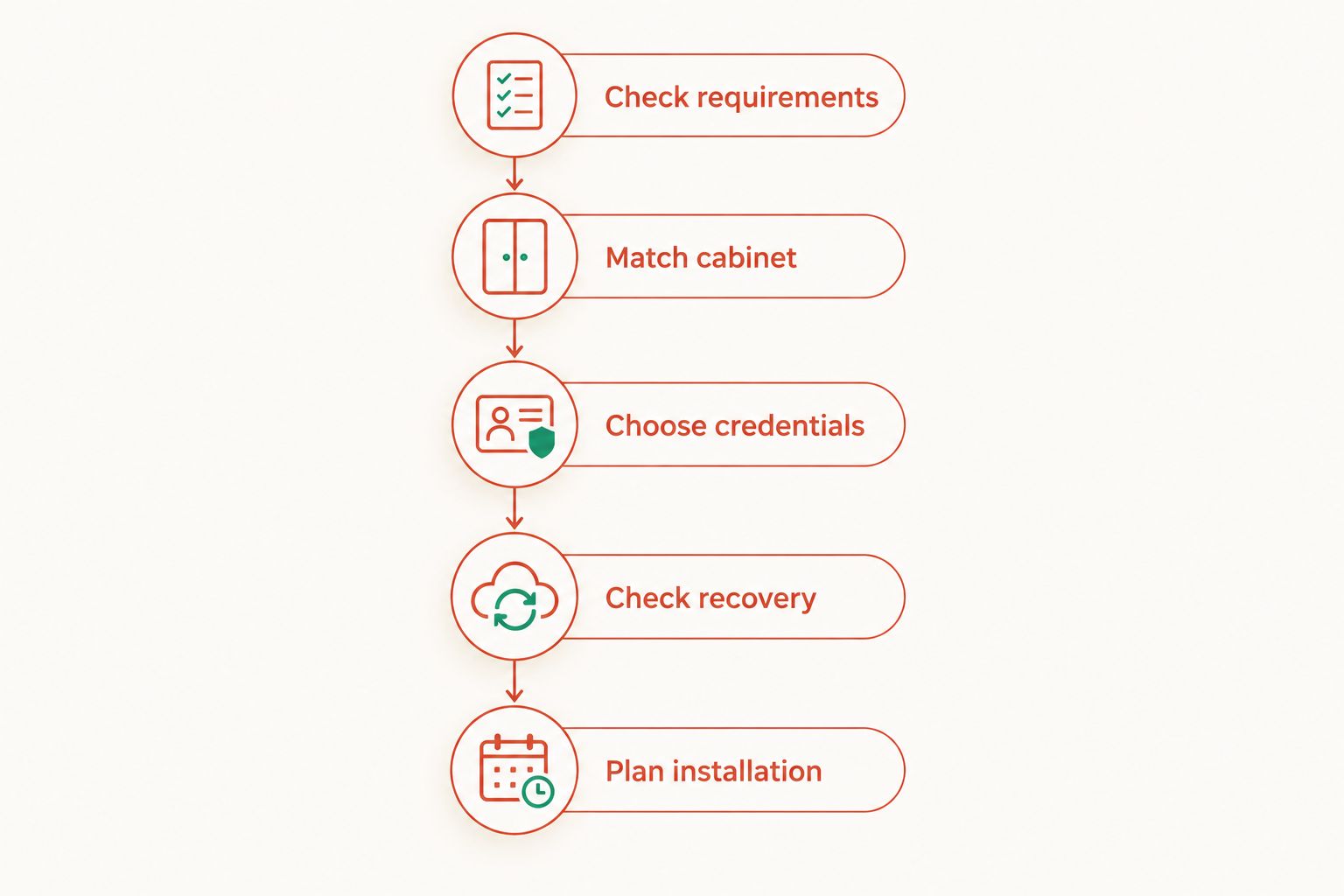
Use this sequence to separate legal suitability from operating preference. Reject an unsuitable cabinet before comparing its keypad, dial or reader.
- Check requirements: Confirm current storage rules with your state or territory firearms authority for your firearm category and circumstances.
- Match cabinet: Verify firearm fit, cabinet construction, ammunition arrangements and the required installation method.
- Choose credentials: Decide whether your household can better control codes, combinations, keys or enrolled fingerprints.
- Check recovery: Obtain the exact lock manual and understand authorised recovery before storing firearms.
- Plan installation: Establish the fixing method and suitable supporting structure before the safe arrives.
Test the operating routine with the door open, following the manufacturer's instructions, before relying on the lock. Keep operating records secure and separate from credentials; a manual is useful, but an exposed access code is not.
For broader comparisons, the guide to choosing the right lock type for your safe explains the same interface choices beyond firearm storage.
How the lock types are ranked
This 2026 ranking prioritises ordinary access, credential control, power dependence and documented recovery. Electronic keypads lead for regular operation; mechanical combinations lead when battery-free, keyless access is the priority.
Key locks depend on disciplined physical-key control. Biometric locks require additional checks around enrolment and fallback access, so they are not the default recommendation here.
These positions are buying recommendations, not laboratory security scores. No opening times, attack-resistance results or reliability percentages are assigned to the listed locks.
Which gun safe lock type should you choose?
Choose an electronic keypad for regular access, or a mechanical combination lock for battery-free, keyless storage. Those are the clearest starting points for an undecided buyer.
Use a key lock when you can securely manage every key. Choose biometric entry only for a defined operating need, after verifying recovery and the complete cabinet's suitability.
When comparing BUYASAFE configurations, keep the safe model and lock model together in your notes. The final decision should identify both, plus the installation arrangement—not simply say digital safe.
FAQ
What's the best gun safe lock type for regular use?
An electronic keypad is the best starting point for regular access when you can maintain its power supply and protect its codes. Confirm the exact lock's operating and recovery procedures before choosing the safe.
Is a digital gun safe more secure than a mechanical combination safe?
A digital interface alone does not establish greater security than a mechanical combination lock. Compare the specified lock, complete cabinet construction and installation rather than the opening interface.
Which gun safe locks work without batteries?
Mechanical key locks and mechanical combination locks operate without batteries. Check the exact configuration, because electronic combination locks still require power.
Does a Category H compliant product description cover every installation?
A Category H compliant product description does not establish that every installation meets the applicable storage requirements. Confirm the cabinet and installation with your state or territory firearms authority.
What happens when an electronic gun safe battery goes flat?
The recovery procedure depends on the exact electronic lock. Read the manufacturer's instructions for battery access, power-loss behaviour and authorised recovery before storing firearms.
Should I choose a biometric gun safe?
Choose biometric entry only when you specifically need fingerprint authentication and have verified the enrolment and fallback procedures. The reader does not replace checks on cabinet construction, anchoring or legal suitability.
Can I store the spare gun safe key near the cabinet?
Do not keep a spare key where an unauthorised person can access it. Physical-key security remains part of firearm access control, including when the key is an electronic lock's backup.
How do I compare gun safe locks in 2026?
Compare access routine, credential control, power dependence and recovery for each exact lock model. Then separately confirm firearm fit, cabinet suitability and installation requirements.
One last thing
An electronic safe with a backup key gives you another recovery method—and another credential to protect. Before ordering, write down every way the safe can be opened and who can access each method.
For a 2026 purchase, choose the lock you can manage securely, not the one with the longest feature list. Keep codes, combinations, fingerprints and keys under the same access-control discipline.


