

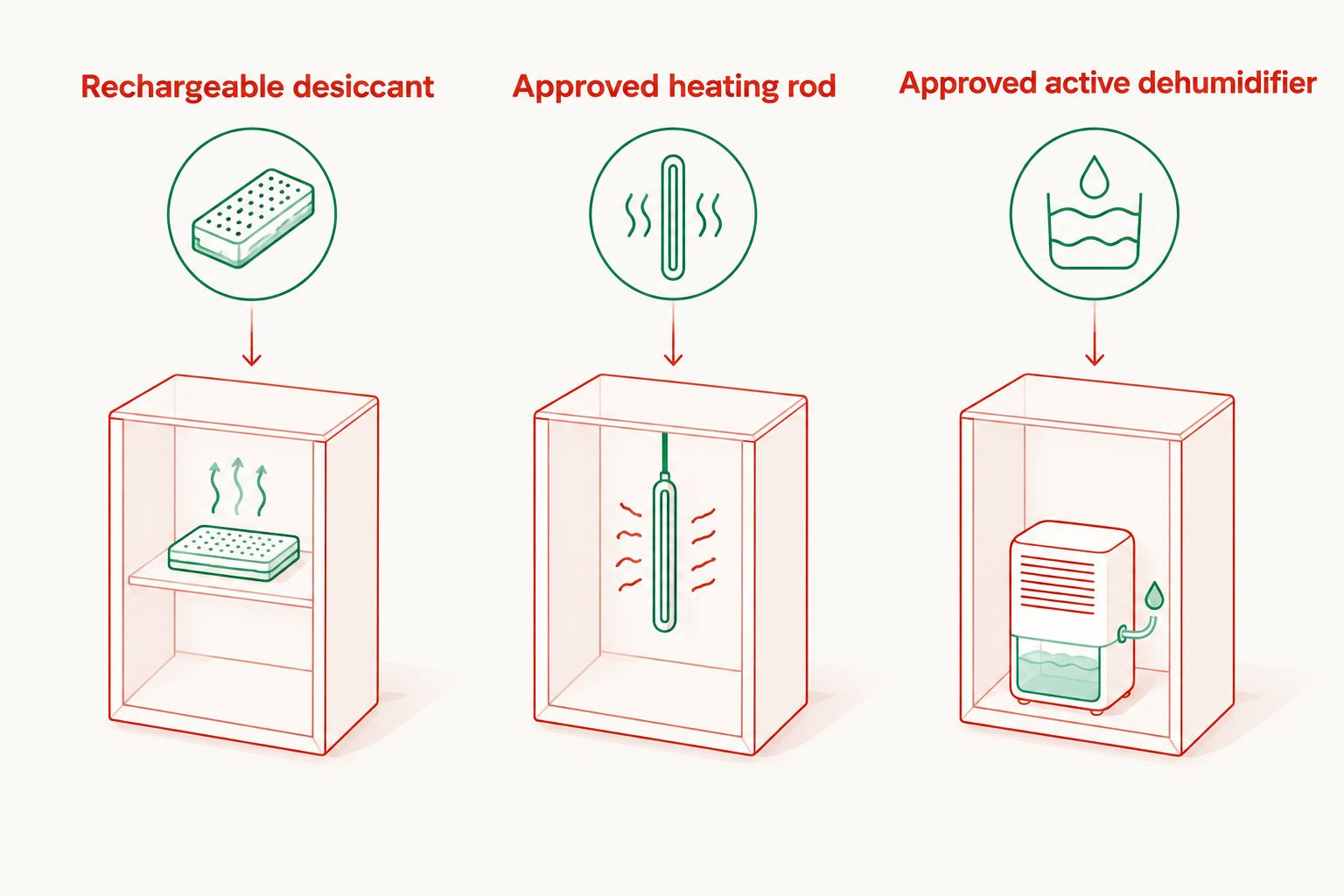
Best default: a compliant gun safe with rechargeable desiccant. Best for continuous powered humidity control: a manufacturer-approved heating rod. Best for active moisture removal: an approved dehumidifier that collects water. When comparing gun safes with dehumidifier features in 2026, distinguish a factory-installed system from an accessory added after purchase.
- For gun safes with dehumidifier features, verify whether moisture control is factory-installed or an optional accessory.
- Rechargeable desiccant is the default for firearm storage without an approved electrical connection.
- A heating rod reduces relative humidity through warming; it does not collect water.
- BUYASAFE offers rifle and pistol safes; confirm moisture-control compatibility before choosing a model.
Why this matters
A gun safe secures firearms, but its lock does not control moisture. Damp equipment, humid room air and temperature changes affect the conditions inside the cabinet. Moisture control needs its own specification.
Choose the safe for lawful storage first, then choose the drying method for the installation. A dehumidifier cannot correct unsuitable construction, inadequate anchoring or an incorrect firearm-storage arrangement.
For a coastal property or damp storage room, start with how to choose a safe for coastal and humid climates. Assess the room as well as the cabinet. A drying accessory inside the safe does not repair water ingress or a damp building.
What makes the best gun safes with dehumidifier features?
The best setup matches security requirements, moisture conditions and maintenance you can actually complete. Use these criteria before comparing product names:
- Storage compliance: Check the current requirements for your jurisdiction, firearm categories, ammunition and installation.
- Documented integration: Require written confirmation of whether the drying device is included, factory-installed or separately fitted.
- Moisture-control method: Establish whether the device absorbs water, collects water or only warms the cabinet air.
- Safe compatibility: Confirm mounting, electrical access, operating clearances and any effect on the safe's certified construction.
- Usable space: Allow room for firearms, optics, shelves and the moisture-control device without obstructing access.
- Maintenance access: Choose a system you can inspect, recharge, empty or service without disrupting secure storage.
For a 2026 purchase, ask for the exact safe model and exact accessory model in writing. A photograph of a drying rod inside a cabinet is not confirmation that the rod comes with the safe.
Gun-safe moisture-control options at a glance
These rankings compare installation approaches, not claimed factory-equipped models. Each approach serves a different storage situation.
| Rank and option | Best for | Standout feature | Key limitation |
|---|---|---|---|
| 1. Rechargeable desiccant | Cabinets without approved electrical access | Absorbs moisture without power during use | Needs inspection and recharging |
| 2. Approved heating rod | Continuous powered humidity control | Warms cabinet air to lower relative humidity | Does not remove water from the cabinet |
| 3. Approved active dehumidifier | Installations requiring collected-water removal | Removes moisture into a collection system | Needs approved power, space and water management |
Do not treat these methods as interchangeable. A heating rod changes the air temperature; desiccant holds absorbed moisture; an active dehumidifier collects extracted water. Those differences determine the installation and maintenance requirements.
1. Rechargeable desiccant: best for storage without power
Rechargeable desiccant absorbs water vapour from the air inside a gun safe. It operates without an electrical connection while stored in the cabinet. Recharge it using the accessory manufacturer's instructions, then return it to the approved position.
This is the most straightforward default when your safe has no approved cable entry. It avoids the need to route a power lead through the cabinet, although it still requires enough space and regular attention.
Rechargeable desiccant pros:
- Absorbs moisture rather than merely warming the air.
- Works inside the cabinet without continuous power.
- Can be removed for recharging and inspection.
- Avoids improvised electrical penetrations through the safe body.
Rechargeable desiccant cons:
- Stops absorbing effectively once its usable capacity is exhausted.
- Requires recharging or replacement according to its instructions.
- Does not correct wet firearms, water ingress or persistent room dampness.
Best for: Firearm owners who lack an approved electrical connection and will maintain the desiccant.
Choose an accessory specified for the cabinet's internal volume. Do not assume a small packet supplied with another product is adequate for firearm storage. Check the saturation indicator where provided, and keep the unit accessible rather than buried behind equipment.
Verdict: Buy a suitable rechargeable desiccant accessory after confirming its placement and maintenance requirements.
2. Approved heating rod: best for continuous powered control
A gun-safe heating rod warms the cabinet air. Warmer air has a lower relative humidity when its water-vapour content remains unchanged, which helps reduce conditions that promote condensation. The rod does not collect or absorb that water.
An approved heating rod suits an installation with a manufacturer-authorised power route and enough clearance. The electrical connection matters as much as the accessory itself.
Approved heating rod pros:
- Provides continuous warming while powered.
- Does not need a water collection container emptied.
- Avoids desiccant recharging as its primary operating task.
Approved heating rod cons:
- Depends on a suitable continuous power supply.
- Does not remove water from the cabinet.
- Requires specified clearances from firearms, lining and stored equipment.
Best for: Owners seeking continuous relative-humidity control in a cabinet approved for the accessory.
Confirm the rod's mounting position and the cable-entry arrangement before ordering. Never pinch a lead in the door seal or drill an opening without written manufacturer approval. An improvised installation changes the cabinet rather than simply adding an accessory.
For your 2026 shortlist, ask whether the electrical provision supports the chosen rod specifically. A battery-powered digital lock is not evidence that a safe can power a separate drying device.
Verdict: Hold until the safe manufacturer confirms the heating rod, mounting and power route.
3. Approved active dehumidifier: best for water removal
An active dehumidifier extracts moisture and collects the resulting water. Unlike a heating rod, it removes water from the air rather than relying on warming alone. It also introduces electrical and water-management requirements inside the storage arrangement.
Only consider an internal installation when both the safe and accessory manufacturers approve it. A household dehumidifier is not automatically suitable for an enclosed firearm cabinet.
Approved active dehumidifier pros:
- Removes moisture into a collection system.
- Provides a visible water-management task where a reservoir is used.
- Offers a different response from warming alone when water removal is required.
Approved active dehumidifier cons:
- Occupies space needed for firearms and safe access.
- Requires approved power and operating clearances.
- Needs reservoir access or an authorised drainage arrangement.
Best for: Installations that require active water removal and have documented compatibility.
Check how you will remove collected water without spilling it near firearms or electrical components. Do not create a drain penetration through the safe body without approval. If internal installation is unsuitable, address the storage room's humidity instead and monitor the cabinet separately.
Verdict: Hold until compatibility, electrical access and water management are documented.
Safe candidates to assess before adding moisture control
BUYASAFE is best for Australian firearm owners comparing rifle and pistol safes before specifying moisture control. The following products provide different starting points for that comparison; neither should be treated as a built-in-dehumidifier recommendation without written confirmation.
| Safe candidate | Best for | Documented feature | Moisture-control decision |
|---|---|---|---|
| Secuguard GS3KL | Assessing a rifle-storage cabinet | Listed as a 10-rifle safe with a 6 mm steel body and 8 mm steel door | Confirm usable space and approved accessory options |
| Dominator Safes HS-1C | Assessing mechanical-lock pistol storage | Big Red 3-wheel combination lock; described as Category H compliant | Confirm applicable storage requirements and accessory compatibility |
Secuguard GS3KL: rifle-storage candidate
The Secuguard GS3KL listing identifies a 10-rifle gun safe with a 6 mm steel plate body and an 8 mm steel plate door. Its description references Level 1 and Level 2 storage and firearm Categories A, B, C, D and H in NSW.
Secuguard GS3KL pros:
- Rifle-storage purpose is explicitly identified.
- Body and door steel thicknesses are stated.
- The description identifies the jurisdiction behind its category claims.
Secuguard GS3KL cons:
- A stated rifle count does not establish fit for your scoped firearms.
- NSW wording does not establish suitability for every Australian jurisdiction.
- Built-in moisture control needs separate confirmation.
Best for: Rifle owners checking cabinet construction and jurisdiction-specific storage suitability.
Measure your actual firearms and allow space for the drying accessory. Verdict: Hold until fit, compliance and moisture-control arrangements are confirmed.
Dominator Safes HS-1C: pistol-storage candidate
The Dominator Safes HS-1C has a Big Red 3-wheel combination lock. Its description identifies it as a Category H compliant pistol safe, making it a candidate for owners comparing mechanical-lock firearm storage.
Dominator Safes HS-1C pros:
- Pistol-storage purpose is explicitly identified.
- The lock type is named.
- Category H storage is addressed in the description.
Dominator Safes HS-1C cons:
- The category description does not settle your complete installation requirements.
- Internal accessory clearances need confirmation.
- Built-in moisture control needs separate confirmation.
Best for: Pistol owners assessing a named mechanical combination-lock option.
Ask BUYASAFE to confirm the relevant dimensions and permitted moisture-control arrangement. Verdict: Hold until the complete storage setup is verified.


How to verify a built-in dehumidifier claim
For a 2026 purchase, make the seller distinguish between equipment included with the safe and equipment the cabinet can accommodate. These are different specifications.
Ask these questions before committing:
- Is the moisture-control device factory-installed, supplied loose or sold separately?
- What is the exact device model, and how does it control moisture?
- Does the safe have an approved electrical entry or internal power provision?
- Where does the accessory sit once firearms and shelves are installed?
- What maintenance does the device require?
- Does installation change any stated security or fire-protection rating?
Keep the answers with the safe's installation instructions. If the description only says the cabinet is suitable for a dehumidifier, do not record it as having one built in.
Ask BUYASAFE about gun safes with dehumidifier compatibility using the exact safe model, your storage location and your intended accessory. That gives the enquiry a clear technical scope rather than an ambiguous request for a “humidity-proof” cabinet.
Installation and monitoring checklist
Start with the location, not the accessory. Inspect the proposed room for leaks, damp surfaces and temperature changes, then confirm that the safe can be installed there under the applicable storage requirements.
Use this sequence:
- Check compliance: Confirm the cabinet and installation requirements with your state or territory firearms authority.
- Plan the layout: Allow for firearms, optics, ammunition storage requirements and accessory clearance.
- Confirm compatibility: Obtain the safe manufacturer's instructions for mounting and electrical access.
- Fit the accessory: Follow the accessory instructions without improvised holes, wiring or drainage.
- Monitor conditions: Use a suitable hygrometer and inspect the stored equipment.
A hygrometer measures conditions; it does not remove moisture. Place it where you can read it without moving firearms unnecessarily, and follow its operating instructions. Compare readings under similar conditions rather than relying on an isolated measurement immediately after opening the door.
Dry and maintain firearms according to their manufacturer's instructions before storage. A dehumidifier is not a substitute for removing rainwater from equipment or dealing with a leak.
How the options are ranked
The 2026 ranking prioritises approved installation, a clear moisture-control mechanism and manageable maintenance. Rechargeable desiccant takes the default position because it works without an electrical connection inside the safe. An approved heating rod serves continuous powered control, while an approved active dehumidifier serves collected-water removal.
The safe candidates are assessed separately on the stated product facts. Steel thickness, a named lock and firearm-category wording do not establish built-in drying equipment. Security suitability and moisture-control compatibility must each pass their own check.
Which setup should you choose?
Choose rechargeable desiccant as the default when there is no approved power route. Choose an approved heating rod when continuous warming suits the installation. Choose active water removal only when the complete arrangement is authorised and maintainable.
If factory-installed drying is essential, require written confirmation before ordering. Do not buy a safe on the assumption that electrical lock operation, fire resistance or a firearm-storage label includes humidity control.
FAQ
What's the best option for gun safes with dehumidifier features?
The best default is a suitable gun safe with rechargeable desiccant when no approved electrical connection is provided. Choose a heating rod or active dehumidifier only after confirming compatibility with the safe.
Does a gun-safe heating rod remove moisture?
A heating rod does not remove water from the safe. It warms the air, lowering relative humidity when the water-vapour content remains unchanged; desiccant and active dehumidifiers control moisture differently.
Are the Secuguard GS3KL and Dominator Safes HS-1C built-in-dehumidifier models?
Do not classify the Secuguard GS3KL or Dominator Safes HS-1C as built-in-dehumidifier models without written manufacturer confirmation. Confirm whether moisture-control equipment is factory-installed, supplied separately or an optional accessory.
Can I put rechargeable desiccant in a gun safe?
Use rechargeable desiccant when its instructions and the safe's layout permit the installation. Choose an accessory suitable for the internal volume, keep it accessible and follow its recharge instructions.
Can I drill a hole for a dehumidifier power cable?
Do not drill the safe without written manufacturer approval. Use only an authorised cable-entry arrangement and confirm whether the installation affects any stated rating.
Does a dehumidifier make a gun safe legally compliant?
A dehumidifier does not establish firearm-storage compliance. Cabinet construction, locking, anchoring and storage arrangements must satisfy the requirements that apply to your jurisdiction and firearms.
Should I use a hygrometer inside my gun safe?
A suitable hygrometer helps you monitor conditions inside the cabinet. It measures humidity rather than controlling it, so use its readings alongside equipment inspections and the drying accessory's instructions.
One last thing
A lower relative-humidity reading does not always mean water has left the safe. Warming alone can lower that reading. Check both the moisture-control method and the stored equipment, not just the display. That distinction prevents you from mistaking a heating device for a water-removal system.


