

Yes, it is safe to buy a secondhand gun safe in Australia only after you verify its condition, take control of every means of access and confirm it meets the storage requirements that apply to you. Previous use does not establish compliance at your address, and moving, lock servicing and installation need to be assessed before you commit.
- Is it safe to buy a secondhand gun safe? Yes, after condition, access control and installation checks.
- Australian firearms storage requirements depend on your jurisdiction and firearms; verify the current rules before buying.
- Reject an unidentified, damaged or untestable safe rather than relying on the seller’s assurances.
- BUYASAFE gun safes suit buyers comparing identified models against a used safe with uncertain specifications.
Why this matters
A used gun safe needs two separate checks: whether the cabinet remains secure and whether your proposed storage arrangement satisfies the applicable rules. A working lock answers neither question by itself.
For a purchase in 2026, start with the gun safe storage laws by state in Australia, then confirm the current requirements with your state or territory firearms registry. Treat retailer guides as preparation, not approval of a particular installation.
Is it safe to buy a secondhand gun safe in Australia?
A secondhand gun safe is an acceptable option when its identity, condition, access controls and proposed installation can all be verified. If any of those checks remains unresolved, hold off buying it for firearm storage.
The distinction is evidence, not appearance. Fresh paint does not establish sound steelwork, and a recognised badge does not establish that the lock or door remains in its original condition.
| Option | Best for | Main advantage | Main limitation | Decision |
|---|---|---|---|---|
| Identifiable private-sale safe | Buyers able to arrange inspection and installation | You can assess the actual cabinet before committing | Condition, alterations and retained keys need investigation | Proceed only after verification |
| Used safe with documented servicing | Buyers wanting a recorded inspection history | Service records help explain work already completed | Records do not establish compliance at your address | Check the scope and date of the work |
| New, identified gun safe | Buyers wanting a model-specific specification to assess | You can compare stated dimensions and construction | Correct selection and installation still remain your responsibility | Compare against your actual requirements |
| Unidentified or untestable used safe | No buyer seeking verified firearm storage | No dependable advantage until the uncertainty is resolved | You cannot establish suitability from assurances alone | Skip |
Check a used gun safe before agreeing to buy
- Identify the cabinet. Ask for the manufacturer, exact model, identification plate and any available manual. Match the information to the cabinet in front of you, including its door layout and lock. If the seller cannot identify it, obtain a specialist assessment rather than guessing from a similar photograph.
- Inspect the body and door. Look for corrosion, distorted edges, cracked welds, unexplained holes and evidence of forced entry or repairs. Examine the base and rear, not just the visible front. Stop the purchase if you cannot determine whether damage affects the safe’s security.
- Demonstrate normal operation. Ask the seller to demonstrate the lock and door using the manufacturer’s instructions, with the cabinet empty. Check for binding, inconsistent operation and a door that needs lifting or forcing. Do not accept a promise that a sticking mechanism only needs lubrication.
- Establish access control. List every key, user code, manager code and override method the particular lock supports. Arrange the appropriate code changes, rekeying or replacement with a safe technician. Receiving the seller’s keys does not prove that no copies exist.
- Confirm legal suitability. Compare the identified safe and intended installation with the current requirements for your jurisdiction and firearms. Ask the registry about unclear requirements before purchase. An interstate seller’s previous storage arrangement is not evidence that yours will comply.
- Plan removal and installation. Confirm the safe’s weight, access route, fixing provisions and intended position. Obtain professional advice where handling or the building structure requires it. Do not put firearms into the cabinet until the required installation and access-control work is complete.
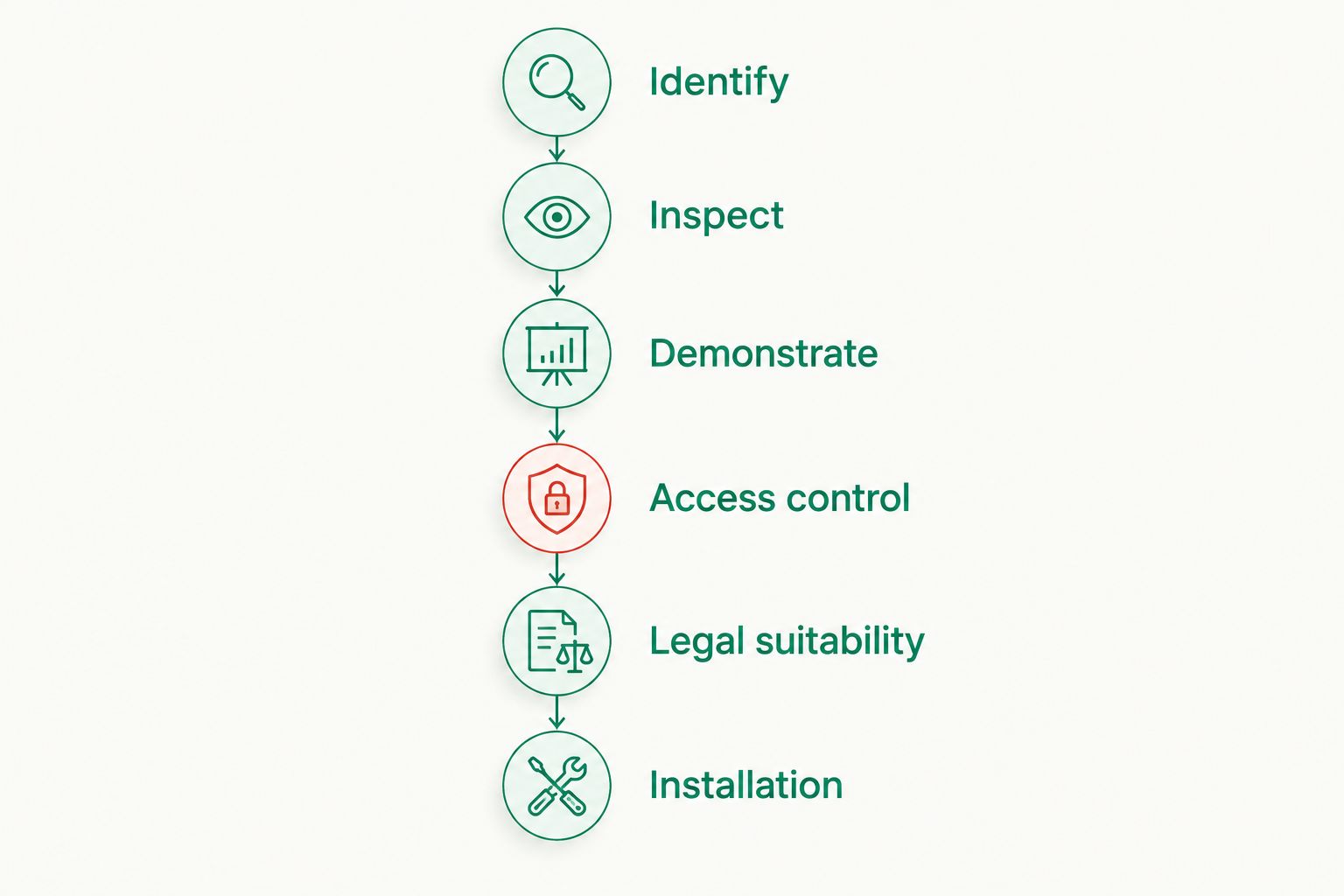
Keep photographs of the identification plate and any areas requiring assessment. A written list of unresolved questions makes it easier to obtain useful advice from the manufacturer, registry or safe technician without relying on memory.
Private-sale gun safes: verify the seller’s claims
Best for buyers who can inspect the cabinet and arrange independent advice. A private sale gives you an opportunity to examine the actual safe, including wear that product photographs would not show.
Ask how the seller acquired it, where it has been kept and whether it has been moved, repaired or opened by a technician. Request supporting records where they exist. Record the model and the seller’s description of its condition on the receipt.
The limitation is uncertainty. A seller can explain their experience, but that account does not establish the internal condition of a lock, the quality of a repair or the current requirements for your firearms.
Skip a private-sale safe if inspection, identification or normal operation cannot be demonstrated. Do not make the purchase depend on an unverified repair being straightforward.
Serviced secondhand gun safes: check what was actually done
Best for buyers who want a used cabinet with a documented assessment. A service record is useful when it identifies the safe, describes the work and names the business that completed it.
Read the scope. A record of a battery replacement is not a structural inspection, and a lock repair does not establish that the cabinet meets your storage requirements.
Ask whether the work covered the lock, boltwork, hinges, door alignment and any previous damage. If a replacement lock was fitted, obtain the relevant operating instructions and confirmation of the access-control arrangements.
For a 2026 purchase, distinguish a recent assessment from an old document that merely accompanies the safe. Hold the purchase until unexplained repairs or alterations have been assessed.
New gun safes: use specifications as a comparison point
Best for buyers who need an identified model to compare against a used listing. A new safe removes questions about a previous owner’s use, but it does not remove the need to check local requirements, fit or installation.
BUYASAFE gun safes provide a relevant comparison point when a used listing lacks dimensions or a clear model identity. For example, the CMI Sports Shooter Rifle Safe SS14-D lists a 230 mm internal top cupboard, 1260 mm clear space below and a stated capacity of 14 rifles.
Those measurements illustrate why the internal layout matters. Compare the clear space with your actual firearms and accessories; a stated rifle count does not establish that every scoped or unusually configured firearm will fit.
The limitation is that specifications still require interpretation. Do not treat a capacity label, model name or retailer listing as approval for your particular firearm categories or premises.
BUYASAFE is best for gun-safe buyers comparing identified models with a used cabinet whose specifications remain uncertain. Confirm the selected model’s suitability before arranging installation.
Why secondhand gun safe suitability varies
The seller’s description is only the starting point. These factors determine how much verification the purchase needs:
- Model identity: A readable identification plate and matching documentation give you a basis for checking construction and instructions. A generic description such as “heavy-duty gun safe” does not.
- Physical condition: Corrosion, distortion and damaged fixing points require assessment. Cosmetic wear and security-affecting damage are different issues; do not assume which one you are seeing.
- Repair history: Replacement locks, repaired doors and altered steelwork need an explanation. Ask who completed the work and what documentation supports it.
- Access history: A secondhand lock comes with previous users. Establish control over the lock’s supported credentials and any physical override, rather than changing only the everyday code.
- Installation requirements: The cabinet, mounting surface, fixing method and applicable rules must work together. Existing bolt holes do not establish that the safe can be installed correctly in your chosen position.
- Usable space: Measure clear internal height, depth and width around shelves, cupboards and door fittings. External size alone does not tell you what the cabinet will hold.
For a 2026 buying decision, resolve these factors before comparing the used safe with an alternative. An unidentified cabinet with unresolved lock work is not a like-for-like comparison with a documented model.
What should make you walk away from a used gun safe?
Walk away when the seller prevents meaningful inspection or cannot demonstrate normal operation. A safe sold locked, with an unexplained fault or with an uncertain identity needs specialist assessment before it becomes a firearm-storage option.
Use these stop signs:
- The seller refuses access to inspect the base, rear or interior.
- Identification details are missing, altered or inconsistent with the cabinet.
- The door binds, sags or needs force to close.
- Corrosion, welding or patched holes remain unexplained.
- The seller cannot describe the available keys and lock credentials.
- Compliance claims rely entirely on a previous owner or another jurisdiction.
A stop sign is not a remote diagnosis of failure. It is a reason not to proceed without the issue being resolved. Do not attempt forced-entry tests or dismantle a lock to settle the question yourself.
Does an old “police approved” claim prove compliance?
No: an old “police approved” claim does not prove that your proposed storage arrangement complies. Ask what the claim refers to, then verify the actual requirements with your firearms registry.
For 2026, assess the exact cabinet, your firearms and its intended installation together. A seller’s recollection of a previous inspection does not replace that check.
Should I change the lock on a secondhand gun safe?
Establish exclusive control over access before storing firearms; whether that requires replacement depends on the lock. Ask a safe technician to confirm the appropriate rekeying, code-change or replacement process and address every supported access method.
Changing an electronic user code does not address a retained physical override key. Likewise, collecting the keys shown by the seller does not establish that no duplicates were made.
Can I use the previous owner’s anchor bolts?
Do not assume the previous owner’s anchor bolts are suitable for reuse at your property. Have the fixing method assessed against the safe, mounting surface, manufacturer’s instructions and applicable storage requirements.
Old holes in the cabinet show where it was fixed before, not whether those points remain sound. Arrange installation advice before transport so an unsuitable location does not become a last-minute problem.
FAQ
Is it safe to buy a secondhand gun safe online without seeing it?
Do not rely on listing photographs alone to establish that a secondhand gun safe is suitable. Arrange an inspection or independent assessment covering identification, condition, normal operation and installation suitability before committing.
Can I buy a used gun safe from someone in another Australian state?
Assess an interstate used gun safe against the requirements that apply where you will store your firearms. The seller’s location and previous use do not establish suitability at your address.
Does a secondhand gun safe need a certificate?
Ask your state or territory firearms registry what evidence is required for your storage arrangement. Keep the model details, relevant specifications and installation records rather than assuming a seller’s certificate settles compliance.
Is surface rust a reason to reject a secondhand gun safe?
Rust needs assessment before you decide whether the safe remains suitable. Do not assume visible corrosion is only cosmetic, particularly around the base, seams, hinges or fixing points.
Can I store ammunition in a secondhand gun safe as well?
Confirm the ammunition-storage requirements for your jurisdiction and firearms before choosing the arrangement. An internal cupboard alone does not establish that the proposed storage meets those requirements.
What measurements should I request before collecting a used gun safe?
Request external dimensions, clear internal dimensions, door-opening clearance and the safe’s weight. Check those details against both the contents you intend to store and the complete removal and installation route.
Is a new gun safe automatically compliant in Australia?
No, buying a new gun safe does not automatically establish compliance. You still need to match the model, firearm categories and installation to the current requirements that apply to you.
One last thing
Recheck the safe after it has been moved and installed. A successful demonstration at the seller’s property does not establish that the door still aligns correctly or the lock operates normally in its final position.
Before first use in 2026, confirm normal operation, completed access-control changes and the required fixing work. Keep the purchase and installation records together; those records are more useful than a screenshot describing the cabinet as suitable.


