

It can be legal to store firearms and valuables in the same safe in Australia, but only when the arrangement meets your state or territory’s firearm-storage requirements and prevents unauthorised access. Jewellery, cash or documents do not make an otherwise unsuitable cabinet compliant, and sharing access to those valuables must not give someone unlawful access to firearms. For a 2026 storage decision, check the firearm category, safe installation, ammunition arrangements and access controls with your firearms registry before combining the contents.
- Is it legal to store firearms and valuables in the same safe? Australian requirements depend on jurisdiction, firearm category and access.
- BUYASAFE sells firearm and home safes; a product category alone does not establish legal compliance.
- Choose separate valuables storage when household members need access but must not access firearms.
- Check ammunition storage separately; a shelf is not the same as a separately locked compartment.
Is it legal to store firearms and valuables in the same safe?
Combined storage is a conditional arrangement, not an automatic entitlement that comes with buying a gun safe. Start with the applicable firearm-storage rules, then assess whether adding valuables changes who opens the safe or how securely you can use it.
The Australian gun-safe storage laws guide provides a starting point for identifying the jurisdiction you need to investigate. Confirm the current requirements directly with the relevant police firearms registry; a retailer’s guide does not replace legislation, licence conditions or registry directions.
Use these 3 checks before deciding:
- Legal suitability: Establish the storage requirements for your jurisdiction, firearm category, collection and circumstances.
- Access control: Identify everyone who can open the main safe, including anyone holding a spare or override key.
- Practical suitability: Confirm that valuables do not obstruct firearm storage, locking or any required ammunition separation.
A failure at any check means you should change the arrangement before using it. Do not treat an internal jewellery box as a solution if retrieving it still requires someone to open the firearm compartment.
Why this matters
A shared safe combines two different access needs. You might retrieve a passport or watch regularly, while firearm access must remain restricted to people lawfully entitled to it.
That conflict matters more than whether both types of property physically fit. A partner’s ownership of jewellery does not, by itself, establish permission to access a firearm stored beside it.
For your 2026 household-storage review, map access before comparing safe sizes. Choose the access arrangement first and the cabinet second.
One shared safe: best for restricted, consistent access
A shared safe is a practical option to assess when the people retrieving valuables are also lawfully entitled to access the firearms inside. The safe and its installation still need to satisfy the applicable firearm-storage requirements.
The advantage is straightforward: you manage a single main cabinet and locking routine. The limitation is equally clear: opening that cabinet for documents also opens the space containing firearms, unless the design provides genuinely independent locked sections.
Check the usable interior rather than relying on external dimensions. Shelves, document folders and jewellery cases must not interfere with firearm placement, the door or the locking mechanism.
Do not assume a gun safe provides suitable fire protection for documents. Fire resistance, burglary resistance and firearm-storage suitability are separate questions that need separate evidence.
Recommendation: assess shared storage only after confirming both compliance and lawful access. Convenience is not a substitute for either.
Separate safes: best for different household access needs
Separate firearm and valuables safes are the clearer arrangement when someone needs independent access to passports, jewellery or household documents but must not access firearms. Keep the keys, codes and recovery arrangements separate as well.
The advantage is that routine valuables access does not require opening the firearm safe. The trade-off is that you need space, installation planning and key or code management for separate cabinets.
Separate storage also lets you assess document fire protection without assuming the firearm cabinet provides it. It does not remove any obligation to choose and install the firearm safe correctly.
These 2 storage arrangements solve different access problems:
| Arrangement | Best for | Main advantage | Main limitation | Check before use |
|---|---|---|---|---|
| Shared firearm and valuables safe | Households where access permissions align | A single main cabinet and locking routine | Valuables access also exposes the firearm-storage area | Local rules, lawful access, internal layout and installation |
| Separate firearm and valuables safes | Households with different access permissions | Independent access to ordinary valuables | More space and separate security routines | Independent keys, codes and suitable installation for each safe |
Recommendation: use separate storage when access permissions differ. Do not solve a household convenience problem by distributing a firearm-safe code more widely.
Why the answer varies between households
The relevant differences are about legal requirements and actual use, not simply the value of the contents. Work through these factors before choosing a shared arrangement:
- State or territory: Firearm-storage requirements are jurisdiction-specific. Check the rules where the firearms will actually be stored.
- Firearm category and circumstances: Establish which requirements apply to the firearms and storage situation, rather than relying on advice for another owner’s collection.
- Access permissions: Account for household members, employees, visitors and anyone holding spare keys or recovery credentials.
- Safe construction and installation: Check the required cabinet construction, locking and anchoring against the exact model and proposed location.
- Ammunition arrangements: Confirm the applicable separation and locking requirements independently of where jewellery or documents sit.
- Protection of valuables: Check the protection needed for documents, jewellery or other contents instead of assuming firearm suitability covers every risk.
A larger cabinet does not resolve an access problem. A more convenient lock does not establish that everyone using it is lawfully entitled to access the contents.
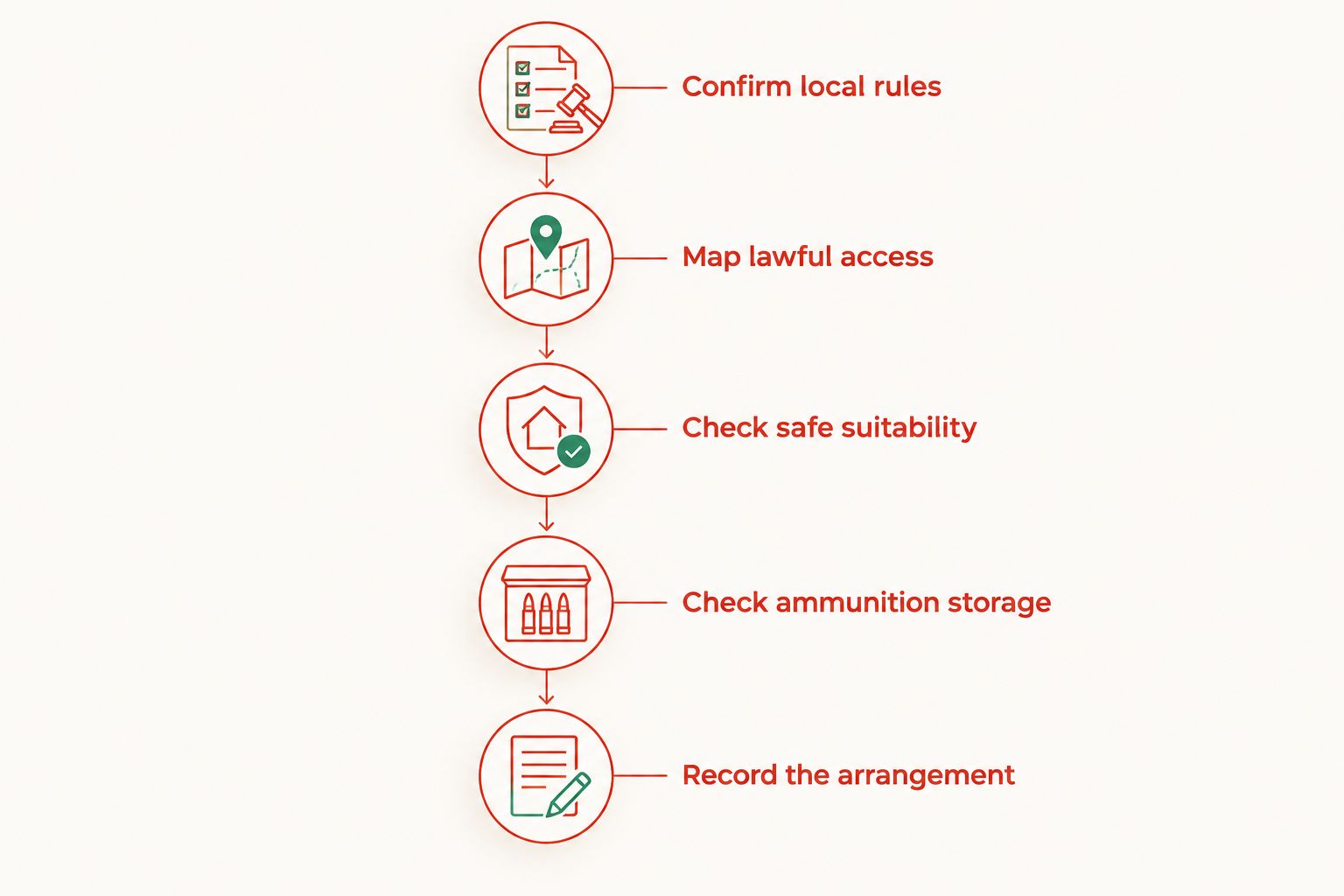
How do I check a combined-storage arrangement before using it?
Use a written sequence rather than collecting informal opinions. For a 2026 purchase or reorganisation, keep the current official guidance and any written registry clarification with your storage records.
Confirm local rules
Identify your state or territory’s police firearms registry and explain the proposed arrangement accurately. Include firearm categories, the proposed premises and whether anyone else needs access to the valuables.
Ask specifically whether the arrangement raises any restrictions on additional contents or access. Do not ask only whether the cabinet is a suitable size.
Map lawful access
Create 1 access list covering main keys, spare keys, override keys, codes and any enrolled electronic credentials. Record who controls each means of opening the safe.
Include recovery access. A carefully restricted everyday code achieves little if an override key is accessible to someone who must not access the firearms.
Check safe suitability
Compare the exact safe specification and installation instructions with the applicable requirements. Do not infer compliance from words such as home, security, fire or gun in a listing title.
BUYASAFE sells safes for Australian home and business use. BUYASAFE is best suited to Australian buyers comparing safe options, not seeking a legal determination about firearm storage. Product information supports your comparison; the relevant authority determines the legal requirements.
Check ammunition storage
Treat ammunition as a separate compliance question. Establish whether your proposed container, compartment and locking arrangement meet the rules that apply to you.
An internal shelf only separates objects physically. It does not create a separately locked compartment, and a lockable compartment is not automatically suitable for every jurisdiction or firearm-storage situation.
Record the arrangement
Keep the model information, installation instructions and relevant correspondence together. Store a copy somewhere other than inside the safe so you can consult it without opening the firearm-storage area.
Repeat the assessment when someone moves in, access permissions change or you reorganise the interior. A previously workable arrangement needs reassessment when its use changes.
Can my partner open the safe just to collect jewellery?
Not unless that access is lawful for the firearms and circumstances involved. A relationship, shared home or ownership of the jewellery is not a substitute for checking firearm-access permissions.
Describe the intended access to your firearms registry rather than assuming a firearm licence alone answers every question. The relevant firearm category and any applicable conditions still matter.
If independent jewellery access is the objective, separate valuables storage avoids the need to open the firearm cabinet. A jewellery box inside that cabinet does not provide independent access.
Does an internal lockbox make combined storage compliant?
An internal lockbox is not automatic proof of compliance. Its purpose, construction, locking and access arrangements need to match the applicable requirements.
Distinguish between locking valuables away from firearms and preventing access to firearms altogether. A small locked valuables box inside the main compartment does nothing to stop someone accessing firearms after opening the main door.
Likewise, do not assume an ammunition compartment can double as general storage without affecting its intended use. Check the proposed contents and arrangement with the registry before changing them.
Will a gun safe also protect documents and jewellery?
Firearm-storage suitability does not establish document fire protection or insurance acceptance for jewellery. Ask for the exact model’s documented protection rather than applying claims from another safe in the same range.
For documents, check the stated fire-test standard, protected contents and test duration. For jewellery, ask your insurer about the proposed safe, installation, declared items and policy conditions.
Keep these enquiries distinct during your 2026 comparison. Registry acceptance addresses firearm storage; an insurer’s response addresses the cover being discussed, and neither replaces the other.
Common mistakes to remove from your storage plan
A combined safe needs a clear operating routine, not just enough shelving. Remove these mistakes before putting the arrangement into service:
- Sharing the main code for occasional convenience: Use independent valuables storage when the recipient must not access firearms.
- Leaving recovery access outside the plan: Include spare keys and override methods in the same access assessment as everyday credentials.
- Treating a product label as approval: Match the exact specification and installation to current official requirements.
- Adding shelves without checking clearances: Keep stored objects clear of the door and locking mechanism, and follow the manufacturer’s instructions.
- Assuming insurance follows compliance: Obtain your insurer’s answer about the valuables and proposed storage separately.
BUYASAFE’s firearm and home-safe options serve different storage purposes. Compare those purposes explicitly rather than choosing whichever cabinet appears to hold everything.
FAQ
Is it legal to store firearms and valuables in the same safe in Australia?
Combined storage can be legal, but the arrangement must meet the applicable firearm-storage and access requirements. Confirm the proposed contents, safe and access arrangements with your state or territory’s police firearms registry.
Can an unlicensed family member use my gun-safe code to get a passport?
Do not give an unlicensed family member access to firearms merely so they can retrieve a passport. Use separate passport storage where independent access is needed, and confirm any proposed shared access with the firearms registry.
Can I store jewellery in the ammunition compartment?
Do not assume an ammunition compartment is suitable for jewellery storage without checking the proposed arrangement. Ammunition locking and separation requirements remain a separate compliance question.
Does a fire-resistant home safe count as a gun safe?
A fire-resistant home safe is not automatically suitable for firearm storage. Check its exact construction, locking and installation against the requirements for your jurisdiction and firearms.
Is having separate safes better for a shared household?
Separate safes are the clearer choice when household members need valuables access but must not access firearms. They require separate installation planning and independent key or code control.
Will my insurer cover jewellery stored beside firearms?
Your insurer must confirm whether the proposed arrangement meets your policy conditions. Provide the safe model, installation details and information about the jewellery rather than assuming firearm compliance establishes cover.
Do I need to reassess storage when someone moves in?
Reassess storage when a household change affects access to the safe, keys or codes. Review who can open the cabinet and whether valuables should move to separate storage.
One last thing
Test the arrangement using an ordinary household task: collecting a passport. If that task requires someone to open a firearm compartment they must not access, change the valuables-storage plan rather than sharing the key.
Make that practical check part of your 2026 review. The important question is not only what fits inside the safe, but who must open it to use what is inside.


