

A safe has no universal replacement age: keep it while its body, door, lock and installation remain sound and its protection still suits what you store. A worn lock does not automatically mean you need a new safe, but structural damage, an unsuccessful repair or inadequate protection can justify replacement. In 2026, condition and suitability—not age alone—should decide whether you keep, repair or replace a safe.
- How long does a safe last? Judge condition, serviceability and protection rather than a universal replacement age.
- Buy A Safe sells home and commercial safes; choose replacement security storage around your current requirements.
- Repair an isolated lock fault only after confirming the safe body and door remain suitable.
- After fire, flooding or attempted entry, arrange assessment before relying on the safe again.
How long does a safe last before it needs replacing?
A safe's useful life ends when you can no longer rely on its security, access or suitability. That decision requires more than checking whether the door opens. Look at the body, locking mechanism, installation, damage history and documented protection together.
Buy A Safe is an Australian safe retailer for home and business buyers comparing security storage. Its safe range provides replacement options, but start by establishing whether your existing safe needs replacement at all.
| Decision | Best for | Main benefit | Main limitation |
|---|---|---|---|
| Keep | A sound, correctly installed safe that still meets your requirements | Retains suitable equipment without unnecessary replacement | Normal operation does not establish its fire or burglary protection |
| Repair | An isolated, serviceable fault in an otherwise suitable safe | Addresses the faulty component rather than replacing everything | Repair does not increase the safe's original protection rating |
| Replace | A compromised, unsuitable or unserviceable safe | Lets you select protection and access suited to current needs | Removal and a new installation require planning |
Do not replace a sound safe just because it is old. Do not keep an unsuitable safe just because it still opens. Those are different decisions, and both depend on evidence about the particular unit.
Why this matters
A safe has several parts with different jobs. The body and door form the physical enclosure; the lock controls access; the anchoring helps secure the unit in place. A fault in one part does not establish the condition of the others.
Replacement also changes more than the equipment. You need somewhere secure for the contents during removal, a suitable location for the new unit and an installation that follows its instructions. Diagnose the problem first so you do not replace the whole safe to solve a battery issue—or replace a lock while overlooking damage to the door.
For a 2026 review, begin with what you need to protect now. Documents, jewellery, business cash and firearms do not all have the same storage requirements.
Keep the safe when condition and protection still match
Keeping the safe is appropriate when its condition, installation and documented protection remain suitable. Age alone is not a fault. However, familiar operation is not proof that every part remains sound.
Check the following without dismantling the safe:
- Body: Look for corrosion, cracks, distortion and evidence of drilling or other alterations.
- Door: Observe whether it closes normally, without lifting, forcing or rubbing that has developed since installation.
- Lock: Note inconsistent responses, unusual resistance and recurring errors.
- Installation: Look for visible movement, damaged fixing points or changes to the supporting floor or wall.
- Documentation: Identify the model, instructions and any relevant rating information.
Use these observations to decide what needs professional assessment, not to certify the safe yourself. Surface appearance cannot establish the condition of internal components or confirm tested performance.
Keeping the safe preserves a suitable installation and avoids unnecessary handling. Its limitation is equally clear: maintenance cannot turn a basic security enclosure into a differently rated safe. If your protection needs have changed, good condition alone is not enough.
Repair the safe when the fault is isolated
Repair is the right question when a specific component fails but the enclosure remains suitable. A depleted battery, damaged keypad or worn lock needs diagnosis before you decide that the entire safe has reached the end of its life.
For an electronic lock, follow the manufacturer's instructions for battery replacement and troubleshooting. Keep the door open during any testing that the instructions permit. If the problem continues, stop treating it as a routine battery issue and arrange service.
For a key or mechanical combination lock, report sticking, inconsistent operation or changes in resistance. Do not force the key, handle or dial. Do not spray lubricant into the mechanism unless the manufacturer specifies the product and procedure.
A safe technician should establish:
- What caused the fault, rather than simply restoring operation.
- Whether the correct replacement component is available.
- Whether the proposed repair suits the particular safe.
- Whether door or boltwork problems contributed to the lock symptoms.
- Whether the repair affects documented certification or insurer acceptance.
Repair retains an otherwise useful safe. Its limitation is that a new lock does not repair a damaged barrier, correct an unsuitable rating or resolve inadequate capacity. Use the safe lock servicing guide to understand the maintenance questions before arranging work.
Replace the safe when protection is compromised or unsuitable
Replacement is justified when the safe cannot be restored to a suitable, dependable condition—or no longer meets your storage requirements. Separate physical failure from a change in purpose. Both can end the safe's useful life, but they require different evidence.
Structural damage needs specialist assessment. Deformation around the door, substantial corrosion, damaged locking points or unapproved modifications are not problems to dismiss because the handle still turns.
A change in contents can also justify replacement. A safe selected for household paperwork is not automatically suitable for a growing jewellery collection, increased business cash holdings or regulated storage. Check the requirements for the contents, then compare them with the existing safe's documented capabilities.
For a replacement selected in 2026, confirm the actual model's protection, internal dimensions, lock arrangements and installation requirements. Do not assume that a heavier unit, a newer keypad or a familiar brand establishes the protection you need.
Buy A Safe sells home, commercial, gun and fireproof safes. That range supports different storage purposes, but the relevant model still needs checking against your requirements; a category name is not a substitute for specifications or compliance advice.
Why a safe's useful life varies
A calendar age leaves out the conditions that determine whether a safe remains useful. Review these factors together:
- Environment: Persistent moisture and corrosion require attention. Check both the safe and its surroundings rather than treating internal dampness as a cosmetic issue.
- Use: Frequent access places repeated demands on locks, handles and boltwork. Record changes in operation instead of accepting them as normal wear.
- Maintenance: Follow the model's instructions. Improvised adjustments and unsuitable lubricants can introduce problems rather than solve them.
- Damage history: Fire, water exposure, attempted entry and impacts during moving all warrant assessment before continued reliance.
- Serviceability: An otherwise suitable safe needs a workable repair path when a component fails. Establish parts compatibility rather than assuming any lock will fit.
- Changing requirements: Insurance conditions, stored contents and applicable storage rules can make a working safe unsuitable for its current job.
These factors explain why a single lifespan figure is a poor replacement rule. The correct decision combines the safe's condition with the protection you require today.
How do I check whether my safe needs replacing?
Use a structured check before asking for a repair or replacement recommendation. Gather observations; leave dismantling, lock adjustments and security testing to a qualified safe technician.
- Identify the safe. Record the brand, model and identifying information. Find the operating instructions and available rating documentation.
- Inspect condition. Look at the body, door edges, hinges and visible fixing points. Photograph corrosion, deformation or damage without disturbing the mechanism.
- Check operation. Note exactly what happens during normal authorised use. Distinguish a keypad warning from a handle that binds or a door that rubs.
- Review protection. List the contents and confirm the relevant insurance or storage requirements. Compare those requirements with the safe's documented capabilities.
- Request assessment. Give the technician the symptoms, photographs and known damage history. Ask for the reasoning behind keeping, repairing or replacing the unit.
The sequence matters. Identifying the model helps establish the appropriate instructions, while recording symptoms makes the service request more useful than simply reporting that the safe is old.
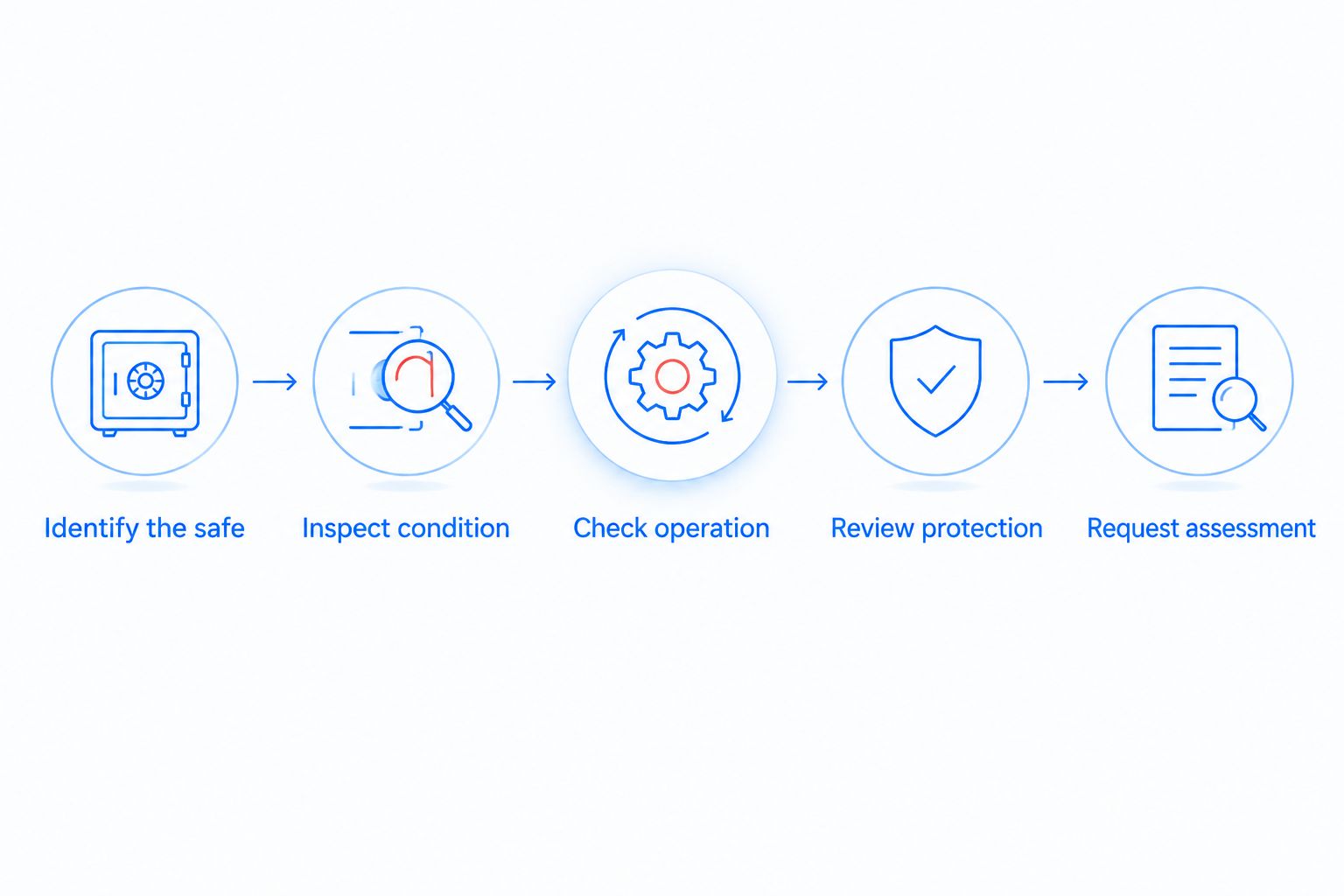
For your 2026 condition record, keep the model details, inspection photographs and service findings together. Record what changed and what action followed. A clear history helps a technician distinguish a recurring fault from a new problem.
Does a digital lock wearing out mean I need a new safe?
A digital lock fault does not automatically require a new safe. Establish whether the issue is the power supply, keypad, lock mechanism or something preventing the boltwork from moving correctly.
Replace a component only after confirming compatibility and the underlying cause. A lock change is not a universal upgrade: the safe's construction, mounting arrangements and certification can restrict what is appropriate.
Electronic access offers code-based operation, but it requires the power source and maintenance specified by the manufacturer. Mechanical access avoids electronic power requirements, but its moving components still need correct use and service. Neither lock type proves a longer life for the whole safe.
Can I keep using a safe after a fire or flood?
Do not rely on a fire- or flood-exposed safe again until it has been assessed. A door that opens successfully does not prove that protective materials, seals, locks or internal components remain suitable.
Fire resistance describes performance under a specified test; it is not permission to reuse a safe after an actual fire. Water exposure also requires separate assessment, including the installation and any electronic components.
Keep photographs and relevant incident details for the manufacturer, technician and insurer. Ask whether repair or continued use is supported for that particular model and damage history. Protecting the contents once is not proof that the safe can provide the same protection again.
Should I replace an old safe that still works?
An old safe that still works needs a suitability review, not automatic replacement. Confirm its identity, condition, installation and protection before deciding to retain it for valuable or regulated contents.
For a second-hand safe, establish who has keys or access codes and whether authorised access can be reset securely. Unknown access is a separate issue from mechanical wear; replacing batteries does not resolve it.
In 2026, check current insurer conditions and applicable storage requirements rather than relying on what was accepted when the safe was installed. Buy A Safe offers installation, repair and safe-opening services in major Australian cities, but confirm the service scope for your location and particular unit.
FAQ
How long does a safe last before I should replace it?
A safe has no universal replacement age. Keep it while its condition, installation, serviceability and documented protection remain suitable; replace it when those requirements cannot be met.
Does replacing the batteries extend the life of my safe?
Replacing batteries maintains the power supply of a battery-operated lock; it does not renew the whole safe. Follow the manufacturer's instructions and arrange service if faults continue.
Is a mechanical safe longer-lasting than a digital safe?
Lock type alone does not establish how long a safe will remain useful. Mechanical locks avoid electronic power requirements, while both types need correct operation and appropriate maintenance.
Can a locksmith replace the lock instead of the whole safe?
A safe technician can assess whether a compatible lock replacement is appropriate. The decision depends on the safe's condition, mounting arrangements, serviceability and any certification or insurance requirements.
Should I replace my safe after someone tries to break into it?
Arrange assessment after an attempted break-in before relying on the safe again. Damage to the door, body, lock or fixing points can require repair or replacement even if the safe still opens.
Does an expired warranty mean my safe needs replacing?
An expired warranty does not establish that a safe has reached the end of its useful life. Warranty coverage and the safe's current condition are separate questions.
What should I check before buying a replacement safe?
Check the protection required for your contents, the model's documented specifications and the installation requirements. Also plan secure temporary storage, removal of the existing unit and authorised access to the replacement.
One last thing
An opening problem and a protection problem are not the same thing. A safe can need lock service while its enclosure remains suitable; it can also open normally while failing to meet your current storage requirements.
Before approving replacement, ask for a written explanation of what has failed or become unsuitable. That gives you a clear specification for the next safe—not just a reason to buy another one.


