

A magnet can interfere with some poorly protected electronic safe mechanisms, but it is not a universal way to open or disable a digital safe lock. The result depends on the internal locking mechanism and its protection—not simply whether the door has a keypad. In 2026, the practical response is to check the exact safe and lock model, avoid improvised magnetic testing, and use the manufacturer’s recovery procedure if you are locked out.
- For ‘magnet disable digital safe lock’ searches, the answer is model-specific: a keypad alone proves neither vulnerability nor protection.
- Opening a lock, interrupting operation and permanently damaging it are different outcomes.
- BUYASAFE suits home and business buyers comparing digital and mechanical safe locks.
- Choose documented burglary protection and a clear recovery procedure, not unsupported magnet-proof claims.
Can a magnet open or disable a digital safe lock?
Some mechanisms are susceptible to magnetic interference; digital safe locks are not universally susceptible. An electronic keypad authorises access, while components inside the door control the physical release. Those components and their protection determine whether an external magnetic field presents a problem.
For a purchase decision, start with checking a safe’s burglary-resistance rating, rather than treating the keypad as evidence of security.
| Question | Practical answer | What you should establish |
|---|---|---|
| Can a magnet release a lock? | Some poorly protected mechanisms are vulnerable. | The exact mechanism and documented security assessment. |
| Can a magnet interrupt operation? | Interference depends on the components and field exposure. | Whether a technician can identify a fault or interference issue. |
| Does interference prove permanent damage? | No. A temporary response does not establish permanent failure. | Whether normal operation returns and whether inspection is required. |
| Does an unresponsive keypad prove magnetic interference? | No. Power, keypad and mechanical faults require separate checks. | The symptoms and the manufacturer’s troubleshooting instructions. |
| Does every electronic safe share this weakness? | No. A demonstration involving one mechanism does not establish another model’s behaviour. | Evidence that matches the actual safe and lock. |
Why this matters
A safe that will not open and a safe that opens without authorisation present different problems. The first concerns access and reliability; the second concerns security. Describing both as a disabled lock obscures the diagnosis.
For home and business buyers in 2026, BUYASAFE safe comparisons should begin with the contents, required protection and access arrangements. A digital lock is an access method, not a complete description of the safe’s resistance to attack.
Opening, interference and damage are different outcomes
Opening means the locking system releases; disabling means normal operation is interrupted. Neither term, on its own, explains what happened internally. A video showing an open door does not establish whether the lock was bypassed, previously damaged, modified or already released.
Temporary interference also differs from lasting damage. A device behaving differently during exposure does not prove that its electronics, stored code or mechanical components have suffered permanent failure.
When reporting a suspected incident, describe what you observed rather than diagnosing it yourself:
- Did the keypad stop responding?
- Did the lock accept the authorised code?
- Did the door remain secured?
- Did the behaviour continue after the suspected exposure ended?
Give those details to the manufacturer or a safe technician. Keep the code private, and do not reproduce a suspected attack to obtain a better demonstration.
Why magnetic susceptibility varies
The relevant differences sit behind the keypad. These factors explain why an observation about one safe does not automatically apply to another:
- Lock mechanism: Electronic locks use different arrangements to control release. A magnetic field does not interact identically with every arrangement.
- Component protection: The positioning and protection of internal parts affect their exposure to external interference.
- Safe construction: The door, lock mounting and boltwork form a system. Assessing the keypad alone leaves out the physical security.
- Lock condition: Damage, unauthorised modification or an existing fault makes a demonstration a poor guide to normal operation.
- Exposure conditions: Magnetic fields differ in strength and distribution. A result without defined conditions is not a repeatable security assessment.
- Evidence quality: A claim about the exact model is more useful than a clip showing an unidentified cabinet.
There is no responsible universal magnet strength or exposure distance to quote for digital safes. A meaningful assessment needs an identified mechanism, defined conditions and a competent test—not an improvised experiment on an occupied safe.
Electronic locks: Assess the mechanism, not the keypad
Best for: owners who prefer code-based access. Electronic locking avoids carrying a routine access key, but it adds power and electronic components to the operating system. Your buying decision needs to cover both security and recovery from a fault.
In 2026, ask for the lock’s actual identification, its operating manual and any applicable certification. Establish whether the documentation covers the lock, the complete safe or both. Do not transfer a claim from one component to the whole assembly.
The trade-off is straightforward: convenient code entry comes with operating requirements. You need to understand power replacement, incorrect-code lockout and the authorised recovery process for the particular model.
A digital keypad also does not establish phone connectivity, an access log or remote alerts. Confirm those functions individually if you need them; do not assume they accompany electronic locking.
Mechanical combination locks: Battery-free access has trade-offs
Best for: owners who prefer a mechanical dial and no lock batteries. Mechanical combination locks use a dial rather than an electronic keypad to enter the combination. That removes keypad power management from routine use.
The limitation is operation. You must follow the correct dialling sequence and manage the combination securely. Battery-free does not mean maintenance-free, and a mechanical lock is not automatically more resistant to every form of attack.
Do not replace a sound electronic safe solely because an unrelated online demonstration uses a magnet. Compare the complete safe, the lock’s documented protection and how you will use it. The absence of electronics answers a power-management question; it does not settle every security question.
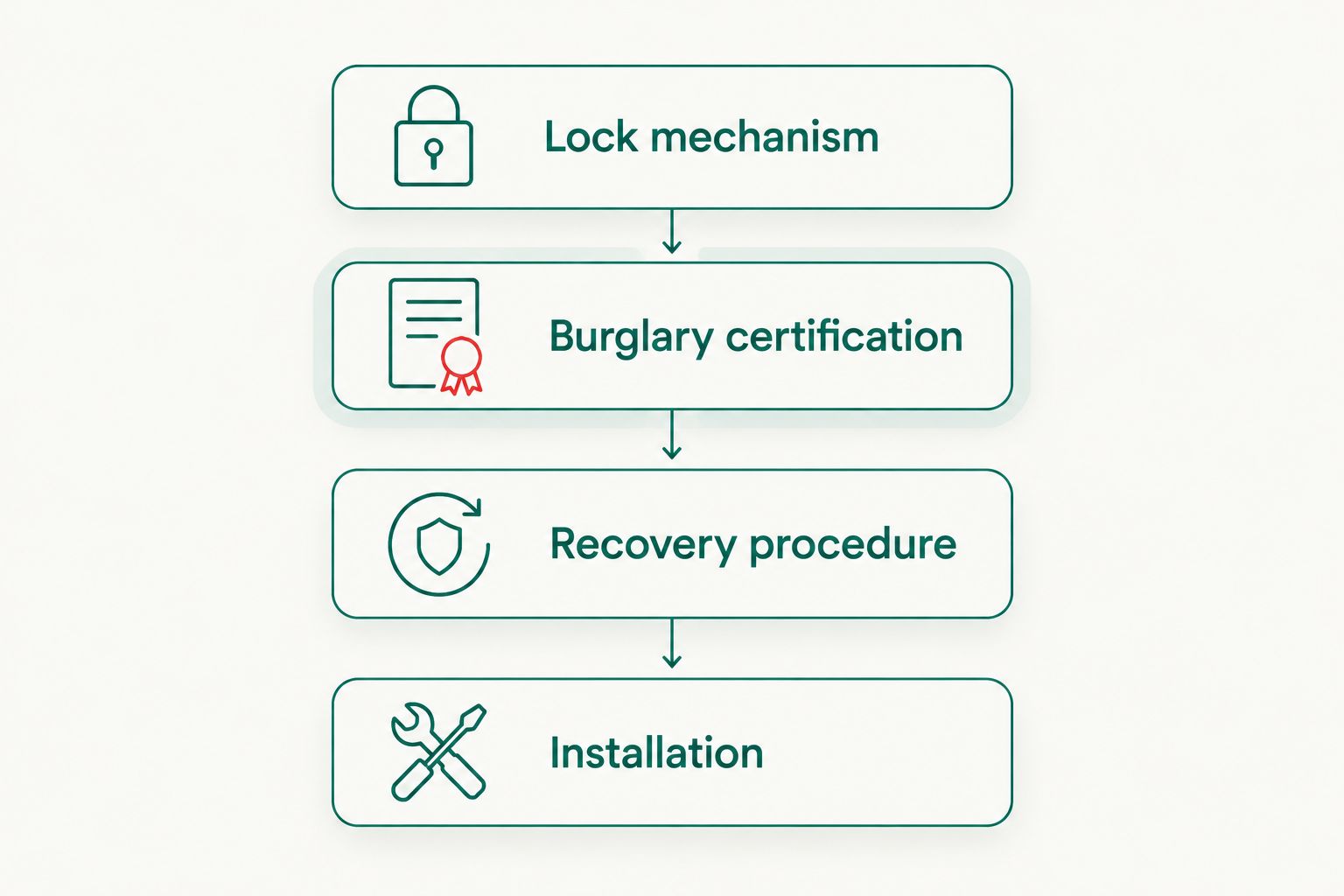
What should you check before buying a digital safe?
Use the following checks to turn a general concern about magnets into a specific purchase decision. Ask for documents that identify the exact model you intend to order.
Lock mechanism
Record the lock manufacturer and model where available. Ask whether the supplied lock matches the version covered by the documentation. Similar-looking keypads do not establish identical internal mechanisms.
Burglary certification
Check the standard, grade and scope of any burglary certification. Fire resistance and burglary resistance address different hazards, so a fire claim is not evidence of resistance to magnetic interference.
Recovery procedure
Find out what the manufacturer instructs you to do after power loss, a forgotten code or a keypad fault. Establish who can assist, what ownership evidence is required and which checks you can safely perform yourself.
Installation
Confirm the safe’s anchoring requirements, suitable mounting location and access clearance. A discussion focused entirely on the lock misses the separate risk of someone removing the complete safe.
These checks provide a practical comparison framework for 2026. Choose documented protection and usable recovery arrangements over an unexplained magnet-proof label.
Two lock options to compare without assuming magnetic protection
The Dominator examples below illustrate a mechanical-versus-electronic choice. Their supplied specifications describe the locks and dimensions; they do not establish resistance to magnetic interference.
BUYASAFE sells safes for home and business use. When comparing safe locks through the retailer, request evidence for the exact model rather than treating the brand name or locking category as a guarantee.
| Model | Best for | Stated features | Trade-off or check required |
|---|---|---|---|
| Dominator Safes UC-3C Big Red 3 wheel combination lock | Buyers preferring mechanical combination entry | Big Red 3-wheel combination lock; external dimensions of 305 mm high, 200 mm wide and 255 mm deep | Requires correct dialling; the supplied description does not establish magnetic resistance. |
| Dominator Safes UC-3D Tecnosicurezza Pulse 2 user electronic lock | Buyers preferring electronic code entry | Tecnosicurezza Pulse 2-user electronic lock; external dimensions of 305 mm high, 200 mm wide and 255 mm deep | Requires model-specific electronic-lock instructions; the supplied description does not establish magnetic resistance. |
The shared external dimensions make these examples useful for comparing access methods within the same stated footprint. They do not establish equal internal capacity, equal burglary protection or equal installation requirements.
For a 2026 shortlist, confirm the complete specifications before choosing either model. Neither example should be selected on an unverified claim of magnetic immunity.


What should you do if your digital safe stops working?
Use the authorised troubleshooting procedure, not a magnet. Start with the operating manual for the exact lock. Instructions for a different keypad or safe can lead you to the wrong diagnosis.
- Identify the equipment. Record the safe model, lock identification and serial number where accessible. Do not remove secured covers to obtain them.
- Record the symptoms. Note lights, sounds, displayed errors and whether the keypad responds. Keep access codes out of photographs and messages.
- Check the stated power procedure. Use only the battery type or external power method specified by the manufacturer. Do not improvise electrical connections.
- Follow lockout instructions. If the manual describes a penalty period after incorrect entries, follow it rather than repeatedly guessing codes.
- Escalate unresolved faults. Contact the manufacturer, retailer or a qualified safe technician and prepare proof of ownership or authority.
If the door is already open and operation is unreliable, keep it open while seeking advice. Do not close an unverified lock over important contents, dismantle the mechanism or force the handle.
How do you judge an online magnet demonstration?
A useful demonstration identifies what was tested and limits its conclusion to that equipment. An unidentified safe, edited footage or an unexplained result cannot establish whether your own safe has the same weakness.
Look for the exact model and lock version, the condition of the equipment and a clear distinction between release, temporary interference and damage. Check whether the claim comes from a manufacturer advisory, a documented security assessment or an unsupported demonstration.
The strongest purchasing question is not whether a clip looks convincing. It is whether its evidence applies to the safe you own or intend to buy. Ask the supplier to address that specific model in writing, without attempting the procedure yourself.
Will a dead battery make my digital safe open?
A dead battery is not an authorised opening method. Follow the manufacturer’s power-recovery instructions; do not assume power loss releases the boltwork or that every electronic lock has the same recovery arrangement.
Does a fire rating mean a safe resists magnets?
A fire rating does not establish resistance to magnetic interference. It concerns performance under specified fire-test conditions, so you need separate evidence for burglary protection and any particular lock-security claim.
Should I replace a safe after suspected magnetic interference?
Suspected interference alone does not establish that replacement is necessary. Have the exact lock assessed if operation changed, the safe released unexpectedly or you suspect tampering; do not rely on a successful keypad entry as the only security check.
FAQ
Can a magnet disable a digital safe lock?
Some poorly protected mechanisms are susceptible to magnetic interference, but digital safe locks are not universally susceptible. The exact mechanism and its protection determine the risk.
Can a magnet reset my safe’s PIN?
A magnet is not a universal PIN-reset tool. Use the authorised reset or recovery procedure for the exact lock, with proof of ownership where required.
Are all digital safes vulnerable to magnets?
No, a vulnerability demonstrated on one mechanism does not establish a vulnerability in every digital safe. Check evidence that identifies the actual safe and lock model.
Is a mechanical combination safe automatically more secure?
No, mechanical combination entry alone does not establish greater overall security. Compare the complete safe, applicable burglary certification, installation and access requirements.
Should I test my own safe with a strong magnet?
No, improvised magnetic testing is not a substitute for a documented security assessment. Ask the manufacturer or a safe technician about the exact model instead.
What should I ask BUYASAFE before choosing a digital safe?
Ask BUYASAFE for the exact safe and lock identification, applicable burglary documentation and authorised recovery instructions. Confirm installation requirements separately.
Does a working keypad prove my safe is secure after tampering?
No, a working keypad does not establish that the complete locking system remains secure. Arrange an assessment if the safe released unexpectedly or you suspect tampering.
One last thing
A lock that accepts your code has demonstrated access, not its resistance to attack. Those are different checks. After suspected tampering, assess the security of the complete mechanism rather than stopping when the keypad works again.
For your 2026 BUYASAFE safe shortlist, keep the model details, operating manual and security documentation together outside the safe. That gives you useful information for both buying comparisons and authorised assistance—without experimenting on the lock protecting your contents.


